
Victorian Corset Styles: Shocking Fashion Secrets You Never Knew
Victorian corsets are often reduced to a cliché of tight-lacing and fainting ladies, but the reality is far more complex, technical and revealing—literally and culturally. Between 1837 and 1901, the corset evolved from a lightly boned support garment into a highly engineered device that shaped the body, signalled class and morality, and reflected advances in industry and medicine. Examining Victorian corset styles is not just a tour through historical fashion; it is a way to understand how technology, gender expectations and consumer culture intertwined in the 19th century.
1. From Stays to Corsets: The Early Victorian Silhouette (1837–1860)
When Queen Victoria ascended the British throne in 1837, women in Britain, France and much of Europe still wore garments more commonly called “stays” than “corsets.” These early Victorian stays were a direct descendant of 18th‑century bodices: conical, relatively straight in the front, and designed primarily to smooth the torso for fashionable dress rather than to carve out an extreme hourglass. The Victoria and Albert Museum (V&A) notes that stays of the 1830s “were long, with the waist at its natural level, and were boned enough to give a smooth line to the figure” rather than to compress it dramatically.
Can You Name the Masterpiece?
Ten masterpieces. Ten questions. How well do you know the history of art?
In the 1840s and 1850s, the line began to soften. Romantic fashion favoured sloping shoulders, long, narrow bodices and bell‑shaped skirts supported by layers of petticoats. Corsets (the term now increasingly used) were cut higher over the bust and lower over the hips, subtly redistributing pressure and beginning to emphasise the waist. Whalebone (baleen), cording, and sometimes cane were combined to create stiffness, while hand-sewn eyelets at the back allowed the garment to be laced snugly. Surviving examples in the collection of the Metropolitan Museum of Art show relatively moderate waist reduction, often in the range of a few inches rather than the extreme tight-lacing sometimes imagined.
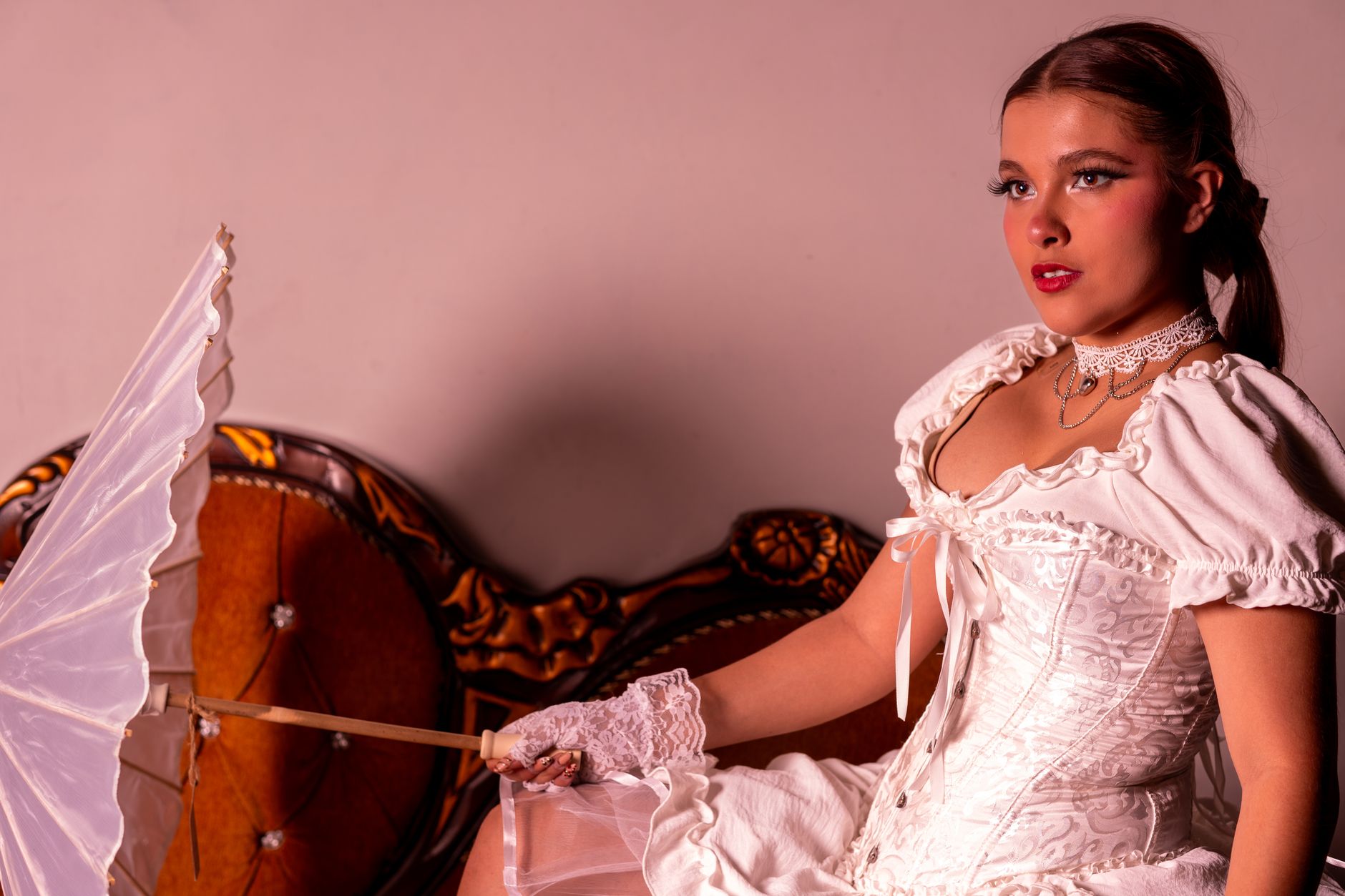
At the same time, the early Victorian corset was tied to moral and social expectations. A well-fitted corset signified respectability: smooth posture, covered flesh, and a controlled body. Middle‑class fashion manuals of the period linked “good stays” with modesty, discipline and appropriate femininity. As the Smithsonian Institution has observed in its analyses of 19th‑century dress, the corset functioned as “a visible sign of invisible virtues,” binding women not only physically but also symbolically to ideals of propriety and self‑control. This foundation would set the stage for the more extreme silhouettes that would follow.
2. Industrial Innovation and the Rise of the Hourglass (1860–1880)
The 1860s marked a turning point. Industrialisation in Britain, France and the United States transformed corset-making from small-scale craft into a mechanised industry. Metal eyelets, already introduced in the early 19th century, now combined with factory-produced steel boning and mass‑made busks—the center-front hardware that allowed corsets to open and close. Sewing machines greatly reduced labour time. As the V&A notes, “By the 1860s, corsets were being made in factories, allowing for cheaper products and greater variety.” This technological shift enabled a new, strongly defined hourglass shape.
Can You Guess the Artist?
Three clues. One artist. How quickly can you identify the painter?
Fashion silhouettes changed in tandem. The cage crinoline and later the elliptical hoop pushed skirts outward, visually shrinking the waist in comparison. To match this exaggerated outline, corsets of the 1860s and 1870s became more curved and heavily boned, with a pronounced inward sweep at the waist and flared hips. Pattern pieces multiplied, allowing the corset to mold more closely to the three-dimensional body. Surviving French and British exemplars in the Louvre Museum’s costume collections and at the Metropolitan Museum of Art reveal sophisticated shaping, with gores and gussets that accommodated the bust while sharpening waist definition.
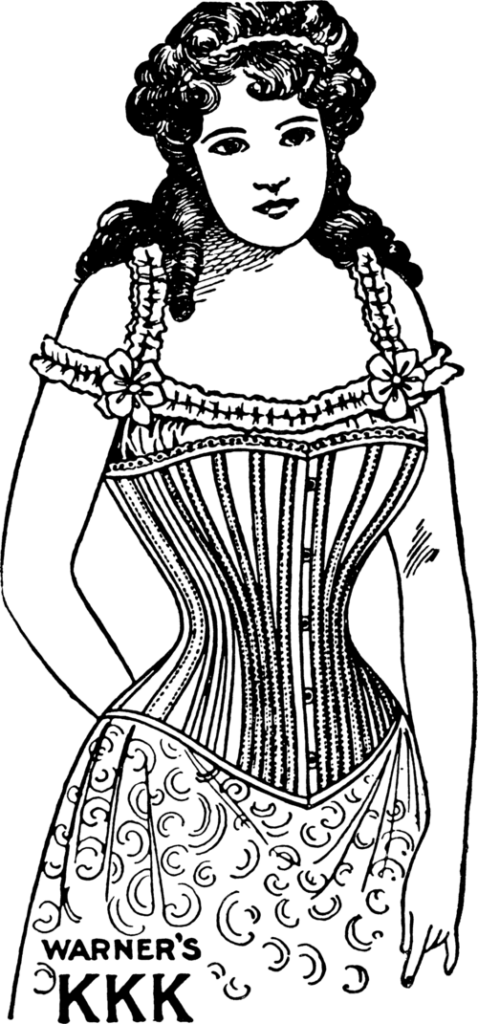
This period is also when tight-lacing became a topic of intense public debate. Medical writers, moralists and dress reformers condemned extreme waist reduction as dangerous and vain, while fashion periodicals often downplayed its extent. The Smithsonian Institution has noted that although some corsets could indeed reduce the waist significantly, “most women worn them more moderately for support and fashionable line rather than for extreme constriction.” Yet the cultural fascination with ever-smaller waists was real, and many commercial corset advertisements boasted remarkable reductions. The hourglass corset of the mid-Victorian period, therefore, stood at the intersection of industrial capacity, visual fashion trends and contested ideas about women’s health and morality.
3. Health, Reform and the Debate Over Tight-Lacing
By the mid‑19th century, medical professionals in London, Paris and other major cities increasingly scrutinised the corset. Physicians published treatises alleging that tight-lacing displaced organs, deformed ribs and caused reproductive disorders. Articles in The Lancet and other journals argued that constrictive corsets contributed to respiratory illnesses and fainting. As one frequently cited 1860s physician, Dr. William Buchan, warned, “The practice of lacing is destructive to health, and totally inconsistent with personal comfort, much less with elegance of dress.” Whether all of these claims accurately reflected typical wear is debated, but they illustrate the intensity of concern.
In response, dress reform movements emerged in Britain, continental Europe and the United States. Organisations such as the Rational Dress Society (founded in London in 1881) criticised conventional corsets and promoted looser garments that would not “deform the figure or prevent the full and natural use of the body.” Museums like the V&A and the Smithsonian hold examples of so‑called “health corsets,” which relied on straight-front cuts, lighter boning, and sometimes elastic inserts intended to relieve pressure on the abdomen and lungs. These designs sought to reconcile fashionable appearance with new notions of physiological well-being.
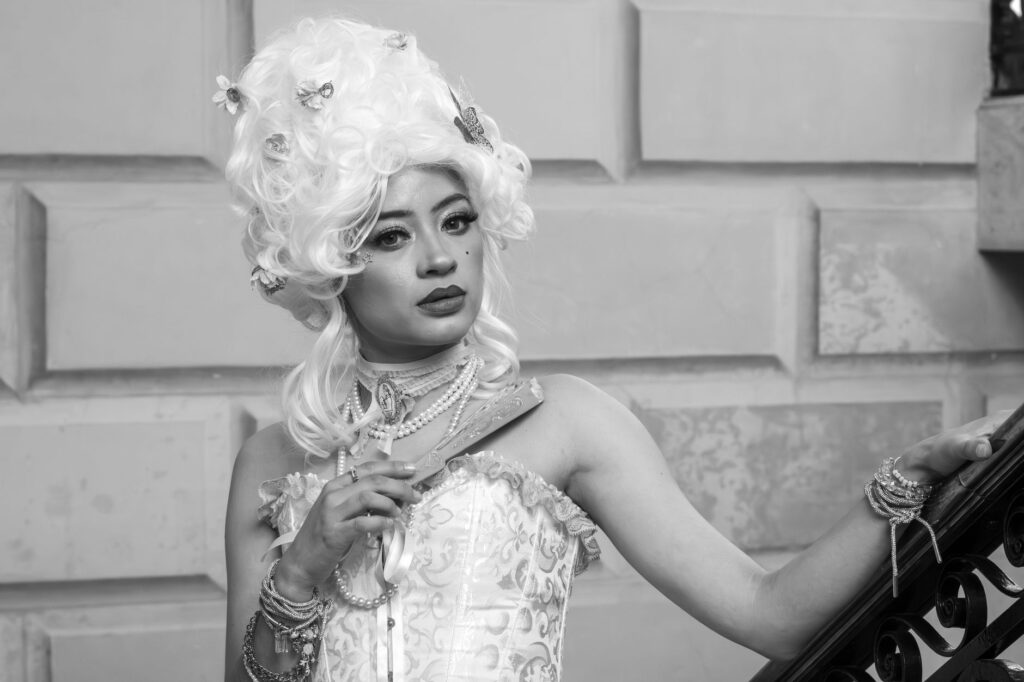
Nevertheless, many women continued to value corsets as essential supports rather than instruments of oppression. Surviving letters, diaries and photographs show women describing their corsets as necessary for posture, comfort and a polished appearance, especially in labour‑intensive roles where bust and back support mattered. As modern scholars have pointed out, the narrative that all Victorian women were passively tortured by corsets oversimplifies a more nuanced reality. As Valerie Steele, director of The Museum at the Fashion Institute of Technology, has argued, “Corsets were a complex garment with many meanings—erotic, fashionable, medical, and social” (Steele, The Corset: A Cultural History, 2001).
4. Late Victorian Styles: The S‑Bend and the Aesthetic Turn (1880–1901)
From the 1880s onward, corset styles shifted again as fashion silhouettes changed. The bustle era (roughly 1870s–1880s) placed volume at the back of the skirt, influencing corset design to support this weight and emphasise the rear projection. Patterning grew more sophisticated, with extra pieces at the hip and side-back. By the 1890s, the bustle retreated and skirts fell closer to the body, but sleeves ballooned into the famous “leg‑of‑mutton” shape. To balance these new proportions, corsets developed a longer, more tapered torso, smoothing from bust to hip and accentuating a narrow waist.
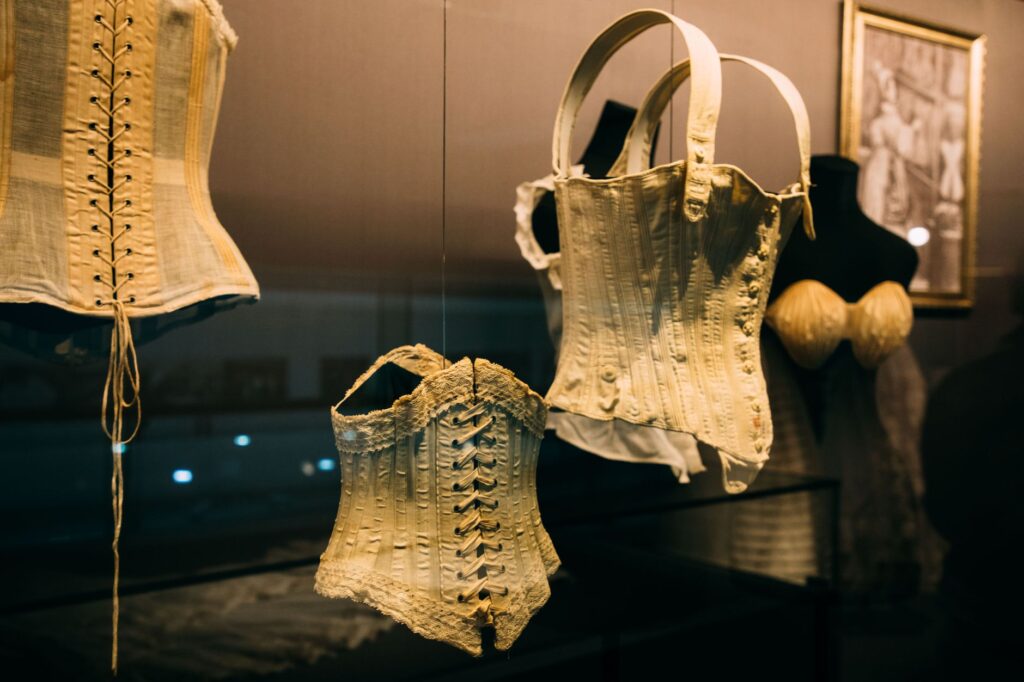
Around the turn of the 20th century, designers introduced the so‑called S‑bend or “health” corset, sometimes retrospectively included within late Victorian styles. This corset pushed the hips back and the chest forward, creating a sinuous S‑curve in profile. Unlike earlier straight-fronted corsets, these often had a stiff busk and reduced waist while claiming to avoid abdominal compression. The V&A’s collection includes multiple S‑bend corsets from British and French makers, showing how widely this silhouette spread among middle‑ and upper‑class consumers. Yet contemporary doctors remained unconvinced of its health benefits, pointing instead to new patterns of strain on the spine and pelvis.
Simultaneously, artistic and aesthetic movements proposed alternative relationships to dress. The Aesthetic Dress Movement in Britain, associated with figures like Oscar Wilde and designers linked to the Arts and Crafts movement, promoted looser, medieval-inspired gowns that often dispensed with tight corsetry. While these styles remained a minority taste, they anticipated the more radical dress freedoms of the early 20th century. Museums such as the Louvre and the V&A hold examples of Aesthetic and artistic dress that demonstrate the coexistence, in the 1890s and beyond, of rigidly structured mainstream corsetry with experimental, anti-corset fashions.
5. Materials, Construction and Social Meaning
Across the Victorian century, corset construction drew on evolving materials and techniques. Early on, whalebone (baleen) provided flexible stiffness, but as whaling declined and industrial metalworking expanded, steel increasingly dominated. Busks—flat pieces inserted at the front—evolved from wooden or horn slats to two-part steel closures with hooks and studs that allowed women to dress and undress themselves more easily. Fabrics ranged from sturdy cotton coutil, designed specifically for corsetry, to silk and satin for fashionable or bridal styles. The Metropolitan Museum of Art presents numerous examples illustrating this spectrum, from simple white cotton corsets to elaborately embroidered, coloured silk pieces intended to be seen in boudoir settings.
Construction details reveal both the precision engineering and the social stratification of corsets. Working‑class women might buy second‑hand corsets, mass-produced in factories in cities like Manchester, Paris, and New York, with minimal embellishment and fewer pattern pieces. Middle‑ and upper‑class women could afford custom-made corsets from specialist corsetiers, involving detailed measurements and fittings. These bespoke garments, some of which survive in the V&A and Smithsonian collections, used multiple gores, complex seaming and careful distribution of boning to distribute pressure and create a smooth line under increasingly tailored outer garments.
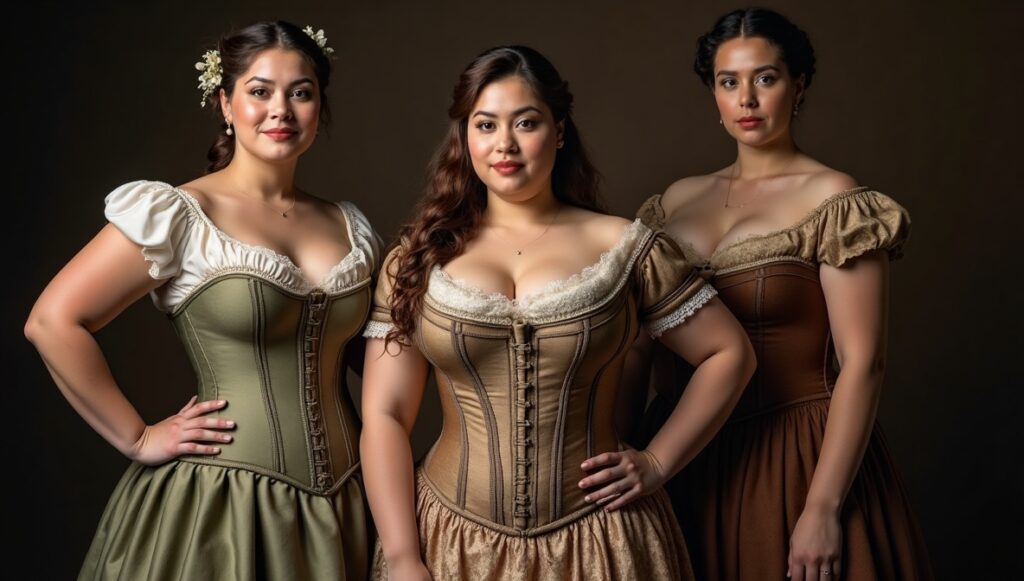
Socially, the corset functioned as a visible–invisible marker of class and gender. To be “properly laced” signalled access to time, money and domestic help, since maintaining and lacing corsets could be labour‑intensive. At the same time, the corset represented a boundary between public and private: lingerie that shaped how a woman appeared in public, but itself usually hidden. As fashion historian Norah Waugh observed, “The corset must be seen as an essential part of the dress of the nineteenth‑century woman; it gave her the fashionable figure, but it also spoke of the mores and social conventions of her time” (Waugh, Corsets and Crinolines, 1954).
6. Key Victorian Corset Types at a Glance
Below is a simplified overview of major Victorian corset styles and their features, integrating information from museum collections and historical scholarship.
| Period & Style | Silhouette Emphasis | Typical Materials & Features | Social / Cultural Notes |
|---|---|---|---|
| Early Victorian stays (c. 1837–1855) | Long, relatively straight torso; mild waist shaping | Linen or cotton with whalebone; hand‑sewn eyelets; front busk sometimes wooden | Emphasis on modesty and posture; transitional from 18th‑century stays |
| Mid‑Victorian hourglass (c. 1860–1875) | Pronounced cinched waist; flared hips; supports crinoline | Cotton coutil, baleen or early steel bones; metal eyelets; front steel busk | Industrial production expands; tight‑lacing debate intensifies |
| Bustle‑era corsets (c. 1875–1890) | Enhanced back support; emphasised rear for bustle; narrow waist | More pattern pieces; heavier boning at back; durable fabrics | Align with bustle skirts; often custom‑made for fit and posture |
| Late Victorian longline (c. 1890–1900) | Longer torso; smooth line from bust to hip; still hourglass | Steel boning; front busk; sometimes decorative silk and lace | Supports tailored dresses; associated with urban, modern femininity |
| S‑bend / “health” corsets (c. 1895–1905)* | Forward-tilted bust, hips pushed back; S‑curve profile | Rigid front busk; straight-front cut; sometimes lighter abdominal pressure | Marketed as healthier; contested by physicians; bridges Victorian and Edwardian styles |
*Often classed as Edwardian, but conceptually continuous with late Victorian debates on health and fashion.
Authoritative Sources and Institutional Perspectives
Leading museums and scholarly institutions have played a crucial role in reassessing Victorian corsetry. The Metropolitan Museum of Art’s Costume Institute houses hundreds of 19th‑century corsets, many digitised with detailed curatorial notes. These records reveal variations in cut, material and wear that counter simplistic narratives. The Met emphasises that corsets “varied considerably in rigidity and tightness, reflecting not only fashion but also the personal preferences and needs of their wearers.”
The Victoria and Albert Museum in London, whose Fashion gallery is among the most comprehensive in the world, situates corsets within a broader history of body modification and silhouette. Its exhibitions and publications stress the interplay between aesthetics, technology and social change. The V&A’s online collections provide high‑resolution images and construction details of numerous Victorian corsets, enabling close study of their technical sophistication.
The Smithsonian Institution and the Louvre Museum contribute complementary perspectives through American and continental European collections. The Smithsonian’s National Museum of American History, for example, presents corsets alongside contemporary medical texts and advertising ephemera, highlighting how marketing, medicine and consumer desire intertwined. The Louvre’s focus on French fashion underscores Paris’s role as a global style leader, with French corsetiers exporting patterns and ideas across Europe and to the United States.
Frequently Asked Questions
1. Did most Victorian women really tight-lace their corsets to extreme degrees?
Evidence from surviving garments, photographs and written accounts suggests that extreme tight-lacing was practiced by some women but was not universal. Many corsets show modest waist reductions intended for support and fashionable shaping rather than severe constriction. Museums such as the V&A and the Met emphasise that corsetry use was diverse and often more moderate than sensational accounts imply.
2. Were corsets genuinely harmful to health?
Excessive tight-lacing could cause discomfort and potentially contribute to health issues, especially respiratory restriction and musculoskeletal strain. However, much 19th‑century medical criticism was shaped by contemporary ideas about women’s bodies and morality. Modern historians and dress scholars argue that worn moderately, corsets functioned as structured support garments, not inherently more harmful than some contemporary shaping undergarments, though long‑term skeletal changes are evident in some remains.
3. Did working‑class women wear corsets too, or were they only for the wealthy?
Corsets were worn across classes in Europe and North America, though quality, fit and fabric varied. Factory production made inexpensive corsets available to working‑class women, and social pressure to appear “respectable” encouraged their adoption. Wealthier women, however, could afford custom-made pieces, superior materials and multiple corsets for different occasions, highlighting class distinctions.
4. How did Victorian corsets differ from earlier 18th‑century stays?
18th‑century stays typically created a conical torso with a relatively straight front and pushed the bust upward and together. Victorian corsets, especially from mid‑century onwards, aimed at a curved hourglass figure, defined waist, and later a longer, smoother torso. Construction became more three‑dimensional, with multiple pattern pieces and gores to contour the body rather than force it into a cone.
5. What replaced the Victorian corset in the 20th century?
In the early 1900s, the S‑bend corset gave way to straighter, longer “modern” corsets, and eventually to girdles and brassieres as separate garments. World War I, women’s increased workforce participation, and changing ideals of health and athleticism all contributed to the decline of heavily boned corsets. By the 1920s, elastic foundation garments and bras were replacing traditional corsetry for many women, though corsets persisted in some formal and theatrical contexts.
Conclusion
Victorian corset styles evolved dramatically over the 19th century, tracking shifts in technology, medicine, aesthetics and gender ideology. From early stays that smoothed the torso to industrially produced hourglass corsets and contentious “health” designs, these garments were never static, nor were they merely instruments of oppression. They were precise technologies of the body, laden with social meaning and adapted to individual needs and desires.
Studied through the collections of institutions like the Metropolitan Museum of Art, the Victoria and Albert Museum, the Louvre and the Smithsonian, Victorian corsets emerge as complex artefacts that shaped, and were shaped by, the society that wore them. Understanding their styles in historical context allows us not only to appreciate their technical craftsmanship but also to question our own assumptions about fashion, freedom and the body.
AI Notice: Some visual content in this article may have been created or enhanced using artificial intelligence (AI) for artistic, editorial or illustrative purposes. Learn more about our approach in our AI & Editorial Principles.