

The Victorian Evening Dress Secret That Transformed Women’s Style
Victorian evening dress remains one of the most eloquent visual languages of the 19th century: a blend of social ritual, industrial innovation, and aesthetic drama that defined public and private life across Britain, Europe, and the Americas. From the domed crinolines of the 1850s to the contoured bustle gowns of the 1870s and the sleeker evening fashions at century’s end, evening wear signaled rank, morals, and modernity. By examining the fabrics, technologies, institutions, and surviving garments preserved by museums such as the Victoria and Albert Museum, the Metropolitan Museum of Art, the Louvre, and the Smithsonian Institution, we can decode what an evening dress meant in Victorian society—and why it still matters to historians, conservators, and designers today.
Victorian Evening Dress: Historical Context (1837–1901)
The Victorian era (1837–1901), spanning Queen Victoria’s reign, was a time of profound social, technological, and cultural transformation. Urbanization, the expansion of the railways, and the rise of a prosperous middle class changed how people socialized and what they wore to social occasions. Institutions such as the Royal Court in London, Parisian haute couture houses (notably Charles Frederick Worth from the 1850s), and municipal theaters established new codes for evening attire that circulated through prints and shop windows across Europe and the United States.
Can You Name the Masterpiece?
Ten masterpieces. Ten questions. How well do you know the history of art?
Fashion historians divide the period into recognizable phases—early Victorian modesty and bell-shaped skirts (1837–1860), the crinoline and sewing-machine era (1850s–60s), the bustle and decorative excess (1870s–80s), and a move toward slimmer silhouettes and aesthetic dress in the 1890s. Museums document these transitions: the Metropolitan Museum of Art’s Costume Institute emphasizes how garments reflect both private customs and public spectacle, while the Victoria and Albert Museum highlights the interplay of craftsmanship and changing taste across decades.
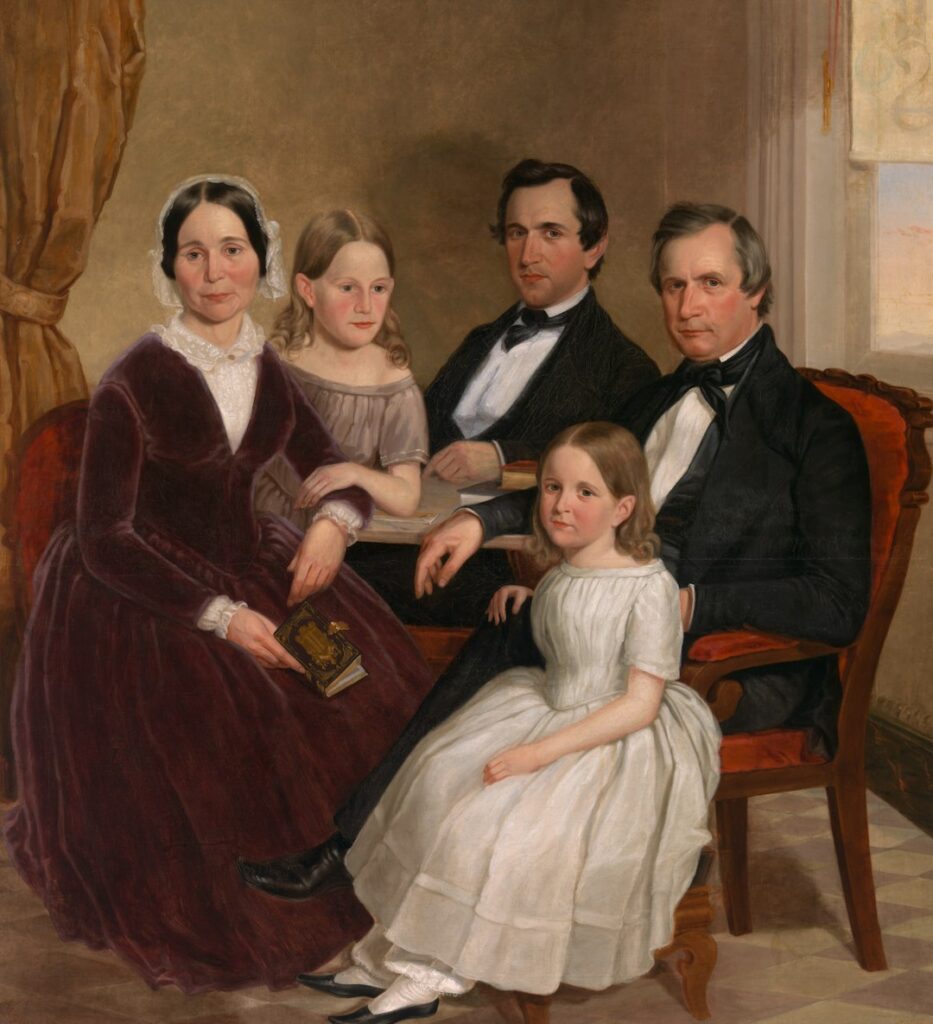
Political and cultural events also shaped evening dress conventions. Court mourning after Prince Albert’s death in 1861 formalized black mourning protocol for women, influencing evening and day wear for years. Simultaneously, technological innovations—chemical dyes, mechanical looms, and the mass production of glass beads and sequins—allowed evening dresses to become more colorful and ornamented, reflecting new consumptive possibilities in cities like London, Paris, and New York.
Silhouettes and Style Evolution
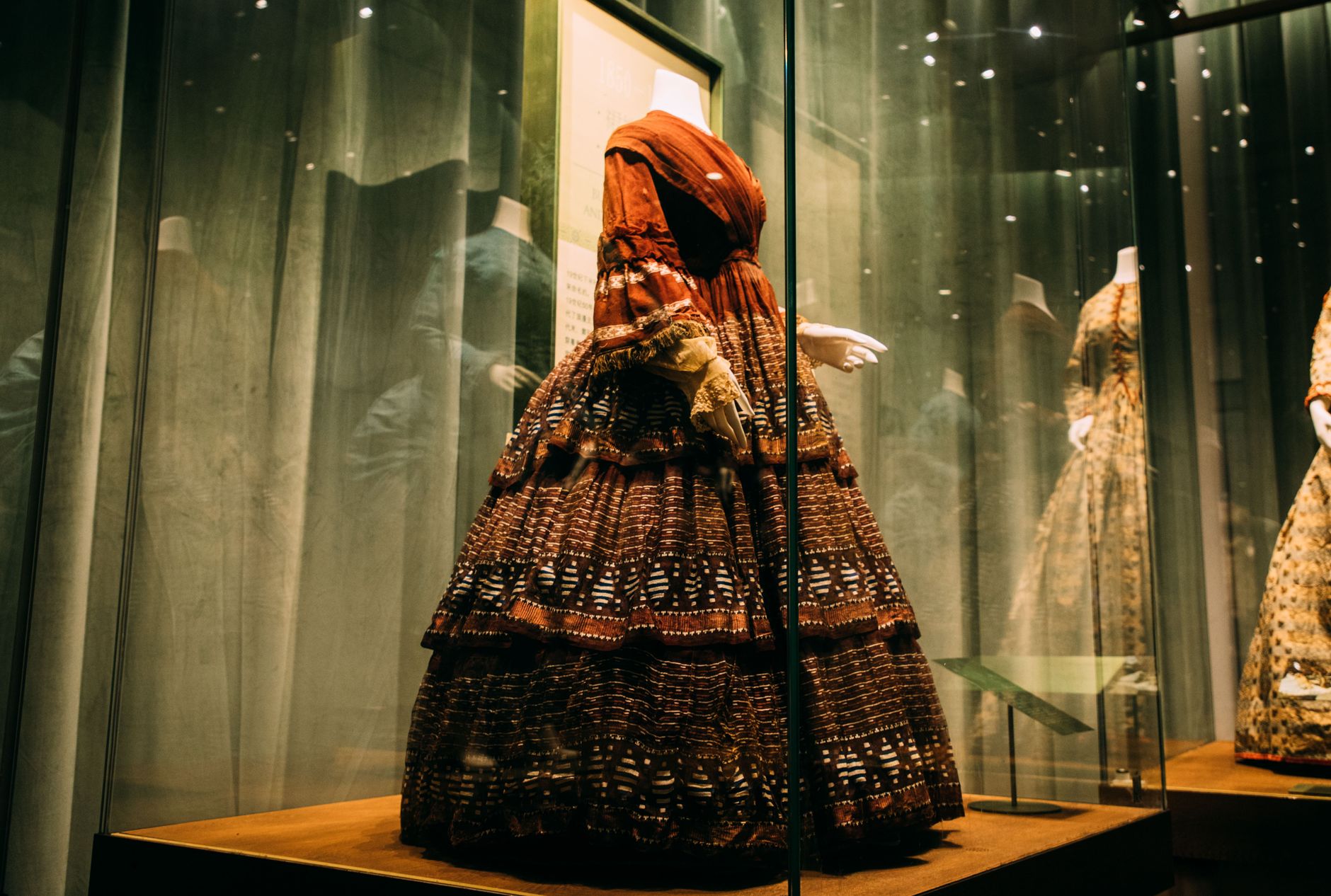
Silhouette defines the era’s evolving approach to evening formality. The 1850s and 1860s favored wide skirts supported by crinolines or hoop skirts, creating a dramatic horizontal sweep ideal for grand ballrooms. Necklines for eveningwear tended to be lower and shoulders more exposed than day dress, while long sleeves or short evening sleeves varied by season and propriety. The overall effect was theatrical: a woman’s presence in the ballroom was as much about volume and surface as it was about color and detail.
Can You Guess the Artist?
Three clues. One artist. How quickly can you identify the painter?
During the 1870s and 1880s the silhouette shifted rearward: the bustle replaced the full bell, concentrating fabric and ornament at the back of the skirt to create a hooked profile. This change allowed for even more elaborate draping, trains, and applied trimmings—lace, passementerie, and ruffles—accented with jet beads and metallic embroidery. Evening bodices became more fitted, supported by evolving corsetry that emphasized a narrow waist and pronounced posterior line, a silhouette well represented in the collections at the V&A and the MET.

By the 1890s evening dress began to slim again and embrace leg-of-mutton sleeves and higher necklines for some day-to-evening overlaps; at the same time, the tea gown and the aesthetic movement challenged strict formalities by promoting looser, artistic garments in private evening settings. As the Louvre and other continental collections show, cross-Channel influences—French tailoring and British conservatism—kept eveningwear a site of negotiation between tradition and innovation.
Table: Key Characteristics of Victorian Evening Dress
| Period (approx.) | Silhouette | Typical Fabrics | Common Embellishments | Typical Accessories |
|---|---|---|---|---|
| 1850s–60s (Crinoline) | Wide bell, full skirt | Silk taffeta, satin, cotton sateen | Lace, ribbons, floral trims | Long gloves, fans, jewelry |
| 1870s–80s (Bustle) | Rear-focused bustle, fitted bodice | Velvet, silk, brocade | Passementerie, jet beading, bows | Evening bags, chokers, reticules |
| 1890s (Slimmer/Tea gown) | Narrower skirt, puffed sleeves | Georgette, mousseline, lace | Embroidery, applique | Decorative combs, opera gloves |
Materials and Embellishment
Evening dress materials combined luxury and new chemical advancements. Early in the century, silk—especially satin and taffeta—dominated formalwear for its sheen under candlelight. After William Perkin’s discovery of mauveine in 1856 and subsequent synthetic dye development, brighter and more varied colors appeared on evening garments, transforming traditional palettes and enabling designers to experiment with chromatic effects under gas and electric lighting in later decades.
Embellishments were not merely decorative; they acted as markers of wealth and taste. Black jet beads, glass paillettes, real metal thread, and applied lace from places like Nottingham were common. The V&A’s textile archives note the growing use of machine-made lace and embroidered trims in the latter half of the century, which reduced cost while expanding decorative possibilities. Jewelry—cameos, seed pearls, and chatelaines—completed the ensemble, often coordinated to the gown’s detailing.
The provenance of materials also reflected global trade: silks from China and France, dyed wool from Bradford mills, and Indian shawls repurposed as evening wraps. Museums such as the Smithsonian and the Louvre (and more specifically Parisian decorative museums) document how international supply chains fed Victorian luxury, connecting London’s West End dressmakers with Paris houses like Worth and with factories across Europe.
Construction and Technology
The construction of evening dress was an interplay of hand and machine work. Tailoring and couture-level dressmaking remained highly skilled, with intricate hand finishing around necklines and hems even as sewing machines (widely adopted after the 1850s) accelerated production of bodices and sleeves. Pattern books and dressmaker’s guides proliferated, and couture houses in Paris formalized methods for fitting and bespoke creation—a shift the Metropolitan Museum of Art contextualizes in its essays on haute couture history.

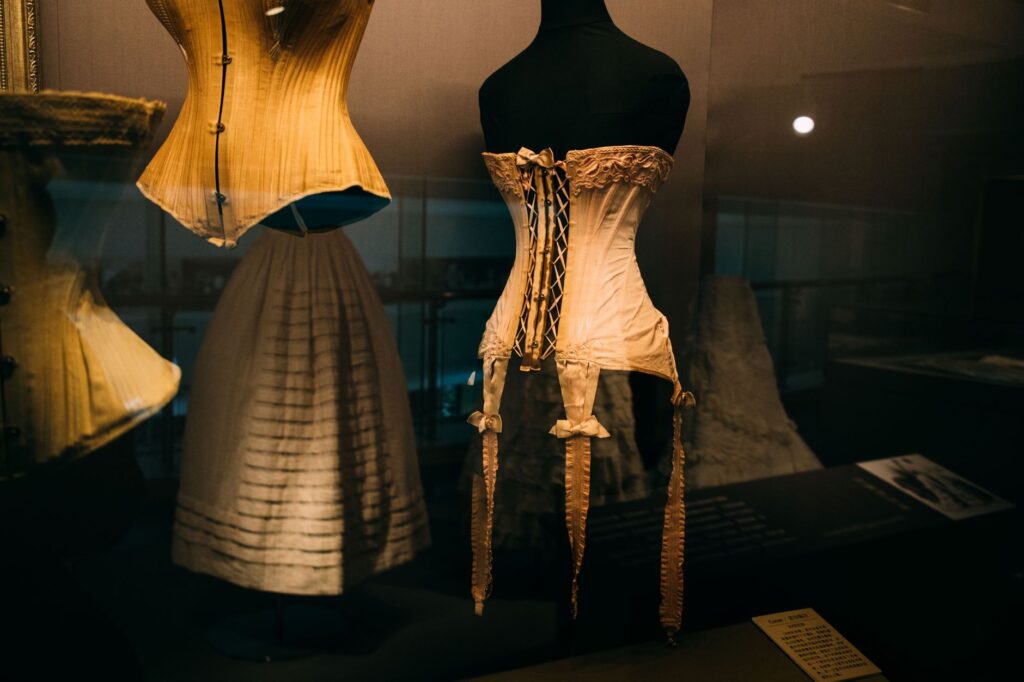
Internal structure—corsets, bustles, and boning—dictated the visible shape of eveningwear. Corsetry evolved in materials (from whalebone to steel busks) and in design, producing the dramatic hourglass and posterior emphasis of late Victorian silhouettes. The bustle itself saw several iterations: soft pads early on, structured frames later. These supports are often preserved in museum collections and provide critical evidence for how garments were worn, reconstructed, and constrained in everyday life.
Lighting and display technologies also influenced construction. As gas and electric lighting replaced candles in theaters and ballrooms, textures and colors took on new visual importance; designers layered silks, metallic threads, and beadwork to catch light. Curators at the V&A and the MET frequently point out that museum display decisions must account for this original lighting context to interpret garments accurately for modern viewers.
Social Significance and Etiquette
Evening dress in Victorian society was a codified social language. Invitations specified evening dress codes—“white tie,” low-necked gowns, or black mourning—and failure to comply could be read as an affront to rank or propriety. The London court at Buckingham Palace and opera houses like the Royal Opera House set visible standards emulated by the bourgeoisie, reinforcing class boundaries through consumption and display.
Gender norms and moral codes were expressed through eveningwear: women’s low necklines and exposed shoulders at a private ball were acceptable, but public displays required negotiation and strict chaperoning. The V&A notes that evening events were simultaneously arenas for fashionable spectacle and regulated social interaction; garments were instruments of presentation, signaling marital status, wealth, and adherence to social rules.
At the same time, evening dress could be a site of resistance and artistic expression. The Aesthetic Movement and certain actresses and artists used theatrical and somewhat androgynous dress to challenge conventional femininity, while reform dress advocates critiqued constricting corsetry and the health implications of extreme fashions. Such tensions are evident in letters, fashion plates, and extant garments preserved in museum archives.
Iconic Examples and Museum Collections
Major institutions preserve illustrative examples of Victorian eveningwear. The Metropolitan Museum of Art’s Costume Institute holds gowns that illuminate the crinoline and bustle transitions, offering detailed curator notes on materials and provenance. The Victoria and Albert Museum’s extensive dress collection includes everyday and court dresses, and their online collection provides high-resolution images and conservation histories used by scholars worldwide.
The Smithsonian Institution’s National Museum of American History documents how Victorian evening fashion migrated and adapted in the United States, reflecting American tastes for ornament combined with pragmatic adjustments. Although the Louvre is not primarily a costume museum, Parisian decorative arts collections and affiliated museums (e.g., Musée des Arts Décoratifs) preserve House of Worth gowns that shaped European haute couture and evening etiquette, underscoring the Franco-British dialogue in dress.
Authoritative voices reinforce these interpretations. As the Victoria and Albert Museum states, “Dress is the material expression of cultural identity and social relationships,” and the Metropolitan Museum observes that 19th-century costume “records technological, economic, and aesthetic change.” Such institutional scholarship is foundational for understanding evening dress’s layered significance.
Conservation, Reproduction, and Study
Conserving Victorian evening dresses requires specialized skills to account for fragile silks, degraded metal threads, and historic sewing techniques. Museums adhere to strict environmental controls, light exposure limits, and storage protocols; for instance, the conservation teams at the V&A and the Smithsonian publish guidelines on humidity, padding, and mounting to prevent fiber collapse and metal corrosion. These best practices are shared in professional literature and museum training programs.
Reproductions for exhibitions, film, and reenactment rely on patterning studies, textile analysis, and sometimes forensic examination of seams and thread types. Costume historians often work with textile scientists to identify dyes and fiber composition; discoveries like Perkin’s mauve have been corroborated through such analyses. The Metropolitan Museum has produced scholarly catalogs that include measured drawings and sewing diagrams used by conservators and costume makers.
Academic study of Victorian evening dress blends archival research—fashion plates, etiquette manuals, and period photographs—with object study. University programs in dress history, museum studies, and conservation often collaborate with institutions like the V&A and the MET for internships and research, producing the next generation of curators and scholars who sustain E-E-A-T-level expertise.
Frequently Asked Questions
Q: What distinguishes “evening dress” from other Victorian women’s garments?
A: Evening dress was specifically designed for formal nighttime events and typically featured lower necklines, richer fabrics, and more ornamentation than daywear. It often required structural undergarments (corsets, bustles) to achieve the era’s fashionable silhouette. Museum collections (Metropolitan Museum of Art, V&A) differentiate garments by provenance, trimming, and wear patterns to identify evening use.
Q: Were evening gowns prohibitively expensive for most women?
A: Cost varied. While royal court and haute couture gowns were expensive and bespoke, middle-class women could commission simpler evening gowns or purchase fashionable ready-made pieces as industrial production advanced. The rise of mass-produced trims and sewing machines democratized aspects of evening dress, a transition documented in museum archives and period commerce records.
Q: How do museums authenticate and date Victorian evening dresses?
A: Curators use a combination of textile analysis, construction techniques, labels, provenance documentation, and fashion plate comparison to date and authenticate garments. Institutions such as the V&A and the MET publish detailed object records describing methods used in dating, including dye analysis and pattern cut study.
Authoritative Quotes and Sources
- “Dress is the material expression of cultural identity and social relationships.” — Victoria and Albert Museum, Fashion and Textiles Department.
- “Costume records technological, economic, and aesthetic change.” — The Metropolitan Museum of Art, Costume Institute publications.
- For primary collections and scholarly resources: Victoria and Albert Museum (V&A), The Metropolitan Museum of Art (MET Costume Institute), Smithsonian Institution (National Museum of American History), Musée des Arts Décoratifs (Paris) and related Louvre collections.
Conclusion
Victorian evening dress is a rich intersection of artistry, technology, and social signaling. Preserved garments and archival records in major institutions enable us to read not only how people dressed but why they made such choices. Understanding these dresses through museum scholarship and conservation practice illuminates a past in which clothing was a public language—complex, contested, and resonant with meaning that still informs fashion history and practice today.
AI Notice: Some visual content in this article may have been created or enhanced using artificial intelligence (AI) for artistic, editorial or illustrative purposes. Learn more about our approach in our AI & Editorial Principles.


