Inside the Gilded Whisper: The Secret Psychology of Rococo Interiors
Walk into a true Rococo room and the first feeling is not admiration, but disorientation. The walls seem to move. Curves slide into more curves, mirrors multiply your own reflection into a silvery chorus, and ornamentation refuses to stay politely in the background. Light dissolves edges; gold trembles along doorframes; painted ceilings open like portals into other, softer worlds.
Rococo interiors do not simply house people. They stage them.
Can You Name the Masterpiece?
Ten masterpieces. Ten questions. How well do you know the history of art?
We tend to think of Rococo—those pastel boudoirs, shell-shaped flourishes, coiling gold leaves—as a matter of taste: pretty, frivolous, charming or cloying, depending on your sensibility. But step closer and the style begins to feel less like decoration and more like psychology in plaster, gilt, and silk. Under its confectionary glow lies a carefully engineered emotional climate: a room that tells you who you are supposed to be and how you are supposed to feel.
To understand what defined Rococo interiors is to understand an entire worldview—the way a culture dreamt about pleasure, power, and escape, and the anxieties it attempted to gild out of sight.

A Room Like a Breath: The Atmosphere of Ease
If you want to find the emotional core of Rococo, begin not with ornament, but with air.
Can You Guess the Artist?
Three clues. One artist. How quickly can you identify the painter?
Unlike the heavy, ceremonious spaces of the Baroque, Rococo rooms were designed to exhale. Their proportions soften, corners blur, everything leans toward the intimate and the conversational. Walls dissolve into panels; doors slip into the architecture as if they have always been there; ceilings hover rather than weigh down.
There is an almost whispered quality to these interiors. The white and pale creams of boiseries, the translucent pastels, the way the lines curve rather than break—together they create an atmosphere that is neither solemn nor grand. It is tenderly theatrical, like a stage set for emotions rather than events.
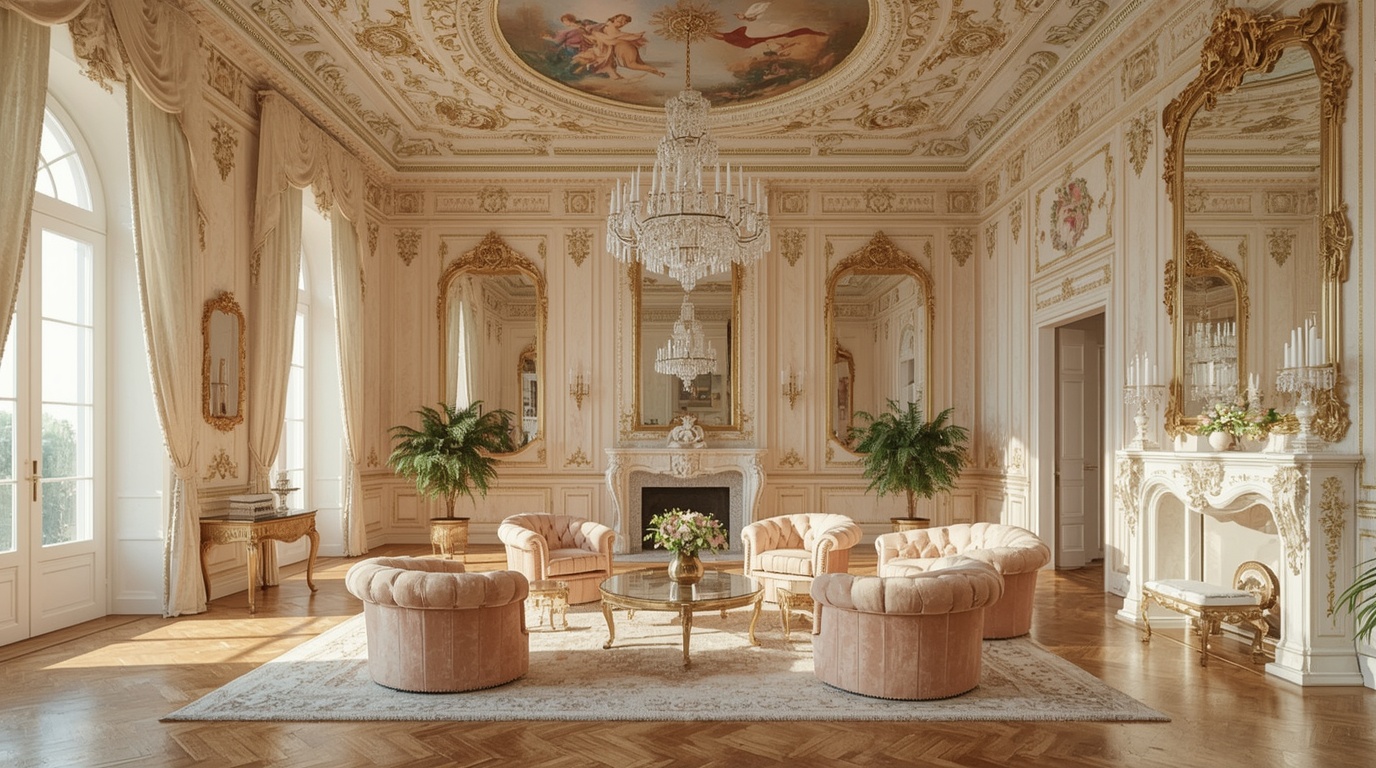
In the Hôtel de Soubise in Paris, walk into the famous Salon de la Princesse. The space seems to float. Gilded stuccowork coils around mirrors, reflecting windowlight that arrives already softened by doubled curtains. Above, ceiling paintings evaporate into clouds and pale skies. You are not meant to stand at attention here. You are meant to lean in, to murmur, to drift from one conversation to another.

That sensation of softness is not accidental. Rococo interiors were crafted as environments of ease—gentle on the eyes, flattering to the complexion, forgiving of proximity. The style’s endless undulation of curves is more than aesthetic preference; it is an architectural form of emotional suggestion. Curved lines invite you in. They suggest flexibility, movement, permissiveness. There are no hard moral edges here, no straight-line sermons from floor to cornice. Instead, the room tells you: relax, you are among friends, let your guard—and perhaps your conscience—down.
The defining atmosphere of Rococo is not opulence. It is intimacy.
Curves, Shells, and Secrets: The Symbolic Language of Ornament
“Rococo” itself likely comes from the French rocaille—rockwork—and coquille—shell. At first glance, the ornament of Rococo seems almost random: shells dissolving into foliage, C-shaped and S-shaped scrolls, putti tangled in garlands, masks, vines, flowers, rocks. Yet the vocabulary is surprisingly consistent, and its emotional messaging remarkably coherent.
Shells, for one, are not an innocent choice. They had long carried erotic and mythological associations—think of Botticelli’s Venus rising from the sea, cradled in a scallop. In Rococo interiors, shells appear not just as coastal souvenirs but as a recurring insinuation of sensuality. They frame mirrors, they crown doors, they sit discreetly above a bed’s canopy—a symbol of birth, of secrecy, of something precious being sheltered.

The endless scrolls and tendrils that bind these motifs together serve their own psychological purpose. Unlike classical ornament, which is governed by symmetry and clear hierarchy, Rococo ornament wants to wander. As your eye follows a gilded line, it slips unexpectedly into a leaf, then into a shell, then into a mask. There is no obvious start or finish, no central story to decode. The room teaches you to enjoy the act of looking itself, rather than to hunt for a single moral or message.
It is an art of distraction, certainly, but also an art of suggestion. Much of Rococo’s eroticism is encoded in foliage that clings too easily to a torso, drapery that ripples a little too purposefully, garlands that tangle like limbs. Bronze mounts on commodes and consoles might show playful nymphs or a pair of doves; clock cases sprout Cupid; candlesticks twist into languorous female figures. There is movement and touch everywhere.
This seduction of the gaze is not merely sensual—it is social. In a culture where flirtation had its own elaborate vocabulary, interiors became part of the code. Every coquettish curve was a visual echo of the verbal games played within these walls, a reinforcement that nothing here was entirely serious, that the line between art and desire was designed to blur.
Rococo ornament, defined at its core, is mood made visible: restless, playful, flirtatious, and just unstable enough to feel thrilling.
Mirrors and Multiplicity: The Narcissistic Theatre
No element reveals the psychological ambitions of Rococo interiors quite like the mirror.
Baroque palaces had used mirrors to proclaim wealth and power—the famous Hall of Mirrors at Versailles is a corridor of intimidation. But the Rococo mirror behaves differently. It does not march in rank but blooms like a decorative organism: oval, asymmetrical, surrounded by curling leaves and shells. It hovers over fireplaces, doubles doorways, sneaks into corners, and clusters in pairs or triplets.

The effect is deeply theatrical. Every Rococo room is also a stage set, and every guest, a performer. As you move, you catch yourself constantly in reflection—not in one dominating pane, but in fractured, glinting glimpses. You become both observer and observed, continually aware of your own visual presence.
There is a psychology of self-fashioning at work here. In an era where wit, charm, and appearance were tools of survival at court, Rococo interiors polished not just the floors but the persona. You are invited—even compelled—to see yourself from outside, to curate your gestures, expressions, postures. The room is a finely tuned machine for manufacturing social selves.
At the same time, the mirrors subtly dissolve the solidity of space. Walls seem less like boundaries and more like surfaces that could open, shimmer, vanish. Your sense of where the room ends and begins becomes unreliable. This soft affront to spatial certainty has an emotional counterpart: in Rococo interiors, reality itself feels negotiable, open to embellishment, soft-focus.
The mirror in Rococo is more than a luxury object. It is a psychological instrument: a device for doubling, for seduction, for the delicate art of becoming the person you wish others to see.
The Pastel Dream: Color as Emotional Climate
The palette of Rococo is often dismissed as “pastel,” as though that meant merely light-hearted. But these colors are more strategic than sentimental.
Powdered blues, diluted greens, shell pinks, champagne creams, faint lavenders—these are the shades of dream rather than day. They flatten shadow, erase harsh contrast, and create a visual fog in which everything appears slightly softened, including age, fatigue, and reality itself.
Color in Rococo interiors is almost always tied to skin. The entire chromatic range is chosen to flatter the people inside: to warm the complexion, to harmonize with powdered wigs and silk dresses, to transform candlelight into something golden and forgiving. Imagine the same ornament in stark white under bright light—it would become aggressive, almost grotesque. The pastel veil is crucial; it is the cosmetic layer over the architecture.
Psychologically, this chromatic gentleness serves as permission. Deep reds and dark blues, associated with state power and solemnity, give way to private, almost intimate shades. The room does not ask you to be heroic. It asks you to be charming, receptive, available to pleasure.
Rococo color defines the genre as much as any scrolling ornament: it is the interior equivalent of a powdered cheek, a light touch of artifice designed to beautify, to flatter, to transform the emotional temperature into a perpetual late afternoon.
A World Turned Inward: The Culture of the Salon
Rococo interiors were never neutral shells; they were built for a particular kind of life. To truly understand them, you must imagine not just their surfaces, but their sound.
The rustle of silk skirts brushing parquet. The low murmur of voices, rising occasionally into bright laughter. The faint clink of porcelain cups. A card falling on a gaming table. A fire’s soft crackle muffled by thick carpets. No shouting, no proclamations—just the layered soundscape of sociability.
These rooms crystallized around an institution: the salon. Here, conversation was both sport and currency. Wit could elevate, a well-timed epigram could wound, a flirtation could shift alliances as effectively as a treaty. The room’s design responded to this social theater. Furniture moved from rigid alignments to more fluid, intimate arrangements: bergères, fauteuils, canapé sofas, and chaise longues—pieces designed for leaning in, for half-reclining, for the luxurious posture of listening.
Small tables followed, ready to host not maps and decrees, but sweets, letters, delicate porcelain, decks of cards. Every surface was an invitation to some minor pleasure.
Notice how the architecture itself participates in this inwardness. Windows are present, of course, but the most intense visual action takes place on interior surfaces: paneling, mirrors, painted overdoors. The outside world—its wars, debts, famines, and political strains—rarely appears. Instead, we find pastoral scenes, mythological lovers, allegories of the seasons, cherubs in endless variations.
Rococo interiors defined themselves by what they excluded. They are bubble-worlds, sealed from discomfort, where conflict is aestheticized into playful struggle and nature is tamed into a decorative backdrop. It was, even then, a fantasy—and everyone inside knew it. The brilliance of Rococo lies in its ability to make that fantasy almost believable for an evening.
Fantasy as Defense: The Anxiety Behind the Gilding
Look past the glow, and Rococo begins to feel less like pure celebration than a charming act of emotional self-defense.
The mid-18th century was not, in reality, a particularly easy time in France and beyond: economic imbalance, tensions between classes, political unease, and the early murmurs of revolution all simmered beneath the surface. In this context, the Rococo interior can look like a carefully constructed denial—a way of editing the world down to its most agreeable fragments.
The psychological mechanism is familiar to us today. When reality bites, we curate. We build controlled environments where ugliness is banished, where we can pretend, for a few hours, that beauty is the natural state of things. Rococo simply did this on a breathtakingly elaborate, artisanal scale.
The constant movement in Rococo ornament, its refusal to settle, can read like a visual expression of suppressed restlessness. The surfaces are never still because the culture that produced them was not calm. Every gilded scroll, every fluttering cherub, every painted idyll whispers: “Look here, not there. Stay in this moment. Do not ask what lies beyond the paneling.”
Yet there is also a melancholy undertone in some of the most exquisite Rococo rooms, an awareness that all this beauty is fragile. Delicate porcelain, fine silk, pale wood—nothing here is durable. It is a world that understands its own ephemerality and chooses, rather than to confront it, to refine it into elegance.
This is the secret undercurrent of Rococo psychology: pleasure not as simple indulgence, but as an anxious, cultivated reprieve from the knowledge that the party cannot last forever.
Why We Still Listen to the Gilded Whisper
Why, in an era of concrete, glass, and clean lines, does Rococo still exert such fascination? It would be easy to say it is mere nostalgia, the lure of opulence in minimalistic times. But our interest runs deeper.
In an age of digital curation, Rococo feels oddly contemporary. Its interiors are the 18th-century equivalent of an expertly edited Instagram feed: life without unflattering lighting, anxiety transformed into aesthetic, mess dissolved into artful clutter. Like our own visual culture, Rococo thrives on surfaces—celebrated, manipulated, layered—yet behind those surfaces lurk genuine emotional needs: for beauty, for recognition, for a space where we can temporarily suspend the harsher edges of reality.
There is also a growing recognition that minimalism has its own psychological cost. The blank wall and the clean line promise calm, but can slide into sterility. Rococo, for all its alleged excess, understands the human appetite for complexity—for objects with stories, for patterns that ask to be traced, for rooms that stimulate as much as they soothe.
We return to Rococo because it reminds us that interiors can be narrative environments, not just functional containers. A Rococo room does not just accommodate life; it scripts it. It asks: Who do you want to be in this space? A wit? A lover? An observer? A conspirator? It offers roles, moods, fantasies—all through its orchestration of light, color, line, and ornament.
In a way, the persistent allure of Rococo is the allure of being allowed, again, to be a little excessive in our feelings. To admit that we crave beauty not just as a design principle, but as a psychological need.
The Last Glow Before the Storm
Rococo was never meant to be eternal. It was, by nature, a twilight style: the last golden light before the sun drops and shadows sharpen. Within decades, its playful curves would be replaced by the moral straight lines of Neoclassicism, its pastel fantasies by earnest references to Roman virtue and Republican austerity. History moved on, and the silk-wrapped salons would one day seem complicit, even culpable, in their refusal to see the gathering storm.
Yet that is precisely why Rococo interiors remain so moving today. We know how the story ended. We walk through gilt-framed mirrors and under painted skies with the benefit of hindsight, aware that these rooms were both a height of artistry and a last, fragile performance before everything changed.
What defined Rococo interiors was not merely their shells and scrolls, their mirrors and pale colors, but the emotional atmosphere they cultivated: intimate yet performative, escapist yet anxious, luxurious yet strangely fragile. They are spaces where a culture tried, with enormous skill and no small desperation, to live inside its own most flattering reflection.
Stand in such a room long enough and the surfaces begin to talk. The gilding whispers of status and taste, the curves murmur of desire and evasion, the mirrors confess a fascination with self and spectacle. You no longer see just “decorative art”; you see an entire psychic universe, suspended in paneling and plaster.
In their shimmering excess, Rococo interiors offer not simply a lesson in style, but an enduring question: What are we trying to soften, to beautify, to hide, when we make our rooms so carefully beautiful?
The answer, as in those 18th-century salons, lies somewhere between the curves of the wall and the curve of the human heart.
AI Notice: Some visual content in this article may have been created or enhanced using artificial intelligence (AI) for artistic, editorial or illustrative purposes. Learn more about our approach in our AI & Editorial Principles.