The pie crust table emerged in Britain in the mid‑18th century, in the orbit of Chippendale design and the rising culture of polite entertaining. When tea was no longer a luxury but a daily fixture, parlors were often furnished with small round tables, the edges of which were carved, a rim to contain delicate cups and saucers. The ornamental lip was like thecrimpededge of a cake and immediatelyricherdomestic appellation.
Until the late Georgian and Regency, it seems that the form became enriched. Tripod bases, balusted shafts and tilting mechanisms created a table that was simultaneously functional and sculptural, as it was horizontal to use but vertical when put away, with the carved top protruding in the manner of a picture frame. The later three-tier period took this theatricality further. Height became a signifier of sociability and display; the more plates, the more porcelain, the more conversation.
American 19 th – century pie crust table entered the parlors and reception rooms, the fold-in to Federal and Victorian needs. And it moved from tea service to universal platform for iconic objects of aspiration: deck-cards, cartes de visite, parlor bronzes according to changes in notions of receiving and class.
Carved Rims and Tripod Legs: Anatomy of Elegance
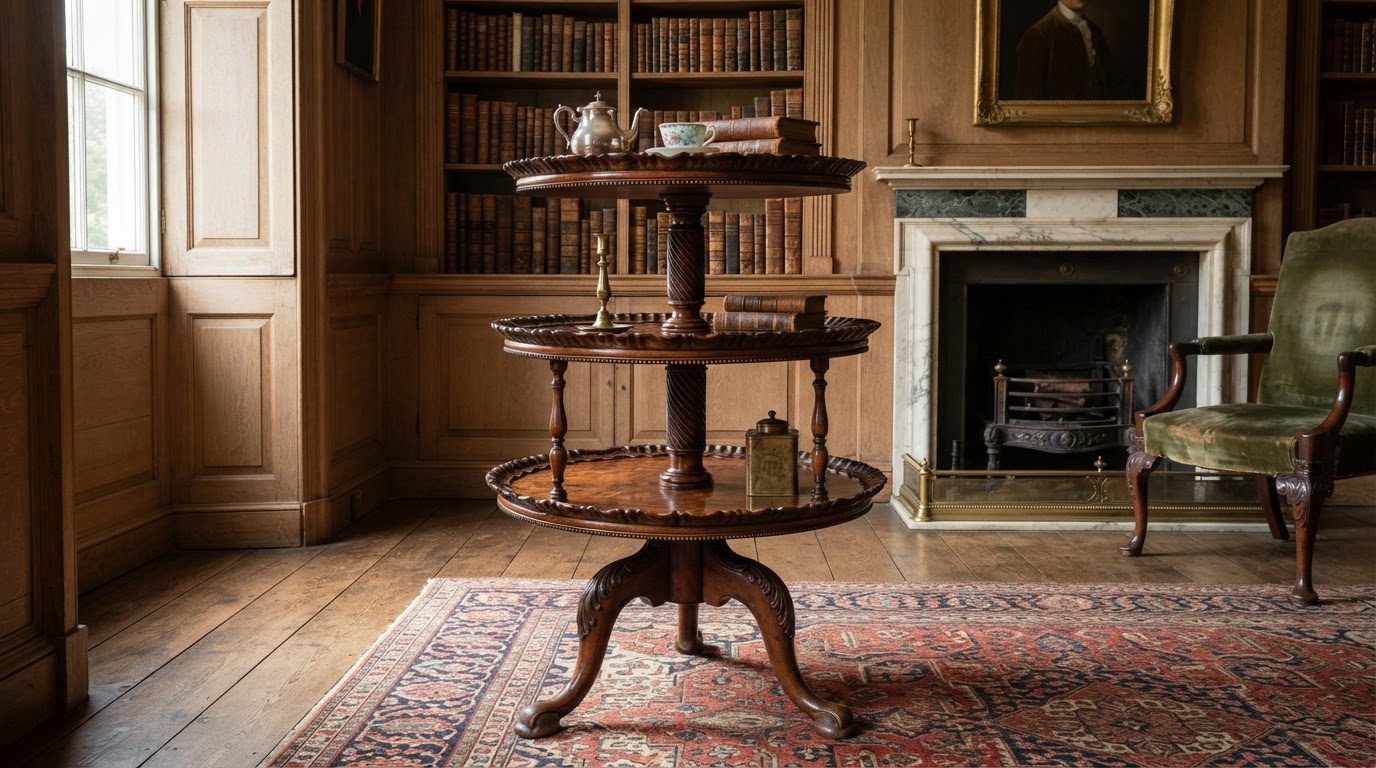
That on first glance, the antique pie crust table is deceptively plain: a round top, a center pole, three legs. The subtlety is where lies its strength. Far from being just a bumpy edge, the pie crust edge in a superb piece is cut with a ruggedly carved series of alternating concave and convex sweeps sometimes further detailed with gadrooning or shell decoration. The topmost rim is almost fleece-like in texture which in the frozen crisp material is like a wood ruffle.
The central shaft is frequently chiselled as a baluster or fluted column diminshing to a tripod base. Those three legs, usually cabriole or restrained S‑curves, end in padded, ball and claw or scroll feet that barely caress the floor, endowing the object with a poised, almost birdlike stance. Scale is integral: the top has to seem as if it‘s floating above a base that seems to be grounded yet weightless.

On three-tiered versions, the column becomes an architectural element. The spacing of the tiers is as important as the execution of the tiers themselves, if the spacing is too narrow too much like a crouched figure, if it is too distant, too spindly. Good examples feel like a scaled-down campanile: rhythmic, escalating, and composed. It is this a delicate balance between excess and moderation that makes the form appear elegant rather than twee.
Three Tiers of Grace: Function Meets Vertical Drama
This single-to-three‑tier design of pie-crust tables responded to both functional and social concerns as interiors became overcrowded with objects. As drawing rooms became filled with books, calling cards, fans, visiting-gifts, and ormolu figural ornaments the need for vertical presentation that did not take up additional floor space increased. The three‑tier table was a sophisticated solution: a graceful column that multiplied surface without impeding the overall continuity of a room.
At each level, the function was different. The topmost round was where things were most fragile–French porcelain, a crystal flower holder, maybe just a single flower in a bud vase–sets as they naturally draw your eyes upward. Second level was for things used: a book halfway through a chapter, a lorgnette, a small lamp. On the lowest plate, the more “storing” and “steadying” elements would be found: the pile of leatherbound books, the inlay box, providing visual weight near the ground.

The painted jars and the stacking of the scalloped disks speak to a domestic totem. Each thin edge receives a slight lightness, a halo and an umbrage, which renders the table strikingly dramatic at a considerable distance in the space. The vertical call also motivated motion: a rhythmic impermanence, with guests reaching around, setting, and shifting items. The pie crust table was not static furniture; it directed a series of elegant, delicate motions.
Mahogany, Walnut, and Shine: Patina as Provenance
Materials trace the history of an antique pie-crust table before the provenance is explicitly present. For British and American versions, fine‑grained, firm mahogany was preferred for durability and for its crisp definition of carving. The warm crimson‑brown hue aged and deepened over many years permits scallops and reeding shafts to express themselves vividly in sharp shadow. Earier, local copies may be of walnut, a shade softer of feel, a warmer, warmer hue.
The finish is also a matter of where the story has taken us. Old French and spirit varnishes, now mellow, create a glossy, almost liquid surface that goes some way to counteract the starkness of the carving, without burying it. Porcelain feet have created tiny scratches; pale rings from glasses long emptied; a ghostlytyre-dyeingwhere a lace tablecloth used to sit.
Collecting jewelry has its own jargon, and one term that is often mentioned is patina. On authentic pieces from 1700s or early 1800s, the undersides of tiers, the interior edges of the pie crust, the tops of feet exhibit wear differentiated from one another that would have taken generations of finished use; on many later copies, the carving may be almost machine-like in precision, the surface more machine-precise and glittering. An authentic period table appears cleanly precise while also gently misshapen, like a well-used pair of leather gloves: the form is accurate, the surface encouragingly imperfect with time.
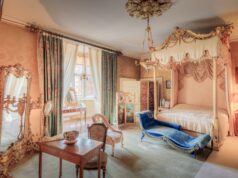
Styling a Grand Boudoir with Antique Pie Crusts
If carefully considered, one of three‑tier pie‑crust tables might suggest cultivated intimacy when installed in a boudoir. The scale is appropriate to rooms intended for withdrawal not display. Next to a chaise, the lower tier might hold cloth‑bound books, the middle a carafe and a glass resting on a small silver tray, and the upper tier a single sculptural object such as a chunk of rock crystal, a tiny bust, or a scented candle in matte glass.
In a dressing area or a dressing table, this kind of table makes a good vertical tray: perfume bottles can be arranged on the top disc, then between a velvet‑lined box for jewelry and the soft cover of silk‑covered hatboxes, cashmere is placed below. The carved rims conveniently surround these objects so that these little daily‑life pictures are presented.
It is negative space. Don’t try to make everything is tonnified the same way. Keep a few arcs of unpainted mahogany that silhouetted pie crust line will stay readable, and the table will register architecturally, not just functionally. For modern spaces, the dialogue becomes even more dramatic: a dark mahogany pillar punctuates light-colored drynessnear a spare sofa or an unfussy four-poster. The pie crust table is one of the intervening arts commasbetween architecturedwelled, mahoganydand not.
The old three‑tiered pie-crust table remains embedded in the resistance to obviousness, absorbed in the desire for utility pelied in ornament, heightened by the contra-rejuvenation of verticality without verticalness, hidden in the practice of domestic ceremony into a nuanced column, which still reads expansively in small modern rooms where there is no space for surface, only for a practiced assemblage of objects, on every table a tiny, spoken ritual to honor each kept object. Living with this table even if at present it cloisters us does not lean on the fallacy of nostalgia: ironic familiarity is a way of simply thanking the edges and moments for the luxury they afford. But I am thinking now of the gracefully scalloped rims, the spindled legs, the fine-and-blatant bloom of a little old polish, and realizing how little of the world needs to be shouty, how persuasive such low articulations are.
A small table occupies the corner and yet it cannot help but define the entire room. Its flat edges ripple like silk on a frilled edge, reflecting light along their scalloped margins. Three round shelves extend in separate, willowy pithy shafts each the ground of a porcelain shrine, a devotion to silver, or merely to a vat of air and confoundry. The anachronistic pie crust table is a peculiar exception: small but astonishing in its presence. It breathes the air of Georgian tea ceremonies, Victorian collector madness, and modern century art lovers, insisting on elegance in the most negligible observances. To investigate the three-tiered outline is, in effect, to glimpse a tycoon‘s history reduced to a handful of offerings.
AI Notice: Some visual content in this article may have been created or enhanced using artificial intelligence (AI) for artistic, editorial or illustrative purposes. Learn more about our approach in our AI & Editorial Principles.