A University of Oxford mathematician, Alain Goriely, has debunked the long-held theory that the Parthenon’s curved base and bulging columns were deliberate optical corrections designed to trick the human eye.
In a paper published in Royal Society Open Science on September 16, 2026, Goriely found that all twelve proposed “optical illusions” are either too small to be perceptible or unsupported by any real visual effect — meaning one of architectural history’s most repeated legends may be, in his words, an illusion of illusions.
The Claim That’s Been Repeated for 170 Years
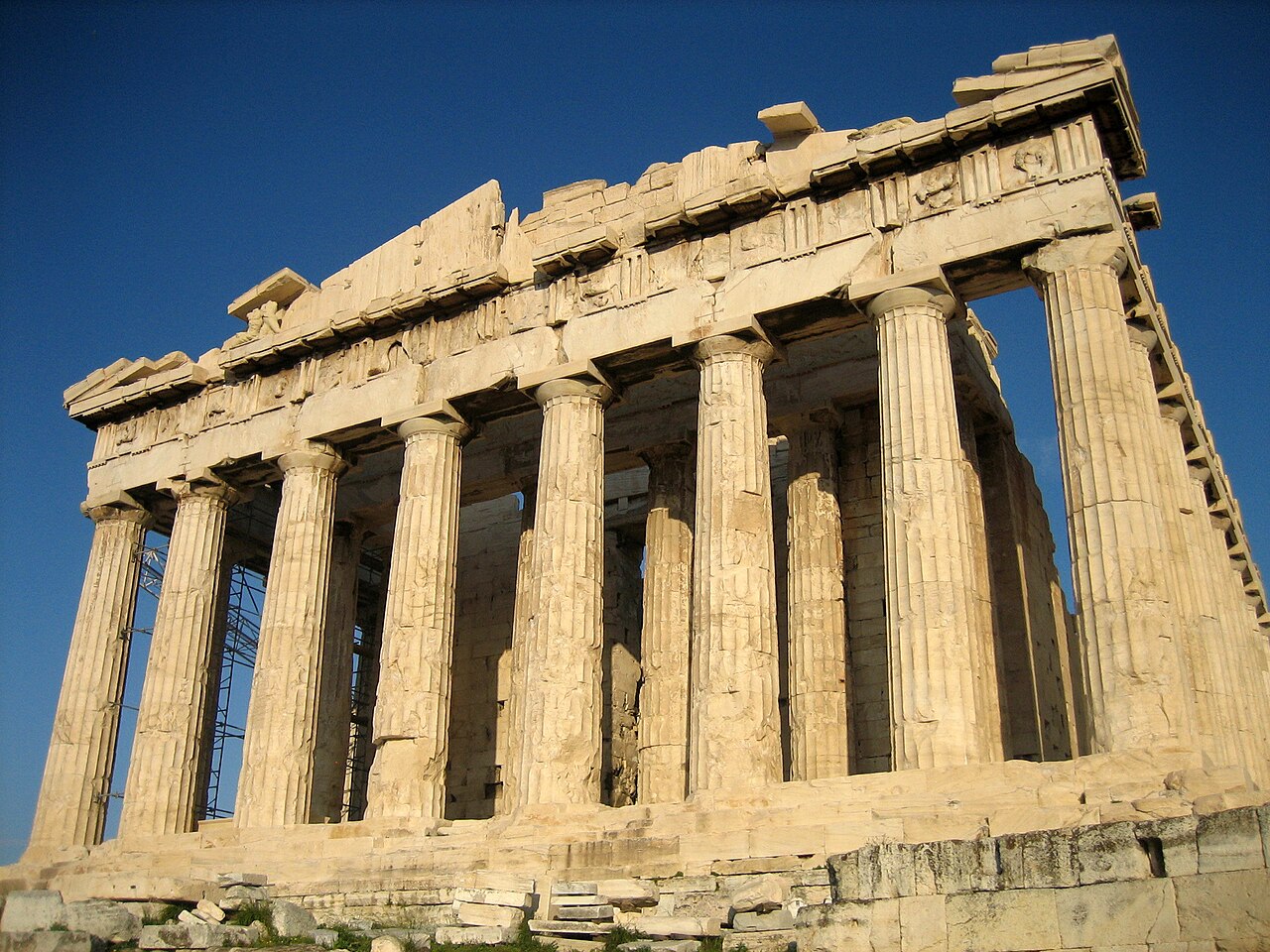
The traditional account goes like this: the Parthenon’s base isn’t actually flat — it curves upward by a couple of inches toward the center — and its columns aren’t perfectly cylindrical, but bulge very slightly partway up. For generations, architectural historians have explained these details as deliberate corrections.

The curved base, the story goes, was designed to counteract an illusion that would otherwise make a long, straight line appear to sag in the middle. The column bulge, known as entasis, was supposedly there to stop the columns from looking too thin, or alternatively to reinforce them structurally against the weight of the roof.
A mathematician at the University of Oxford decided to actually test these claims rather than simply repeat them, and the results were not kind to the legend. Using modeling to evaluate twelve separate “optical corrections” long attributed to the Parthenon’s architects, the researcher found that most of the supposed adjustments are either too small for the human eye to register or aren’t grounded in any real optical effect that would need correcting in the first place.
The base’s curve, for instance, rises only a couple of inches over its full length — nowhere near enough to visually counteract a sagging illusion that, per the analysis, likely wouldn’t have been perceptible anyway. The column bulge fares even worse: under an inch of swelling, framed as a fix for a visual problem that the geometry doesn’t actually support, and structurally unnecessary given how thick the columns already are.
Digging into the historical record didn’t help the traditional theory either. The ancient Greeks themselves, it turns out, left no writings connecting the Parthenon’s design to optical trickery. The idea instead seems to trace back to a Roman architect writing centuries after the temple was built, was later picked up by Renaissance scholars rediscovering classical texts, and was cemented into architectural canon by a 19th-century survey of the Acropolis. In other words, a theory born long after the building’s completion slowly hardened into unquestioned fact.
A Bit of History
This wouldn’t be the first time the Parthenon has been enlisted to support a tidy modern narrative about ancient genius. The building has spent the last two centuries as a kind of blank canvas onto which successive generations project their own ideals — a symbol of democracy for 18th-century Enlightenment thinkers, a template of mathematical perfection for 19th-century architects obsessed with the golden ratio, and now, in this latest correction, a case study in how easily scholarly consensus can calcify around an appealing but unproven idea.
The 1850s survey that helped popularize the optical-correction theory was itself a product of that era’s fascination with treating ancient Greece as the origin point of Western rational thought — a lens that made it very easy to assume the Parthenon’s builders had already solved problems of visual perception that wouldn’t be formally studied for another two thousand years.
Our Take
We think this story is interesting less for what it says about ancient Greek architecture and more for what it says about how myths get built in scholarship generally. Nobody set out to invent a false story about the Parthenon — each generation of scholars was working in good faith, building on the work of the generation before. But once a claim gets repeated by enough respected sources, it stops being treated as a hypothesis and starts being treated as settled knowledge, and at that point almost nobody goes back to check the original math.
There’s also something worth sitting with in the researcher’s own framing of the problem: a tendency to idealize the ancient world as having already mastered forms of knowledge that actually took millennia longer to develop. It’s flattering to imagine the architects of the Parthenon as proto-engineers running sophisticated visual-perception calculations, but it’s arguably more interesting, and more historically honest, to accept that they may have simply made aesthetic choices they liked — a curved base because it looked more organic, or drained water better, without any grand theory of optics behind it at all.
None of this makes the Parthenon less remarkable. If anything, we’d argue it’s more remarkable that a 2,500-year-old building can still generate genuine scholarly debate, and that new tools — in this case, careful modeling rather than any new archaeological find — can meaningfully revise what we think we know about one of the most studied structures on Earth.
Sources:
- Artnet News: https://news.artnet.com/art-world/parthenon-illusion-mathematician-debunk-2812354
- Royal Society Open Science: https://royalsocietypublishing.org/rsos/article/13/9/rsos260999/483304/The-illusion-of-illusions-there-are-no-optical
AI Notice: Some visual content in this article may have been created or enhanced using artificial intelligence (AI) for artistic, editorial or illustrative purposes. Learn more about our approach in our AI & Editorial Principles.