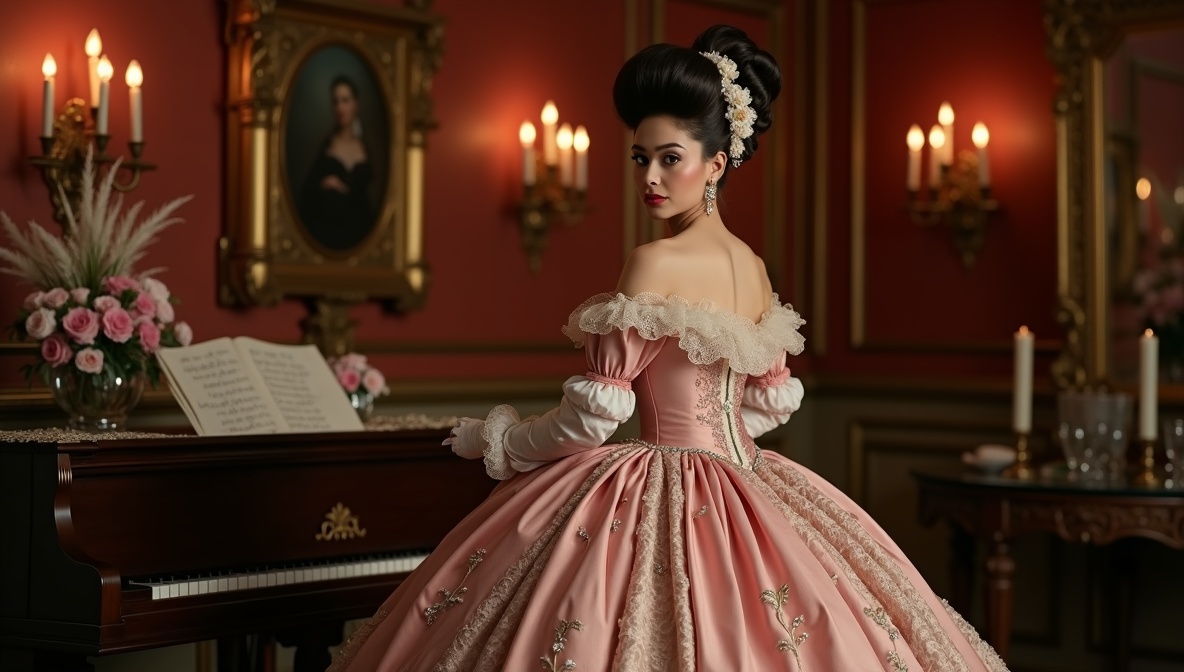
Step Inside the World of Victorian Party Dresses You’ve Never Seen
Victorian party dresses were far more than beautiful garments; they were visual manifestos of class, morality, and technological change in a rapidly evolving 19th‑century world. In the candlelit ballrooms of London’s Mayfair, the glittering salons of Paris, and the grand drawing rooms of Boston and New York, women’s evening wear functioned as a coded language. Color, cut, decoration, and even the slope of a neckline signaled a woman’s social rank, marital status, and adherence to prevailing standards of respectability. To understand Victorian party dresses is to glimpse the complex social choreography of the era: a world of strict etiquette, expanding consumer culture, and industrial innovation wrapped in silk, tulle, and whalebone.
1. Historical Context: Victorian Party Dresses
The Victorian era, defined by Queen Victoria’s reign from 1837 to 1901, spanned immense social and technological change across Britain and its global sphere of influence. Party dresses evolved alongside the era’s shifting ideals: early Victorian gowns emphasized modesty and romantic softness, while late Victorian designs flaunted technical ingenuity and increasingly elaborate silhouettes. In major centers like London, Paris, and New York, urban elites used evening dress to differentiate themselves from the growing middle classes, even as those very classes began to emulate aristocratic fashion through the rise of ready-made garments and fashion periodicals.
Can You Name the Masterpiece?
Ten masterpieces. Ten questions. How well do you know the history of art?
This was also the age of the fashion system as we now recognize it. Paris, under the influence of couturiers such as Charles Frederick Worth (often dubbed the “father of haute couture”), became the undisputed capital of elite women’s fashion. Wealthy British and American women traveled to Paris to commission ball gowns, then wore them in London’s Grosvenor Square or New York’s Fifth Avenue drawing rooms. The Victoria and Albert Museum in London notes that by the 1860s, Worth’s designs “helped establish the concept of the seasonal fashion collection,” effectively linking party wear to a global, trend-driven economy rather than purely local custom.
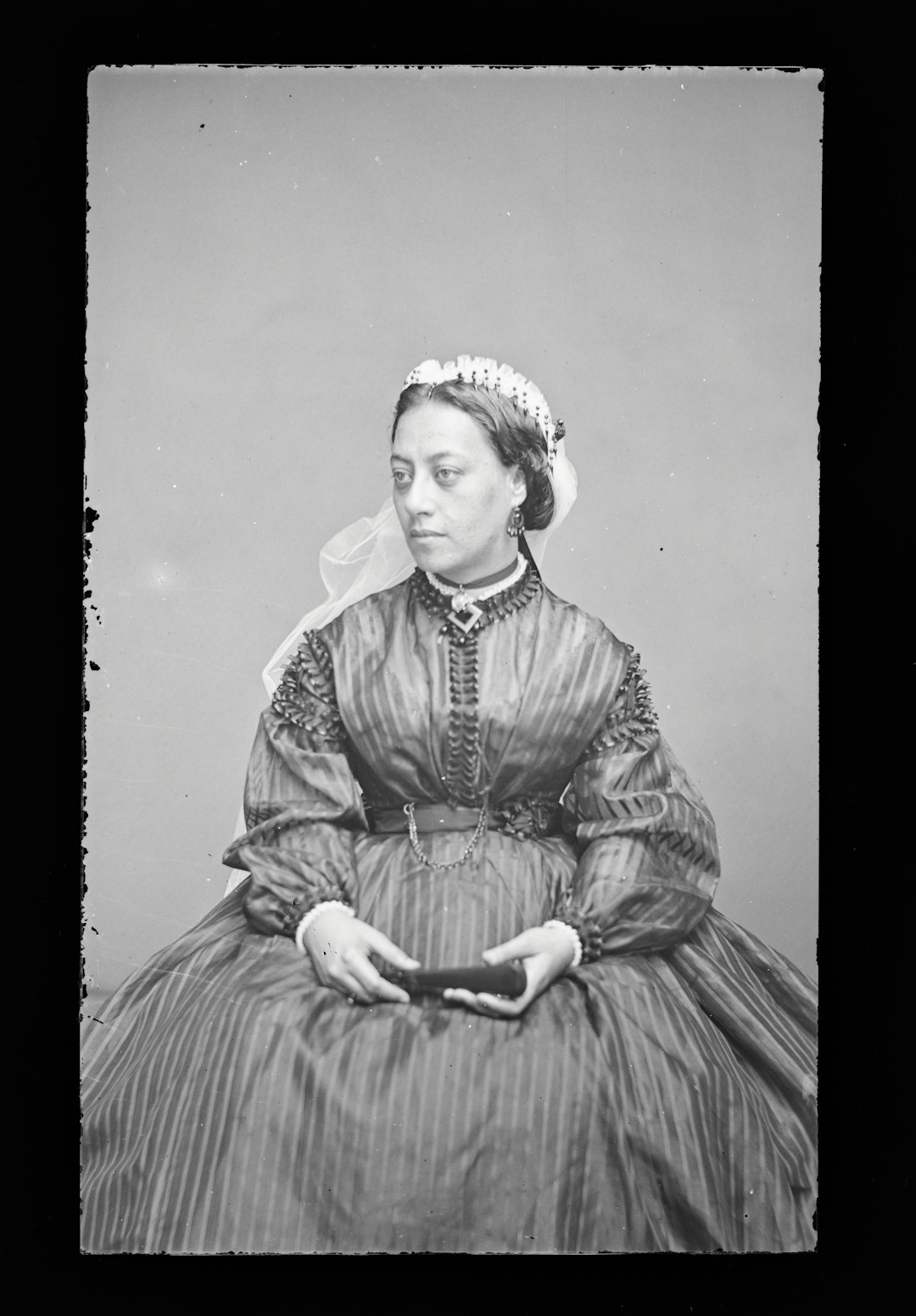
At the same time, industrialization transformed what was possible in terms of materials and ornament. Mechanized looms in Lyon and Spitalfields produced intricate jacquard silks; aniline dyes yielded intense new colors like mauve and magenta after the 1850s; and improved distribution networks brought luxury textiles to dressmakers in cities such as Manchester, Boston, and Philadelphia. Yet amid this technological modernity, Victorian party dresses clung to ideas of feminine decorum and moral respectability. As the Smithsonian Institution’s National Museum of American History observes, clothing in the 19th century was “a powerful indicator of one’s place in the social order,” and nowhere was that more visible than at a formal evening event.
2. Silhouettes and Structure: From Crinolines to Bustles
Early Victorian party dresses of the 1840s and 1850s emphasized a bell-shaped skirt supported by layers of petticoats and, later, steel-hooped crinolines. The Metropolitan Museum of Art’s Costume Institute describes how the introduction of the cage crinoline in the mid‑1850s allowed skirts to expand dramatically without the unbearable weight of multiple starched petticoats. For evening wear, these wide skirts were paired with tightly fitted bodices, sloping shoulders, and low necklines, creating an exaggerated contrast between a small, corseted waist and a voluminous skirt—an idealized “feminine” form aligned with middle-class notions of fragility and grace.
Can You Guess the Artist?
Three clues. One artist. How quickly can you identify the painter?
By the late 1860s and into the 1870s, the silhouette shifted from dome-shaped breadth to an emphasis on the back of the body. The crinoline contracted at the front and sides, evolving into the bustle: a structural framework of steel, horsehair, or padded fabric that projected the skirt backward. This change was particularly conspicuous in party dresses, where the bustle allowed for cascading drapery, complex overskirts, and opulent trains designed to be seen in motion as a woman walked or danced. The Victoria and Albert Museum notes that “the bustle gave designers a new architectural surface to decorate,” markedly raising the level of visual complexity in evening wear.
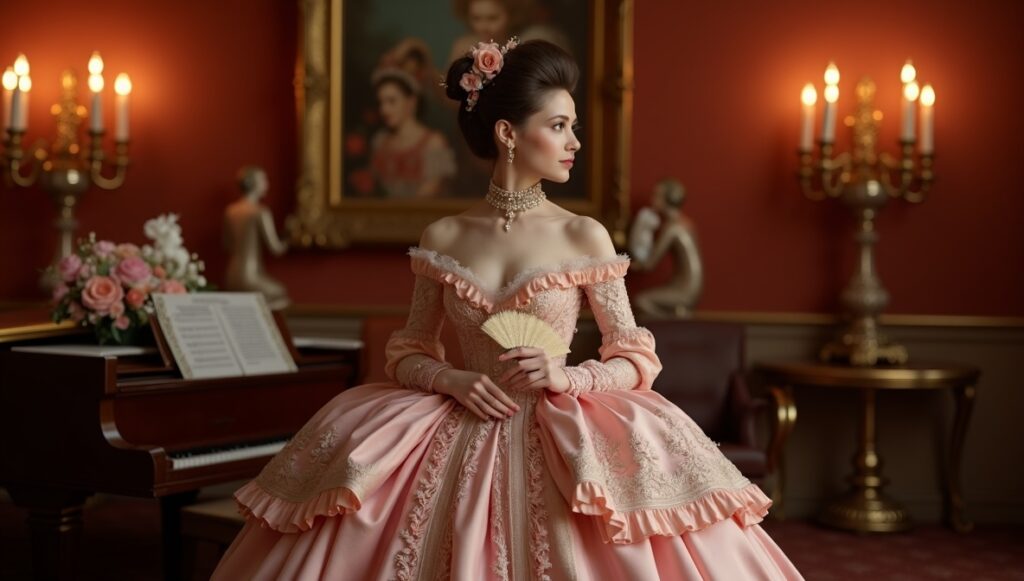
Throughout the Victorian period, corsets were fundamental to the party dress ensemble. Although often caricatured as instruments of torture, surviving corsets in collections such as the Louvre’s Musée des Arts Décoratifs and the Met’s Costume Institute reveal a range of stiffness and silhouette, tailored for different bodies and occasions. For formal evening events, a sharply cinched waist could be a status symbol: it implied that the wearer did no manual labor and had access to dressmakers skilled enough to cut and fit garments precisely. As fashion historian Valerie Steele writes in The Corset: A Cultural History, “The corseted body in the nineteenth century was not simply a fashionable figure; it was a moral and social ideal.”
3. Materials, Colors, and Decoration
Victorian party dresses were showcases of textile innovation and decorative craftsmanship. Silk satin, taffeta, moiré, and gauze formed the backbone of high-status evening wear, often layered with tulle and lace to create lightness and depth. Lyon silks and English brocades were particularly prized. Institutions such as the Victoria and Albert Museum preserve mid‑19th‑century ball gowns whose woven floral patterns were achieved using jacquard looms—technology that encoded complex designs onto punch cards, foreshadowing early computing methods. The luxury of the fabric alone signaled wealth, but the volume used in skirts and trains amplified the message.
Color choices were equally significant. Early Victorian evening gowns favored pale shades—white, ivory, soft pinks, and blues—associated with youth and purity, especially for unmarried women. Later decades embraced richer tones: deep burgundy, emerald green, and royal blue made possible by synthetic dyes pioneered in the 1850s and 1860s. The Metropolitan Museum of Art notes that the discovery of mauveine by William Henry Perkin in 1856 sparked a “mauve mania,” rapidly reflected in fashionable dress. At night, under gas or candle lighting, darker and more saturated colors appeared especially luminous, turning ballrooms into kaleidoscopes of moving color.
Decoration ranged from subtle to spectacular. Embroidery, beadwork, and appliqué embellished bodices and skirts; silk flowers, ribbons, and fringes were common trimmings. For high-society events, dresses might be further adorned with real lace from Brussels or Chantilly, or with jet beads and sequins that caught the light. The Louvre Museum’s fashion and textile collections include late 19th‑century Parisian evening gowns where embroidery and beadwork nearly obscure the base fabric, underscoring the association between visual complexity and social prestige. Yet underlying all this ornament was the expectation that the dress should still display the wearer’s figure and movement, not overwhelm it—a tension that remained central to Victorian couture.
4. Social Codes and Dress Etiquette
Victorian party dresses were governed by an intricate etiquette that dictated what could be worn, where, and by whom. Fashion manuals, magazines like Godey’s Lady’s Book in the United States, and British periodicals such as The Queen provided detailed advice. Necklines, sleeve lengths, and train size were all tied to the formality of the event. For a full-dress ball, low necklines and short sleeves were standard for women, whereas dinner parties might require slightly higher bodices and more subdued trimmings. The Smithsonian’s collections of 19th‑century fashion plates attest to these differentiations, often labeling ensembles explicitly as “Ball Dress,” “Dinner Dress,” or “Evening Dress.”
Age and marital status also shaped what was considered appropriate. Young unmarried women were expected to appear in lighter colors, airy fabrics, and more revealing necklines; married women and older matrons typically wore richer tones and more conservative cuts. Jewelry followed similar rules: pearls and modest ornaments for debutantes; diamonds and more elaborate sets for established society figures. Etiquette writers emphasized that a woman’s dress should never appear ostentatious or attention-seeking, even as wealthy families used precisely such garments to advertise their status. As one 19th‑century commentator insisted, “True elegance is known by its quietness and refinement, not its glittering display.”
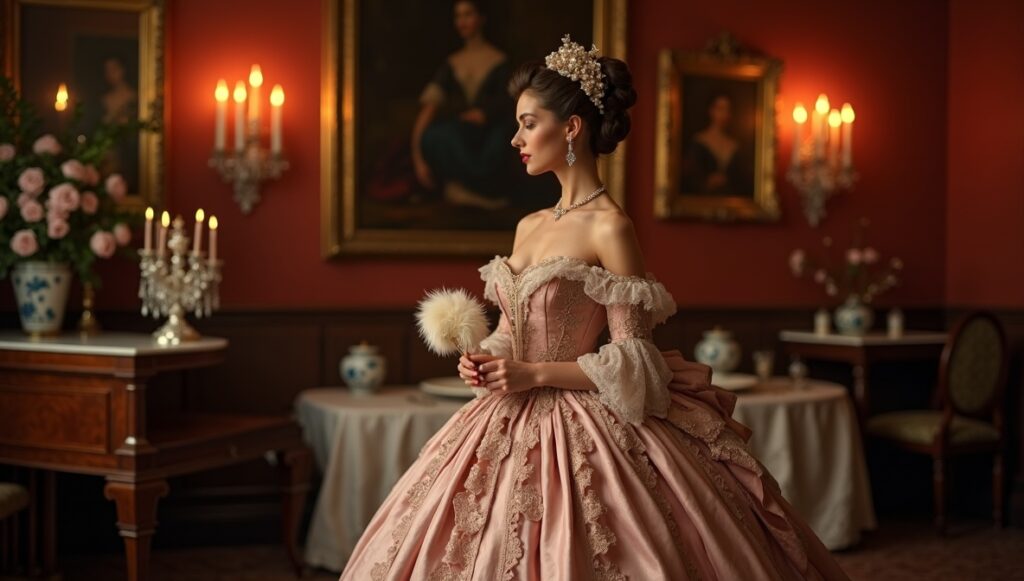
Moreover, party dress etiquette had a moral dimension. The Victorian era was deeply preoccupied with respectability, and women’s bodies were treated as sites of moral scrutiny. Evening dresses might bare shoulders and arms, but overt sensuality—excessive décolletage, clinging fabrics, or overly bright colors—could provoke criticism. Public institutions reinforce this context: the Victoria and Albert Museum notes that fashion in the period “both reflected and reinforced rigid gender roles,” with women’s formal dress emphasizing domesticity, dependency, and ornamental value. Thus, a Victorian party dress was not merely chosen for aesthetic reasons; it was a negotiated response to cultural expectations about femininity, class, and virtue.
5. Types of Victorian Party Dresses
Within the broad category of evening wear, Victorians distinguished several types of party dresses, tailored to specific social occasions. The ball gown was the most glamorous, designed for dancing in large public or semi-public gatherings. Ball gowns typically had the lowest necklines and shortest sleeves among respectable garments, with skirts cut to allow graceful movement in waltzes, polkas, and quadrilles. Trains were usually short or pinned up to prevent tripping on the dance floor. The Metropolitan Museum of Art’s 1860s and 1870s ball gowns often feature airy tulle overlays and floral garlands that would sway with each turn.
Dinner dresses occupied a middle ground between day and full evening dress. Worn at private dinners and smaller gatherings, they featured somewhat higher necklines and might incorporate heavier fabrics, darker colors, and less overt decoration. Unlike ball gowns, which often required a separate set of gloves, fans, and hair ornaments, dinner dresses could sometimes be adapted from existing gowns with different accessories. The Smithsonian’s costume collections include several examples of bodices specifically labeled for “dinner” versus “evening,” underlining how a woman might own multiple interchangeable bodices to re-style one skirt for different levels of formality.
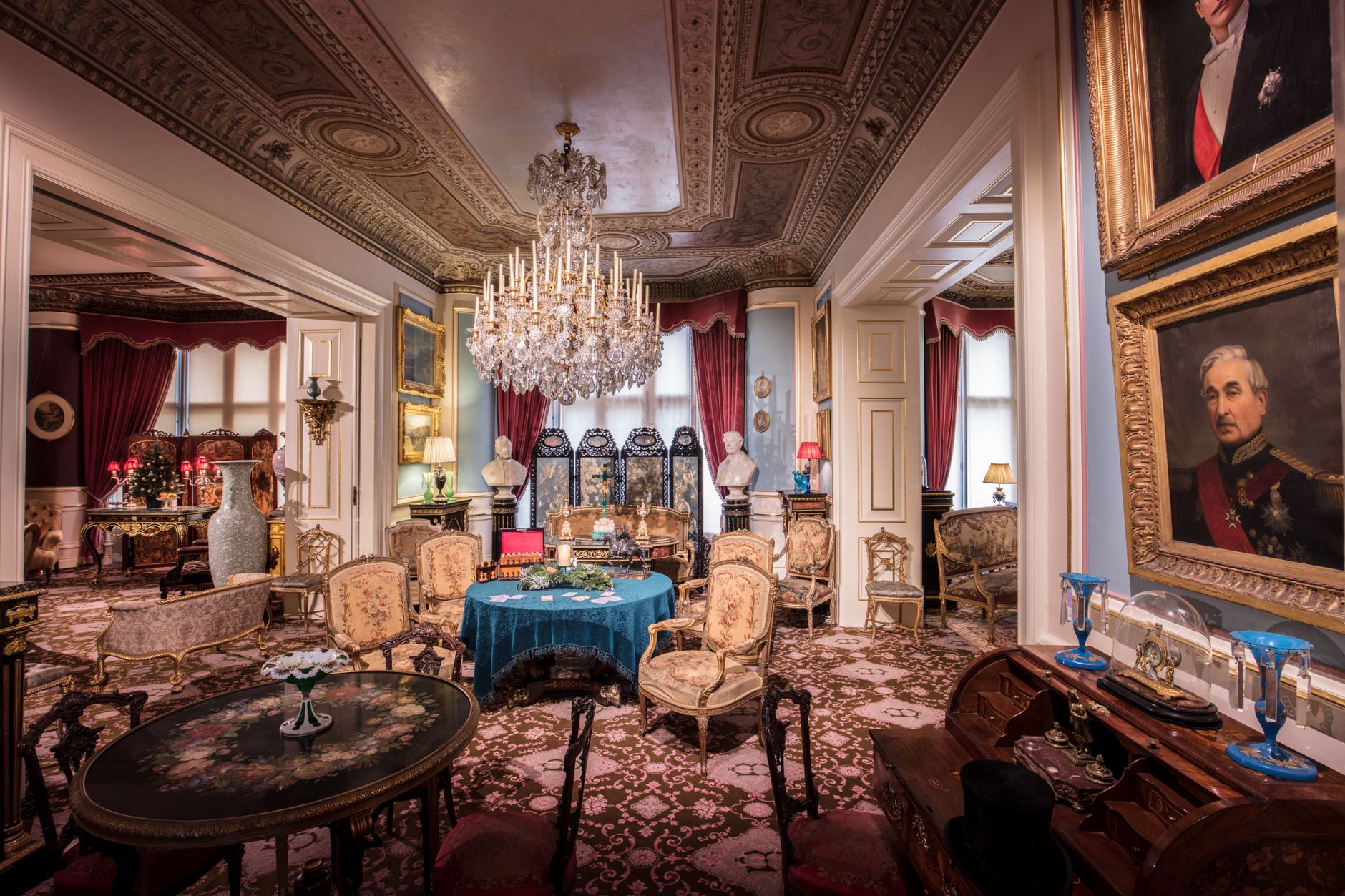
There were also reception dresses and visiting toilettes intended for afternoon or early evening social calls, some of which blurred into semi-formal party wear. While not as revealing as ball gowns, these dresses might still incorporate fashionable fabrics and trims, especially if the wearer expected to be seen by a wide circle of acquaintances. In major cities like London and Paris, where the social “season” concentrated balls, receptions, and theater outings into a few months, women needed wardrobes that could navigate nuanced transitions between public and private, formal and informal. Each dress was a tool for managing social visibility within a tightly stratified world.
6. Key Characteristics at a Glance
The following table summarizes defining features of Victorian party dresses across the era:
| Feature | Early Victorian (c. 1837–1860) | Mid Victorian (c. 1860–1880) | Late Victorian (c. 1880–1901) |
|---|---|---|---|
| Dominant Silhouette | Bell-shaped skirts, many petticoats → crinoline | Full crinoline, then bustle emphasis at back | Refined bustle early; later, slimmer princess lines |
| Structural Support | Corded petticoats, early crinolines, corsets | Steel cage crinolines, elaborate bustles, corsets | Bustle pads/frames, heavily boned corsets |
| Typical Fabrics (Evening) | Silk taffeta, satin, fine muslins, gauze | Silk satin, moiré, tulle, lace | Silk satin, velvet, brocade, metallic embellishments |
| Neckline & Sleeves | Low, wide necklines; short puffed sleeves | Off-the-shoulder necklines; short sleeves | Variety of necklines; still low for evening; short sleeves |
| Color Trends | Pale pastels, white, soft florals | Wider palette; bright aniline dyes from 1850s | Jewel tones, dark rich colors, complex combinations |
| Decoration | Modest trimming, some lace and ribbons | Heavier flounces, ruching, floral garlands | Dense beading, embroidery, appliqué, elaborate trains |
| Primary Social Context | Court events, private balls, small salons | Grand balls, public events, international fashion | Highly codified social seasons, theater, elite soirées |
7. Evidence, Collections, and Expert Perspectives
The most reliable understanding of Victorian party dresses comes from surviving garments, fashion plates, photographs, and archival documents housed in major museums. The Metropolitan Museum of Art in New York holds a renowned collection of 19th‑century gowns, including numerous evening dresses by Charles Frederick Worth and other Parisian couturiers. Detailed object descriptions on the Met’s Heilbrunn Timeline of Art History emphasize the interplay of technology, craftsmanship, and social meaning. One entry on a 1860s ball gown notes that the dress “is as much a feat of engineering as of decoration,” highlighting the complex understructures required to support its skirt.
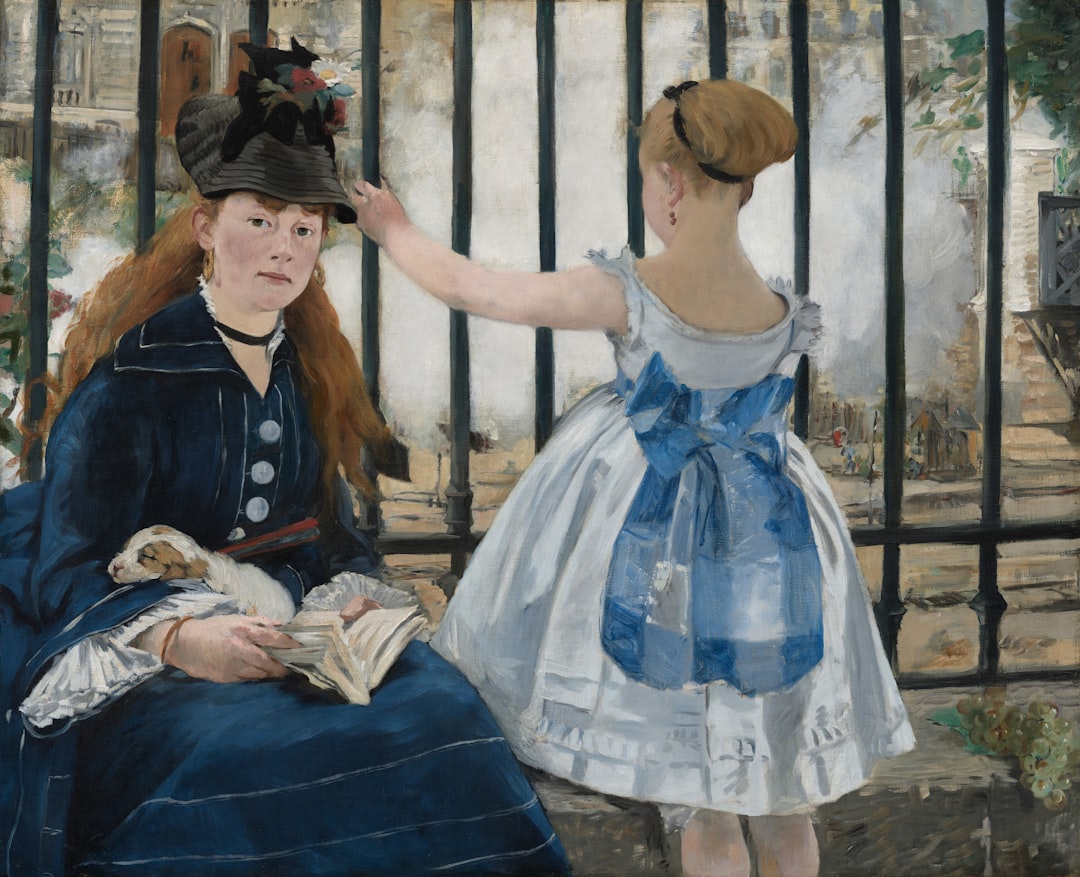
In London, the Victoria and Albert Museum (V&A) maintains one of the world’s most comprehensive collections of European dress, with numerous Victorian evening and ball gowns accessible both on-site and via its digital catalog. The V&A’s curators have extensively published on the era’s fashion, stressing that clothing functioned as “a form of visual communication” in Victorian society. Their analyses corroborate literary and historical accounts that link particular dress features to issues like class anxiety, imperial trade (especially in textiles and dyes), and shifting ideals of femininity.
Institutions such as the Louvre’s Musée des Arts Décoratifs and the Smithsonian Institution further broaden our view beyond Britain. French collections reveal the centrality of Parisian couture to upper-class wardrobes across Europe and the Americas, while the Smithsonian’s holdings illuminate how transatlantic elites in cities like New York, Washington, and Boston adapted European styles. Taken together, these scholarly resources demonstrate that Victorian party dresses were not marginal fripperies, but central artifacts of a globalizing 19th‑century culture—objects that scholars now use to interrogate labor histories, trade networks, gender roles, and aesthetic theory.
Frequently Asked Questions
Q1: Were Victorian party dresses comfortable to wear?
Not by modern standards. Most required a corset, multiple layers, and structural supports like crinolines or bustles. However, contemporary accounts suggest that many women were accustomed to these garments from adolescence. Museums such as the Met and the V&A emphasize that comfort was secondary to social expectations; a willingness to endure constriction signaled refinement and self-discipline.
Q2: Did all Victorian women own elaborate party dresses?
No. Luxurious ball gowns made of silk and lace were primarily the preserve of upper- and upper-middle-class women who participated in formal social seasons. Working-class women rarely had access to such garments. Even within the middle classes, families might economize by remodeling older dresses, dyeing fabrics, or using less expensive trimmings—a practice evidenced by altered garments in the Smithsonian and V&A collections.
Q3: How did women clean and maintain such delicate dresses?
Victorian party dresses were often spot-cleaned rather than fully washed, especially if made of silk. Bodices and skirts were sometimes separate, allowing one part to be replaced if damaged. Linings, detachable trims, and under-sleeves helped protect expensive outer fabrics. Surviving garments in museum collections frequently show signs of alteration, repair, and re-use, reflecting the substantial investment they represented.
Q4: Were there differences between British, French, and American party dresses?
Silhouettes and general styles were similar among elites, largely because Paris dictated fashion trends for much of the 19th century. Still, there were subtle distinctions: French gowns might be more avant-garde and lavishly decorated; British evening dress could be slightly more conservative; American women often combined imported Parisian couture with locally made garments. Collections at the Met, the Louvre, the V&A, and the Smithsonian together illustrate this shared yet locally inflected fashion culture.
Conclusion
Victorian party dresses crystallize the contradictions of their age: technologically advanced yet bound by rigid etiquette, astonishingly beautiful yet often restrictive, personal garments that carried vast social meaning. From the widespread domes of early crinolines to the sculptural drama of the bustle, these dresses were instruments of display in a world obsessed with hierarchy, morality, and appearances. Thanks to the careful preservation and interpretation work of institutions like the Metropolitan Museum of Art, the Victoria and Albert Museum, the Louvre, and the Smithsonian, we can now read these gowns not merely as charming relics, but as authoritative witnesses to the ambitions, anxieties, and aspirations of 19th‑century society.
AI Notice: Some visual content in this article may have been created or enhanced using artificial intelligence (AI) for artistic, editorial or illustrative purposes. Learn more about our approach in our AI & Editorial Principles.