
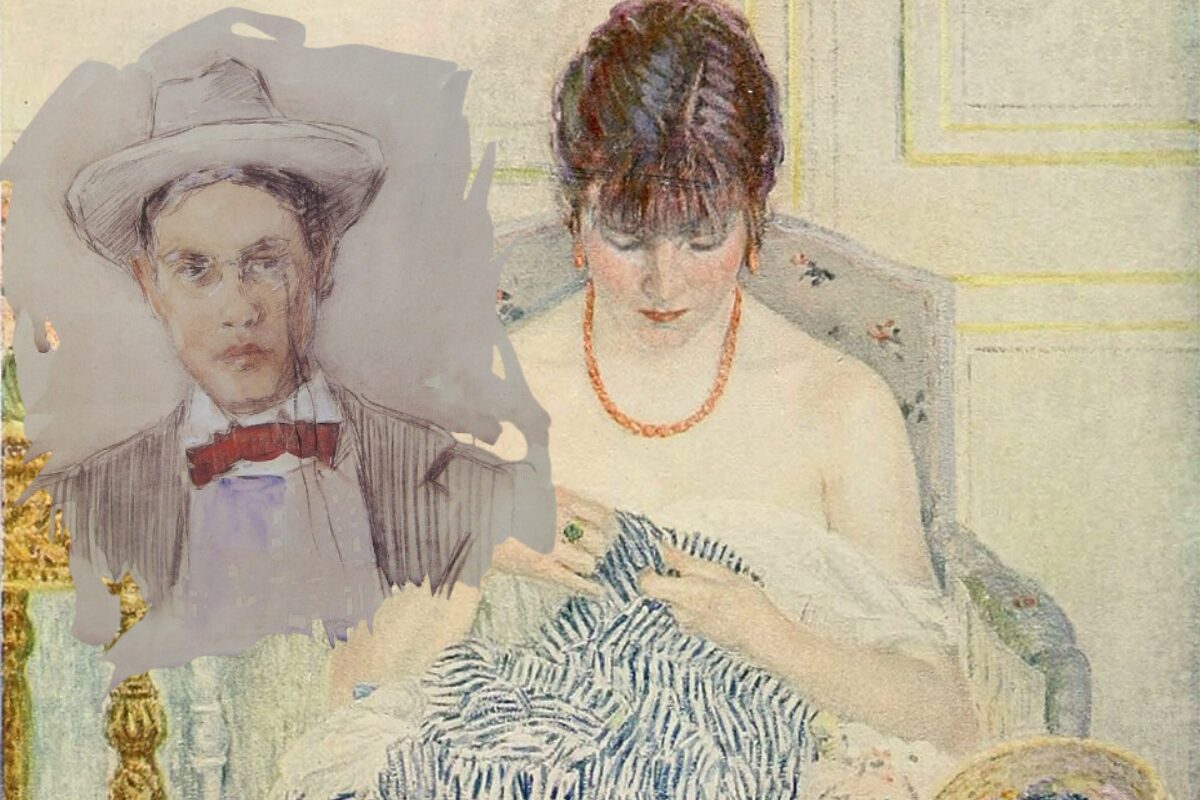
Frederick Carl Frieseke
Frederick Carl Frieseke (1874–1939) stands among the most distinguished American painters associated with the Giverny colony and the broader movement of American Impressionism. Celebrated for luminous depictions of women bathed in sunlight and dappled shade, Frieseke developed a refined, decorative approach to color and surface that married the observational strategies of Impressionism with an acute sensitivity to pattern, textile, and atmosphere. His paintings, often intimate scenes of women reading, resting, or dressing—frequently rendered in kimono-like garments—reveal a sustained interest in the interplay of light, shadow, and surface ornament. Over the course of a career spent largely in France but linked to American markets and collectors, Frieseke built a reputation as a master colorist whose work remains highly desirable to museums and private collectors alike.

Early Life
Frederick Carl Frieseke was born in 1874 in Michigan, into a prosperous family that encouraged cultural pursuits. Raised in the American Midwest during a period of growing interest in European art, he showed early artistic aptitude. Frieseke’s early life was shaped by regional educational opportunities and an openness to travel that would later become central to his artistic development. By the mid-1890s he had committed to professional art training and prepared to seek advanced instruction abroad, a common path for ambitious American painters at the turn of the century.
Education and Training
Can You Name the Masterpiece?
Ten masterpieces. Ten questions. How well do you know the history of art?
Frieseke’s formal training reflects the bicontinental apprenticeship typical of American Impressionists. He began studies in the United States, receiving foundational instruction in drawing and composition that emphasized academic draftsmanship and the fundamentals of figure work. Seeking to refine his technique and engage with the European avant-garde, he traveled to Paris where he studied at established ateliers and academies, absorbing the French academic tradition while confronting contemporary developments in color, light, and modern subject matter.
While in France, Frieseke supplemented formal atelier training with direct observation of contemporary painting—most notably the works of French Impressionists and Post-Impressionists—and the study of Japonisme and decorative arts that would have a lasting impact on his palette and compositional choices. This combination of American academic grounding and Parisian exposure allowed him to synthesize rigorous draftsmanship with a freer, more chromatic approach to surface.
Career Development
After completing his training, Frieseke settled in France and became closely associated with the artist colony at Giverny, a village in Normandy that had been transformed by Claude Monet into a magnet for international artists. There he found an environment keyed to the study of light and landscape and an international community of artists exchanging ideas. Frieseke’s career developed through exhibitions in both Paris and the United States, sales to private patrons, and a growing reputation among critics who admired his chromatic sensibilities.
Can You Guess the Artist?
Three clues. One artist. How quickly can you identify the painter?
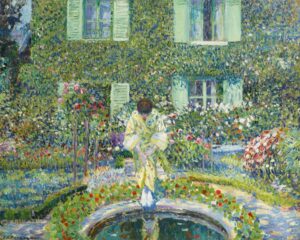
Throughout the first two decades of the 20th century Frieseke refined a body of work focused on the female figure in domestic or garden settings. He alternated between studio work and painting en plein air, exploiting open windows and garden vistas to create interiors suffused with outdoor light. As his style matured he became known for intimate compositions, a predilection for white and pastel garments, and an almost decorative use of light spots and color patches—a technique that helped distinguish his approach from that of other American painters in Giverny.
Frieseke’s work enjoyed steady demand among collectors in both Europe and the United States, enabling him to maintain a productive studio practice. He participated in exhibitions at major salons and in American galleries, and his paintings entered important private and public collections during his lifetime.
Artistic Style
Frieseke’s pictorial language is notable for several interrelated qualities:
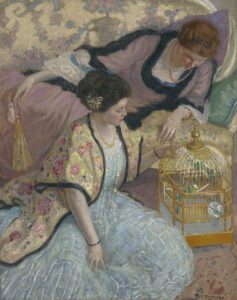
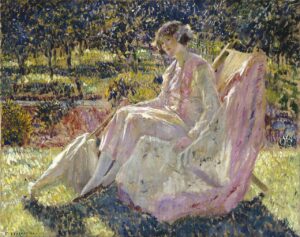
– Color and Light: Frieseke was a consummate colorist. His palette favored high-key tones—soft pinks, creams, pale blues, and warm greens—balanced with luminous flesh tones. He used color to model form and to describe light filtering through leaves or across fabric.
– Decorative Pattern: Influenced by Japonisme and the decorative arts, Frieseke often incorporated patterned textiles—kimonos, shawls, chair coverings—into his compositions. These patterns are not merely ornamental; they organize pictorial space and create rhythmic contrasts with the figure.
– Dappled Light and Patchwork Brushwork: One of Frieseke’s most distinctive tactics is the use of broken, patch-like brushstrokes to indicate sunlight flecking across surfaces. This technique produces a mosaic of color that unifies figure and environment, dissolving edges while preserving clarity of form.
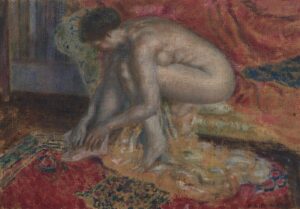
– Intimacy and Domesticity: Frieseke’s subjects are typically private: women at rest, women dressing, or women quietly engaged in reading or thought. These scenes eschew narrative drama in favor of mood, emphasizing tranquillity and the sensory qualities of material and light.
– Synthesis of Impressionism and Decoration: While indebted to Impressionist concerns with transient light and color, Frieseke’s work often leans toward a more planned, decorative composition, anticipating later advances in modernist colorism.
Technically, Frieseke combined alla prima passages with carefully reworked passages of glazing and scumble, allowing for both immediacy and depth. The surfaces of his paintings suggest a tactile quality, where paint is at once surface ornament and a vehicle for convincing description.
Influences and Inspirations
Frieseke’s influences are both explicit and subtle. The primary currents that shaped his art include:
– Claude Monet and Impressionism: The emphasis on light, the search for chromatic truth, and the practice of painting in and near nature were formative. Living in Giverny placed Frieseke in direct contact with Monet’s legacy.
– Japanese Prints (Japonisme): The compositional flattening, patterned textiles, and stylized forms of Japanese ukiyo-e prints contributed to Frieseke’s decorative sensibility and his frequent use of kimono-like garments.
– French Post-Impressionists and Decorative Modernism: Developments in France around color and surface—including a move toward decorative abstraction—encouraged Frieseke to explore bold color juxtapositions and rhythmic patterning.
– American Academic Roots: Frieseke’s early training provided a strong foundation in drawing and figure construction that he never abandoned; his academic discipline underpins the looseness of his later brushwork.
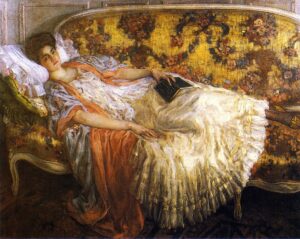
– Contemporary Peers: Other members of the Giverny colony, including Americans and Europeans who experimented with similar subject matter and techniques, provided an on-the-ground exchange of ideas that continually refreshed his practice.
Together, these influences allowed Frieseke to produce work that was distinctly personal: formally modern yet grounded in a refined appreciation for the pleasures of visual surface.
Famous Works
Below are several notable works by Frederick Carl Frieseke. Each entry includes the title, date (when known or approximated), medium, and current museum or collection designation.
– The Pink Kimono
– Year: c. 1909
– Medium: Oil on canvas
– Current Museum or Collection: Private collection
– Explanation: The Pink Kimono typifies Frieseke’s fascination with patterned dress and filtered light. A woman reclines or sits in a garden setting while the artist explores the interplay between the soft rose of her garment and the cool greens of foliage. The painting demonstrates Frieseke’s ability to balance decorative surface with a convincing portrait of quiet introspection.
– Afternoon in the Garden
– Year: c. 1910
– Medium: Oil on canvas
– Current Museum or Collection: Art Institute of Chicago (notable public holdings include comparable works)
– Explanation: In this work Frieseke stages a figure near a sun-drenched window or open porch, capturing the movement of dappled sunlight across skin and fabric. The painting’s luminous color and rhythmic brushwork provide a study in how natural light can structure an interior composition, dissolving boundaries while maintaining warmth.
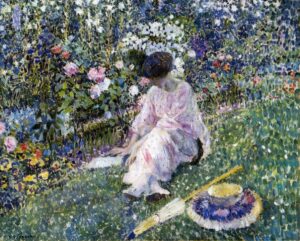
– Woman with a Blue Robe
– Year: c. 1912
– Medium: Oil on canvas
– Current Museum or Collection: Private collection
– Explanation: The Blue Robe series demonstrates Frieseke’s colorist tendencies and his interest in cool chromatic harmonies. Here a young woman is rendered with restrained modeling and surrounded by flecks of light; the blue robe acts as a compositional anchor that unites figure and environment.
– Reading in the Garden
– Year: c. 1915
– Medium: Oil on canvas
– Current Museum or Collection: Smithsonian American Art Museum (works with similar themes are held by major American institutions)
– Explanation: A recurring subject in Frieseke’s oeuvre is the contemplative female reader. This painting uses a limited palette and careful spatial compression to emphasize mood over narrative. The sitter’s absorbed pose and the soft handling of foliage reflect Frieseke’s capacity for psychological intimacy expressed through color.
– The White Dress
– Year: c. 1908
– Medium: Oil on canvas
– Current Museum or Collection: Private collection
– Explanation: The White Dress is iconic for Frieseke’s repeated use of white garments as a means of capturing reflected color. Rather than treating white as absence, Frieseke layers hues—the palest pinks, blues, and greens—to convey reflected light and the texture of fabric. The composition plays on contrasts between shadowed and sunlit planes.
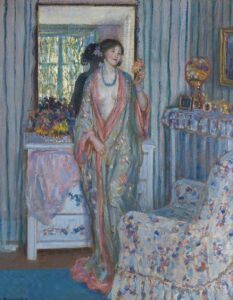
– Girl in a Garden (Study)
– Year: c. 1913
– Medium: Oil on canvas
– Current Museum or Collection: Private collection
– Explanation: Studies such as this one reveal Frieseke’s working method: rapid observation combined with deliberate formal decisions. The painting displays the small, mosaic-like brushstrokes he used to describe light—each mark serving as both a descriptive unit and a decorative element.
Note: Frieseke produced numerous variations on these themes across his career. Many works are held in private collections, while public museums in the United States and Europe maintain representative holdings. Because Frieseke often revisited the same motifs and titles, specific works may appear in different exhibition catalogues under variant names; provenance and museum records remain the best way to confirm precise attributions.
Legacy and Influence
Frederick Carl Frieseke’s legacy is secure within the narrative of American Impressionism and early twentieth-century colorist painting. Several aspects of his influence stand out:
– Advancing a Decorative Modernism: Frieseke helped bridge late Impressionist observation with a decorative modernism that prioritized surface rhythm, pattern, and chromatic invention. His approach influenced subsequent American painters who sought to reconcile realist depiction with painterly surface.
– Elevating the Intimate Interior: By focusing on domestic and garden interiors inhabited by women, Frieseke contributed to a visual vocabulary of modern femininity that emphasized subjective experience and aestheticized repose.

– Pedagogical and Exhibition Impact: Through exhibitions and the dissemination of his images in catalogues and reproductions, Frieseke’s work reached collectors and younger artists, fostering greater appreciation for color-driven compositions.
– Market and Museum Recognition: The placement of Frieseke’s paintings in major museums and prominent private collections helped preserve his reputation and encouraged scholarly reassessment, particularly in the latter half of the twentieth century when American Impressionism was reevaluated.
Frieseke’s paintings are frequently discussed in surveys of American art of the period because they encapsulate a particular refinement: a commitment to sensory pleasure, technical sophistication, and a nuanced synthesis of transatlantic stylistic currents.
Market Value and Collectibility
Collectibility of Frieseke’s works has increased over the past decades, driven by renewed interest in American Impressionism and the desirability of museum-quality examples. Several factors affect market value:
– Quality and Condition: Paintings in excellent condition with original paint surfaces and stable canvases command the highest prices.
– Size and Composition: Larger, finished salon-sized works or exceptionally composed pieces featuring complex figural arrangements tend to be more valuable than small studies.
– Provenance and Exhibition History: Works with documented provenance, particularly those included in important exhibitions or catalogues raisonnés, attract greater bidder confidence and higher prices.
– Rarity and Subject: Unique or rare subject matter—unusually composed scenes, striking color experiments, or works from pivotal periods in Frieseke’s career—are especially desirable.
– Signature and Documentation: Clear signatures, dated works, and supporting letters or documentation from contemporary collectors enhance marketability.
Price range: Frieseke’s market is varied. Smaller studies and lesser-known compositions may sell in the lower tens of thousands at auction, whereas major works with museum-quality provenance can achieve prices in the upper hundreds of thousands and, in exceptional cases, into the low millions. Collectors and institutions often seek out Frieseke for holdings that illustrate American Impressionist colorism and the Giverny connection.
For prospective buyers and sellers, condition reports, expert appraisals, and consultation with specialists in American art are recommended steps to ensure accurate valuation and successful placement.
Museums and Collections
Frederick Carl Frieseke’s paintings are represented in a variety of public and private collections. While many works remain in private hands, notable museums and institutions that have historically held or exhibited his paintings include:
– Major regional and national museums in the United States that collect American Impressionism and early twentieth-century painting.
– European collections and museums with holdings from the Giverny circle or that focus on Franco-American artistic exchanges.
– University art museums and smaller regional institutions that emphasize American expatriate artists and collectors from the late 19th and early 20th centuries.
Collectors, curators, and scholars interested in viewing Frieseke’s work should consult museum catalogues, online collection databases, and exhibition archives, as holdings may rotate or be loaned for special exhibitions. Exhibitions focused on Giverny or American artists in France often feature strong Frieseke representation and provide a context for his work alongside contemporaries.
Interesting Facts
– Frieseke was a prominent member of the Giverny artist community, which included a diverse group of American expatriates who were drawn to Monet’s home and the lush Normandy landscape.
– He frequently dressed his sitters in kimono-like garments influenced by Japanese textiles; these costumes allowed him to explore pattern and color while tuning into the vogue for Japonisme.
– Frieseke’s paintings are celebrated for their treatment of white: he used subtle color shifts to describe white fabrics as repositories of reflected light, rather than as a neutral absence of color.
– His practice combined plein-air observation with studio refinement; many of his best-known works were composed as studies on location and finished in the studio.
– Although primarily associated with his Giverny period, Frieseke continued to paint variations on his favorite themes throughout his career, making the motifs of reading, repose, and garden interiors central to his artistic identity.
FAQ
Who was Frederick Carl Frieseke and why is he important?
Frederick Carl Frieseke was an American painter (1874–1939) associated with the Giverny artist colony. He is important for his distinctive synthesis of Impressionist light study and decorative colorism, producing intimate paintings of women in garden and domestic settings that are celebrated for their luminous palettes and refined surface treatments.
What are the hallmarks of Frieseke’s painting style?
Key hallmarks include a high-key, pastel-leaning palette; the use of patterned textiles and kimono-like garments; dappled, mosaic-like brushwork to indicate sunlight; and a focus on quiet, domestic subjects. Frieseke’s work blends observational naturalism with decorative surface rhythms.
Where can I see Frieseke’s works in public collections?
Frieseke’s works appear in a range of public and private collections. Interested viewers should consult museum collection databases and past exhibition catalogues for specific holdings; museums that collect American Impressionism and the Giverny school are the most likely to display his work during relevant exhibitions.
Are Frederick Carl Frieseke paintings valuable?
Yes. Market values vary depending on size, condition, provenance, and exhibition history. Smaller studies may sell for tens of thousands of dollars, while major works with museum-quality provenance can reach into the high hundreds of thousands or low millions at auction. Quality and documentation drive the market.
How can I authenticate a Frieseke painting?
Authentication should begin with a condition report and provenance research. Consultations with recognized specialists in American Impressionism, comparison with catalogue raisonnés, and technical analysis (such as pigment and canvas studies) are standard steps. Reputable auction houses and academic institutions can assist with authentication inquiries.
—
This article has outlined Frederick Carl Frieseke’s life, artistic development, signature motifs, and ongoing importance to collectors and museums. His harmonious fusion of color, light, and decorative sensibility continues to attract scholarly interest and market enthusiasm, securing his place among the leading figures of American artists who made France the laboratory for an enduring, distinctly modern vision.
AI Notice: Some visual content in this article may have been created or enhanced using artificial intelligence (AI) for artistic, editorial or illustrative purposes. Learn more about our approach in our AI & Editorial Principles.