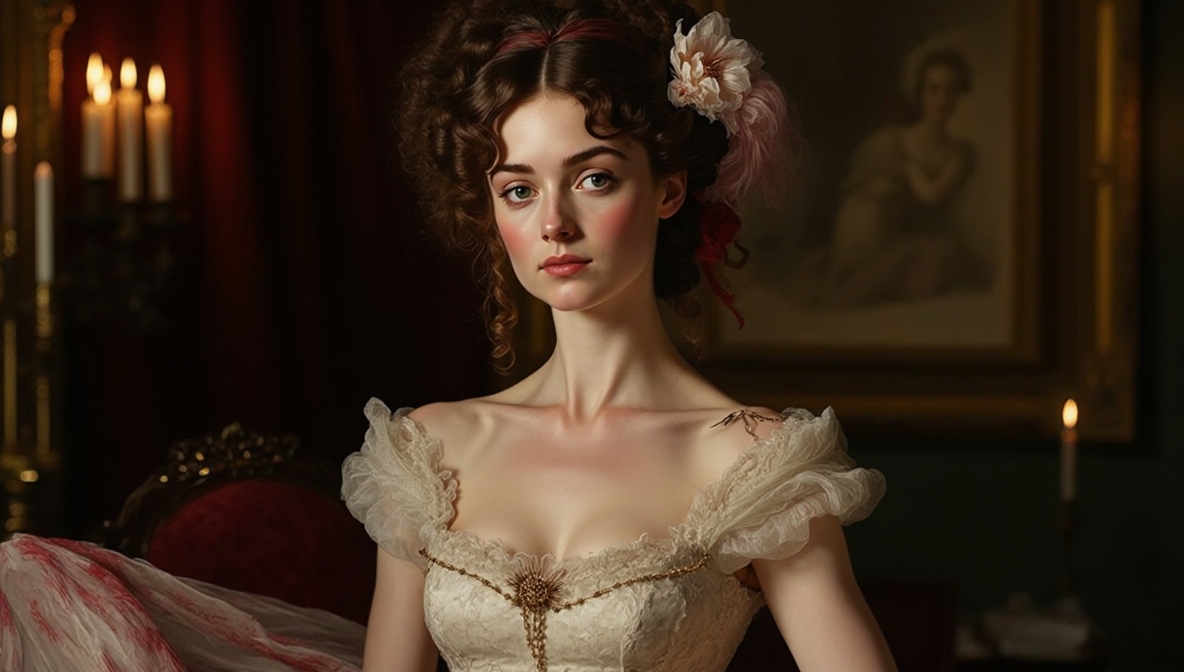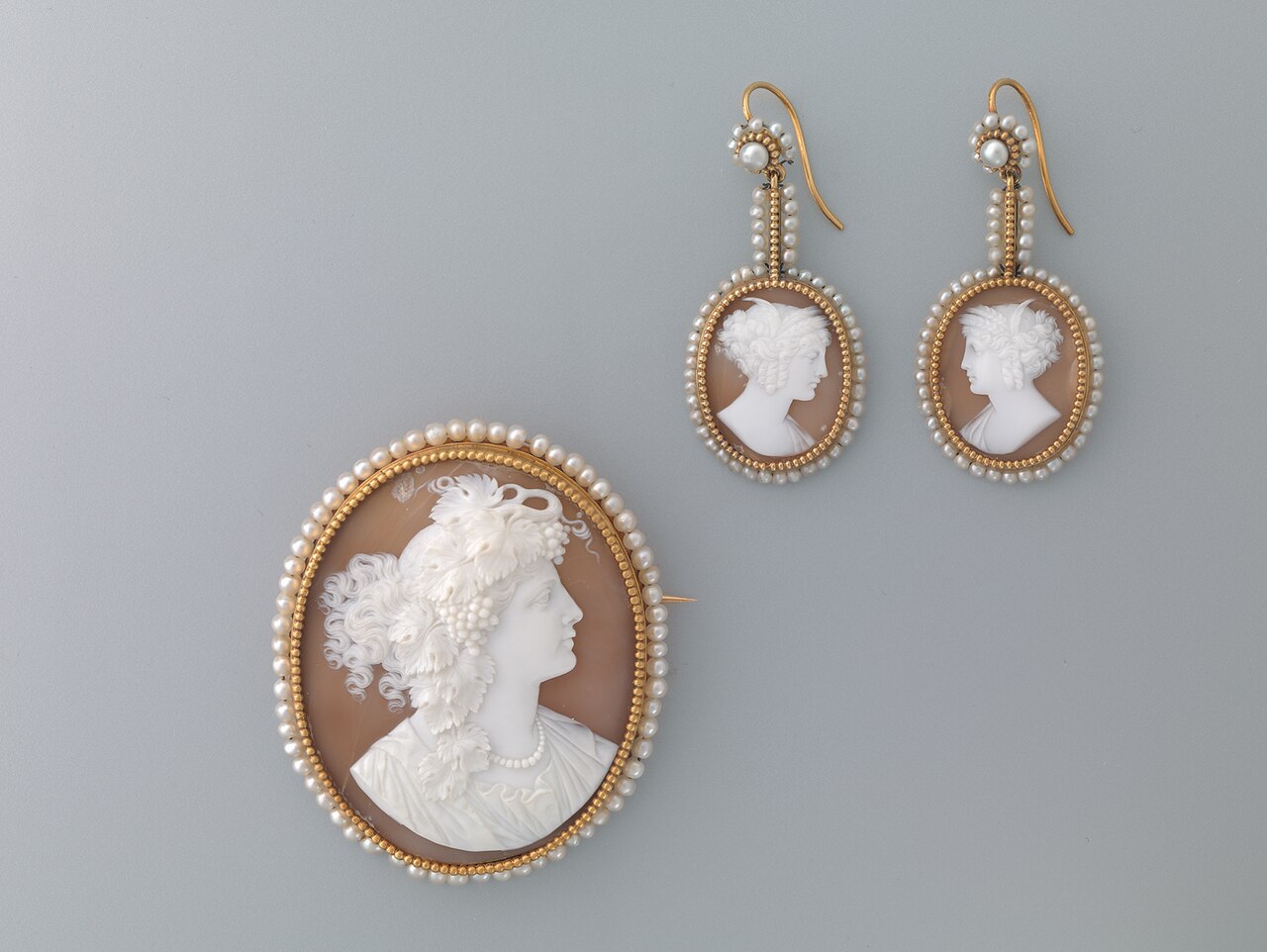

Victorian Parasols: The Fashion Secret That Transformed Sun Protection
Parasols may seem like delicate relics of a bygone age, but in Victorian Britain they were powerful social tools—signaling class, morality, gender expectations, and even technological innovation. To walk through London’s Hyde Park or Paris’s Bois de Boulogne in the late 19th century without a parasol, if you were a lady of means, was to risk not only sunburn but social comment. These fragile-looking accessories drew on centuries of craftsmanship, reflected industrial advances, and embodied strict codes of respectability. Victorian parasols were far more than pretty shade-makers: they were wearable symbols of status, identity, and modernity.
The Rise of the Victorian Parasol
The parasol has ancient roots in Egypt, Greece, Rome, China, and India, but its Victorian flowering was tied to specific social and industrial conditions in 19th‑century Europe. In Britain, the reign of Queen Victoria (1837–1901) overlapped with rapid industrialization, urbanization, and the expansion of a prosperous middle class. These forces reshaped daily life and consumer culture, including the market for clothing and accessories. As the Metropolitan Museum of Art notes in its collections essays on 19th‑century costume, accessories like parasols became “essential instruments of self-presentation” in public spaces, rather than mere functional items.
Can You Name the Masterpiece?
Ten masterpieces. Ten questions. How well do you know the history of art?
For the 125 years from 1800-1935 pale skin could do more than mark you as belonging to a refined social order. No longer a marker of country living and a reflection of the health that came with it, tanned skin (and the inevitable sunburn that came with it) now signaled a higher class status attached to the factory worker and an inability to indulge in the natural, outdoor pursuits of the upper-class citizen. The V & A venerates this association in its fashion galleries; ‘A fair complexion was associated with elegance and leisure, parasols and veils helped sustain this delicate image’ and that apparent social standing could, in many circles, be easyly marked by detecting the hue of ones skin.
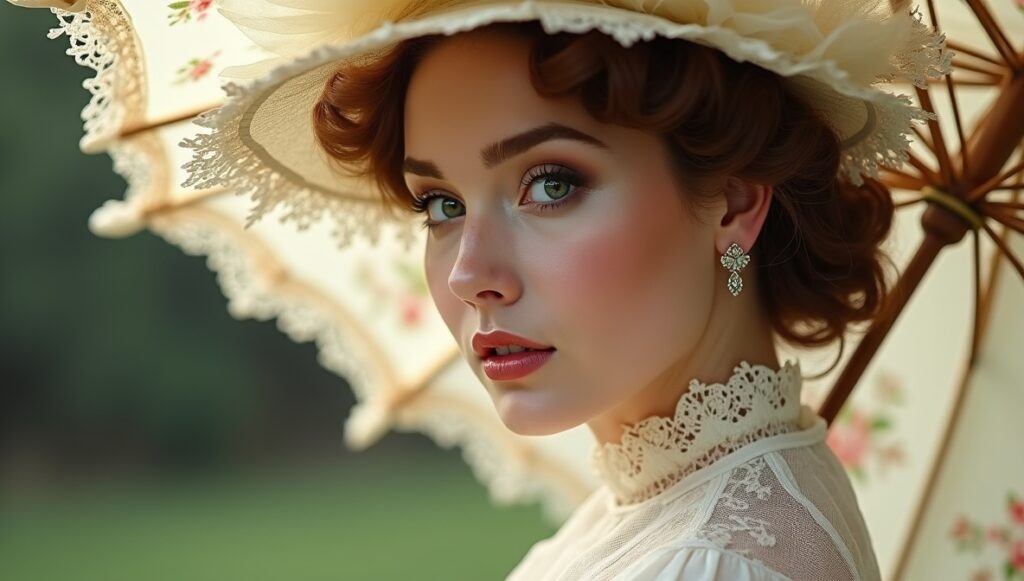
This – simultaneous- expansion of leisuretime (promenades, seaside holidays, travel by train) was coupled with the proliferation of public display- spaces. What women wore in gardens, on carriage drives, or in pilgrimage to seaside resorts (Brighton, Bath, in many others) had to function in the day-to-day execution of promenades, parks, or racecourses. Parasols were all but indelible in the ‘shape’ of fashionable public life, ‘their inclusion in the standard ‘uniform’ of public life ranging…from the beginning of the decade’. The most popular period etiquette manuals, like Mrs. Beeton‘s Book of Household Management, originally published 1861, included advice on paraspols and how to carry and use them gracefully. So parasols ‘risings in Victorian
Design, Materials, and Innovation
Victorian parasols combined decorative excess with inventive engineering. Early in the 19th century, frames were commonly made of whalebone or baleen, with wooden shafts and silk or cotton covers. As the century progressed, metal ribs—often steel—became the norm, making parasols lighter, stronger, and more flexible.The National Museum of American History, part of the Smithsonian Institution and home to many 19century parasols, observes that the innovations in techniques of manufacture and metallurgy facilitated “more complex folding arrangements and sleeker outlines,” as “the same industrial expertise [was] finding expression in the building of railways and bridges.
Can You Guess the Artist?
Three clues. One artist. How quickly can you identify the painter?
Victorian parasols were decorated with fabric and on the surface to satisfy the Victorian obsession with ornaments. Good quality silk, satin and taffeta was used for the upper-class parasol, and these often had additional ruching, embroidery or hand painted flowers and patterns. Then middle-class output and those intended for everyday use, tended to have handles and fabric made of cotton or mixed fibers. Perhaps the most luxurious parts of a Victorian parasol was the handle, which could either be a turned piece of wood, or for those who had more money to spare, made of tortoiseshell, solid ivory or mother-of-pearl. The V&A has several beautiful examples of parasol handles carved with animal heads or holding up an image of a classic Greek or Roman figure, a reflection of Victorian interest in nature and the classical world.
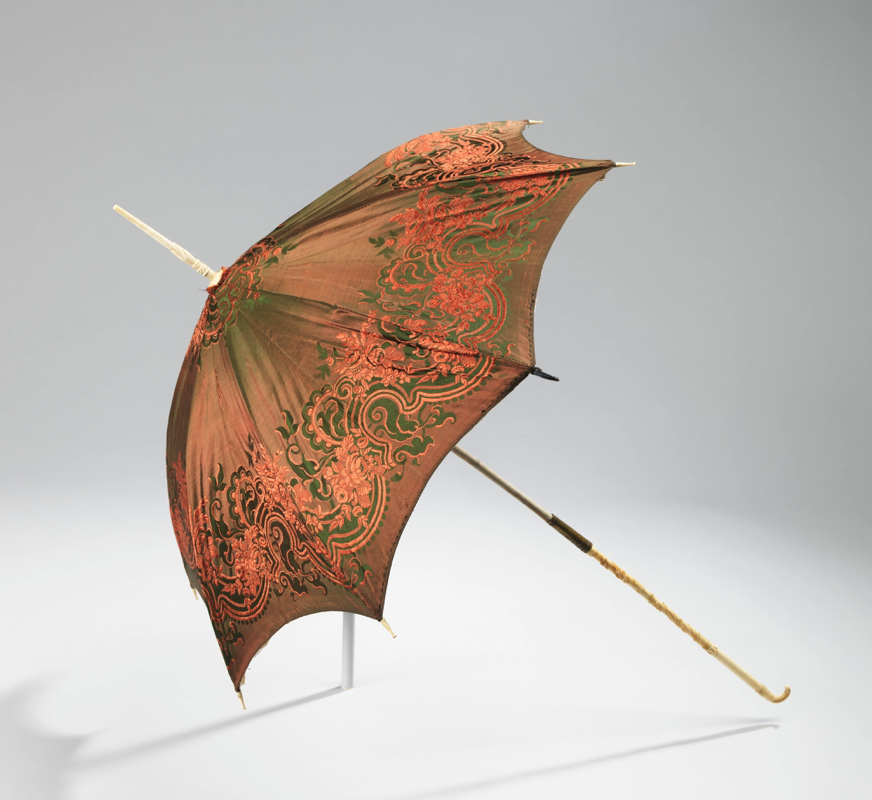
More innovation and invention! Folding and ‘concertina’ parasol frames appeared in the middle part of the century, making umbrellas more portable. There were also a number of innovations to parasol covers, interchangeability of covers or detachable handles, which meant that, for instance, one umbrella frame could be used for many different fashion purposes. Other parasols incorporated novelty methods such as spring-loaded mechanisms or combination parasol-and-walking-stick arrangements. As Aileen Ribeiro notes in her work on the history of dress in the nineteenth century, ”… Utility and display were not adversaries in Victorian fashion but interwoven objectives, with ingenuity targeted at theatrical effect.” And the parasol was a machine for modesty and spectacle at the same time:
Color, Symbolism, and Social Codes
Color choice in Victorian parasols was never neutral. Early in the century, soft pastels and pale shades—white, cream, lilac, and subdued blue—dominated daywear parasols, aligning with the ideal of pure, unblemished femininity. For mourning or half‑mourning, black or deep purple parasols were worn in accordance with strict codes of bereavement dress. The Metropolitan Museum of Art’s 19th‑century accessories catalog emphasizes that “mourning accessories, from veils to parasols, made grief visible in public while also affirming adherence to social norms.” Even grief had its sanctioned palette.
By the late Victorian era, the development of chemical dyes in synthetic form and the growing popularity of aniline dyes after the 1850s meant that the possibilities for color were practically endless. Brilliant hues of green, violet and magenta began to be seen on the parasol in fashion, much to the regret of many conservative commentators, although the intense hues were also said to give the parasol a youthful air and to be a good indicator of one‘s age and marital status. Contrasting with this is the fine black lace parasol, a symbol of sophistication and culture, and blending the lexicon of mourning with that of seduction.
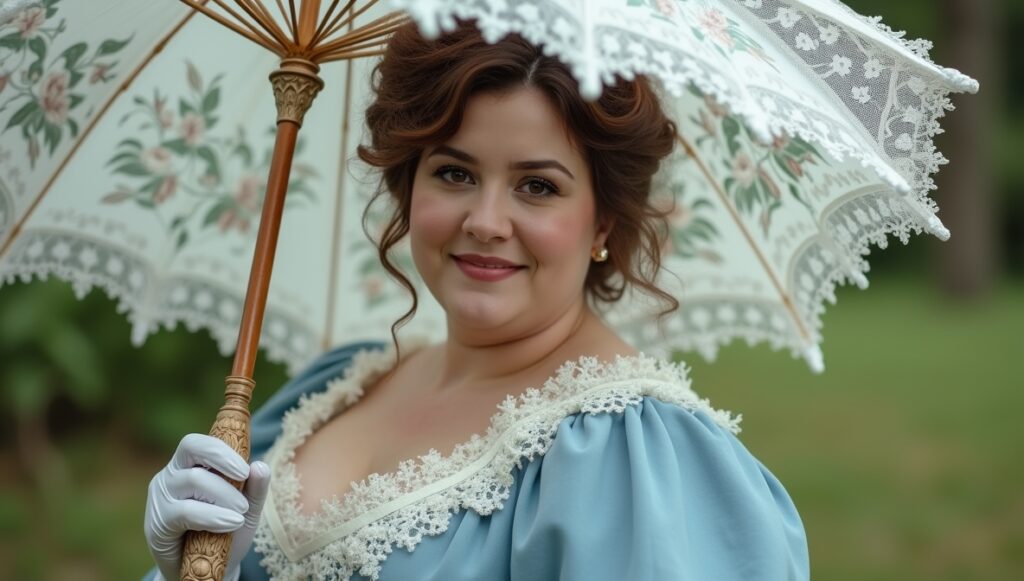
The parasol itself also made a social statement: it showed or didn‘t show up. A lady of rank ought to carry a parasol; a lady who did not was either vulgar or shocking unconcerned with her complexion. It was how she carried it that counted. Guides to etiquette and broadsheet fashion plates in magazines such as The Englishwoman‘s Domestic Magazine and La Mode Illustree show how a lady should hold her parasol, tilted at a precise angle to her shoulder, neverJabbing it out in front of her. The parasol was part of what the sociologist Pierre Bourdieu later called a ^bodily hexis^: a bodily manner learned so thoroughly that it became second nature.
Class, Gender, and Respectability
Victorian parasols were a distinctively gendered accessory. While earlier centuries had seen both men and women use sunshades in some cultures, by the mid‑19th century in Britain and much of Western Europe, the parasol was firmly coded as feminine. Men might carry umbrellas for rain, but sun protection was deemed unnecessary, even effeminate, for them. This asymmetry reflected broader gender ideologies: women were viewed as physically fragile, needing protection from the elements—and from public gaze—even as they served as highly visible markers of family status.
Divisions in class, then, were also marked by parasols both in their materials and in their contents. According to the V&A, ‘a parasol for a prestigious carriage drive, garden party or seaside promenade was part of the female savoir-faire and some women changed their parasol as often as they did their gown’. It was an accessory that middle-class ladies often carried one or two of, with varying degrees of respectability, whereas working-class women would hardly be as fortunate; working outdoors was no pretext for a dollop of pride-like paleness when their work-weary skin was a memorably gritty and tanned shade that was in strong contrast with the guarded pallor of their affluent employers. As the V&A states in its social history displays, “the darker shades of beauty…were a prominent sign of the laboring classes and visibly distinguished those who labored from those who simply burned.“The parasol was just one of these indicators.
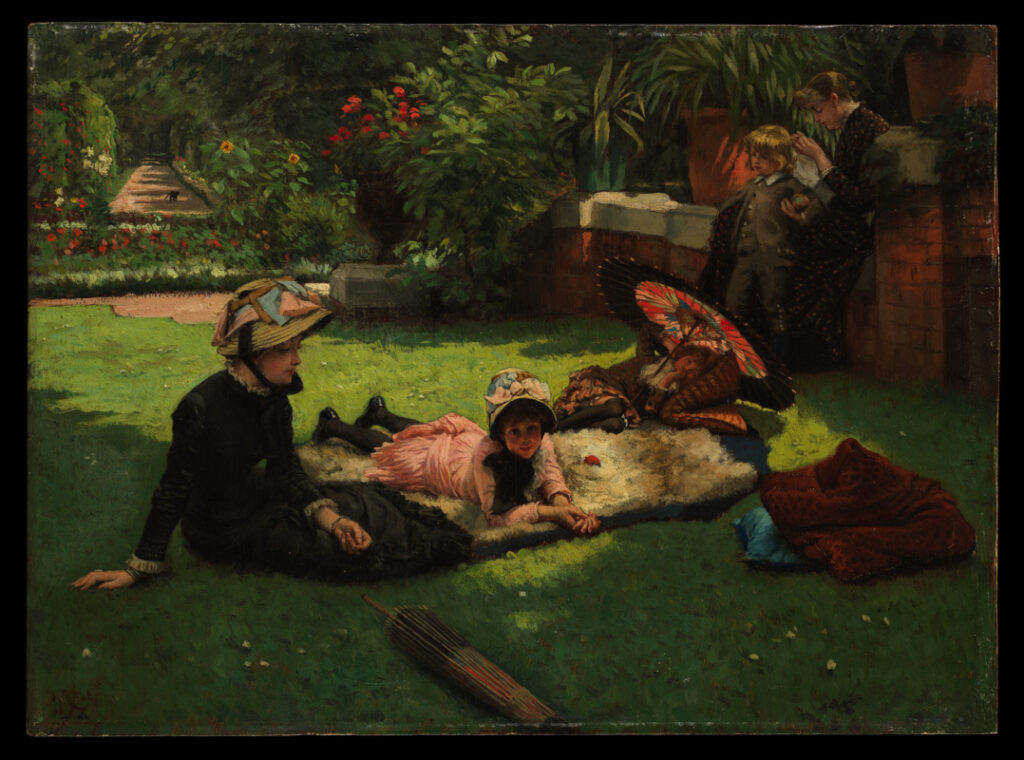
Respectability and modesty went hand and hand with parasol etiquette. It not only could be used as a shield to protect the face from the sun but also from unwelcome stares,“she could avoid meeting a pair of eyes by hiding her own behind a veiled lace or shadowed by its umbrella.” Traditional literature is full of scenes describing coy writhings of eyes from behind the umbrella ribs and parasanic gestures of refusals expressed with the downward turn of an umbrella. Literary critics have written about the means of parasols in novels by Anthony Trollope and Henry James to be the cinematic emotional props. They are opened in fraught nervousness and twirled in flirtatiousness and closed in rage and they are a mute adjunct to the social dramatics.
Parasols in Art, Fashion Plates, and Museum Collections
Victorian parasols appear frequently in the visual record, confirming both their ubiquity and symbolic weight. French Impressionist paintings, for example, make lavish use of parasols as compositional devices. Claude Monet’s Woman with a Parasol – Madame Monet and Her Son (1875), now in the National Gallery of Art (Washington, D.C.), shows a windblown green parasol casting dappled shadows over a white dress, using the accessory to study light and atmosphere. While not British-Victorian in strict sense, it reflects parallel European fashions. The Louvre Museum in Paris, which houses numerous 19th‑century works, notes in its interpretation that such accessories help “locate figures in a specific social environment of leisure and modernity.”
Fashion plates from magazines like Le Moniteur de la Mode or Godey’s Lady‘s Book demonstrated how parasols were promoted as part of a full and fashionable outfit. These plates, now held at the V&A Museum or the Metropolitan Museum, indicate an incredible variety of styles; dainty ‘toy’ parasols for ornamental use, folding types worn at walking speed and multi-tiered canopy umbrellas with a frilly fringe and lace detail. Such images were used as blueprints of desire for dressmakers and consumers in provincial towns and, even, communities across the sea. The parasol‘s profile was regarded just as carefully as the shape of the crinoline or the bustle.
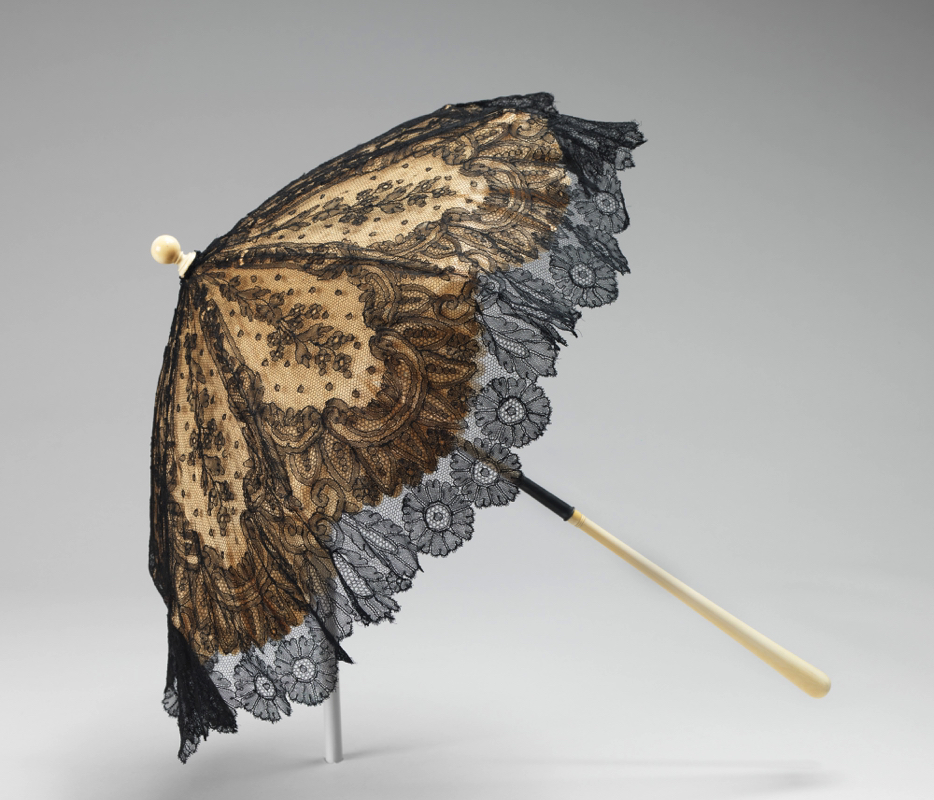
This is where the most concrete evidence of parasol design comes from for Victorians: modern museums have collections of parasols that date from the 19 th century. The Metropolitan Museum of Art, the Victoria and Albert Museum, the Smithsonian Institute, as well as institutional and private European collections, including the Musee des Arts Decoratifs in Paris, all own 19 th-century parasols. Their descriptions often mention maker‘s marks, patented mechanisms, provenance all show how the objects were passed on, handed down. The museum curators highlight that parasols (like gloves or fans) are essential to recreate everyday life.
Types and Characteristics of Victorian Parasols
Though the range of what was made could be extremely varied, some general types of Victorian parasols are clear. The daytime “promenade” or visiting parasols were usually in lighter shades and fabrics, just large enough on a reasonably-sized diameter for both the face and shoulders without dominating the figure. The evening or carriage parasols could be more ornate, and even slightly smaller in diameter in some cases, but often heavily decorated and used more as fashion statements than all-day sun shades. There were also particular seaside parasols for places like Brighton, Scarborough, or Nice, that were slightly larger and possibly slightly more reinforced.
And there were hybrid versions: the umbrella-parasol pairs became popular in the later 19 th century including interchangeable covers and lined canopies appropriate for both rain and shine. Folding parasols suited travel during the growth of the railways and steamship services. Some introduced innovations such as secret compartments within the handle for perfumes, vinaigrettes or calling cards. As with many Victorian objects, practicality was often disguised behind layers of playful or luxurious excess.
The table below summarizes key characteristics of common Victorian parasol types:
| Type | Typical Materials | Primary Use | Distinctive Features |
|---|---|---|---|
| Daytime promenade | Silk, cotton, lace; wood/metal frame | City/garden walking | Light colors, moderate size, decorative trims |
| Carriage/evening | Silk, satin, lace; carved handles | Visits, formal outings | Smaller canopies, rich ornament, dark tones |
| Seaside/resort | Cotton, mixed fibers; sturdy frames | Beach, promenades | Slightly larger, more practical, muted colors |
| Folding/travel | Lightweight silk; metal frames | Travel by rail or ship | Collapsible mechanisms, compact when closed |
| Umbrella-parasol hybrid | Waterproofed silk/cotton; metal ribs | All-weather use | Dark exteriors, light interiors, dual function |
Curators and fashion historians use such distinctions to trace how changes in leisure, transport, and technology reshaped accessory design. As Valerie Steele, director and chief curator of The Museum at the Fashion Institute of Technology, has written about 19th‑century fashion, “The accessory is not peripheral; it is central to understanding how bodies inhabited the modern world.”
Decline, Survival, and Modern Reinterpretation
This may have weakened in the early 20th century. The changing standards of beauty, and the combatting of the Victorian idea that light skin was associated with a high class lifestyle and the advent of tanned models such as Chanel in the 1920s, have further sucked to parasols. They did not offer much sense of style to a woman who was now taking part in more outdoor-activities (motoring, outdoor sports) or wearing more practical clothes, believing that the parasol was now in fact ‘self-indulgent and superfluous’. ‘Unguaranteed for the rain, but you needed an umbrella just as badly.’.
The parasol, then, was not altogether extinct. It lingered in a few pockets of culture Japanese and Chinese paper parasols, for example, were still used for ceremony and aesthetic effect, no connection to fashion required. Elsewhere Europe, North America the parasol persisted as a costume item, a wedding prop, an artifact of costume dramas and historical re-enactments. Museums highlighted their significance as genderperformance artifacts of the nineteenthcentury and sustained research interest.
More recently, the anxieties about skin cancer and UV radiation have rebounded in a cautious renaissance of some city streets; a modern day “UV umbrella”, for example, or incorporated into couture collections as Victorian parasols, with may be darkened canopies, or tudored handles, or Venetians, carved from contemporary materials. These new versions do not embody the same dense social codifications. Yet they do echo a history of darkness an ancient language of shading oneself.
Frequently Asked Questions about Victorian Parasols
Were Victorian parasols used for rain as well as sun?
Primarily, parasols were for sun; umbrellas were for rain. However, by the late 19th century some hybrid designs appeared with waterproofed fabrics and sturdier frames, described in trade catalogs as suitable for “rain or shine.” Museum catalogs from institutions like the Smithsonian sometimes classify such items under both categories.
Did all Victorian women own a parasol?
Ownership was strongly correlated with class and income. Middle‑ and upper‑class women in Britain, France, and the United States were likely to own at least one respectable parasol, as photographic portraits and surviving examples suggest. Working-class women often could not afford them or prioritized more practical items; their sun exposure—and resulting tans—marked their social position.
How expensive were Victorian parasols?
Prices varied widely. Simple cotton parasols with wooden frames were relatively affordable, while silk parasols with carved ivory handles and elaborate lace trims could be luxury items. Surviving department store catalogs from the later 19th century show a broad price spectrum, mirroring the stratified consumer market for dresses and hats.
How did women learn to use parasols “properly”?
Usage codes were absorbed through etiquette manuals, fashion magazines, observation, and informal instruction. Illustrated fashion plates depicted correct postures and ways of carrying parasols. Conduct literature of the period stressed modesty and restraint, discouraging overly flamboyant gestures that might appear flirtatious or unladylike.
Are there famous Victorian parasols preserved in museums today?
While individual parasols rarely have famous owners attached, many notable examples survive. The Metropolitan Museum of Art, the Victoria and Albert Museum, and the Smithsonian Institution all have significant collections featuring rare materials, patented mechanisms, and representative styles. Their online catalogs provide detailed images and contextual essays.
What’s the difference between a parasol and a fan in Victorian etiquette?
Both were coded as feminine accessories, but they operated differently. Fans were more closely associated with flirtation and indoor social spaces (balls, theaters), while parasols were outdoor objects linked to modesty, status, and the management of public visibility. Together with gloves and veils, they formed a kind of “toolkit” for negotiating gendered norms of respectability.
Conclusion
Victorian parasols were fragile objects with formidable cultural weight. Framed by industrial innovation, constrained by strict codes of gender and class, and animated by daily gestures of use, they reveal how deeply 19th‑century societies invested meaning in even the smallest accessories. Today, as institutions like the Metropolitan Museum of Art, the Victoria and Albert Museum, the Louvre, and the Smithsonian Institution conserve and interpret these artifacts, parasols help us understand not only how Victorians dressed, but how they moved, interacted, and imagined themselves in public space. To study a Victorian parasol is to glimpse a whole world of light, shadow, and social choreography—one that still shapes our ideas of fashion, privacy, and the body in public.
AI Notice: Some visual content in this article may have been created or enhanced using artificial intelligence (AI) for artistic, editorial or illustrative purposes. Learn more about our approach in our AI & Editorial Principles.