Few objects capture the drama and charm of 18th‑century Europe as vividly as a Rococo chair. With its sweeping S‑curves, lavish carving, and unapologetic sense of luxury, the Rococo chair was more than a place to sit—it was a declaration of taste, status, and cultural sophistication. Born in the courts and salons of early‑18th‑century France and spreading through Europe’s royal and aristocratic houses, these chairs helped redefine what furniture could be: not just functional, but theatrical, intimate, and deeply expressive.
But today, Rococo chairs dominate the collections of major museums be it the Met in New York, the Victoria and Albert in London, or the Louvre in Paris. Conservators, art historians, and designers all turn to these objects for their ornamentation, for their technical mastery, for their stylistic subtlety. As the V&A so aptly captures in its collections summary, though, “The enlightened extravagance, exuberance and playful elegance of Rococo furniture … surpassed the rather heavier Baroque and the later, more pragmatic Neoclassic.” To study these chairs, then, is to study how taste, politics and craftsmanship came together at an important point in European history.
This paper discusses the origins, characteristics and detection of genuine examples of the decorative arts furniture form known as the Rococo Chair. Using research and holdings from the Metropolitan Museum of Art, the Victoria and Albert Museum, the Louvre, and the Smithsonian Institution, this brief, evidence based guide aims to remain accessible and practical by drawing upon recent curatorial advancement in the subject.
Origins of the Rococo Style
The Rococo style took shape in France around the 1720s, during the Regency of Philippe d’Orléans and the early reign of Louis XV (1715–1774). After the grand, formal Baroque of Louis XIV and Versailles, French elites began seeking interiors that felt more intimate, light, and playful. Salon culture—especially in Parisian hôtels particuliers (private townhouses)—encouraged conversation, flirtation, and informal gatherings. Furniture, including chairs, evolved to support this new social world, emphasizing comfort, ease of movement, and visual delicacy.

The name “rococo” itself is probably derived from the French rocaille (rockwork) and coquille, the two favorite motifs of the style. As a general description of the Metropolitan Museum of Art on the Heilbrunn Timeline of Art History, rococo was “characterized by sinuous curves, asymmetry, and an exuberant use of natural motifs, [especially] shells, leaves, flowers and scrolls.” These were not merely decoration, but a reaction to them too: a way of lending a sense of movement and improvisation to interiors which had once been dominated by rigid symmetry and grand metaphor.
From France the Rococo style disseminated to other European centers especially Germany, Austria and Italy where the style was modified for regional preferences. In Bavaria and Saxony, for instance, royal workshops produced variants which tended to be more sculptural and exuberant than those of France. According to the Victoria and Albert Museum, by the middle of the eighteenth century ‘Rococo ideas had penetrated all levels of design’ architecture and stucco work, small decorative items and most significantly, seating furniture.
Defining Features of Rococo Chairs
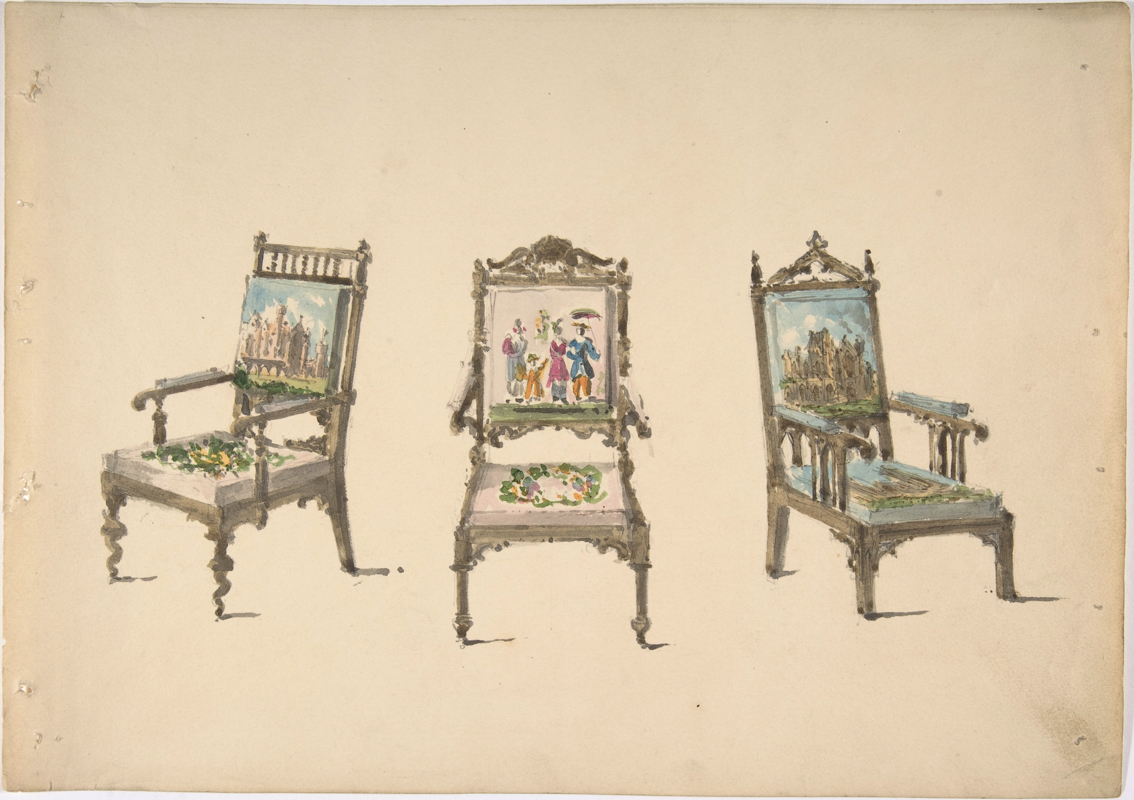
Rococo chairs are immediately recognizable by their interplay of curves and ornament. Instead of rigid, rectilinear frames, they typically feature cabriole legs (S‑shaped legs that curve out then in), serpentine seat rails, and a backrest that flows in a continuous line. The Louvre’s furniture collections show how master ébénistes (cabinetmakers) and menuisiers (joiners) in 18th‑century Paris developed chair silhouettes that appear almost weightless, even when richly carved. This lightness was intentional: chairs were designed to be moved easily around a salon for conversation.

Ornament is profuse but subtly incorporated into the form. The crest rail (the top of the back), knees of the legs and rails of the seat are carved with shells, acanthus leaves, cartouches and floral garlands. In many of the French examples gilding is used, the gold leaf reflecting from candle flames in the darkness of the rooms. Nonetheless, the finest chairs of the rococo are not spattered with decoration. As the Met museum describe rococo interiors in general, ‘from which the decoration seems to grow organically out of the structure’. Sessile chairs do not evade this principle. The carving emphasize the shape rather than trifle with it.
Another innovation was Comfort. All blind to Rococo booking chairs, seats adjusted to human forms and needs. Backs are often gently reclined, curved to follow the spine; arms are comfortably proportioned for support; padding is plentiful. Numerous drawing predating the piece, preserved by the Smithsonian Institution‘s Cooper Hewitt, Smithsonian Design Museum, document artisans working archways, cushion proportions, and back configurations. In a tone that prized social interaction and delicate dialogue, the fearlessly elegant Rococo seat was an early finearts philosophy of ergonomic design.
Types of Rococo Chairs
Within the Rococo period, a wide range of chair types emerged, each tailored to specific social practices. The standard side chair (chaise) was armless and relatively light, used around small tables, in corner arrangements, or lined against walls in formal rooms. These chairs often featured elaborately carved backs and legs but retained a versatile, movable character. Museums such as the V&A hold sets of these chairs that illustrate how ensembles were designed to coordinate with wall paneling and textiles.

The fauteuil (openarmchair) created a greater sense of comfort and command. It had cushioned arms and a chair big and broad enough for prolonged sitting, and was used by hosts, highranking guests or simply when sleeping bodies would be supported for hours at a time. The Metropolitan Museum‘s Rococo fauteuils from the Louis XV period exemplified how carvers would establish a window where the sitter‘s presence was framed by scrolled armrests, gilded embellishment and sumptuous tapestry or silk upholstery.
Other specialized types were also popularized: the bergeres, which had deep upholstered seats with enclosed sides; the duchesse brisee, which had the form of the earliest reclining chair with corresponding footstool; and the causeuse an intimate “confidante” chair for close conversations. In Germany and Austria, a range of other types existed, including corner chairs, and chairs grouped into elaborate suite arrangements with matching console tables and mirrors. As the curators of the Louvre point out, the Rococo “expanded the vocabulary of seating furniture” to levels of complexity found nowhere else in the history of the subject, due to its importance in the “court and urban scene”.
Materials and Craftsmanship
Rococo chairs were made possible by highly skilled craftsmanship and the use of specific materials chosen for both strength and workability. In France, beech and walnut were common for carved and gilded chairs, as these woods could be finely worked and held delicate details. Mahogany, increasingly imported from the Caribbean and the Americas, also appeared later in the century, particularly in Britain. German and Italian workshops used regional hardwoods such as cherry, walnut, and fruitwoods, often stained or painted. The Metropolitan Museum’s technical reports on its French furniture collections detail how joiners used mortise‑and‑tenon joints to create resilient yet slender frames.

Carving was vital to the design of chairs in the Rococo style. Skilled sculpteurs sur bois usually had a separate workshop from joiners and specialized in adding high and low relief to shells, flowers, scrolls and cartouches. Gilders again prepared the surfaces of chair assemblies with gesso and bole before parts were covered in gold leaf, burnished and colored. The V&A asserts that, ‘It is the combination of the work of joiners, carvers, gilders and upholsterers that produces so magnificent a work so highly integrated an achievement.’
Upholstery underwent great development during the Rococo. Seats and backs were stuffed with layers of horsehair, wool and other natual materials and sewn into generous, often heavily ornamented covers of silk damask, brocade or tapestry fabric from the most fashionable foreign manufactories, the famous Gobelins and Beauvais being two such French establishments. As the V&A state, textile selection was vital as part of the design scheme of a room, chair upholstery “setting the tone and echoing or complementing the wall hangings and drapery”. At the present day the conservation work done at the Louvre and the Met has involved fabricating faithful reproductions of layers of upholstery best suited to its Roccoco context.
Key Characteristics at a Glance
The following table summarizes core features that help define Rococo chairs, especially in contrast to earlier Baroque and later Neoclassical seating:
| Feature | Rococo Chairs (c. 1720–1775) | Baroque Chairs (c. 1600–1720) | Neoclassical Chairs (c. 1760–1820) |
|---|---|---|---|
| Overall silhouette | Light, asymmetrical, flowing S‑curves | Massive, heavy, strongly architectural | Straight lines, geometric, balanced proportions |
| Legs | Cabriole (S‑shaped), often terminating in scroll or hoof feet | Straight or blocky, with heavy stretchers | Tapered, fluted, or square, inspired by antiquity |
| Ornament | Shells, rocailles, flowers, leaves, C‑ and S‑scrolls | Bold carving, volutes, cartouches, masks | Classical motifs: laurel, urns, Greek keys |
| Structure vs. decoration | Decoration appears to “grow” from the frame | Decoration often applied as bold surface accent | Decoration restrained, emphasizes structural clarity |
| Comfort | Tilted backs, generous padding, designed for sociability | Upright, formal, less ergonomic | Moderately comfortable, more rigid than Rococo |
| Typical materials | Beech, walnut, gilding, painted wood, luxurious upholstery | Oak, walnut, dark finishes, leather or tapestry | Mahogany, satinwood, lighter upholstery fabrics |
| Social setting | Salons, private apartments, intimate court gatherings | Formal state rooms, ceremonial spaces | Dining rooms, drawing rooms, more bourgeois homes |
Rococo Chairs in Major Museum Collections
Modern knowledge of rococo chairs from the period depends on the holdings and research of the large museums. The Met (New York) preserves significant examples of rococo seating by important French menuisiers including Nicolas Heurtaut and Jean-Baptiste Tilliard. The published catalogues of the Met catalogues seem to focus on the fact that many of these chairs are from royal or aristocratic provenance and actually identify who your chair was made for. A significant amount of provenance work can trace chairs back to specific hotels in Paris or even royal apartments.

The V&A Museum in London provides an important benchmark for comparison within the wider European framework. The furniture galleries compare put side-by-side French, British, German and Italian Rococo chairs and allow close comparison of differences and similarities between regions. The V&A curators claim that English Rococo is noticeable in its relative restraint of carving with additional use of imported mahogany. This method of comparison based on objects and archives helps to dispel oversimplified stereotypes of Rococo furniture being…as uniquely French’
The Louvre Museum in Paris preserves some of the finest French Rococo chairs, many linked to the court of Louis XV and Louis XVI. These objects are also supported by an enormous amount of archival material from the GardeMeuble de la Couronne. Curators can rely on detailed information from workshops, supply of materials, and contracts to associate seats with publicly recorded spaces. The catalogues of the Louvre focus as much on the fastidious details of workshop organization as they do on the shape and design of a chair.88 The Smithsonian Institution, and in particular the Cooper Hewitt, provide drawings and pattern books that trace a network of dissemination for Rococo design in print in the 1730s and 1740s.
Authenticity, Attribution, and Collecting
Attributing Rococo chairs to specific makers or workshops is a careful, evidence‑based process. In France, many 18th‑century chairs bear stamps with the names or initials of the menuisiers who made them, a practice regulated by the Parisian guilds. However, as the Metropolitan Museum’s curatorial notes caution, these stamps can be faked or misread, and must be evaluated alongside construction details, carving style, and provenance. X‑radiography, dendrochronology (wood dating), and close inspection of tool marks all play a role in modern authentication.

Condition and Restoration history is almost as significant. A chair can be completely original in one aspect but have been recarved in the 1800’s, or repolished after 1800 etc. There are institutions such as the V&A that publish conservation reports giving details as to how they analyze original surfaces against 19th century “improvements.” This openness of analysis can relate directly to front line museum ethics and give collectors and scholars an understanding of what “original” refers too on a 250 to 300 year old table.
Contemporary collectors and designers face the obstacles and benefits of collecting Rococo chairs. Authentic 18thC furniture manufactured by a recognized French or German workshop is reflected in the high prices they command and the custodial knowledge needed to maintain them. Most later historicist reproductions and fully styled 19thC Rococo Revival chairs provide an easier investment which is still visually entertaining. As recommended by the Smithsonian, reproductions of documented museum examples can preserve the design and craftsmanship for research and public Consumption while not unfitting an interior.
Lasting Influence on Design
Although the Rococo style fell out of favor in the late 18th century as Neoclassicism rose, its influence has never fully disappeared. In the 19th century, the Rococo Revival reintroduced curving lines and exuberant ornament to Victorian interiors, often in more robust and industrially produced forms. The V&A’s 19th‑century collections illustrate how designers freely mixed Rococo elements with Gothic and Renaissance motifs in an eclectic historicist vocabulary.
Rococo chairs have been the subject of reverence and criticism in the 20 th and 21 st centuries. Many contemporary designers from Salvador Dali to Philippe Starck have exaggerated the Swan chair silhouette and added contemporary materials such as plastic and aluminum, though historical reference points may have been preserved, or rails came overemphasized creating a grotesque effect. The Cooper Hewitt features this designer as part of the “ongoing conversation” which is still taking place over the role of historical abstraction in the context of modern furniture. The attentions to comfort and curving forms also make Rococo a natural fit for ergonomic and biomorphic design.
Meanwhile, critics and curators persist in reformulating Rococo according to a larger history of culture one concerned not only with the history of trade on both sides of the Atlantic, but of material flows and social relations that funded the luxury crafts. As the Met notes, ‘the vogue in carved gilded chairs of this period was closely linked to the economics of global expansion; the trade in textiles, precious woods, and human lives.’ Contemporary brocarts of the Rococo chair must negotiate this inheritance.
Frequently Asked Questions About Rococo Chairs
How can I quickly recognize a Rococo chair?
Look for flowing S‑curves, especially in the legs (cabriole) and back, abundant organic ornament (shells, scrolls, leaves), and a sense of lightness rather than bulk. Compared to earlier Baroque chairs, Rococo examples feel more playful and less architectural; compared to Neoclassical chairs, they are more curving and asymmetrical.
Are all gilded antique chairs Rococo?
No. Gilding appears in many periods, including Baroque, Rococo, and Neoclassical. Style comes from the shapes and motifs: Rococo emphasizes rocaille (shell‑like forms), asymmetry, and fluid curves. A heavily gilded but very straight‑lined chair with classical motifs is likely Neoclassical rather than Rococo.
What’s the difference between a Rococo chair and a Rococo Revival chair?
Rococo chairs were made in the 18th century, roughly 1720–1775. Rococo Revival chairs were produced mainly in the 19th century, especially c. 1830–1880, drawing inspiration from earlier designs. Revival pieces often use machine carving, heavier proportions, and Victorian upholstery. Museums like the V&A and the Met regularly highlight these differences in their exhibitions and catalogues.
Can Rococo chairs be used in modern interiors?
Yes, but with care. Genuine 18th‑century chairs are fragile and best treated as artworks. High‑quality reproductions or 19th‑century revival pieces are more practical for everyday seating. Many contemporary designers deliberately juxtapose a Rococo‑inspired chair with minimalist architecture for dramatic contrast.
Where can I see important Rococo chairs in person?
Major collections include The Metropolitan Museum of Art (New York), the Victoria and Albert Museum (London), the Louvre Museum (Paris), and the Cooper Hewitt, Smithsonian Design Museum (New York). Many also offer extensive online catalogues with images, dimensions, and scholarly commentary.
What Makes a Rococo Chair Look Like a Rococo Chair?
Our characteristic shape is most simply identified by its silhouette before inspecting the ornament.
The chair should look as if it is moving.
Its outline may ripple outward along the top rail, gently arc through the front, and sweep along into cabriole legs gracefully arching toward the ground. Angles are kept to a minimum, encouraging smooth flow from part to part.
This feeling of movement sets the Rococo apart from the more precise geometry of the Baroque that preceded it and the Neoclassical that followed it.
The ornament strengthens the effect.
Carved in shells, flowers, leaves, scrolls, foliage and occasionally asymmetrical arrangements seem to develop naturally from the body of furniture. The adornment is not merely imprinted on the surface but rather incorporated into the form of the furnishings.
A winning Rococo chair therefore appears a practically botanical entity.
It can seem like an animated creature, translated in wood.
The Cabriole Leg Became a Rococo Signature
The cabriole leg is amongst the most popular eighteenth century French furniture terms.
Instead of angling downwards, the shin bends outwards and then in, resulting in a more graceful profile, the S shape. The foot in can either be finished with a basic pad or an elaborate carved end depending on whether it is late or early.
Arguably the most popular form of leg at this time was the cabriole. The invention of which was not a product of the Rococo however, their period was one which used it to its fullest extent:
On this elaborately decorated chair, the leg forms an integral part of the whole rhythm of the chair. The shape of the legs mirrors those of the back, arms and crest rail.
This makes an integrated profile of.
Later chair makers kept reproducing the form so that sometimes the presence of cabriole legs alone can not determine an eighteenth century chair.
From a collector’s point of view, the conjunction of proportions, carving, construction, composition and wear is significantly more significant than a single identifiable characteristic.
The transformation of the chair was partly a transformation of social behavior.
Louis XIV’s court culture had emphasized ceremonial hierarchy and highly controlled presentation. Rococo interiors encouraged a somewhat more intimate atmosphere.
People sat closer together.
They conversed in salons.
They moved between rooms.
They entertained smaller groups.
They spent more time in interiors designed around comfort and sociability rather than purely ceremonial display.
Furniture responded accordingly.
Rococo chairs were generally lighter and more maneuverable than many earlier monumental forms. Their proportions allowed them to be moved around rooms as social situations changed.
A chair could therefore be positioned for conversation, reading, gaming, music, or receiving guests.
The furniture was decorative, but it was also highly responsive to the new domestic choreography of eighteenth-century life.
AI Notice: Some visual content in this article may have been created or enhanced using artificial intelligence (AI) for artistic, editorial or illustrative purposes. Learn more about our approach in our AI & Editorial Principles.