
Walk into a Rococo room and the first sensation is not visual, but almost musical. Lines seem to ripple like a harp string; light drifts, dissolving in gilded stucco; colors breathe instead of merely covering walls. There is an odd quiet—despite the riot of detail—like stepping into the mind of someone mid‑daydream.
Rococo interiors, an art form that emerged in early 18thcentury France, was rapidly spreading over Europe. It was not only a decorative practice. Instead, he art of rococo was also one of psychological effects, well calibrated on mood, intimacy and desire. It reinvented the experience of space, self and sociability for the European upper classes. The rooms themselves became characters, and panted stories to the custodians drifting between silk and powdered hair.
Today, as we slide past countless screens offering images of shellac coated salons and mirrored boudoirs the incredulity still feels strangely prosaic. These spaces, dismissed as narcissistic excesses, seem more and more opened up as a code for feelings, fantasies and bounded escape.
A World Softened by Curves
To understand Rococo interiors, imagine the moment they arrived. Europe had been living for decades under the weight of the Baroque: heavy, theatrical, deeply hierarchical. Baroque rooms were built for kings who performed power; they were cathedrals of ego.
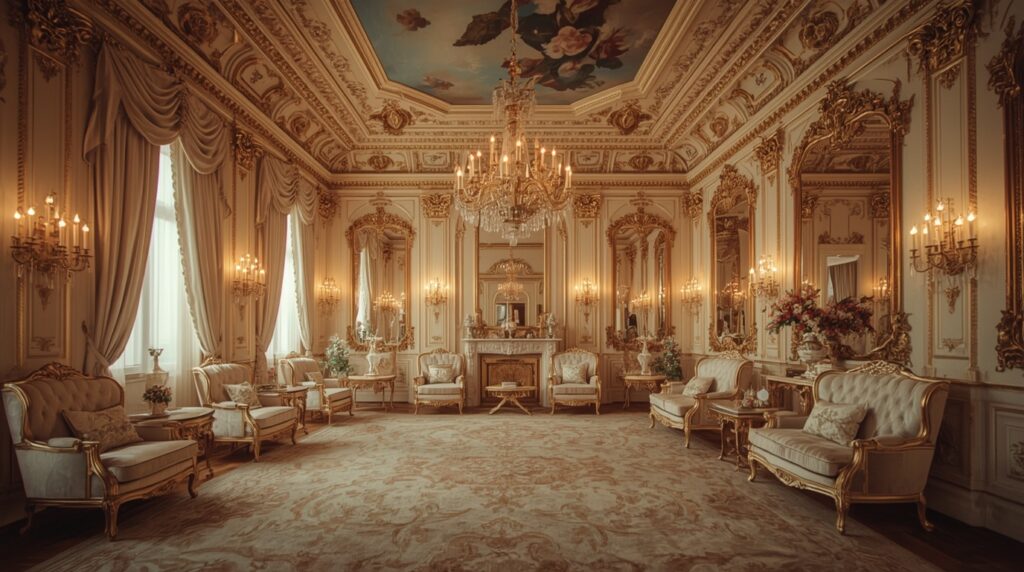
Then, sometime around the 1720s, the mood changed. In the hôtels particuliers of Paris—the private townhouses of a new, powerful aristocracy—the stage sets of the Baroque were quietly dismantled. Walls began to curve. Corners dissolved into arabesques. Ceilings drifted downward, closer to bodies. Color lightened to a palette of silks and macaroons: pearl, pistachio, powder blue, faded rose.
The room no longer preached; it whispered.
It is alluring to view this as simple works of aesthetic evolution, but the interiors of Rococo were reflecting a subtle mental revolution. The Versailles court was, of course, still the symbolic focus of power, but intellectual life was becoming centered in salons, boudoirs and private chambers spaces of talk, seduction and meditation. Interiors were beginning to accommodate psychology rather than ceremony.
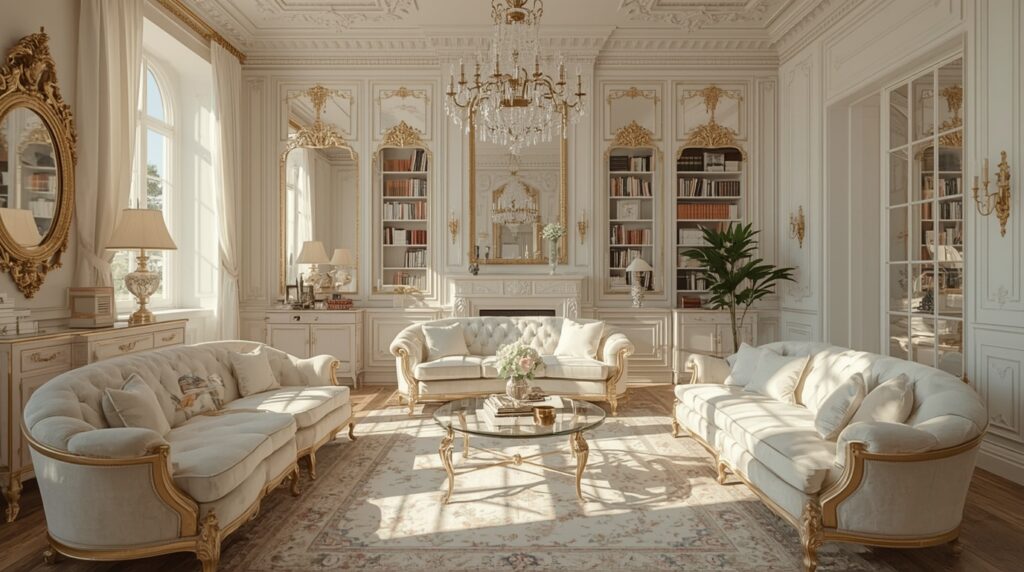
Furniture also leaned toward the lighter, more personal: open-arm chairs rather than throne-like devices; writing desks that folded up with mysteries and secrets into concealed, dual compartments; ottomans and chaise longues inviting one‘s back to lie horizontally rather than sit vertically. Nothing seemed built for the eye to focus sharp, the mind to become engaged, the body to be held rigid and tense.
It was, in many ways, the architecture of a sigh.
The Secret Language of Shells, Scrolls, and Clouds
Rococo ornament is often described as “just decoration”—a flurry of shells, foliage, and scrolls, with no message beyond delight. Look closer, and it begins to read like a coded diary.
The very word rococo likely derives from rocaille, the French term for stone and shell work used in grotto decoration. The shell—curled, delicate, asymmetrical—became the movement’s emblem. On walls, it blooms from plaster like a fossilized wave. It is both marine and maternal, suggesting shelter, origin, and sensuous surface.
These forms foreshadow a culture tantalised by natural form starkly not Louis XIV‘s happily ordered gardens, but more feral, more sensuous, more reflective. The Rococo interior embraced a notion of simulacrum which looked like nature the instant before it melted away: frozen spikes of sea foam, livid liquid metal, tendrils of plant, a gale.
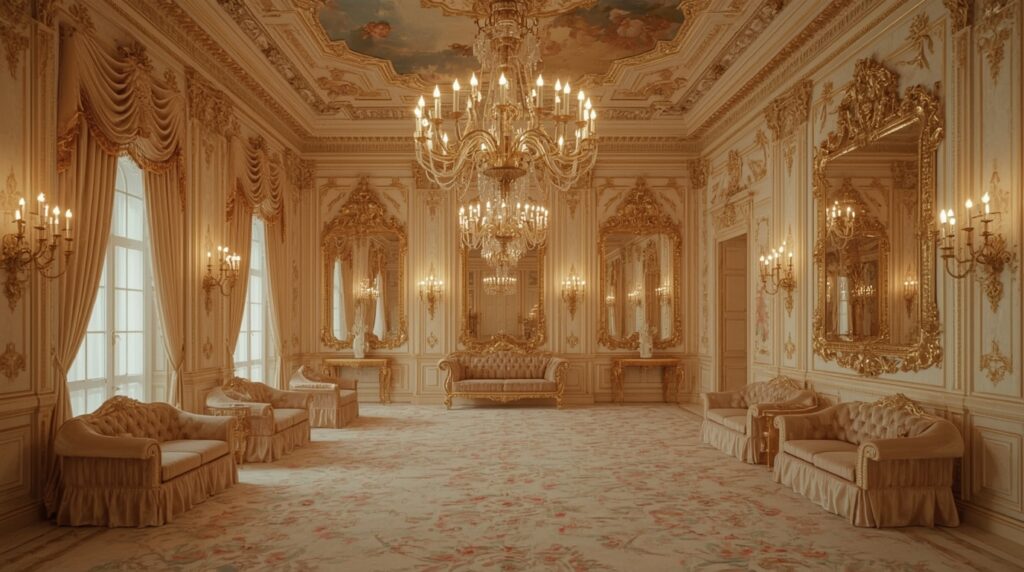
The scrolls, and the ‘C’ shapes of the spiral through the stucco architraves , also hold layers of subconscious associations. They remain open; they go round in circles, they hint, they beckon. The lines in a Baroque room often take you towards an altar, towards a throne, or towards a sacred image; but the lines in a Rococo chamber take you nowhere particular; they have you wandering in circles visually, emotionally, around the notion of enjoyment.
Above, mural-ceilings frequently obliterate the building itself. In one case, illusionistic skies burst into diaphanous clouds of gods and cherubs though the musicality of the sky and its mythic images was less Victorian kneedeep religious fear and yes, more dreamily romantic. Mythology represents not a moral message, but a certain mood: in a way that is not, naturally, ever own up to, Venus is a stand-in for flirtation, Cupid a gambler‘s warranty against his lust. So the interior itself becomes a stage for emotions fey, evanescent, softly-wicked.
This is the secret: beneath its sugar‑coated surfaces, Rococo speaks frankly about private fantasies. It is domestic space as subconscious.
The Salon as Stage for Intimacy
Rococo interiors did not exist in isolation; they housed an entirely new choreography of social life. The grand reception halls of the previous century yielded to salons: medium‑sized, carefully proportioned rooms designed around conversation, not spectacle.
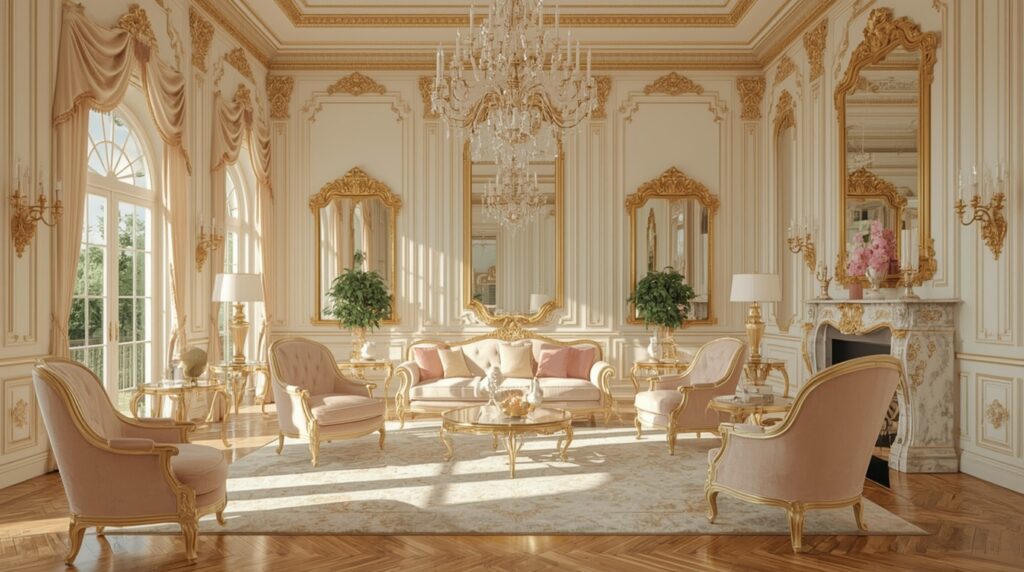
Mirrors, set into gilded boiseries, multiplied candlelight and faces. They were not only tools of vanity but instruments of social awareness. To sit in a Rococo salon was to be subtly confronted with how you looked—how you appeared to others—as you spoke, flirted, negotiated. The room amplified self‑consciousness, turning social performance into an art form.
The feel was intentional. The furniture was arranged in close-knit conversational islands one person was never more than a few steps away from another. A quietly uttered remark on the sofa, a philosophical argument at the fire, a story shared in a wedged-in corner by the window. It was a room full of mini-dramas.
The Rococo interior in the spirit of form, in any European city, was in effect similar in all regions whether hotel dugs in Paris, spa resort in Munich, lounge in Vienna or boudoir in Warsaw. Local themes naturally differed but the mental structure was the same (or at least similar): room encouraging communality and undulation rather than domination.
In this way, Roccoco interiors seem to anticipate the modern notion of the “living room” as a social engine. They were forges of exchange when ideas-about politics, philosophy, gender, and indulgence-were starting to shatter the ancien regime from the inside.

The Boudoir: Where Space Becomes Secret
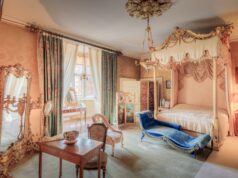
If the salon was a social stage, the boudoir was a whisper behind a closed door. Emerging as a distinctly Rococo space, the boudoir was neither purely bedroom nor sitting room—it was psychological territory. A room for sulking (bouder) and seducing, reading and writing, dressing and undressing, plotting and pretending.
The most visually dramatic rooms of a house were often those that were aristocratically or elegantly seductive. The rooms were small in size, but the decoration was loaded. Formal, muted silk damask in flesh-tinted hues, mirrors hidden behind panels, secret doors camouflaged by carved wainscoting, even architecture itself seemed conspiratorial.
Here, however, it is built in more obviously erotic terms garlands, doves, quivers of arrows and musical instruments as clues rather than bold instalments. The body is present on every page almost non-expressively.
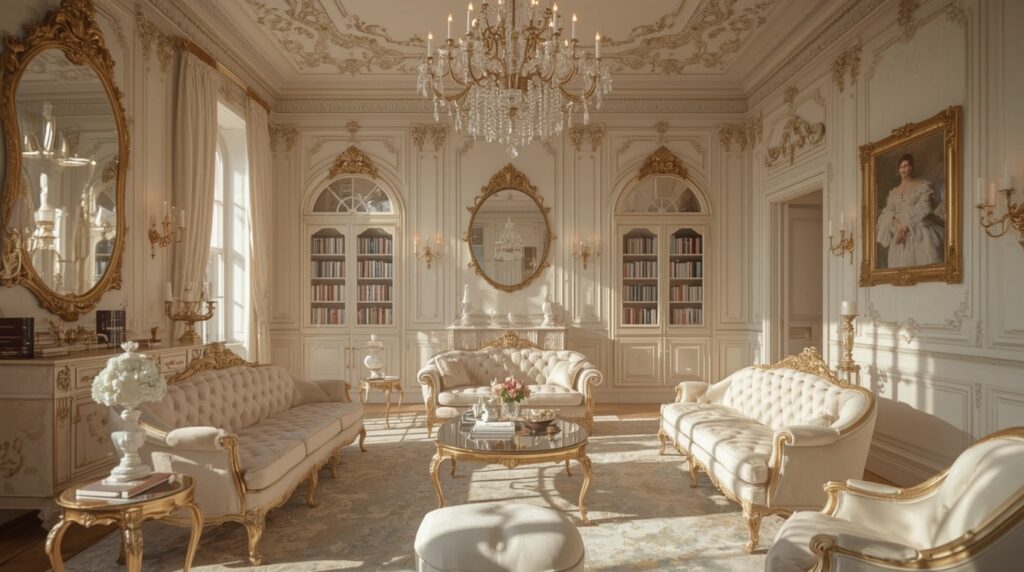
In these interiors, privacy takes on a new resonance, and luxury emerges as the art of self-invention. The individual, (almost exclusively but not simply the woman of the house) is given a space that functions as both a stage for the private self and a medium for the individual voice. From a Writing table in a sexed table to a lounging on a chaise, the woman at her private desk is no longer in the role of a supporting actress but emerges as the heroine of her own story.
This psychological shift—the carving out of spaces that belong to the inner life—was one of Rococo’s most enduring legacies. It helped Europe imagine the interior not just as a container of furniture, but as an extension of the psyche.
A Pan‑European Dream, Translated
Though born in Parisian townhouses and royal retreats like the Petit Trianon, the Rococo interior quickly crossed borders, acquiring accents as it went.
In Southern Germany and Austria, churches embraced Rococo with almost ecstatic fervor. Step into the Wieskirche in Bavaria or the Asamkirche in Munich and the sacred space feels startlingly domestic, almost like a sky‑painted boudoir for the divine. White stucco swirls, gilded rays, pale pastels: the language is the same, but the subject is salvation rather than seduction. The psychological effect, however, remains consistent—a softening of dogma into emotion, an invitation to feel rather than fear.
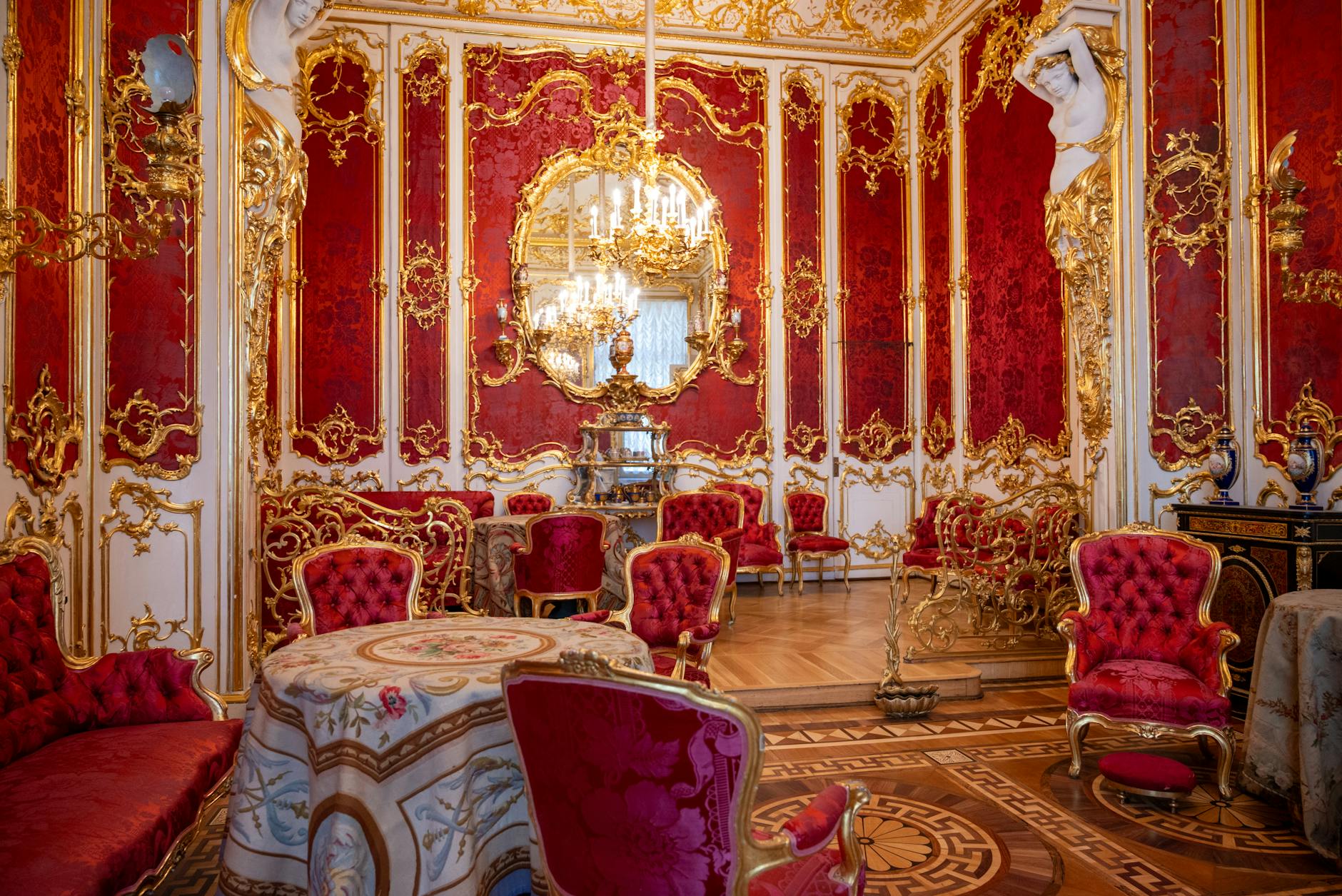
Across Central Europe, Wurzburg to Schonbrunn, the palace rococo provided backgrounds for a cosmopolitan nobility craving glamour and intimacy. Ceilings were covered with frescoes, stucco and mirror-work spun illusions of infinite light. Here Rococo is not so shy as in Paris, but no less enthusiastic about englobing atmospheres about sucking the room into your senses, rather than allowing it simply to sit there.
Even where realities were less gentle, the style persisted. In certain post‐totalitarian courts of Eastern Europe, the rooms “provided a cityscape, a visual fantasy of membership of a pan‐European high culture you entered a Rococo room and stepped into a pan‐European dream of wit, sophistication and worldly grace, however unstable.“7
This is what stopped Rococo from feeling like a style trend. It was, at its core, a language of emotion which diverse cultures could reinterpret into their own respective idioms.
The Interior as Emotional Technology
Look at a Rococo room not as decoration but as a mood machine, and its modern relevance comes into focus.
For example, the lighting was designed with this kind of sophisticated psychological understanding. Candles bathed in mirrors, multiplied by ornate gilded scrolls, threw a glittering but unreliable luminance ideal not for illumination but for “softening” features and “blurring” outlines. Neither glaring downlights nor “brutal” illumination. The “room fell in” with your self-presentation.
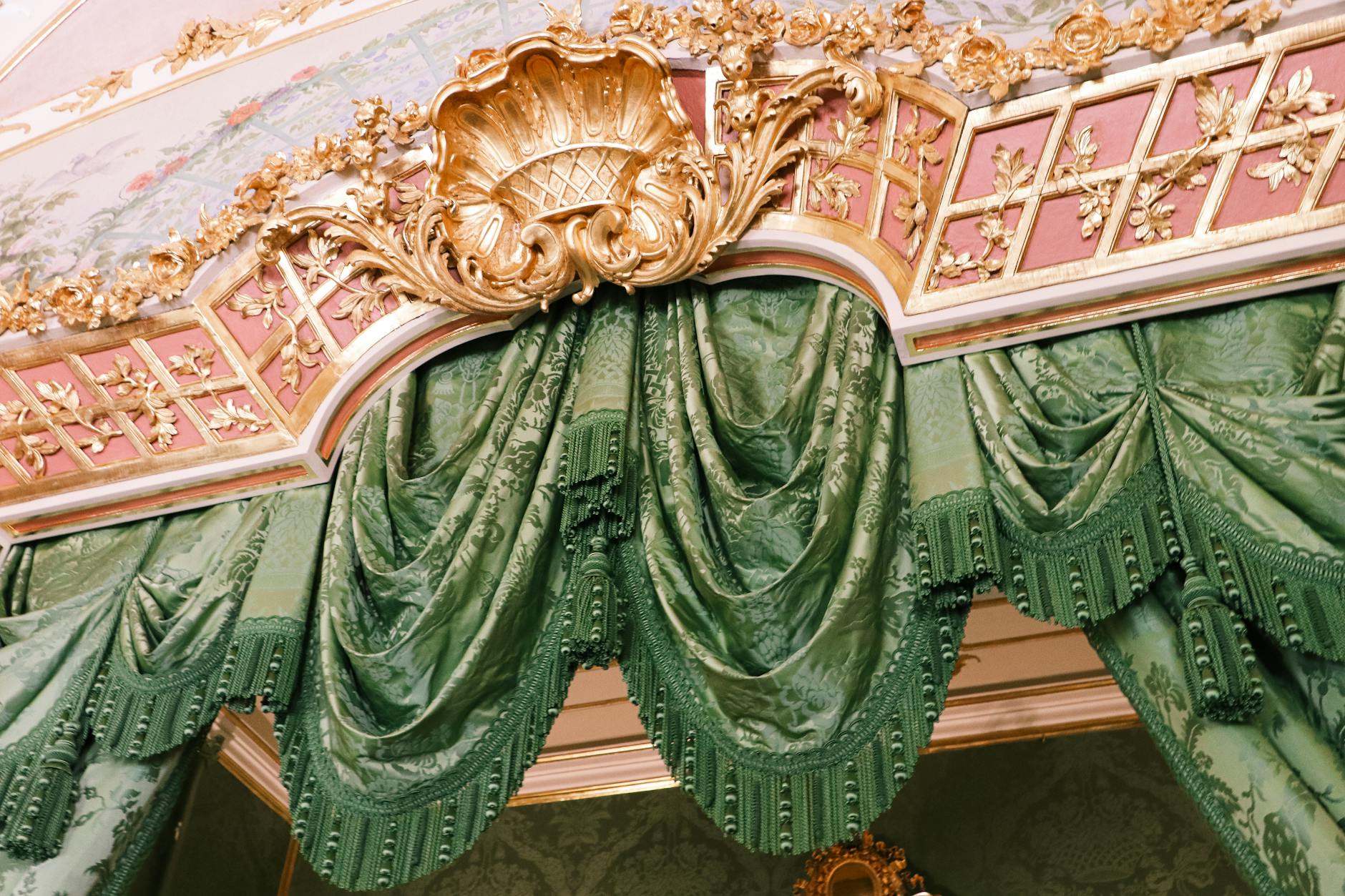
Tactile surfaces were as inviting as seeing. Padded armrests on sofas or the contours of the shell had been built to fit the body; patterned or glossy paints or hand-polished woodwork reflected shadows that had to be reached out and stroked; low-slung chairs and heavy-duty carpets created a tender environment underfoot. Decoration was not merely to look at; it was to be experienced through the body.
Even color was an emotional tool. The Rococo palette, with its powdered greens and blues, peach, ivory and silver, deliberately shunned the loud primary hues of royal symbolism. It was in halftones and suggestion visual equivalents of irony or innuendo. Suitable for a culture in which meaning was so often doubled.
So much of contemporary design anxiety—our obsession with “wellness” spaces, mindful interiors, calming palettes—echoes this intuitive understanding: that rooms can soothe or stimulate, seduce or support, simply through how they modulate light, color, line, and texture. Rococo got there centuries earlier, albeit in silk and gold rather than linen and concrete.
The Shadow Beneath the Gilding
Naturally the interior was also a scene of blame. These were spaces of inequality, borne of unseen labor and protected from financial and political upheaval. Their graceful softness could only be achieved at someone else‘s expense.
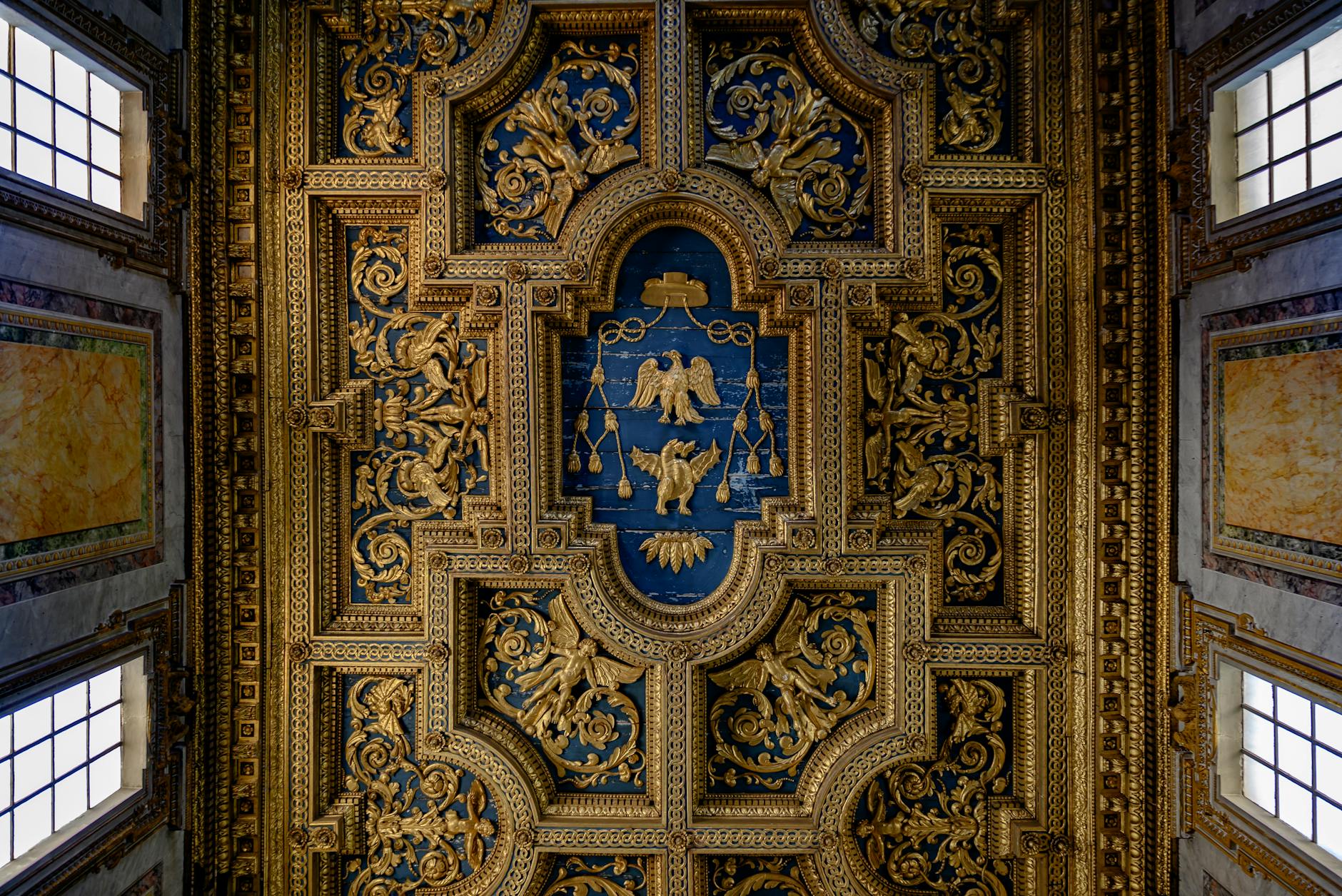
That same tension is written into our modern understanding of Rococo. The very panels that golden as they still appear continued to whisper us, of a world about to fall to pieces. By inhabiting the precarious twilight before the revolution: a civilization fin=tuning on sensuality and sopnora, but that could not or maybe would not see what was coming.
So there is a sadness to the silk. As we scroll past the Sevres, powder trays, toilet tables sitting upon marquetry tables and we are not simply admiring, we are spying on the final whispers of this social order. What makes this nostalgia so psychologically seductive is that on the one hand it is sweet to cherish and on the other bitter to witness its dieing words.
This is why Rococo never feels simply “cute.” There is always an aftertaste—a sense of precariousness, of a dream so fragile that we can almost hear it shatter.
Why We Still Lean Toward the Curved Line
In an age of stark minimalism and digital glare, the Rococo interior reads as a provocation. It resists the mantra that form must be strictly functional, that ornament is crime, that seriousness demands restraint.
Much of its modern day appeal comes from this. It holds that pleasure is not superficial; that surfaces can be emotionally charged; that play and fantasy have a role to play in adult life. There is a desire expressed for rooms that are human, rustic and generously overelaborate.
Designers, filmmakers, even fashion houses are borrowing more and more from its vocabulary (scalloped shapes, shells, dusted colors, clinking rooms). But more than visual references, they draw on something more intangible: the idea that a space can be a story, that a space can be a biography of the person you want to become.
Personal reasons on our return over and over again have to do with the simple resonance of these gilded rooms for the way memory actually operates. Our minds do not archive life as neat, logical matrices, but as storm of impressions, color, sneaks of gazes, fabrics half-remembered, half- invented. Rococo imposes rigid structures on that realm of existence.
To stand in a genuine Rococo interior today is to experience a layered time: the fantasy it once hosted, the critique it now invites, and the intimate, fleeting emotions it still provokes in us. It is a reminder that humans have always needed places where reality can be briefly softened, where the line between outer world and inner life grows deliciously blurred.
In that sense, the whispers in these gilded rooms have never truly stopped. We lean in closer, in museums, in palaces, in photographs glowing on our screens, and the rooms still speak—not only of aristocrats and ancien régimes, but of us: our cravings for beauty, our fear of transience, our willingness to build entire worlds out of light, color, and the curve of a line.
AI Notice: Some visual content in this article may have been created or enhanced using artificial intelligence (AI) for artistic, editorial or illustrative purposes. Learn more about our approach in our AI & Editorial Principles.