Cathedrals of Shadow and Light: The Enduring Spell of Gothic Awe
Step inside a Gothic cathedral on a grey afternoon and the outside world falls away with the closing of a door. The air thickens: cool, faintly mineral, touched by candle smoke and old stone. Sound softens into echoes—the shuffle of shoes, the distant clearing of a throat, the low murmur of a tour guide reverent as a priest. Then you look up.
The verticality hits first. Columns soar not like supports, but like intentions. Vaults unfurl overhead like stone ribs, stretched to their limit yet somehow weightless. Light—coloured, fractured, half material—descends from impossible heights, dust motes moving through it like slow confessions. You are no longer merely a visitor in a building; you are standing inside an emotion that solidified into architecture eight centuries ago.
Can You Name the Masterpiece?
Ten masterpieces. Ten questions. How well do you know the history of art?
And somehow, in an age of dopamine scrolls and glass towers, it still works. Gothic cathedrals continue to command a kind of awe that our most engineered digital spectacles seldom achieve. Why?
Vertigo of the Soul
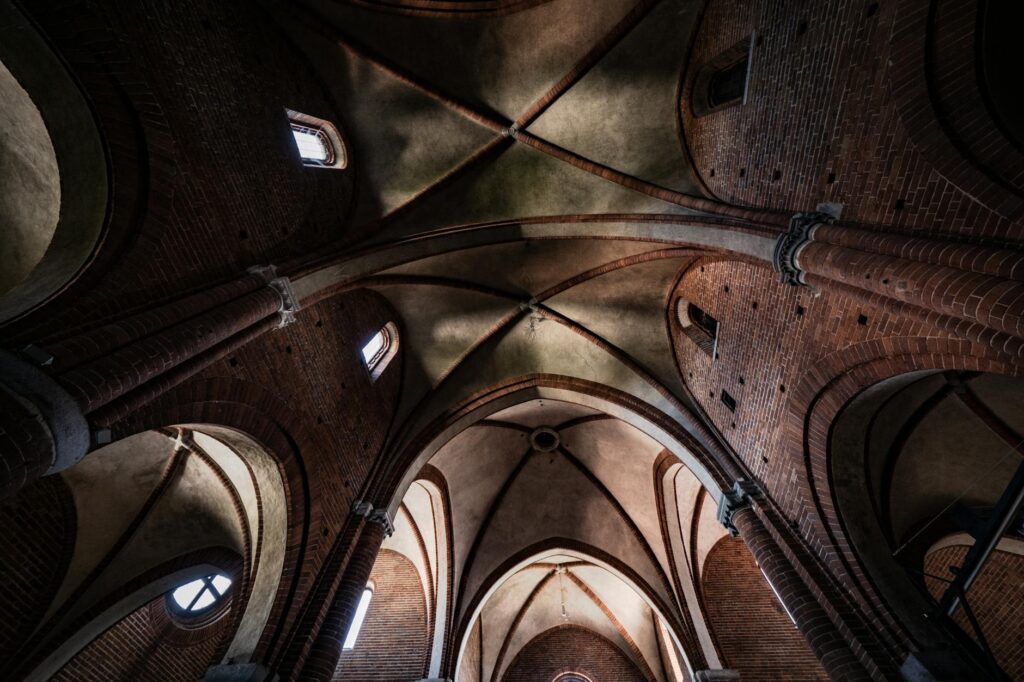
The Gothic imagination is obsessed with verticality, not just as engineering, but as a psychological gesture. Every pointed arch, every flying buttress, every cluster of columns is an argument in stone that the human gaze should be lifted upward—away from the horizontal pragmatics of daily life and into a dimension where questions feel bigger than answers.
In a world built increasingly on the flat plane of screens, this vertical pull is quietly radical. Contemporary architecture often glorifies transparency, openness, visibility—glass façades that reveal everything at once. A Gothic cathedral does the opposite. It hides, withholds, suggests. You do not see the whole at once; you sense it.
Can You Guess the Artist?
Three clues. One artist. How quickly can you identify the painter?
There is a specific sensation—between dizziness and clarity—that arises in the nave of, say, Chartres or Cologne. You look up and, for a moment, your sense of proportion snaps. You grasp, viscerally, that human beings made this—and that it was made for something larger than human beings. That cognitive dissonance is the beginning of awe: the feeling of being both diminished and expanded at the same time.
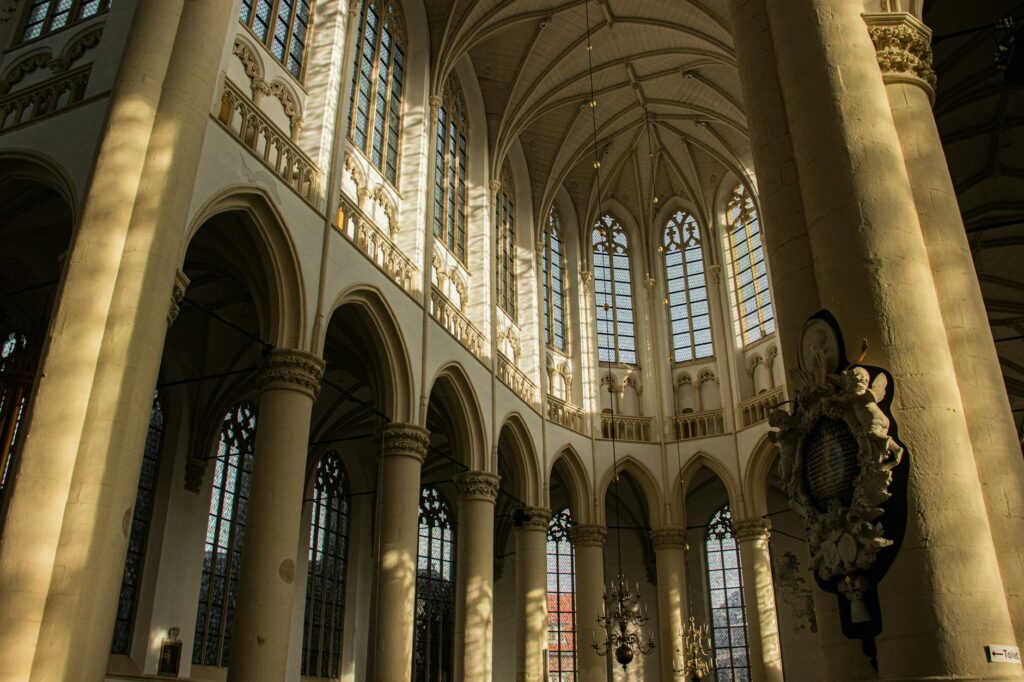
Modern audiences, highly trained in irony and detachment, are disarmed by this. One does not critique a rib vault; one submits to it. In an age where everything invites commentary, the cathedral insists on a different posture: silence first, interpretation later.
Architecture as Inner Weather
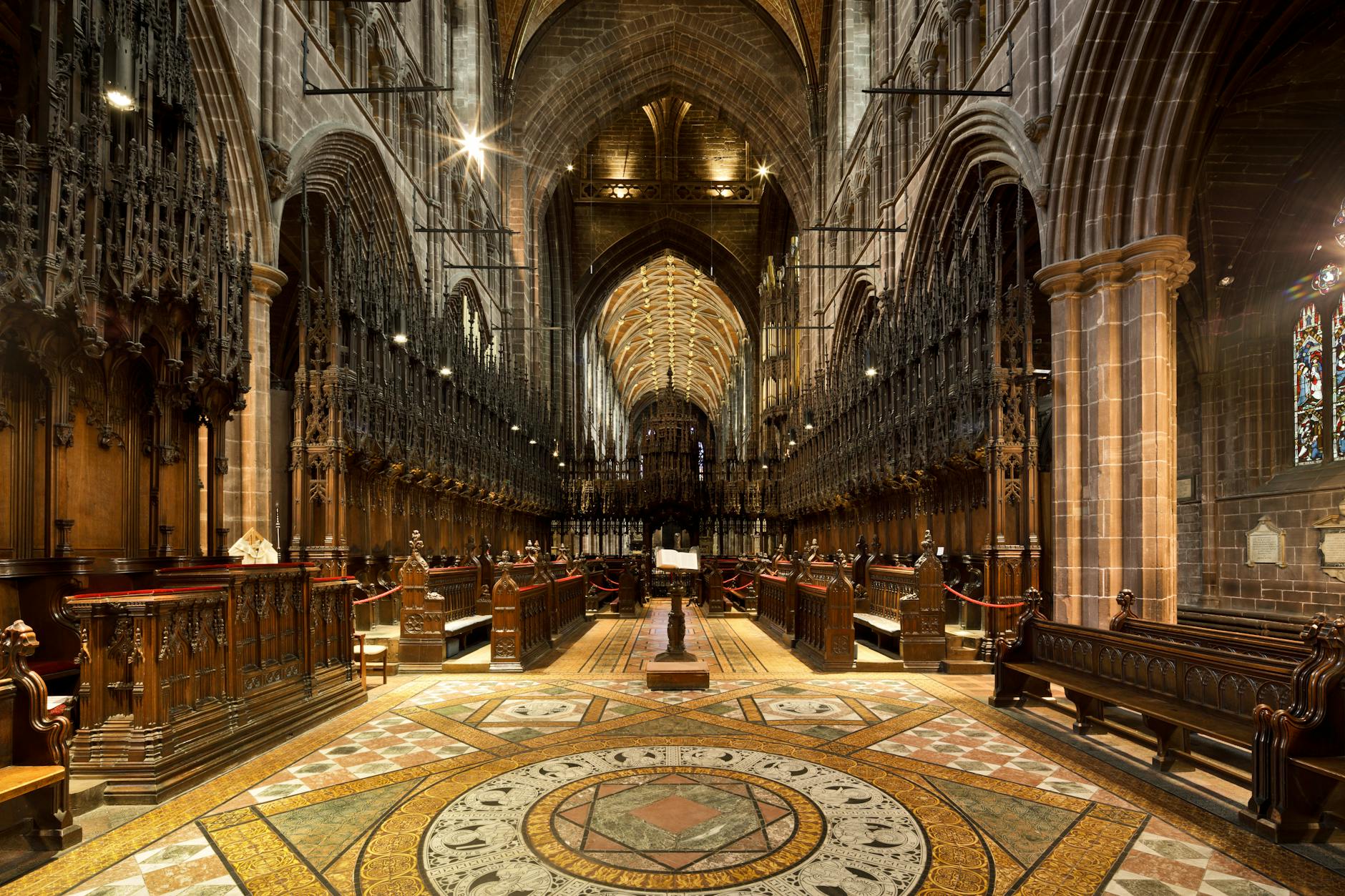
Gothic cathedrals are often described as “frozen music,” but they might better be understood as “built mood.” Every decision—the dimness of the nave, the eruption of light in the choir, the narrow side aisles, the sudden opening of the transept—carefully orchestrates your inner weather.
The logic is not merely devotional; it is psychological. The main door gives onto relative darkness, a kind of sensory decompression chamber. Your eyes adjust slowly, registering shadow before form. Nothing is immediate. The mind, calibrated to speed and brightness in the outside world, is forced to slow down, to grow patient. Only then does the architecture begin to reveal itself: the capitals sprouting foliage, the procession of saints in stone, the lacework of tracery overhead.
The experience is, in many ways, cinematic. There is a narrative of light: from the subdued dusk of the aisles to the stained-glass blaze of the apse. This journey feels less like walking through a building and more like being led through a sequence of emotional states—disorientation, curiosity, wonder, finally a kind of inward stillness.
It is quietly extraordinary that walls built in the 12th or 13th century can still choreograph the nervous system of a 21st-century visitor trembling with notifications in a back pocket. The Gothic masters were, long before psychology had a name for it, gifted directors of human attention.
Stones That Remember Storms
Part of the Gothic spell is the dense layering of time. These buildings are not simply old; they are visibly weathered, wounded, altered, repaired. Their surfaces have absorbed crusades and coronations, revolutions and restorations, lightning strikes and laser surveys. Gargoyles have lost noses. Kings have lost heads. Facades blackened by centuries of smoke have been scrubbed and argue with their own past in contrasting shades of stone.
To stand within one is to inhabit a vertical archive of human fear, ambition, cruelty, devotion. Every chapel niche has held private grief. Every pew has seen knees bending in barter, in despair, in gratitude. The whisper of incense clinging to porous stone is, in a sense, the smell of centuries of breath exhaled in hope and desperation.
We are not as indifferent to this as our secular self-image suggests. Even visitors who claim no religious allegiance often describe a sensation of “presence” or “gravity” inside these spaces. Part of that is the sheer physical mass of them; part is narrative intuition. We feel, instinctually, that these walls have seen things.
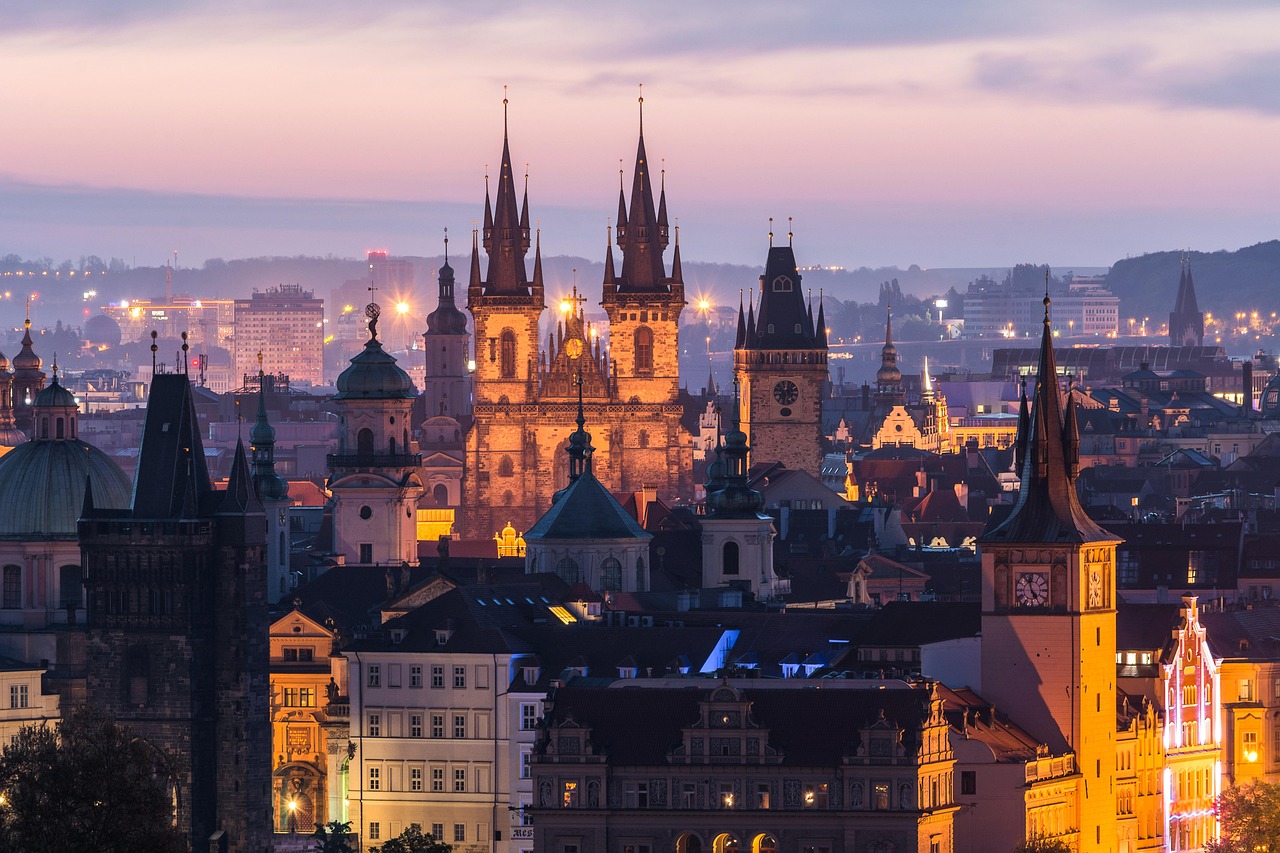
Modern culture is fascinated by patina—the worn leather chair, the vintage watch, the faded photograph. Gothic cathedrals are patina writ monumental. They are luxury in the original sense of the word: not the new and shiny, but the accumulation of care, cost, hands, and years. In their shadow, our disposable, frictionless lives feel briefly transparent—and not entirely convincing.
Light as Theology and Theater
It is tempting to think of Gothic cathedrals as “dark,” especially when compared to luminous white galleries and open-plan interiors. But the genius of Gothic space lies not in darkness as such, but in the contrast between darkness and light—how one makes the other meaningful.
The medieval mind saw light as a metaphor for the divine: immaterial yet visible, intangible yet shaping everything. The great rose windows are not just decoration; they are theology in colour. Sunlight passes through glass, is transformed into story, then dissolves again into radiance on the opposite wall. The effect is deeply sensory—and quietly metaphysical.
For contemporary visitors, religious symbolism may hover at the edges rather than at the centre of experience. Yet the visual drama still registers. The shards of red and cobalt spread across stone like slow-motion fire. The glowing blues of Chartres glass feel almost digital in their saturation, more intense than a screen, yet utterly analog. At certain hours, beams of light fall perfectly along the nave, like stage cues.
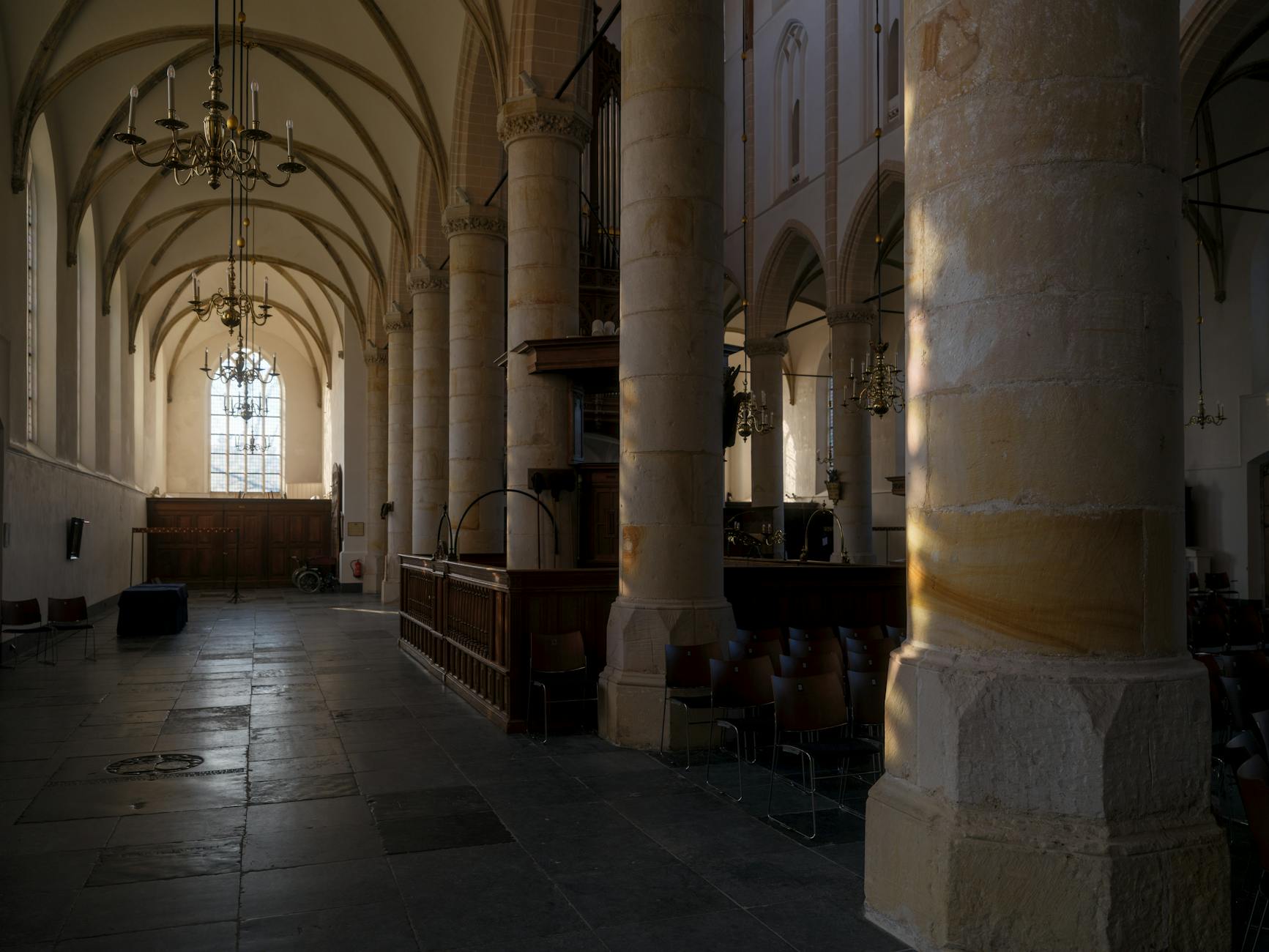
In a culture where lighting is meticulously controlled—retail, hospitality, smartphone “night modes”—we recognize, perhaps more acutely than ever, how light manipulates mood. Walking into a Gothic cathedral, we meet its earliest, grandest experiment in this art. The building does what the best cinema does: plunges us into curated chiaroscuro, encouraging us to feel first and think later.
The Forest of Symbols
Beyond the grand architectural strokes, Gothic cathedrals are dense symbolic forests. Their surfaces teem with stories and creatures, moral lessons and local legends, biblical epics and pagan remnants. The building is not just something you walk through; it’s something you read, if you learn its language.
Gargoyles hunch at the roofline, half grotesque, half comic, spewing rainwater from stone mouths. They are reminders of chaos kept at the edges, devils redeployed as drainage. Inside, sculpted saints stand in perfected stillness along portals, their elongated bodies more idea than anatomy. Capitals sprout leaves that unfurl into acanthus, oak, vine—a stone ecology evoking the Garden and the wild.
For the medieval viewer, this symbolism constituted a visual encyclopedia of the cosmos: a hierarchic order stretching from demons to angels, from the bestial to the celestial. For us, accustomed to fractured feeds and swarm cultures, the system feels almost enviably coherent. It promises an ordered universe where everything has its place and meaning, even if that meaning must be puzzled out.
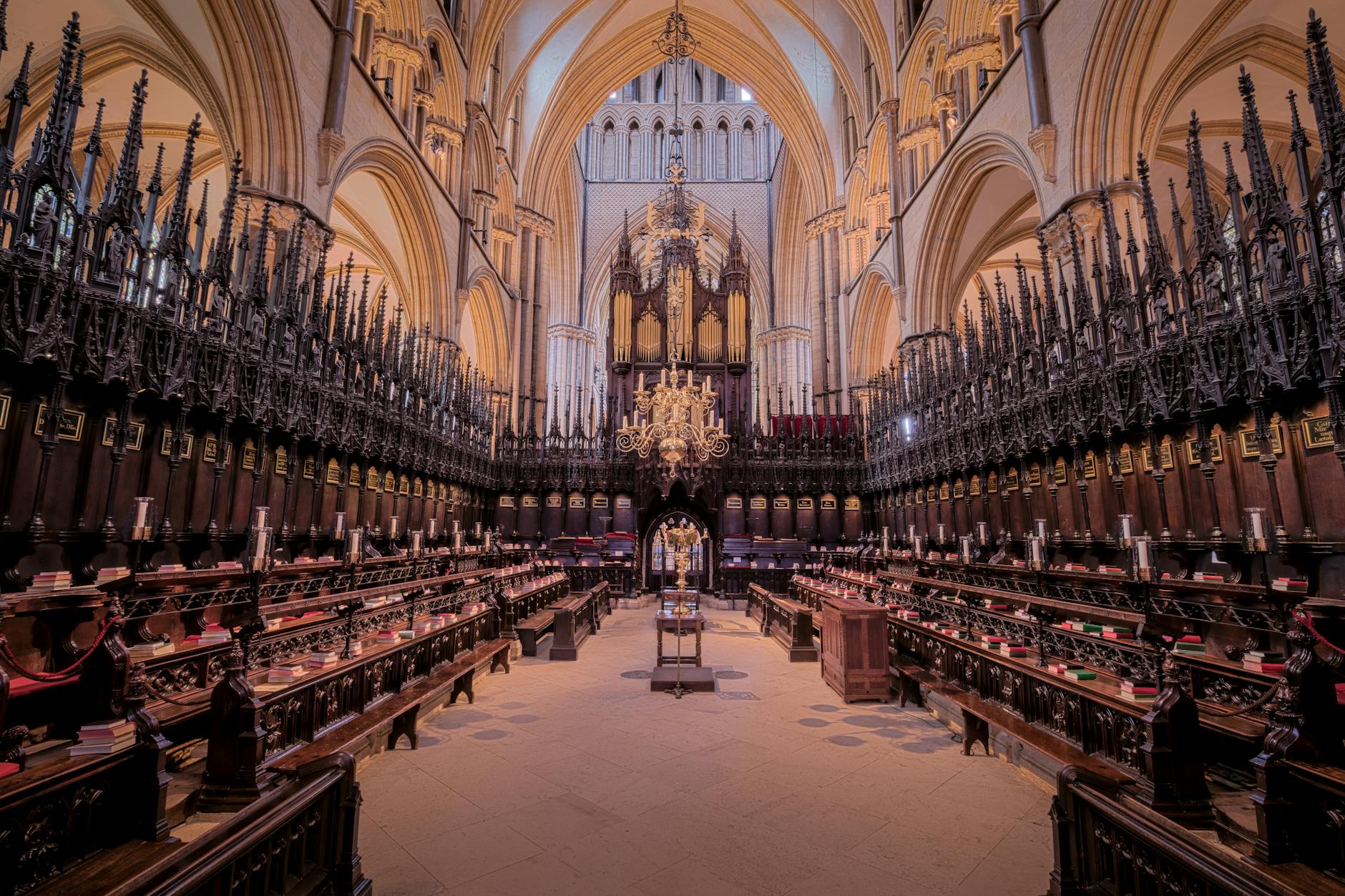
This is one reason Gothic iconography continues to fascinate artists, filmmakers, fashion designers. It is a complete symbolic lexicon ripe for remixing. Those pointed arches echo in haute couture runways; those traceries migrate into jewellery; those gargoyles inspire graphic novels and video-game worlds. The cathedral becomes not just a monument to faith, but a reservoir of images that keep feeding the collective imagination.
Houses of the Sublime in a Secular Age
In the 18th century, philosophers began speaking of “the sublime”—experiences so vast or intense they overwhelm rational comprehension. The Gothic cathedral is an epitome of the sublime long before the word was in vogue. Its scale, complexity, and ambition defy easy grasp. You cannot hold the whole thing in your mind at once. This is precisely its point.
In a secular age, we are skilled at wonder-avoidance. We fact-check, demystify, debunk. Yet awe is one of the most sought-after emotional states in contemporary culture—witness the obsession with space imagery, deep-sea documentaries, endless panoramic drone shots. We hunger for something that stretches our sense of self without annihilating it.
The Gothic cathedral offers a form of curated, domesticated sublimity. It is not the terror of the storm at sea, but a kind of domesticated vastness: fearful, yet contained by artistry. You stand in a controlled encounter with magnitude—spiritual, architectural, historical. This is awe you can enter and leave by a front door.
Crucially, the building does not demand belief in order to work. It asks only that you consent, briefly, to feel small in a meaningful way. For religious visitors, that meaning is metaphysical. For others, it may be cultural, aesthetic, or existential. In either case, the sensation is curiously similar: a humility that doesn’t diminish, but enlarges.
Sacred Space in an Age of Everywhere
In a time when so much of life takes place in seamless “non-places”—airports, coworking spaces, app interfaces—the Gothic cathedral insists ferociously on somewhere. It is, almost aggressively, specific.
Each one is anchored to its city not just physically, but psychologically. Think of Notre-Dame as an axis around which Paris’s collective memory spins, or Milan’s Duomo as the marble exclamation mark at the centre of the city. These are not interchangeable buildings; they are deeply local characters with individual moods.
This particularity feels luxurious to a generation that lives largely in the cloud. A cathedral is unapologetically inconvenient: heavy, idiosyncratic, weather-dependent. Its bells ring not on demand, but on their own ancient schedule. Its worst angles cannot be cropped out. Its best angles require patience and vantage.
To step inside is to enter a spatial contract: here, time is slower; sound behaves differently; light arrives on its own terms. Modern audiences, hungry for “experiences” that feel authentic rather than algorithmically optimized, respond instinctively. The cathedral offers something even the best-designed boutique cannot: a sense that the space cares nothing for you, and thus can be truly encountered, not merely consumed.
The Luxury of the Handmade Impossible
It is easy, now, to see the Gothic cathedral as inevitable: a historical genre, one of many architectural styles. But nothing about it was inevitable. At its inception, it was a technological and aesthetic audacity bordering on the irrational.
The pointed arch and rib vaults were not just stylistic choices, but structural revolutions. Walls could thin, windows could widen, heights could increase. The flying buttress—those elegant external skeletons—allowed the interior to dissolve into light. All of this was achieved without CAD modelling, steel reinforcement, or even a unified plan in many cases. Generations of masons, often anonymous, adapted as they built.
For a contemporary audience weary of invisible algorithms orchestrating their lives, this physical transparency is deeply seductive. You can, quite literally, trace the structure with your eyes. You can see where the loads travel, where the stone thickens, where the buttresses lean in with quiet solidarity.
There is also the sheer improbability of the labour it represents. Hundreds of craftsmen—stonecutters, glassmakers, carvers, carpenters—committed to projects that would outlive them, often by centuries. We live in a world where the product cycle is measured in months; these were lives spent knowing that the work would never be fully witnessed by the hands that made it. The result is an architecture steeped in a form of intergenerational generosity that feels nearly utopian to us.
In an age saturated with the instantly replicable, the Gothic cathedral is the opposite of a template. It is the luxury object par excellence: singular, unreproducible, taking centuries to “craft,” and still imperfect, gloriously so.
Why We Still Look Up
So why, in the era of private space tourism and quantum computing, do crowds still queue in the drizzle to enter these stone leviathans? Why do phones rise in unison beneath the rose window, why does even the jaded traveller lower their voice in the nave?
Because beneath our technological fluency, we remain the same storytelling, symbol-seeking, scale-sensitive creatures who first stepped, terrified and enraptured, into these spaces eight hundred years ago.
We still crave places that alter our pulse. We still respond to the play of shadow and light on textured surfaces. We still feel a tremor at the thought of human hands lifting stone into something that resembles prayer. We may no longer all share the faith that birthed these cathedrals, but we recognize, with a certain ache, the depth of wanting that carved them into being.
Gothic cathedrals endure not as relics, but as mirrors. They reflect back to us both our smallness and our capacity—our insignificance in the face of time, and our astonishing ability to intervene in that time with beauty, stubbornness, and ambition. In their vast interiors, we encounter a fact that feels almost subversive today: that some human projects are worth beginning even if you will not live to see them finished.
Perhaps that is the most modern thing about them. In a culture obsessed with instant returns, the Gothic cathedral stands as a manifesto in stone for the long, slow, collective act—a place where awe is not an algorithmic trick, but a patient accumulation of shadow and light.
And so we keep returning. We step from the street into the cool gloom, our eyes lifting almost against our will. For a suspended moment, framed by pointed arches and fractured light, we are simply creatures looking up—humbled, enlarged, held within the great, enduring spell of Gothic awe.
AI Notice: Some visual content in this article may have been created or enhanced using artificial intelligence (AI) for artistic, editorial or illustrative purposes. Learn more about our approach in our AI & Editorial Principles.