
Why Victorian Cloak Clasps Are Suddenly the Most Wanted Vintage Detail
The shimmer of polished brass at a cloak’s throat, the quiet click of interlocking metal, the sudden transformation from loose fabric to sculpted silhouette—few details in historical dress feel as small yet as powerful as the Victorian cloak clasp. In an era obsessed with propriety, polish and the performance of status, the point at which a cloak fastened was never “just” a closure. It was a focal point, a miniature work of art and technology embedded in everyday life. To trace the story of the Victorian cloak clasp is to discover how fashion, industry, gender and symbolism intersected in the 19th century.
The Victorian Cloak: Context for the Clasp
During the Victorian era (1837–1901), named after Queen Victoria of Great Britain, a century of dramatic social and technological change, cloaks, worn by high and low, continued to link the worlds of the past and present. Cloaks lent themselves to the return of romance and glamour associated with previous centuries but became more and more of a product of machine production. Not just influenced by trends in London, Paris and New York, the technological advances of railway travel, department stores and the emerging middle class were also reflected in the design of cloaks. Thus the clasp, situated at the collar or chest, became ideal for a more conspicuous form of fastening.
Can You Name the Masterpiece?
Ten masterpieces. Ten questions. How well do you know the history of art?
Outside, cloaks were utilitarian outer garments, protecting sailors, traders, dock workers and other urban dwellers from the city’s soot, smoke and rain. As factories arose in once-agricultural cities like Glasgow, Birmingham and Manchester, new textile processes meant warm, tightly woven woollen fabrics were available. Yet the densest and most insulating of fabrics created a problem: the clasp had to be of sufficiently high electrical conductivity to support the weight of the garment without damaging the costly hardware, but refined enough to be normative.

In Victorian society‘s prescriptive world of look, literally every aspect of dress, no matter how utilitarian, was open to moral and social judgment. Standing in the less salubrious world of transportation, a women‘s travelling cloak with a modestly simple steel clasp could be said to strike a tone of modest respectability; a velvet opera cloak, with an opulent gilt or silver clasp, would broadcast wealth and cultivation, and a familiarity with the trending taste whether in West End London, in the Grands Boulevards, Paris, or on Vienna‘s Ringstrasse. The clasp became a marker of where one did or would like to stand in a class-conscious society.
Forms and Functions: How Cloak Clasps Worked
Victorian cloak clasps belonged to the wider family of garment fastenings—buttons, hooks and eyes, frog closures—but had distinct requirements. They typically consisted of two interlocking parts: one fixed to each side of the cloak front, often at the collarbone level. These might be made of cast metal, formed wire, or a combination of metal and textile. Some used a simple hook-and-loop system; others employed slide-in tongues, spring tension or pivoting bars to hold the cloak securely under strain.
Can You Guess the Artist?
Three clues. One artist. How quickly can you identify the painter?
It was fundamentally quite a sophisticated piece of engineering. Large heavy woollen or broadcloth cloaks were fastened with clasps that spread tension evenly to avoid strain points and tearing of the fabric. Often the carpenters would fit a wide mounting plate (with many sewingholes), concealed behind the veneering; the clasp could be lapstraked (stitched) across many warp and weft threads so that the load was further distributed. For a much lighter silk or velvet cloak (in particular a night-time wrap or an opera cloak) the clasp needed to be both lightweight and secure, and metal would be combined with reinforced stitching along a small patch of more durable fabric where necessary.
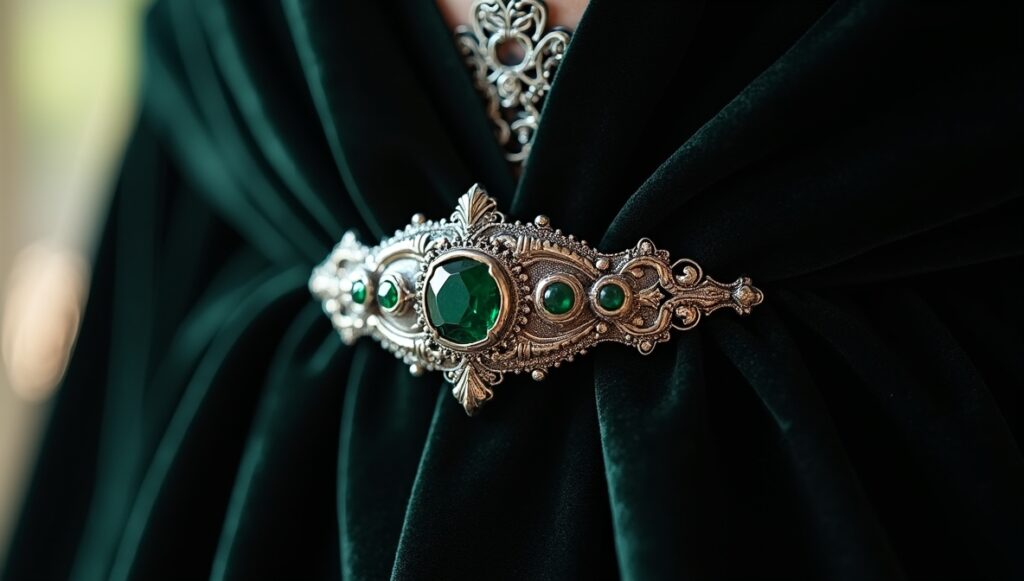
Innovations in the technology of working in metal increased the potential for elaborate ornament and mechanisms. Machine stamping and die-casting became widespread in the mid 1800s provided mass production of metal clasps with complex relief. As the Victoria and Albert Museum describes, ‘the rise of mass production in Birmingham and elsewhere revolutionised the availability of metal trimmings for dress. Women of the middle classes could buy dresses with the sort of metal fittings once reserved for the upper classes.’
Materials and Aesthetics: From Brass Utility to Gilt Display
Victorian cloak clasps were crafted from a rich palette of materials that reflected both technological innovation and shifting aesthetic taste. Common metals included brass, steel, and various copper alloys; higher-end examples used silver, silver-gilt, and occasionally gold. The Metropolitan Museum of Art’s collections show numerous 19th-century garment fastenings with stamped brass fronts and iron or steel backings—a pragmatic combination that balanced cost, strength and appearance.
Finish was also essential. As an affordable medium, base metals could be made to look costly via gilding, silvering and enamelling. In these contexts blackened steel, with its delicately lustrous tone and rust-proof nature, was a fashionable choice in the mid-19 th century, an echo of the dark-palette fashionable in accessories associated with the period of mourning following Prince Albert‘s death and the long-spanned mourning for Victoria. Cloak clasps made of gutta-percha, vulcanite or jet materials that carried a significant association with mourning jewelry are also represented in museum collections, injecting adornments for outerwear with a weight of association even more heavily loaded with grief18.

Design motifs followed the prevailing decorative trends of the time. The earliest Victorian clasps include floral sprays, acanthus scrolls and snail-shaped motifs popular in 18thcentury decorative arts and late Rococo and Regency styles; in the 1860sand 1870s, Neo-Gothic and Renaissance Revival designs appeared, with pointed arches, quatrefoils and medieval motifs. The holdings of the Smithsonian Institution describe fashionable 19th-century decorative arts as having “a historicist vocabulary of forms,” and clasps are no different. Some late Victorian examples are influenced by the Art Nouveau and Aesthetic styles popular in the 1880sand 1890s, with whiplash curves, stylized lilies and peacock feathers painted in black and white enamel on the metal.
Social Signals: Class, Gender and Occasion
A cloak clasp in Victorian Britain or France functioned as a coded signal, silently communicating the wearer’s social position and the context of use. Working-class men and women typically wore plain, functional closures—simple hooks, rings or bar clasps in unadorned metal. These might be purchased from local drapers or attached by home dressmakers. Their modesty aligned with the practical demands of factory work, domestic service, or rural labor; ornament for its own sake was a luxury.
Meanwhile the wealthy and noble cut a dash by the way they accessorized their evening cloaks with clasps as a mark of status. A well-to-do gentleman‘s night cloak to take in the opera at Covent Garden or the Paris Opera House would have a subtle ornate clasp in silver or gilt brass, perhaps engraved with a monogram or crest. Ladies’ dramatic cloaks, particularly to be worn in London, Paris, and St Petersburg during the social season had boldly decorated cloaks with repousse relief, inset enamels, or clusters of tiny paste or semi-precious stones.
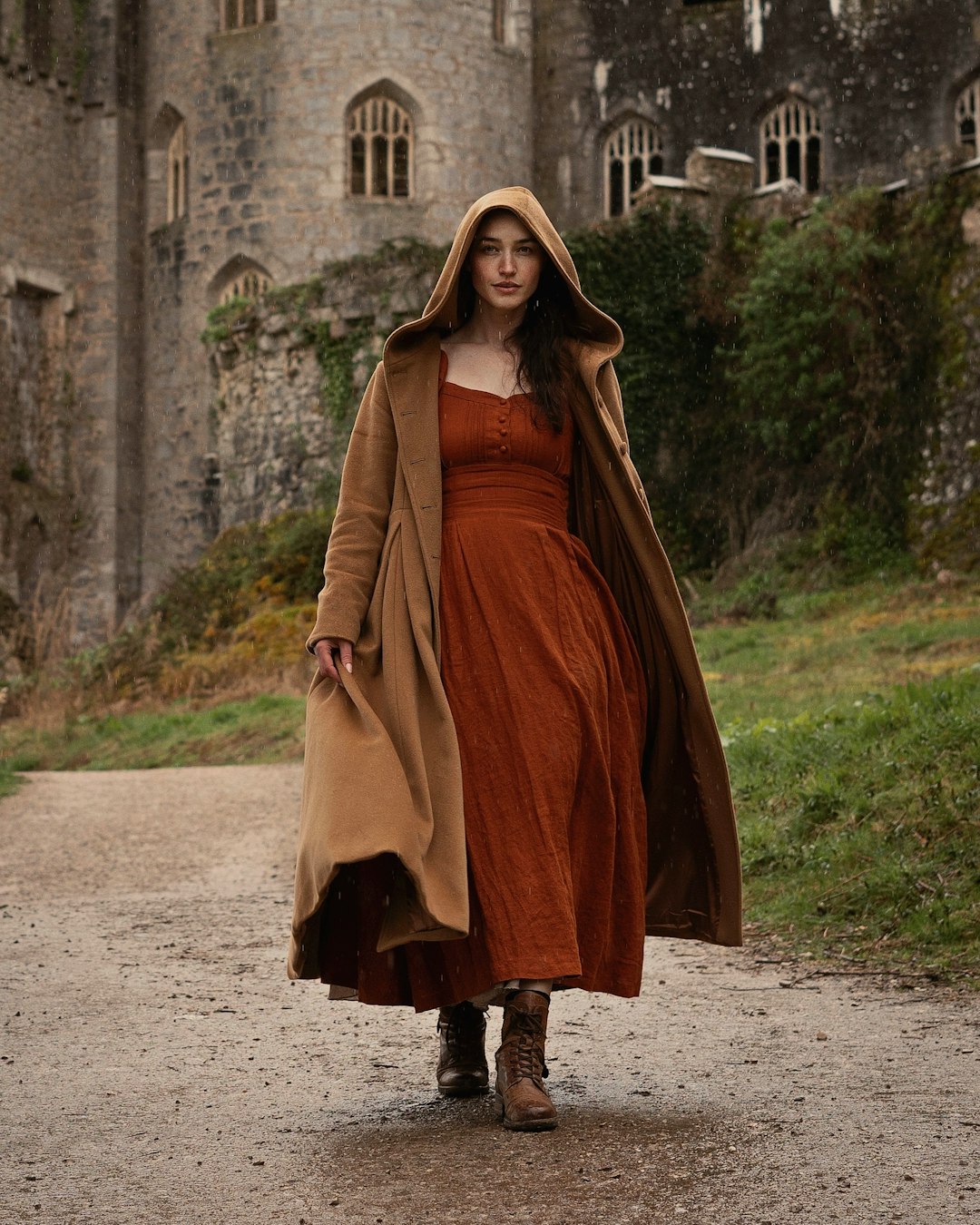
Gender defined both shape and prominence. Male clasps appear to demonstrate structural discursion, frequently being partly obscured by high necklines and overlapped front edges. Female cloak clasps seemingly provide an aesthetic focal point near the throat or bust level. The treasures of the costume collection at the Louvre show that “jewelled and metal fittings in women‘s dress of the 19th century helped to focus attention to areas of social and aesthetic importance” and this would have applied to the focal point of women‟s cloak fastenings.
Manufacturing, Trade and the Rise of Ready-Made Clasps
Behind the elegance of a Victorian cloak clasp lay a web of industry and trade. Britain’s metalworking centers—Birmingham, Sheffield, and parts of the Black Country—were major producers of small metal goods, including clothing fastenings. The Victoria and Albert Museum has documented extensive 19th‑century trade in “furnishings for dress,” ranging from buttons and buckles to hooks, eyes and clasps. Many were sold via wholesale warehouses in London’s commercial districts and exported across Europe and North America.
The economics of cloak clasps were revolutionized by the Process of industrialization; earlier closures may have been formed by hand in local smithies or by specialist workshop craftsmen. Half a century later, die-struck plates, machine-cut wire hooks and standardized designs saturated the market, making the provision of durable, cheaply and consistently made fastenings available to ready-to-wear cloaks at department stores such as Paris‘s Le Bon Marche or London‘s Whiteley‘s. Simultaneously, royal and haute couture commissions established ateliers‘s still requested specialized fittings from specialist workshop.

Images of transatlantic exchange are visible in the trade in materials. Industrialists in New England and Mid-Atlantic regions of America started to provide these new middle-class customers with the cloak clasps that were featured in women‘s magazines and trade catalogues. The Smithsonian Institution possesses a collection of 19th century trade cards and pattern books that shows closures were promoted both as functional upgrades and fashionable enhancements, with the engraving depicting a sophistication, strength, and contemporary design.
Table: Key Characteristics of Victorian Cloak Clasps
| Aspect | Common Features (c. 1837–1901) | Notes & Historical Context |
|---|---|---|
| Primary Materials | Brass, steel, copper alloys; silver, silver-gilt, jet, vulcanite | Industrial metalwork + specialized materials for mourning and luxury |
| Construction | Two-part interlocking units; stamped or cast plates; wire hooks | Mechanically produced components increasingly standard after 1850 |
| Surface Decoration | Repoussé relief, engraving, enameling, plating, stone setting | Motifs followed Rococo Revival, Gothic Revival, Renaissance Revival |
| Functional Design | Wide backing plates; multiple sewing holes; reinforced stitching | Designed to support heavy cloaks without tearing the fabric |
| Gender Differences | Men: plain, often partly hidden; Women: decorative, highly visible | Linked to Victorian ideals of masculine restraint vs. feminine display |
| Social Range | From utilitarian iron hooks to gem-set gilt or silver clasps | Accurately reflected class and wealth distinctions |
| Typical Placements | Throat, upper chest, sometimes multiple down front edges | Placement influenced silhouette and emphasis in the outfit |
| Production Centers | Birmingham, Sheffield, Paris, Vienna, New England workshops | Part of larger networks in metal fittings and fashion accessories |
Collecting and Studying Victorian Cloak Clasps Today
For historians, curators and collectors, Victorian cloak clasps serve as concise but information-rich artifacts. They often survive long after the fabrics they once secured have decayed, providing vital clues about lost garments. Institutions like The Metropolitan Museum of Art and the Victoria and Albert Museum hold numerous examples of 19th-century garment fasteners that, while small, shed light on manufacturing techniques, trade patterns and evolving aesthetics.
The V&A have also studied examples of clasps using magnification and iron as a means of identifying tool marks, the way they were plated, and even signs of repair or change. Such technical details allow the dating, workshop attribution or reconstruction of a garment‘s function. As an example, the V&A has catalogued 19thcentury dress trimmings noting that “it is often the minutest and most seemingly insignificant parts of a costume that provide more information about the working processes of fashion than anything else can.
Even among private collectors are occasional bits of brass or steel frame with nothing but a few clasp parts left, frequent in pooled assemblages of vintage jewelry or sewing items. When correctly classified they can reveal whether the attached garment belonged to an early, mid or late Victorian era, or to a British, French or Central European Style. Recognising the motifs, construction specifications and clasp techniques is crucial to differentiating between antique Victorian clasps and those new reproductions that look back to the 19th century.
Conservation, Attribution and Ethical Considerations
Caring for Victorian cloak clasps involves both materials science and ethical awareness. Many clasps combine dissimilar metals, organic elements (such as textile backings or leather reinforcements) and surface coatings, each with distinct conservation needs. Tarnish, corrosion and metal fatigue are common problems. Museums such as the Smithsonian Institution and the Metropolitan Museum of Art follow preventive conservation practices: stable environmental conditions, minimal handling, and, when necessary, reversible treatments.
Attribution identifying where and when a clasp was made is often problematic. Maker’s marks are less common on small fastenings than on larger pieces of metalwork, although hallmarks are occasionally evident on silver parts fashioned in London, Birmingham or Paris. Comparing relics with catalogued UK and European pieces in the V&A and other museums is frequently the only approach to make reliable attributions. Museums tended to generalise in their dating, using the standard phrase “European, 19th century” showing “a lack of certainty as well as accuracy”.
When clasps are stripped from garment and sold as jewelry or decorative objets d‘art, concerns often arise. Although there is no denying the teaching opportunities attached to independent clasps, how they sat upon an individual, and their social context are lost; contextualization. Top museums are now starting to advocate the preservation of entire ensembles wherever feasible, so that the garment may be regarded as a document of lived experience. (Valerie Steele).
Frequently Asked Questions
Were Victorian cloak clasps purely decorative, or mainly functional?
They were both. Functionally, they had to hold substantial weight and withstand movement and weather. Aesthetically, they served as visible indicators of taste and status, especially on women’s cloaks and formal outerwear. As the Victoria and Albert Museum’s curators often note in catalog entries, 19th-century clothing components “fused utility with ornament in ways that embodied the ideals of the period.”
Did all Victorians use specialized cloak clasps, or were simple hooks common?
Simple hooks, eyes and ties remained widespread, particularly among the working classes and in rural areas. Specialized, ornamented cloak clasps became more common in urban middle- and upper-class wardrobes, where ready-made trimmings and metal findings were more readily available through department stores and drapers’ shops in cities like London, Paris and Boston.
How can I tell if a metal clasp is genuinely Victorian?
Dating requires examining materials, construction and design. Genuine Victorian clasps often show hand-finishing over machine-stamped bases, age-appropriate wear, and motifs consistent with 19th-century decorative styles. Consulting museum collections—such as online databases from The Metropolitan Museum of Art, the Victoria and Albert Museum or the Louvre Museum—provides useful comparanda. When in doubt, seek an assessment from a specialist in antique dress accessories.
Were cloak clasps different in Britain and continental Europe?
Yes, though there was significant cross-fertilization. British examples often reflect industrial Birmingham metalwork and understated forms, while French and Central European clasps more frequently incorporated high-style historicist motifs and elaborate enameling. Trade and travel blurred many boundaries, however, and imported clasps circulated widely through European and American markets in the late 19th century.
Are Victorian cloak clasps still used or reproduced today?
Modern costumers, reenactors and designers frequently draw on Victorian clasps as inspiration. Reproductions in brass, pewter or alloy are sold for historical dress and fantasy costumes. These usually differ from originals in casting quality, weight and patina. Original Victorian clasps are collected both as dress history artifacts and as components in jewelry making, although many museum professionals caution against repurposing historically significant pieces.
Conclusion
The Victorian cloak clasp may be no larger than a thumbprint, but it condenses an entire world of 19th-century experience—industrial innovation, class distinction, gendered display and the romance of travel and ceremony—into a single point of contact between fabric and body. Viewed through the lens of institutions like the Metropolitan Museum of Art, the Victoria and Albert Museum, the Louvre and the Smithsonian, these modest fastenings emerge not as trivial adornments, but as precise, enduring witnesses to how Victorians chose to be seen, and how they held their changing world—quite literally—together.
AI Notice: Some visual content in this article may have been created or enhanced using artificial intelligence (AI) for artistic, editorial or illustrative purposes. Learn more about our approach in our AI & Editorial Principles.