
Rococo Interior Decoration: A Complete Expert Guide to the Most Playful Style in European Design
Rococo interior decoration is the moment in European design history when rooms stopped taking themselves so seriously. Born in early 18th‑century France and spread across palaces, salons and townhouses from Paris to Munich, it turned heavy Baroque grandeur into light, intimate, and exquisitely detailed spaces. To understand rococo interiors is to understand how elite Europeans actually lived—how they entertained, flirted, read, and relaxed in rooms designed not for state ceremony, but for pleasure. This guide explains what defines rococo interior decoration, how it developed, how to recognize it instantly, and how its principles still shape contemporary design.
Quick Answer: What Is Rococo Interior Decoration?
Rococo interior decoration is an 18th‑century European style characterized by lightness, asymmetry, pastel colors, curved lines, and intricate ornament inspired by shells, foliage, and fantasy. It emerged in Paris around the 1710s–1720s, flourished under Louis XV, and spread to courts and cities across Europe, especially in France, Germany, Austria, and Italy.
Can You Name the Masterpiece?
Ten masterpieces. Ten questions. How well do you know the history of art?
Where Baroque interiors are bold in conception, building on an overall symmetry in the design, and have an air of grandeur (monumental) and theatrical, rococo rooms can be considered to be small-scale, playful and intimate in scale. In these rooms stucco work, wood panelling (boiseries) with scrolls and shells, large mirrors frameless in the design in order to reduce the room walls, spectacular chimneypieces with all its gilt carving, and decorative arts – furnishing, textiles, porcelain, and painting, being yet again one integrated entity.

But in contemporary usage rococo is still a comfort zone for design that aims to be luxury without heaviness. Its broader motifs–the soft pastels, the sinuous lines, the pirouetting surfaces, the idea of flow and flight–are heavily borrowed by numerous highend homes, small hotels, and fashion-based interiors in willfully modern reconstructions.
Historical Origins: From Baroque Power to Rococo Pleasure
Rococo interior decoration emerged in France after the death of Louis XIV in 1715, as the court moved away from the formal, ceremonial life of Versailles to more relaxed urban residences in Paris. The Metropolitan Museum of Art notes that the regency of Philippe II, Duke of Orléans, was a turning point in taste: court society wanted private salons and boudoirs instead of vast throne rooms, and a style that matched this more intimate social world. Designers such as Gilles‑Marie Oppenord and Juste‑Aurèle Meissonnier began to soften Baroque forms, introducing playful curves and intricate ornament.
Can You Guess the Artist?
Three clues. One artist. How quickly can you identify the painter?
By the 1730s and 1740s Louis XV had popularized rococo in the grand salons of the best French interiors. Gentlemen‘s city mansions (hotels particuliers), such as the Hotel de Soubise, ambitious interiors were meticulously and expansively paneled in carved boiseries, gilded the mounting, with paintings inserted over the adjoining doors. The Louvre and the Musee Carnavalet house important rococo interiors and panels that reveal how these rooms were truly integral to their use as a complete environment. Once labeled a passing trend, this rococo, as displayed in modern museums such as the V&A has become recognized as a pivotal era that affected the entire scope of art history.
The style was adopted quickly throughout Europe as high society and courts emulated the French. In southern Germany and Austria the style was appropriated in a particularly vigorous stucco tradition in churches and palaces such as the Amalienburg at Nymphenburg Palace in Munich, and the Wurzburg Residenz. Italian cities such as Venice, and Spanish Bourbon courts in Madrid and Naples, also applied rococo motifs to local materials and traditions. All of these interiors can be distinguished by their common characteristics of curving forms, exquisitely detailed decoration and the urge to stimulate all sensations, to enclose the viewer within a sensuous environment.
Defining Features: How to Recognize a Rococo Interior
Rococo interiors are immediately recognizable by their use of curves—there is almost no strict right angle in sight. Walls are broken up by projecting panels, mirrored surfaces, and rounded corners; ceilings flow into cornices and wall decoration through seamless stucco scrollwork. The basic structural framework of the room is often concealed by ornament, making the architecture feel like a continuous, softly animated envelope. The Musée du Louvre describes this effect as “architecture dissolved in decoration.”
Color is also an important part of the effect. Color schemes associated with the Rococo are characterized by light, translucent tones: light azure, white, pink, green, sprinkled with gold leaf. These are complemented by painted decoration: puffy clouds, birds, puther, and chinoiserie, and further contribute to a feeling of gaiety. Unlike most Baroque rooms which often used washing reds and blacks, many rococo rooms relied upon the quality of their light, which was regularly dulled or brightened depending on the time of day and candle lighting. Large mirrors were used to reflect the light, and to create an illusion of space behind them.

Finally, and here the concept that generalizes hyperstylization becomes irrefutable, the rococo interiors can be defined by the synthesis of the decorative arts: furniture, textiles, porcelain, metal work and painting can be especially conceived for the space and stylistically unified. In a salon furnished in mid 18 th century Paris one can find hammered gilt boiseries, a marble chimneypiece with giltbronze mounts, canape sofas upholsterer in silk damask, Sevres porcelain on console tables, abovedoor paintings by prominent artists. TheVV&A insist of the European decorative arts galleriesUevoke rhythmically the fact that the effect of a rococo space is as much about life style, the orchestrated setting of display and comfort.
Key Elements of Rococo Decoration (Table)
| Element | Typical Features | What to Look For in Interiors |
|---|---|---|
| Overall Form | Asymmetry, curves, flowing lines | Few straight lines; scrolling wall panels; curved doors |
| Ornament Motifs | Shells (rocaille), foliage, C‑ and S‑scrolls, flowers, putti | Carved or stucco shells, leafy scrolls, floral garlands |
| Color Palette | Pastels (blue, green, pink), ivory, white, gilding | Light walls, gilded details, harmonious soft colors |
| Materials | Stucco, carved wood (boiserie), giltwood, marble, mirrors | Paneled walls, elaborate moldings, mirrored panels |
| Furniture | Serpentine fronts, cabriole legs, scrolling arms and backs | Light‑looking pieces, often gilded or lacquered |
| Ceiling Treatment | Painted scenes, stucco frames, illusionistic clouds | Sky or mythological scenes framed by stucco scrollwork |
| Light & Reflection | Large mirrors, crystal chandeliers, reflective surfaces | Mirrored overmantels, sparkling pendants, glass |
| Decorative Arts | Porcelain, lacquer, silver, tapestries, silk textiles | Coordinated sets; display on consoles and brackets |
Iconic Rococo Interiors and Where to See Them
Many of the greatest rococo interiors survive in situ, offering a direct sense of how the style functioned. In France, the Hôtel de Soubise in Paris preserves some of the finest rococo salons, with carved and gilded boiseries that virtually define the style. At Versailles, the Petit Trianon, created for Madame de Pompadour and later inhabited by Marie Antoinette, contains more restrained late‑rococo and early neoclassical interiors that show the transition away from the style’s height. The Louvre displays important rococo paneling and furniture removed from demolished Parisian houses, allowing close study of carving and finish.

In Germany and Austria the sacral and courtly rococo can be identified in the Wieskirche in Bavaria, of the churches by the Asam brothers in Munich, and in the Amalienburg at Nymphenburg. Here the interior translated the French salon, now into a more ecstatic, spiritual key in which the stucco sculpture is more three-dimensional, light more much more ethereal, a sense that architectural boundaries dissolve into clouds, angels, and gilded rays. The Wurzburg Residenz, with Balthasar Neuman and Giovanni Battista Tiepolo, and the Mirror Cabinet and staircase are the perfect examples of Central European rococo.
Rococo interiors can, of course, be found in museums. The Metropolitan Museum of Art, New York, and the Victoria and Albert Museum, London, each have a whole period room built from eighteenth-century boiserie and furniture. Entering the Brooklyn Museum’s ‘Rococo Revival Parlor’ or theV&A’s famous eighteenth-century French period rooms provides overwhelming spatial and decorative intensities. The Smithsonian Institution’s Cooper Hewitt, Smithsonian Design Museum, owns over ten thousand drawings and designs by rococo architects and ornament designers, making the fact that these were not improvisations all the more apparent.
Techniques, Craftsmanship, and Materials
Rococo interiors depended on highly specialized crafts that blurred the line between architecture, sculpture, and painting. Wood paneling (boiserie) was carved by menuisiers and sculptors, then gessoed, painted, and often gilded with gold leaf. Stucco workers (stucateurs) executed elaborate scrolls, shells, and figures that projected from walls and ceilings. These elements were designed to integrate seamlessly with painted panels, mirrors, door frames and chimneypieces. The precision with which these crafts were coordinated is one reason rococo rooms feel like total works of art.

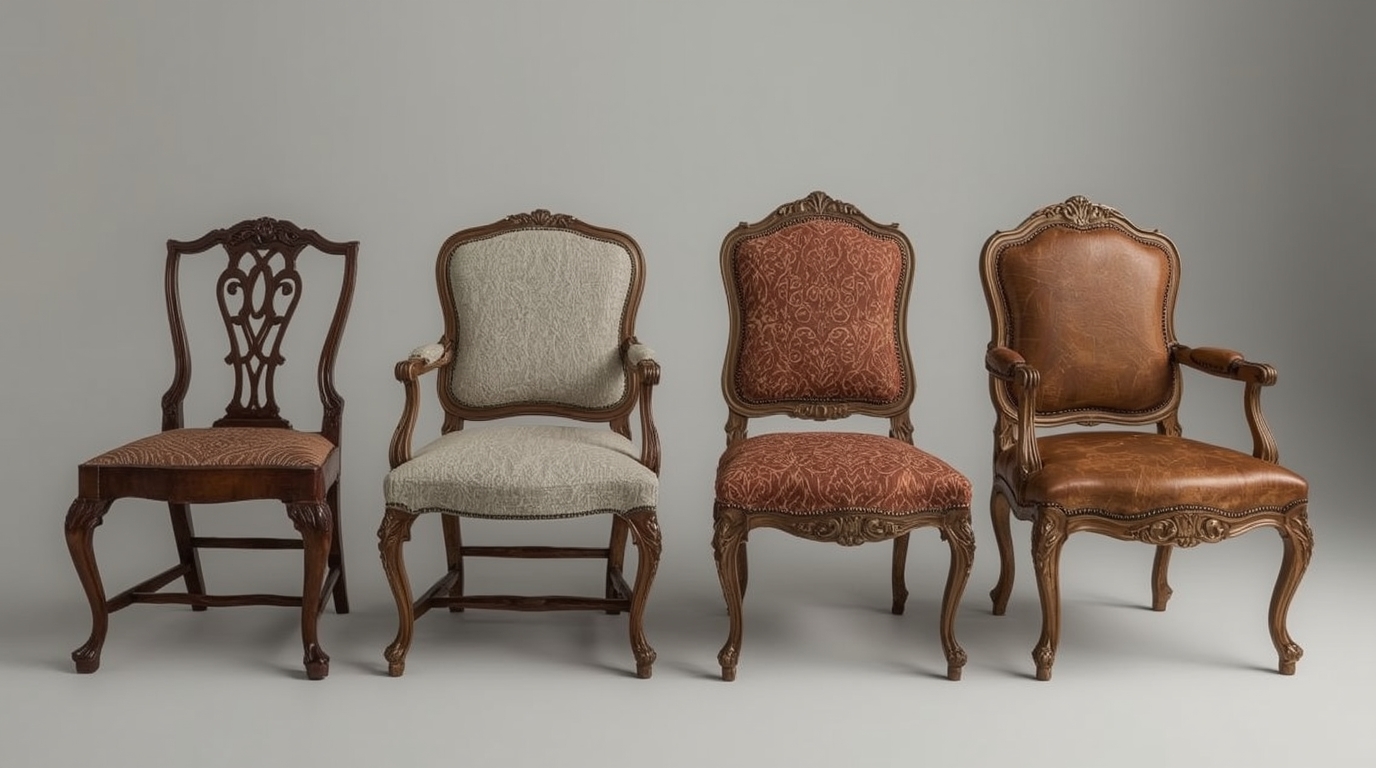
Furniture making did reach a new height of refinement during the rococo. French ebenistes including bernard II van rispen and jeanfrancois oeben produced commodes, secretaries, and tables with bombe (bulging) fronts, marquetry veneers, and giltbronze mounts that mimicked the curves of the room’s architecture. Upholstered seats including fauteuils, bergeres, canapesans were of use both as objects of sociability and as sculptural ones by virtue of their smooth spheres of stuffed fabric and sumptuous textiles. Examples from the Victoria and Albert Museum collections elucidate the extent to which these pieces had been both.
Surface effects and color effects equally vital. Walls would be softened by drawing on light shades, with gilding used sparingly to highlight the relief to add sparkle in flickering candle light. Painted panels could show chinoiserie, landscapes, mythic love-embracing scenes, and trappable flowers. Porcelain, in particular from Sevres, Meissen, served not only as ornament but as another degree of color and gloss. As the Met‘s online essays on the rococo reveal, the purpose was to glisten.. its materials all contributing delicate optical effects in daylight and candlelight too.
Cultural Meaning: Rococo Interiors and 18th‑Century Life
Rococo interiors were not simply decorative; they expressed changing social and intellectual currents of the 18th century. The shift from grand state apartments to smaller salons and private rooms mirrored the rise of salon culture, where conversation, literature, music, and flirtation flourished. Rooms like the Salon de la Princesse in the Hôtel de Soubise were designed to host intimate gatherings rather than official ceremonies. Their decoration—light, playful, often erotic or pastoral—suited a world in which pleasure and wit were central social currencies.
In terms of themes, rococo interiors resorted to pastoral, mythological and exoticized scenes in order to provide elegant escapes. Wall paintings by the likes of Francois Boucher and JeanHonore Fragonard depicted scenes of lovers, nymphs, shepherds and mock-Oriental creatures. The Smithsonian Institution‘s exhibitions have pointed out that chinoiserie, the most significant motif of rococo decoration, was indicative both of a real curiosity about Asia and a projection of fantasy, influenced by trade, colonialism and literature. These were spaces for aristocratic society to imaginatively step beyond court ceremony and social rigidity.
Meanwhile, rococo was falling out of fashion for its triviality and immorality. By 1750s and 1760s that railed against rococo‘s asymmetry, excessiveness and decadence of aristocratic lifestyle. These tendencies were invigorated by excavations of Herculaneum and Pompeii, as well as revived interest in Greek and Roman ‘simplicity’. However, as the Louvre and V&A highlighted in recent research, while rococo‘s decorative style failed to continue on into the 19 th-century, its ideas of comfort, intimacy and experiencestyle were rooted in the modern?
Rococo Influence on Modern and Contemporary Interiors
Although pure rococo fell from favor in the late 18th century, its influence has resurfaced repeatedly. The 19th century saw a “Rococo Revival,” especially in the 1830s–1860s, when designers revisited the style for bourgeois parlors, theaters, and luxury hotels. Institutions like the Met and the V&A preserve many objects from this period, showing how industrial techniques were used to mass‑produce rococo‑inspired ornament. While critics sometimes dismissed this as mere pastiche, it underscores the lasting appeal of rococo’s lightness and curvature.
In the 20th and 21st centuries, designers have selectively borrowed from rococo to create interiors that balance historical reference with contemporary sensibilities. Elements such as ornate gilt mirrors, curving chairs, and delicate stucco moldings are often paired with plain walls and modern art, creating a dialogue between minimalism and ornament. High‑end hotels, boutiques, and restaurants frequently use rococo motifs to signal luxury and theatricality. The key difference is that today, these are conscious quotations rather than default taste, allowing for playful, ironic, or subversive uses.
Contemporary scholars and curators also reassess rococo through new lenses, including gender, class, and global exchange. The Smithsonian and other institutions have explored how rococo interiors were often associated with female spaces—boudoirs, dressing rooms, salons—and how this association influenced the style’s later marginalization as “feminine” or “frivolous” in contrast to “rational” neoclassicism. Similarly, the role of colonial trade in supplying porcelain, lacquer, textiles, and exotic woods is now central to understanding these interiors as products of a global 18th‑century economy.
Authoritative Quotes and Sources
- The Metropolitan Museum of Art describes rococo as “a style of art and decoration characterized by its intricate ornament, asymmetry, and emphasis on themes of love, nature, and lighthearted entertainment” (The Met, Heilbrunn Timeline of Art History).
- The Victoria and Albert Museum notes that “rococo design sought to create unified, harmonious interiors in which architecture, furniture and objects were conceived together as a complete work of art.”
- The Louvre Museum emphasizes that “in the rococo interior, architecture tends to disappear behind an enveloping decorative skin, where stucco, paneling, mirrors and painting merge.”
Key institutional resources for further reading include:
- The Metropolitan Museum of Art – Heilbrunn Timeline essays on Rococo Art and 18th‑Century France.
- Victoria and Albert Museum – European 1600–1815 galleries and online collections.
- Louvre Museum – Department of Decorative Arts, 17th–18th centuries.
- Smithsonian Institution – Cooper Hewitt, Smithsonian Design Museum collections and research on ornament and pattern.
Frequently Asked Questions about Rococo Interior Decoration
1. What is the difference between Baroque and Rococo interiors?
Baroque interiors are generally symmetrical, monumental, and focused on dramatic contrasts and religious or dynastic themes. Rococo interiors are smaller in scale, more intimate, and emphasize lightness, asymmetry, and playful or romantic subjects. Baroque uses bold color and heavy forms; rococo favors pastels, delicate ornament, and curving lines.
2. Is Rococo the same as Louis XV style?
“Louis XV style” broadly corresponds to the high rococo period in France (roughly 1723–1774), especially in furniture and interiors. However, not all Louis XV objects are strictly rococo; there were transitional phases, regional variations, and more restrained works. In practice, dealers and museums often use “Louis XV” to signal French rococo design.
3. Which countries have the best preserved Rococo interiors?
France, Germany, and Austria have some of the most important rococo interiors. In France, look to Parisian hôtels particuliers and Versailles’s satellite buildings; in Germany and Austria, to rococo palaces and pilgrimage churches (for example, the Amalienburg in Munich, the Würzburg Residenz, and the Wieskirche). Italy, Spain, and Central Europe also preserve significant examples.
4. Can Rococo work in a modern home?
Yes, but usually in a toned‑down, selective way. Many contemporary interiors borrow single elements—an ornate mirror, a curved sofa, decorative moldings—and combine them with neutral walls and modern lighting. The most successful modern interpretations prioritize rococo’s principles (lightness, curves, visual flow) rather than copying full historical schemes.
5. How can I identify authentic Rococo furniture and paneling?
Authentic 18th‑century rococo furniture typically has hand‑carved detail, irregularities that reflect craftsmanship, signs of age in finishes, and high‑quality woods and bronze mounts. Original boiseries show evidence of period construction methods and layers of historic paint or gilding. Museums, auction houses, and connoisseurship guides (such as those published by the Met or V&A) are invaluable for comparison.
Conclusion
Rococo interior decoration crystallized a moment when European elites reimagined how rooms could look, feel, and function. Moving away from Baroque grandeur, it created environments of intimacy, pleasure, and sensory refinement, uniting architecture, furniture, painting, and objects into seamless works of art. Preserved in palaces, churches, and museums from Paris to Munich—and continually reinterpreted in contemporary design—rococo remains one of the most sophisticated and influential approaches to interior decoration. Understanding its history, techniques, and meanings not only clarifies an important chapter in art history, but also enriches how we think about comfort, beauty, and experience in the spaces we inhabit today.
AI Notice: Some visual content in this article may have been created or enhanced using artificial intelligence (AI) for artistic, editorial or illustrative purposes. Learn more about our approach in our AI & Editorial Principles.