
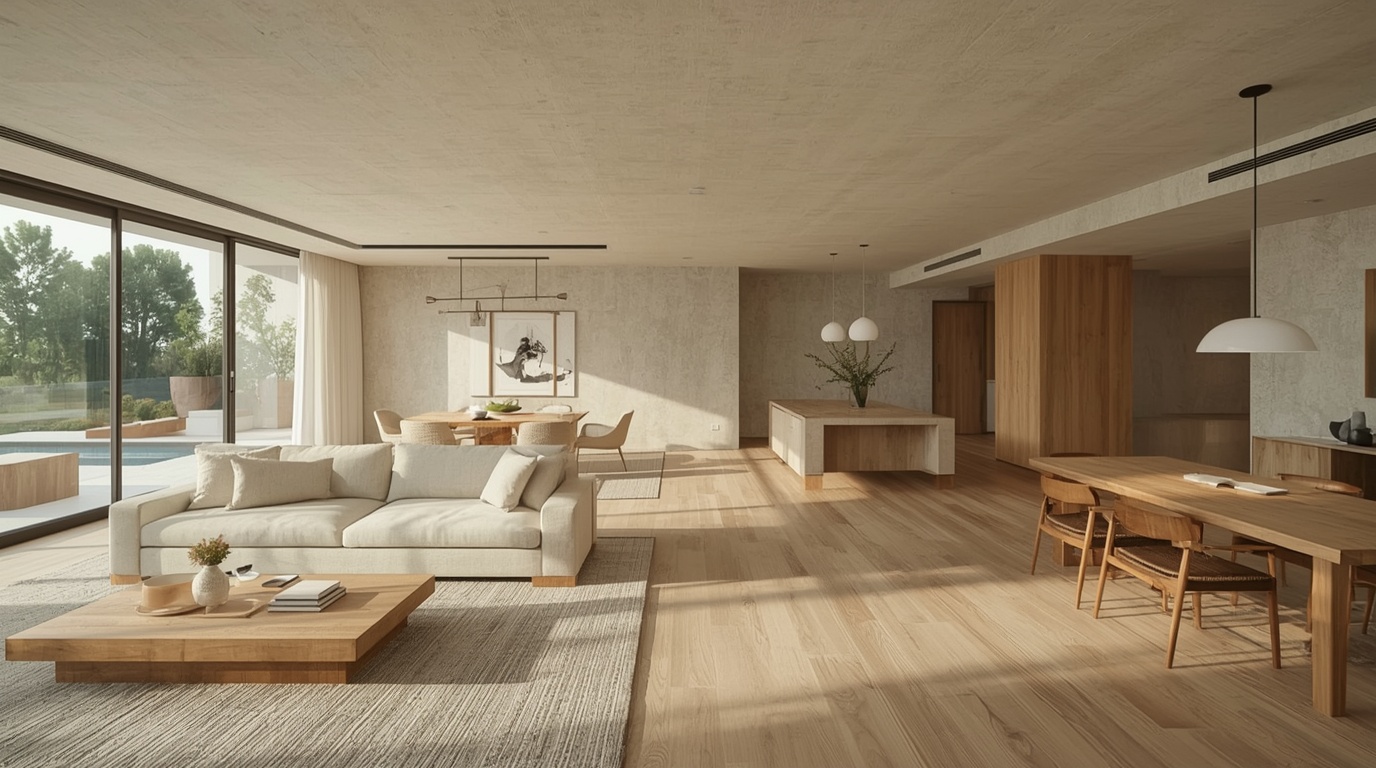
There is a particular kind of silence that arrives in a Japandi room.
Not the cold, echoing quiet of emptiness, but a dense, velvety hush—the sound of subtraction. You cross the threshold and feel it first in your shoulders, which drop a fraction; then in your breath, which lengthens without permission. The room does not perform for you. It invites you to lower your voice, and then, almost imperceptibly, to lower your guard.
Japandi—this cross-cultural whisper between Japanese and Scandinavian design—has become a mood more than a style. It’s the aesthetic of Sunday mornings and slow winters; of open books and bare feet on pale timber. In an age of relentless glare and notification anxiety, Japandi offers something radical in its softness: an interiors language that speaks to our need for both clarity and comfort, stillness and soul.
Beneath the pale woods and soft linens, however, lies a far more intricate story—a quiet choreography of ideas about time, beauty, and the human psyche.
Two Quiet Traditions, Meeting in the Half-Light
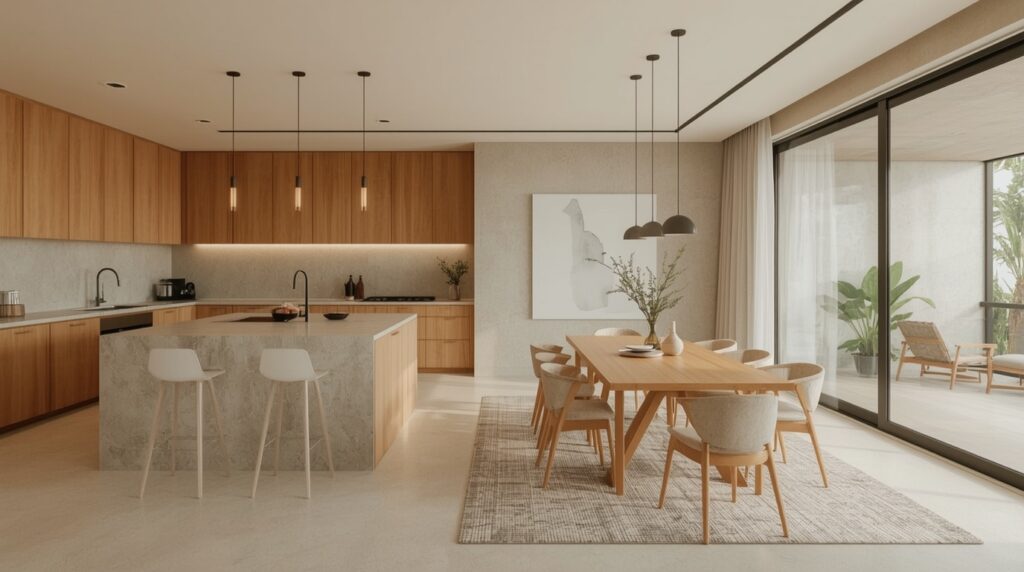
If you listen closely, Japandi is less a trend than a conversation between climates, philosophies, and ways of seeing.
From Japan comes the ritualised austerity of Zen: rooms that hold space like a held breath, where emptiness is not a lack but an active presence. Tatami floors, shoji screens, alcoves for a single flower—these were never merely design choices but spatial poems about ephemerality and restraint. The Japanese concept of ma—the meaningful pause, the space between—is inscribed in every expanse of unfilled wall, every uncluttered surface. It is what a pianist might call “the music between the notes.”
From Scandinavia, another climate of thought: long winters, short days, and an almost political insistence that beauty must be domestic, democratic, lived with. Nordic modernism rejected decoration for its own sake, championing instead the warmth of timber, the generosity of natural light, the pared-back dignity of functional forms. Its emotional center is hygge: intimacy, togetherness, the emotional utility of a well-worn mug and a wool blanket as daylight fades at 3 p.m.
Japandi lives at the point these two sensibilities overlap: a Venn diagram of light and shadow, rigor and softness, meditation and everyday comfort. One tradition refines; the other reassures. The result is an interior language that feels both disciplined and human, like a well-tailored coat lined in cashmere.
The Psychology of a Calm Room
Why do people, already drowning in design options, keep returning to Japandi’s soft minimalism? Because it stages a quiet protest against our mental clutter.
Neuroscience has caught up with what monks and craftspeople have long known: our surroundings script our inner monologues. Chaotic rooms amplify internal noise; visual disorder pulls on the mind like static. Japandi’s characteristic restraint—fewer objects, quieter colours, functional clarity—acts as a psychological noise-cancelling device.
But it is not the harsh minimalism of blank white boxes and echoing spaces. Japandi replaces sensory overload with sensory nuance:
- Tactile calm: Smooth wood, coarse linen, the almost-grain of handmade ceramics. These are materials that ask to be touched, not scrolled past. Touch pulls us into the present in a way screens never do.
- Visual softness: Muted palettes—stone, chalk, oat, ink, smoke—ease the constant micro-decisions the eye makes. Your gaze can rest, glide, pause; it is no longer forced to fight for focus.
- Spatial breathing: Carefully edited objects against generous areas of emptiness leave room for attention to land and remain. In Japandi, the most important element is often what has been deliberately left out.
Psychologically, such spaces offer a form of gentle containment. They acknowledge the unquiet of the external world and respond not with escapist fantasy, but with a quieter stage on which your own thoughts may finally step forward, unshouted.

The Colour of a Whisper
Japandi’s palette is often described as “neutral,” a term that does it a disservice. These are not the bland beiges of corporate lobbies, but the nuanced tones of a remembered landscape.
Think of the colour of river stones after rain; the grey of winter light on water; the palest cedar, bleached by years of touch. In a Japandi living room, walls may sit in a soft clay or warm greige, while the floor holds the fresh, honeyed grain of ash or oak. Black is used sparingly, like ink on handmade paper—framing, grounding, underlining.
There is a psychological cunning in this restraint. Bright colour excites, accelerates; it can energise but also exhaust. Japandi chooses the long game: hues that you do not tire of sharing oxygen with. Shades that absorb the day’s emotional fluctuations without triggering new ones.
Symbolically, these quiet colours work like fog: they soften the edges of things, making the room feel less like a stage and more like a sanctuary. In an era obsessed with self-display, Japandi offers something far more subversive: an invitation to be unobserved, to disappear peacefully into your own space.
The Poetry of Imperfection: Wabi-Sabi Meets Nordic Honesty
At the heart of Japandi lies a shared reverence for authenticity—edges left slightly raw, the mark of the tool still visible, the story of the hand that made.
From Japan comes wabi-sabi: the bittersweet appreciation of imperfection, transience, and the modest. A hairline crack in a tea bowl becomes not a flaw but a record of time’s passage; a weathered wooden beam holds the soft authority of age. In Nordic craft, too, there is a kind of stubborn honesty: knots in the wood, visible grain, joinery that reveals itself without ornament or disguise.
Japandi fuses these into an ethics of beauty. The table might be planed smooth but retain the irregular outline of the original tree. The ceramic vase might be asymmetrical, the glaze pooled and thinned unpredictably. Linen drapes with a permanent, gentle crease, refusing military crispness.
Psychologically, these details are important. In a culture obsessed with airbrushed perfection, spaces that honour the worn, the weathered, the not-quite-symmetrical offer deep relief. They whisper that life may be allowed to show on your surfaces. They make room for our own imperfections to exist without assault.
There is a quiet symbolism here: the home as a place where things and people are permitted to age, to change, to bear marks of experience without needing to be replaced or concealed.
Furniture as Low Murmurs
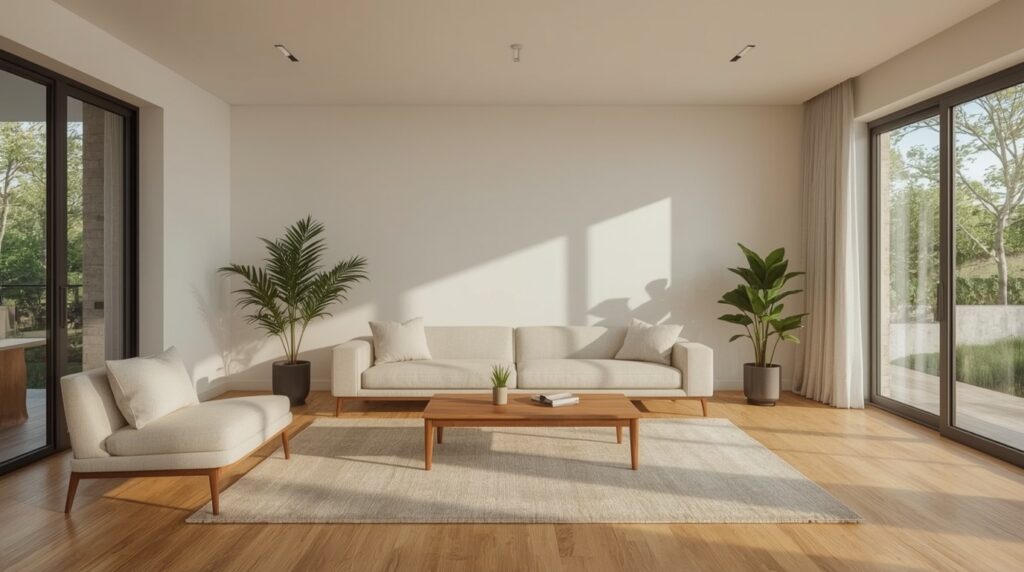
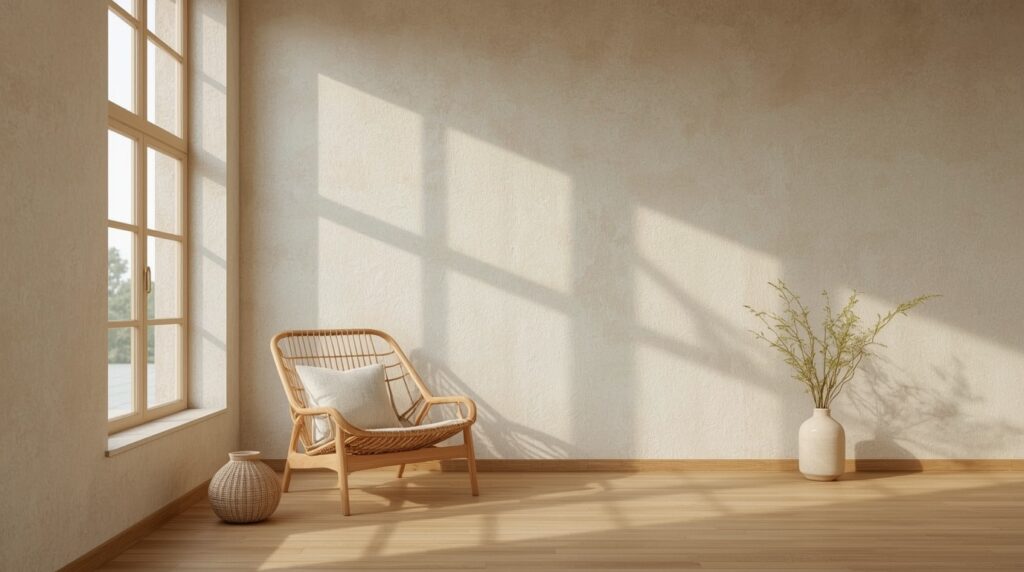
Japandi furniture tends to sit low, close to the ground, as if on speaking terms with gravity. Sofas with modest legs, low tables, cushions or simple upholstered benches replace thrones and pedestals. The horizontal line dominates; verticality is tempered.
There is psychology in this lowering of the silhouette. Low seating changes posture—hips relax, the spine curves slightly, conversation angles inward. You become less performance-ready, more receptive. The room does not elevate you above anything; instead, it tucks you into the landscape of the floor.
Forms are stripped to their essence: a chair is lines, planes, joints. A bed is a platform, not a drama. But this simplicity is not the cold reduction of industrial minimalism. The Scandinavian lineage ensures ergonomics and comfort; the Japanese influence preserves the meditative elegance of geometric clarity.
Look closely, and each piece becomes a quiet metaphor: the unadorned chair as an invitation to presence, the modest table as a stage for a single ritual—tea, a book, a vase of winter branches. In Japandi, furniture is not a declaration of status but a choreography of daily gestures.
Light Like a Soft Thought
Light is where Japandi becomes cinematic. It is not blasted into the room but filtered, folded, stroked across surfaces.
Daylight arrives diffused: through sheer curtains that turn windows into soft screens, or across pale walls that catch and scatter it. Shadow is not an enemy to be vanquished, but a collaborator. Corners are allowed to remain duskier, recesses to hold pools of gentle dark. The effect is not gloom but depth: a room with a narrative of light, from morning’s thin silver to dusk’s amber thinning.
At night, lighting drops to the level of conversation and reflection. Paper lanterns, linen shades, bare bulbs softened by tinted glass—all casting quiet, localised halos. There is little appetite for overhead glare. Instead, light becomes situational: a lamp beside the reading chair, a candle on the low table, a glow along a shelf.
Psychologically, this calibration of light in Japandi interiors moves us from productivity to presence. The room refuses the relentless brightness of the office or the showroom. It suggests that here, your role is not to perform but to inhabit.
Rituals in the Everyday Object
Japandi spaces are famously “decluttered,” but this is not the sterile emptiness of an impersonal lobby. It is a careful curation in which each remaining object is promoted to the role of quiet protagonist.
A single branch in a rough vase can carry the entire narrative of a room: season, texture, gesture. A wooden tray near the entrance gathers keys, phone, wallet—turning the daily shedding of burdens into a miniature ritual. A teapot and two cups on a low table anticipate conversation, even when no one is there.
This is where Japandi’s psychological intelligence shines. By drastically reducing the number of objects, it increases the symbolic weight of those that remain. Your eye, no longer overfed, lingers. Suddenly, the grain of the dining table, the curve of a chair’s back, the handmade wobble of a mug become small, persistent pleasures.
Rituals anchor the day. Making tea, opening curtains, folding a blanket—Japandi does not glamorise these actions but gives them a stage. In doing so, it quietly repositions domestic life not as the backstage of “real” productivity, but as the realm where meaning is rehearsed and felt.
The Sound of Soft Footsteps: Sensory Layers
Although often photographed as a visual style, Japandi is profoundly multisensory.
There is the sound: the faint thud of bare feet on wooden planks, the soft rasp of linen, the clink of ceramic on wood. Without jangling patterns and buzzing devices, small sounds regain dimension and presence. Even silence itself becomes textured.
The air, too, shifts. Natural materials breathe differently from synthetics; they hold and release warmth, they carry faint scents—the tang of oiled wood, the mineral smell of clay, the ghost of last night’s candle. Japandi often folds in discreet botanicals: a sprig of eucalyptus, a pot of rosemary on the sill, an arrangement of dried grasses. The room smells not perfumed but quietly alive.
Even temperature plays a role. Understated textiles—wool throws, cotton cushions, tatami or jute rugs—invite seasonal adjustments. A Japandi room is not hermetically climate-controlled but layered, adaptable, tuned to weather as much as to mood.
All of this pulls the inhabitant out of the abstract and into the sensory now. In a world where so many experiences are mediated through screens, the simple physicality of a Japandi interior—the feel of a mug, the give of a cushion, the grain under fingertips—is not trivial; it is antidotal.
Why Japandi Speaks So Clearly to Our Time
It would be easy to dismiss Japandi as just another aesthetic cycle, a Pinterest-ready fusion destined to pass. But its persistent allure suggests something deeper.
We live with multiple anxieties: environmental, technological, existential. Our homes, once merely shelters, are now offices, classrooms, studios, even hospitals of the spirit. Under such pressure, design that shouts about novelty can feel hollow. Japandi, by contrast, is almost suspicious of the new; it favours the enduring, the repairable, the quietly made.
Its emphasis on natural materials aligns with a cultural hunger for sustainability, but goes beyond the checkbox of eco-consciousness. Wood, clay, linen, wool—these are not only less harmful; they remind us, tactually, of our continuity with the natural world. They restore a scale of time that is slower than the upgrade cycle of devices.
On a psychological level, Japandi scratches an itch for coherence. In a fragmented information landscape, it offers a spatial narrative that makes sense: every object has a purpose, every decision a reason, every empty space a role. The home becomes, in effect, a manifesto written in timber and light: this is what I choose to value, this is what I allow in.
And culturally, the fusion itself matters. Japandi suggests a way of borrowing across borders that is not superficial but dialogical. It respects that traditions can meet not in a collision of clichés, but in a shared commitment to human needs: calm, beauty, touch, time.
The Room as a Quiet Mirror
In the end, the fascination with Japandi interiors is not about chairs or colour charts. It is about who we become in their presence.
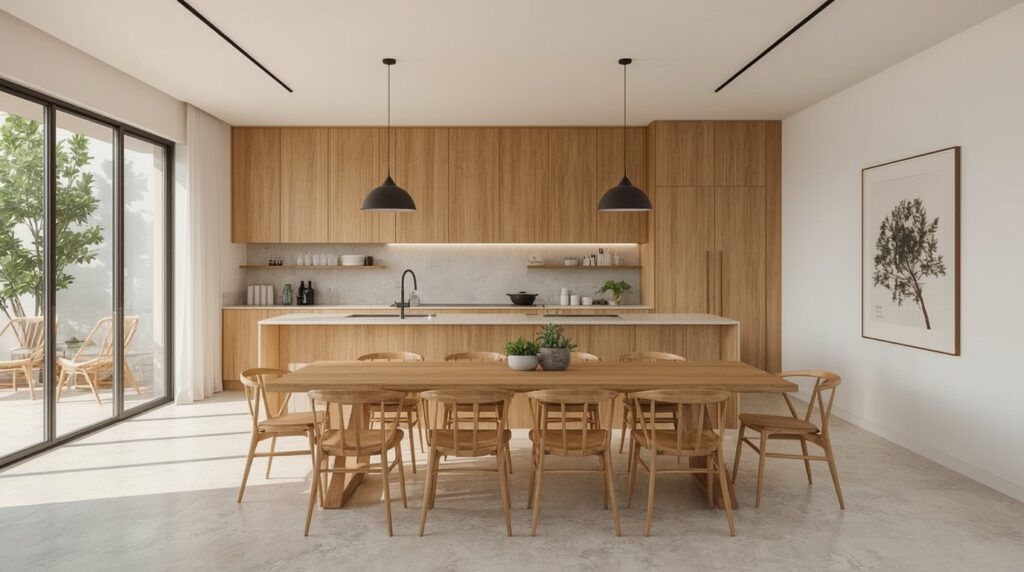
In a Japandi bedroom, with its low bed, softened light, unbusy walls, you may find that sleep comes more easily—not because the room is “on trend,” but because it has been stripped of the visual and mental campaigns that demand your attention. In a Japandi kitchen, with its open shelves and measured tools, cooking may feel less like a chore and more like a series of deliberate acts.
These spaces hold up a kind, undistorting mirror. They neither flatter nor judge; they simply make room. In doing so, they reveal the extent to which much of our restlessness is not intrinsic but environmentally triggered. When the exterior noise is lowered, the interior voice grows more audible.
Perhaps that is why, in photographs of Japandi homes, people so often appear barefoot, mid-gesture, half-turned towards a window or a book. The rooms do not demand a pose. They catch their inhabitants—like the light—between moments.
And that may be Japandi’s most poetic accomplishment: not that it looks serene, though it often does, but that it teaches serenity as a spatial practice. A way of arranging wood, light, and air so that the mind, long crowded, can finally hear its own whispers of stillness.
AI Notice: Some visual content in this article may have been created or enhanced using artificial intelligence (AI) for artistic, editorial or illustrative purposes. Learn more about our approach in our AI & Editorial Principles.