
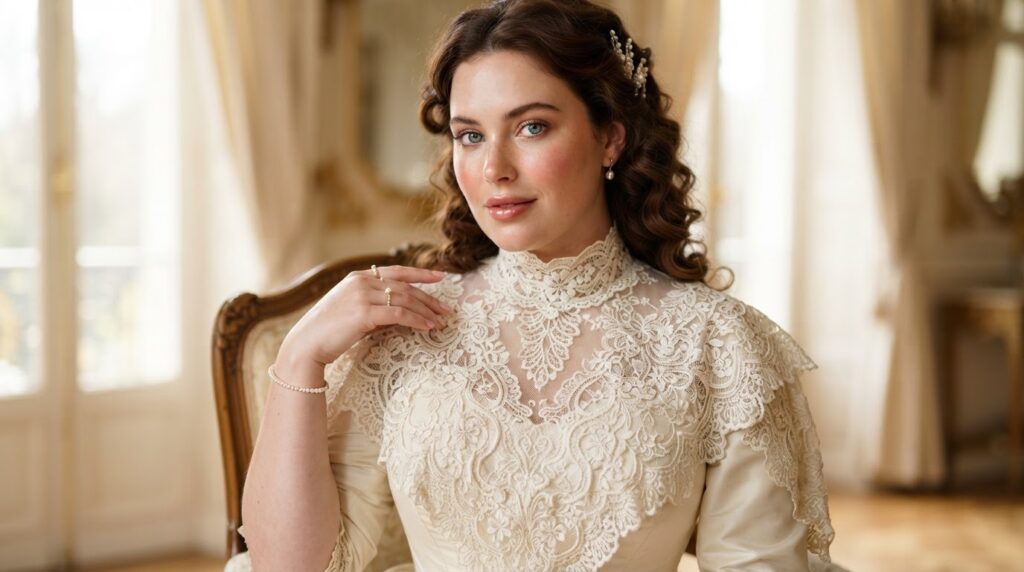
Few materials capture the contradictions of the Victorian age as perfectly as lace. At once fragile and enduring, modest and extravagantly ornamental, Victorian lace wrapped itself around everything from royal wedding gowns to parlor curtains, from baby bonnets to burial shrouds. In a century obsessed with progress yet nostalgic for the past, lace became a powerful visual language—signaling class, femininity, piety, and even technological innovation. To study Victorian lace is to read the social history of the nineteenth century thread by thread.
Between the reign of Queen Victoria (1837-1901) the lace fashion evolved from an affluent, handcrafted art form to fashionable, mass produced commodity. But though the physical makeup of the material may have changed, the cultural importance did not. Modern museums (including the Victoria and Albert Museum (London), the Metropolitan Museum of Art (New York City), the Louvre (Paris), and the Smithsonian Institution (Washington, D. C.)) use Victorian lace to document the changing face of industry, role of women, and accepted standards of beauty and decorum.
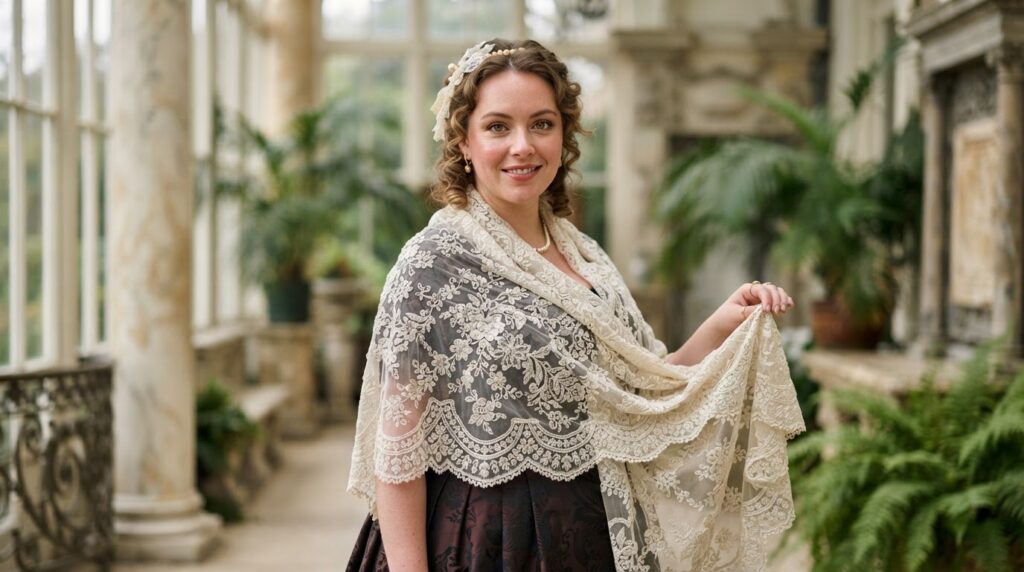
To grasp Victorian lace, however, one must look past sentimental notions of “old-fashioned prettiness.“The threads of Victorian lace tell the stories of cottage-based industries wiped out by the rise of mechanization, of European convent schools training lace-workers, of exhibition halls exhibiting superbeings of the machine-made, and of international mercantile circuits bringing Turkish silks and Egyptian cotton to British mills. Victorian lace can be most profitably viewed as a textile that was located at the intersection of art, technology and class.
The Historical Context of Victorian Lace
When Victoria ascended the throne in 1837, lace already had centuries of prestige behind it. Seventeenth- and eighteenth-century European courts—from Louis XIV’s France to the Habsburg Empire—had used lace as a conspicuous marker of aristocratic rank. By the early nineteenth century, handmade lace from centers like Brussels, Chantilly, Honiton, and Venice was still enormously valued but increasingly vulnerable to mechanization. The Industrial Revolution in Britain pushed textile invention into overdrive, and lace was ripe for innovation. According to the Victoria and Albert Museum, the first successful lace machines appeared in the early 1800s, but it was during the Victorian decades that machine lace became truly refined and widespread.
The great exhibition of 1851, inside the new crystal palace in London, was a watershed event (Victoria and Albert Museum). Nottingham’s lace manufacturers displayed a show of machine-made lace in conjunction with old hand-made works. People were astonished that a new machine could create what had previously only been achievable through skill and labor of the human hand. The exhibition proclaimed lace both an art and a technological achievement a marriage of Victorian pride in industry and admiration of craft.
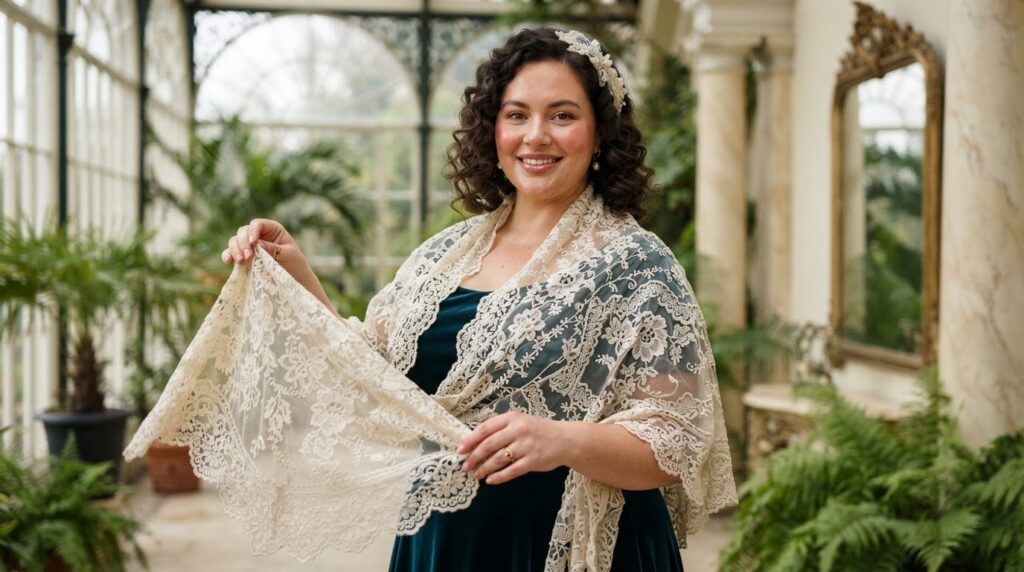
Simultaneously, however, the association of lace with the Victorian woman was tied directly to larger Victorian ideas about society and morality. In this period, what was beautiful emphasized modesty, inward beauty and contained sensuality; the airy transparency of lace fit these ideals. Lace high-collars, high-colors decorated with lace, and fine lace underpinnings kept a person modern by the standards of the day but still perceived to be proper. As the MetropolitanMuseum of Artsuggested, “the Victorian woman‘s wardrobe was ‘full of adornment and still within the bounds of propriety’, and lace played no small part in this expression.”
Materials, Techniques, and Regional Styles
Victorian lace drew on a range of fibers, with cotton and linen dominating everyday pieces and silk favored for finer, more luxurious work. Earlier European lace traditions had relied heavily on flax (linen) thread, especially in places like Flanders and Italy, but the nineteenth century saw a distinct shift toward cotton—boosted by Britain’s global cotton trade and industrial spinning capacity. The Smithsonian Institution’s textile collections underscore this material shift, noting that the ready availability of machine-spun cotton thread made lace production cheaper and more consistent, especially for machine-made varieties.
Two main techniques were used to define Victorian lace: bobbin and needle. Bobbin lace, the dominant method in Devon‘s Honiton, and important artistic centres such as Chantilly, in France, was created by twisting and plaiting threads wound upon dozens of mini-bobbins, over a paper pattern. Needle lace, although still highly refined, was considered the most delicate art of the virtuoso laces: a needle and thread were used to form individual embroidered-looking motifs upon a non-visible netted ground which was later removed. Both of these existed alongside crochet and knitted lace, which were technically different, but which middle-class women found it easier to learn as “lace-like” crafts.
Local traditions continued to play a big part though, even in the face of the new machine-made lace. Honiton, with its stiff outlined flower sprigs and herded together designs, became famous for British bridalwear, partly due to Queen Victoria, who wore Honiton on her wedding day in 1840. Black silk Chantilly, with its fine flowers, was used in shawls, wraps and for evening wear. Brussels lace was still prized for its refining subtle design. The textile department of the Louvre shows photographs of nineteenth-century French lace and evidences how each center (Calais and Caudry being the main ones) managed to produce designs based on traditional tropes, but adapted for the machine.
Handmade vs Machine-Made: Technology and Tradition
One of the central narratives of Victorian lace is the tension—and the interplay—between handmade and machine-made production. Early in the century, handmade lace still occupied the top tier of prestige. Needle lace and fine bobbin lace, created by women working long hours in cottage industries or convent schools, commanded high prices and were prized for their slight irregularities, which expert eyes read as proof of authenticity. The Victoria and Albert Museum notes that handmade lace remained the preferred choice for royal and aristocratic commissions well into the century.
However, the development of lace-making machinery in countries such as England‘s Nottingham district changed the playing field considerably. As early as the mid 1800s, machine-made lace could replicate vast numbers of historic patterns with astonishing accuracy. The Nottingham lace curtain, for instance, became an item of household decor regularly used in Victorian homes, providing middle class families with the opportunity to festoon their windows with elegant designs once exclusively adorning palace, castle and cathedral. Machine-made lace also made glamour affordable, with shopgirls and seamstresses able to surround themselves with collars, cuffs, fichus and trims previously obtainable only by the very wealthy.
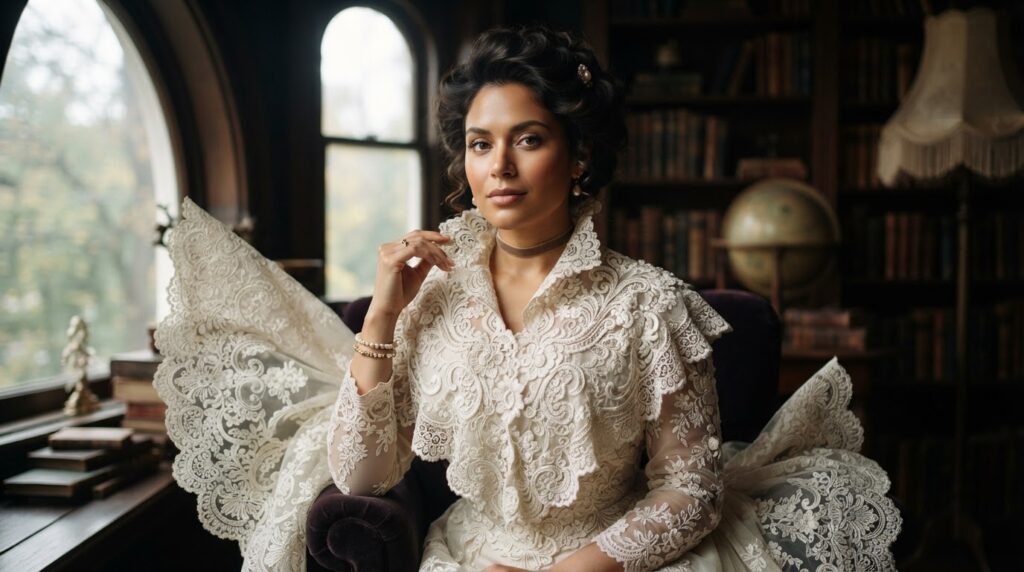
Most significantly, the dividing line between handmade and machine-made was far from clear-cut. Commercial Victorian gowns frequently employed machine-made nets or grounds with one-off handmade appliqué motifs most evidently in wedding and evening dresses. This allowed the consumer to economise on design and manufacturing while still seeming to display handwork. As among the costume collections of The Metropolitan Museum of Art, the late nineteenth-century dress often consisted of a machine-made (or servo-motor generated) tulle base with sewn-in lace panels, a period that debated craftsmanship with mechanical efficiency rather than echoing it.
Lace in Victorian Fashion and Society
Lace functioned as a visual index of respectability and status in Victorian dress. Women’s daywear often featured lace trimming at the collar and cuffs—areas that visually framed the face and hands, considered the most visible markers of refinement. Evening dress allowed for more dramatic lace applications: voluminous lace flounces, lace bertha collars draping over the shoulders, and lace shawls that both revealed and obscured the body beneath. Men, too, wore lace, though far less ostentatiously than in previous centuries; small lace-edged accessories or discreet lace jabots survived in certain formal or clerical contexts.
While no Victorian garment can be more associated with lace than the wedding dress the Queen Victoria wedding gown with its Honiton lace flounces and veil was influential in defining the bridal myth the prominence of lace has long been indicative of the construction of the Victorian bride‘s identity. The Victoria and Albert Museum claims that the Queen‘s wedding eyes revived the interest in the English lace industry while also “tying together the white, lace-trimmed bridal mode as the haut monde nation‘s pure, domestic and patriotic image.” As much as between the middle-class bride‘s lace-trimmed veil and clothing, it became “a crucial component of what modern historians refer to as the ‘invention’ of the contemporary wedding.”

However, the careful crafting that defined lace was also applied homeward. Knitted lace, at once a display of skill and a means of personal adornment, also decorated the private sphere as curtains, antimacassars (lovely doilies erected over the backs of chairs), table cloths, pillow shams and more flooded Victorian homes with pattern and texture. This is exactly what a description of domestic textiles from the Smithsonian Institution states, domestic textiles also connote notions of a proper homemaker and womanly virtues: Clean, fresh, laundered lace on the sofa told of a responsible housekeeper and a woman of income. In this way, lace spread the language of women‘s clothing to the home.
Labor, Industry, and the Social Cost of Beauty
Behind the delicate surface of Victorian lace lay harsh labor realities. Handmade lace production was notoriously time-consuming and poorly paid. In British and Continental lace districts, women and children often worked from dawn to dusk to create small sections of lace, straining eyesight and posture. The Victoria and Albert Museum and various social reformers of the period documented these conditions, noting that lace-making—especially by candlelight—could lead to early blindness and chronic ill health. Lace thus belongs in any honest account of Victorian women’s work and the gendered division of labor.
The factoryization of machine-made lace did not bring an end to exploitation but transferred some of the hours, and for women, the sewing, into the factory. In Nottingham and other industrialized centers, lace workers worked on complicated machinery under discipline, but in some respects, the machined product produced a degree of shift from hand to machine skills, and wages and conditions were often more secure than in the diffuse cottage industry world. The Smithsonian Institution‘s collections of industrial histories show that story too, the place of lace machinery within the history of nineteenth-century work struggles.
It is also worth noting the global aspects of Victorian lace. Though the design and functioning of the lace was mostly European, the raw materials, most notably cotton, were connected to transatlantic trade and, in the earlier part of the century, to slavery and colonial extraction. As textile historians note, the whiteness and brightness of a lace-trimmed Victorian gown can obscure otherwise distant and hidden supply chains. Thus, Victorian lace serves as a material reminder that beauty, comfort, and privilege in industrial society are often intricately linked to faraway people performing hidden, exploited labor.
Key Characteristics of Victorian Lace
| Feature | Description | Typical Example |
|---|---|---|
| Time Period | Reign of Queen Victoria, 1837–1901 | Early crinoline era to late Edwardian styles |
| Primary Techniques | Bobbin lace, needle lace, machine-made lace, crochet & net | Honiton bobbin lace, Brussels needle lace |
| Common Fibers | Cotton, linen, silk (sometimes blended with wool) | Cotton machine lace curtains; silk Chantilly shawls |
| Visual Motifs | Naturalistic flowers, foliage, scrolls, medallions | Rose sprays, fern leaves, garlands |
| Color Palette | Predominantly white, cream, black; some pastel tints | White bridal lace, black mourning Chantilly |
| Social Associations | Respectability, femininity, bridal purity, domestic virtue | Lace-trimmed collars, veils, curtains |
| Production Context | Cottage industry, convent schools, factories, home sewing | Nottingham factories; Devon lace villages |
| Cultural Status | From elite luxury to middle-class staple | Royal commissions vs. mass-produced trims |
Authoritative Voices on Victorian Lace
Leading museums and scholars have stressed the significance of Victorian lace as more than mere surface decoration. The Victoria and Albert Museum succinctly frames lace as “a luxury fabric, often handmade, that was central to European dress and identity for centuries, and which adapted—sometimes painfully—to the rise of industrial production.” This perspective underscores both continuity and disruption across the nineteenth century and situates Victorian lace in a longer European textile history.
The Metropolitan Museum of Art discusses lace as an integral element of Victorian dress as a whole, commenting that “by the mid-19th century, advances in textile manufacture and the increasing availability of pattern books and fashion plates brought elaborate trimmings particularly lace within reach of a burgeoning middle class.” In this case, then, its indicative significance lies in lace as way to understand the democratization of taste as well as the centrality of visual media in circulating style. Nearly every idealized female figure photographed in fashion plates from London, Paris, and New York is dressed in trimmings of some kind of lace.
While French and American sources help to contextualize lace within the crafts and industries of decorative arts, contextualize it within the history of industry, the Louvre’s textile department attends to a sophisticated history of nineteenth-century French lace, as “a convergence of old paradigms of production and the realities of a nation with new aspirations to dominate European art as well as industry, and the Smithsonian Institution frequently points to lace as a material that exemplifies how ‘women‘s’ goods were key to economic and technological shifts.” Supported by these multiple authoritative voices, I would argue that Victorian lace is neither an extinct breed nor simply a charming fashion, but rather, a subtle act of historical production.
Frequently Asked Questions about Victorian Lace
1. How can you tell if Victorian lace is handmade or machine-made?
Handmade lace usually shows slight irregularities in thread tension and pattern, and individual motifs may be assembled and joined rather than woven in one continuous piece. Under magnification, bobbin and needle lace typically reveal more varied thread paths than machine-made net. Machine lace, especially from the later nineteenth century, tends to have more regular, grid-like grounds and repeated motifs. Curatorial notes from the Victoria and Albert Museum and the Metropolitan Museum of Art often highlight these diagnostic features when cataloging lace.
2. Was Victorian lace only worn by wealthy women?
Early in the Victorian era, high-quality handmade lace remained the domain of the wealthy and aristocratic. However, by the mid- to late nineteenth century, machine-made lace dramatically expanded access. Middle-class women could purchase lace collars, cuffs, and trims, and even working-class women might own a modest lace-edged cap or shawl. That said, the fineness and complexity of the lace still signaled class: a duchess’s hand-embroidered Brussels lace veil was not comparable to a shopgirl’s machine-made net fichu.
3. Is Victorian lace still made today, and is it valuable?
Certain traditional lace-making techniques from the Victorian period are still practiced today by specialized artisans and hobbyists, particularly in regions with strong historical traditions such as Honiton and parts of Belgium and France. Antique Victorian lace can be valuable, especially if it is finely made, well-preserved, and associated with notable makers or historical events. Museums such as the Victoria and Albert Museum and the Metropolitan Museum of Art house exceptional examples; the collector’s market prizes intricate handmade pieces and documented provenance. Condition, originality (i.e., not cut down from a larger piece), and rarity all affect value.
Conclusion
Victorian lace is far more than a pretty embellishment on old dresses and curtains. It is a textile that captures the nineteenth century’s defining tensions: between handcraft and machinery, luxury and mass consumption, domestic virtue and global exploitation. From Queen Victoria’s Honiton lace veil to the Nottingham curtains hanging in modest row houses, lace threaded its way through the period’s aspirations, anxieties, and daily routines.
By examining Victorian lace through the lens of its materials, techniques, labor systems, and cultural meanings—and by drawing on the expertise of institutions like the Victoria and Albert Museum, the Metropolitan Museum of Art, the Louvre, and the Smithsonian Institution—we gain a richer, more grounded understanding of the era itself. The next time you see a fragment of delicate Victorian lace, you are not just looking at ornament; you are looking at a woven record of industrial change, social ambition, and human skill.
AI Notice: Some visual content in this article may have been created or enhanced using artificial intelligence (AI) for artistic, editorial or illustrative purposes. Learn more about our approach in our AI & Editorial Principles.