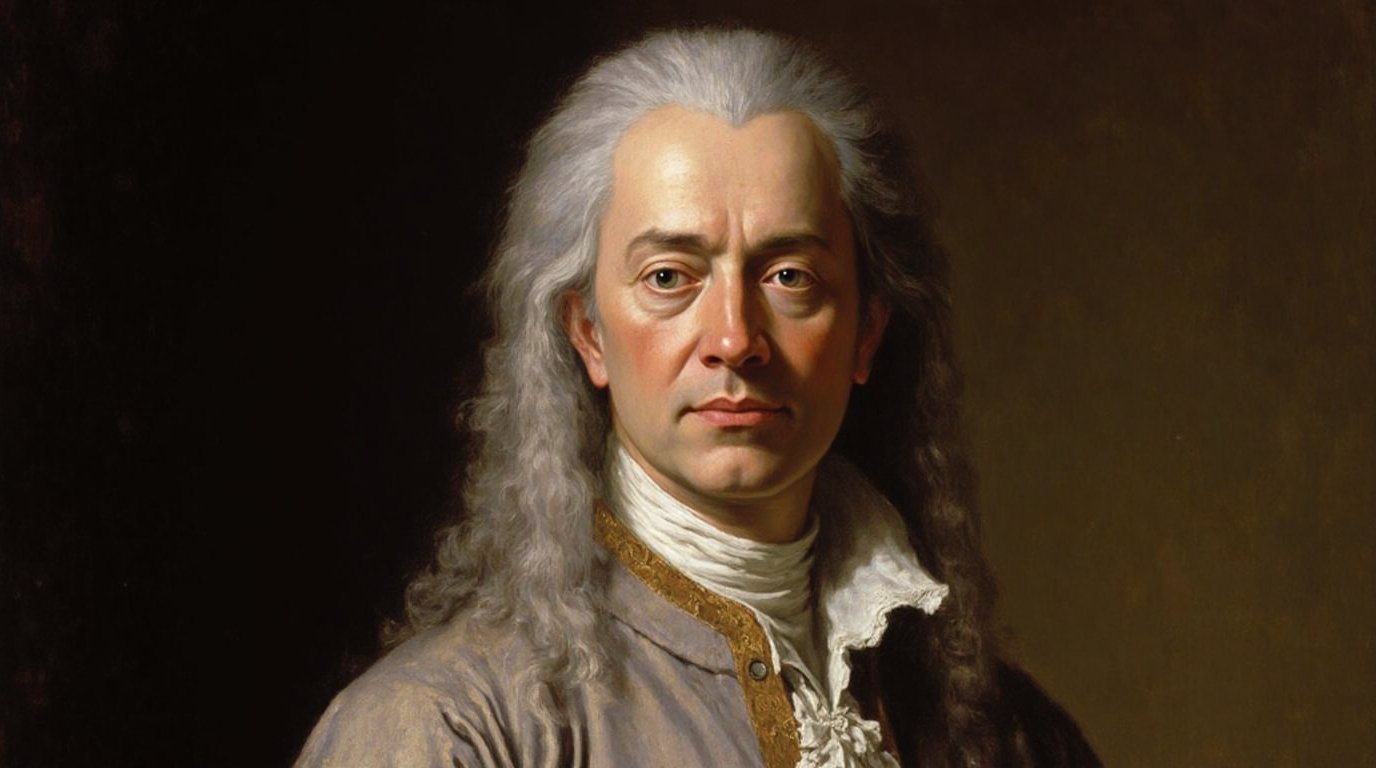
William Hogarth (1697–1764) was an English painter, engraver, and sharp-eyed storyteller who turned everyday London into art with the force of a headline and the precision of a moral fable. He didn’t simply portray society—he dissected it, exposing greed, hypocrisy, vanity, and political corruption with scenes so vivid they feel staged for the viewer’s judgment. Long before modern comics, editorial cartoons, or serialized TV drama, Hogarth built narratives in images that unfolded like chapters. His work is entertaining, often funny, sometimes brutal—and consistently revealing about how power and vice operate.
William Hogarth: Biography
William Hogarth was born in London in 1697, the son of a schoolteacher and writer whose financial troubles left a lasting mark on him. Hogarth’s early life coincided with a city swelling from commerce, print culture, and social inequality—conditions that would become the raw material of his art. He trained first as an engraver, apprenticed to Ellis Gamble, learning the craft that later allowed him to distribute his images widely and profit from them. That foundation in printmaking shaped his career: Hogarth thought in terms of reproducible images and mass audiences, not just elite patrons.
Can You Name the Masterpiece?
Ten masterpieces. Ten questions. How well do you know the history of art?
In the 1720s and 1730s, he moved from engraving into painting while staying deeply involved with the booming world of prints. His marriage to Jane Thornhill, daughter of the painter Sir James Thornhill, helped him enter higher artistic circles, but William Hogarth never became a courtly flatterer. He preferred the street to the salon: taverns, theaters, markets, debtors’ prisons, and drawing rooms where social ambition curdled into cruelty. London was his stage, and his figures—rich and poor—were never treated as mere decorative types.
Hogarth‘s fight was not just against the Market; he also fought to defend rights of the artist. It was partly through his efforts that the Engravers’ Copyright Act was passed in 1735 (sometimes called “Hogarth‘s Act”) which gave some protection against illegal print copying. But the struggle was about aesthetic as well as economic control: Hogarth also wanted control of the dissemination of his stories: in a world where images were quickly copied, manipulated and translated, authorship defined meaning.
By 1764 – when he died – William Hogarth had established himself as one of the defining voices in British visual culture. He was too unusual to sit comfortably within the then fashionable European hierarchy of history painting, but he created a modern type of art, which told stories of contemporary life, argued a point of morals and worked like a journalist with headlines and sound-bites. He left a legacy in satire, pictorial storytelling and the concept that art could interrogate society.
Major works
Can You Guess the Artist?
Three clues. One artist. How quickly can you identify the painter?
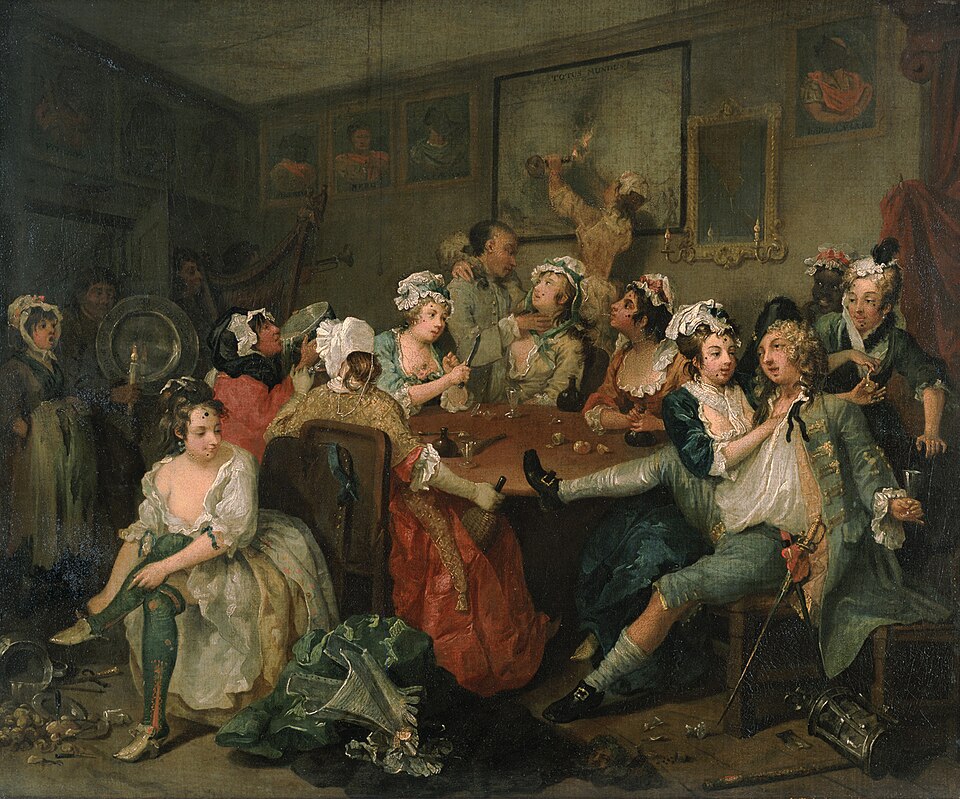
Hogarth’s most famous achievements are his narrative series—sequences of images that track a character’s rise and fall with almost cinematic pacing. A Harlot’s Progress (1732) follows a young woman lured into prostitution and ultimately destroyed by disease and exploitation. A Rake’s Progress (1734) charts Tom Rakewell’s inheritance, indulgence, and collapse into madness, ending in Bedlam. These are not abstract moral lectures; they are social autopsies, showing how institutions, money, and desire trap individuals long before the final ruin.
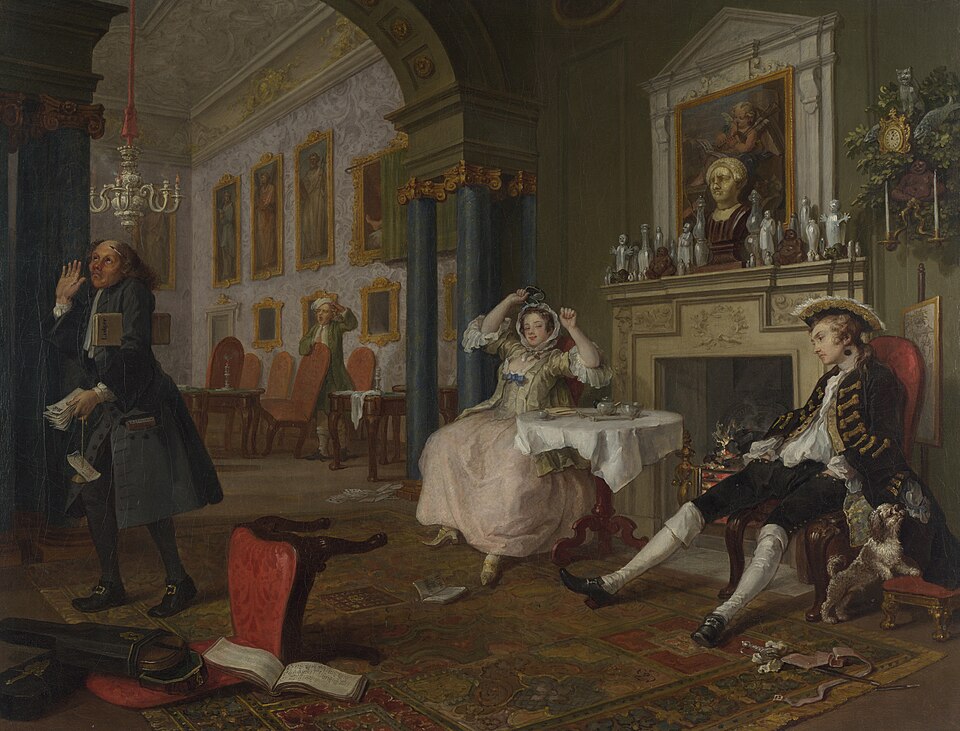
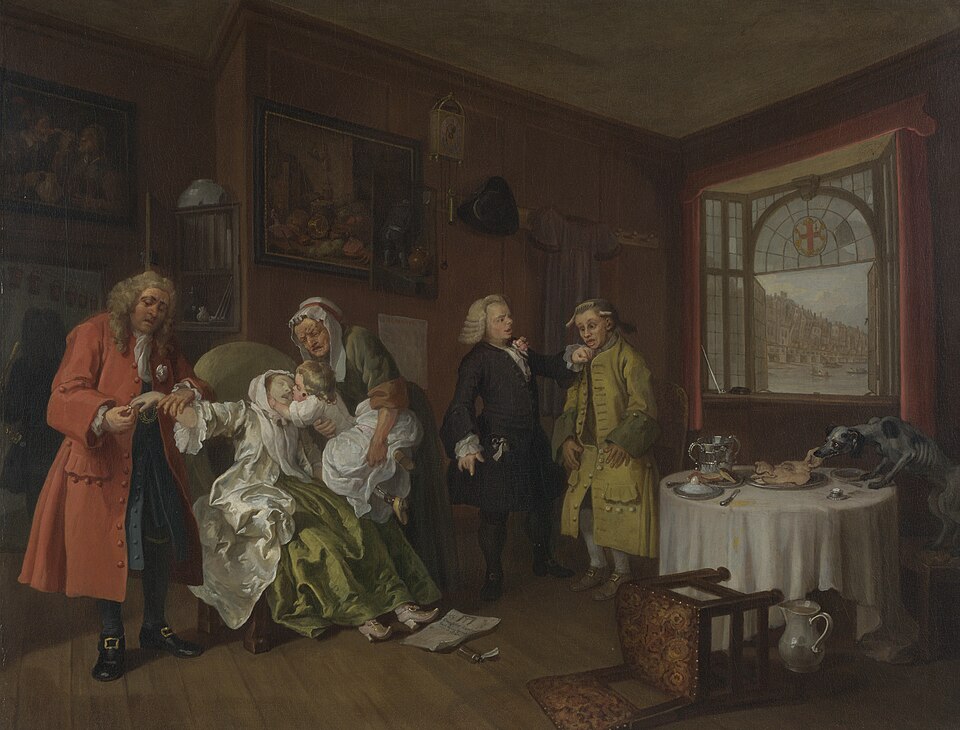
Another landmark is Marriage A-la-Mode (c. 1743–45), a set of paintings later engraved, depicting a disastrous arranged marriage between the cash-poor aristocracy and the cash-rich merchant class. William Hogarth turns the domestic interior into a courtroom of clues: unpaid bills, flirtations, inherited vanity, and the quiet violence of transactions disguised as romance. The series is also a brilliant study of how “respectability” can be staged while private life disintegrates—an idea that still feels contemporary.
Single images can be as powerful. The gin lane and beer street plates (1751), must have been produced amid public hysteria about the rise of gin drinking in a similar way to propaganda, they juxtapose social demolition and stolidity and industry. On the other hand, the Four Times of the Day (1736–8) is a poignant and often comic depiction of London life morning, noon, evening and night where class antagonisms and moralistic assumptions are in every gesture, but where even Hogarth is lighthearted, he is never neutral. Each figure asserts a social position.
Hogarth also painted portraits, and even these are often loaded with narrative snark. Captain Lord George Graham in His Cabin (c. 1745) is vividly theatrical, alive with personality and smirks of understanding rather than cardboard posturing. Furthermore it seems to be the same all around his art: he is brilliant at drawing portraits and genre pictures that come to life with close analysis and can be read as a story of objects, faces and the arrangement of the space they occupies.
Meaning behind his work
Hogarth’s art is built on the belief that society writes itself onto the body and the room around it. A slumped posture, a torn lace cuff, an overstuffed interior, a sly sideways glance—these details are not mere realism; they are moral and psychological evidence. In his narrative series, characters often seem less like isolated villains than products of a system: predatory businessmen, cynical guardians, fashionable libertines, and corrupt officials form a web that turns private weakness into public tragedy.
Symbolism is everywhere, but it is rarely mystical; it is practical, legible, and anchored in daily life. In Marriage A-la-Mode, for instance, art objects and decorations become accusations—classical statues, paintings, and ornamental clutter hint at imitation rather than virtue, taste used as camouflage. In Gin Lane, the collapsing architecture mirrors collapsing social order; the city literally breaks apart as addiction, poverty, and neglect become normal. Hogarth’s symbols work because they feel observational: you can imagine encountering them in a real street or room.
Deeper still is Hogarth’s focus on the performance of life how people take on roles in order to live or climb the social ladder. The “fashion” in Hogarth’s London is not simply aesthetic but a vocabulary of power and self-deception. The bourgeois aristocrat “performs” taste and Wealth while being heavily in debt; the would be social climber “performs” morality just as a trader “performs” marketing. Indeed, the typecasting of the London bourgeoisie culture through the art of performance is what makes William Hogarth feel modern: his London a proto-media world, where superior image control might trump fairness of reputation.
But William Hogarth isn‘t just a scold. Even his satirical images can have compassion, in how they portray the weak innocently caught up in the crowds of neglect. The laughter they generate may be uneasy, because the viewer is involved. His images say: are you just watching, or are you a member of the crowd whose passivity leads to these crimes? That moral strain that entertainment mixed with moral attack that‘s what makes him great.
Why is he famous
William Hogarth is famous because he essentially invented a visual form of storytelling that bridged fine art and mass culture. His sequential “progress” narratives function like early graphic novels: recurring characters, escalating consequences, and dense visual plotting. This was not just an artistic innovation; it changed how images could communicate complex social commentary to large audiences, including those who might never enter elite art spaces. He proved that serious ideas could travel through popular formats without losing bite.
He is also famous for shaping the language of modern satire. Later political cartoonists and illustrators inherited his methods: embedding arguments in scenes, using caricature sparingly but effectively, and placing symbolic “evidence” throughout the composition. Hogarth’s London is a precursor to the editorial page—an arena where visuals can criticize power more sharply than polite prose. His work helped establish the expectation that artists can be public commentators, not just decorators for the wealthy.
His influence reaches beyond aesthetic questions into moral, class and capitalist debates in 18th-century Britain. William Hogarth chronicled a society in flux growing consumerism, increasing inequality, fears over city corruption. Instead of romanticizing the age, he revealed how profit could alter the shape of family, politics even of the self. His historical significance is therefore not only aesthetic but documentary: his images reveal what the official portrait and the mammoth historical painting too often hide.
Hogarth‘s fame, it turns out, was no fluke he understood distribution. By distributing his work directly through published engravings, by defending copyright claims aggressively, he constructed a portrait of the artist that resonated with a nascent media economy. His notoriety was carefully crafted through tight management of production, continuity of theme, and a consistent narrative voice. In doing so, he prefigured the modern professional creator: one part prophet, one part publisher.
Interesting facts
- Hogarth’s A Harlot’s Progress was so popular that it triggered a rush of pirated copies, pushing him to campaign for stronger copyright law.
- The Engravers’ Copyright Act of 1735 is often nicknamed “Hogarth’s Act” because his lobbying helped make it happen.
- He depicted London’s institutions—prisons, hospitals, and madhouses—with unsettling specificity, turning real places into moral arguments.
- William Hogarth wrote about aesthetics too, most notably The Analysis of Beauty (1753), where he argued for the expressive “line of beauty” (the serpentine S-curve).
- Many of his scenes are packed with readable clues—newspapers, shop signs, and background incidents—inviting viewers to “decode” the image like a puzzle.
William Hogarth still matters because he shows how art can be both vivid entertainment and serious social diagnosis. His London feels distant in costume and architecture, yet familiar in its appetite for status, spectacle, and moral shortcuts. By turning everyday life into narrative images loaded with meaning, he helped shape satire, visual journalism, and sequential storytelling as we understand them today. Hogarth’s lasting impact lies in his insistence that pictures can argue—about class, power, and human weakness—while remaining irresistibly watchable.
AI Notice: Some visual content in this article may have been created or enhanced using artificial intelligence (AI) for artistic, editorial or illustrative purposes. Learn more about our approach in our AI & Editorial Principles.