
Claude Lorrain’s paintings stop you mid-step because they make light feel like a memory: sun breaking through haze, distant harbors dissolving into atmosphere, tiny figures dwarfed by the grandeur of nature. In the hands of this 17th‑century master, landscape became more than background—it became a stage for history, myth, and faith, rendered with such poetic clarity that collectors, academies, and later painters treated his work as a touchstone for what “beautiful” landscape could be.
Who Was Claude Lorrain? (Life, Rome, and the Baroque World)
Claude Lorrain (c. 1600–1682), born Claude Gellée in the Duchy of Lorraine (then part of the Holy Roman Empire), built his career primarily in Rome during the Baroque period. Rome in the 1620s–1670s was an international hub for artists and patrons—from ecclesiastical powerbrokers to aristocrats on the Grand Tour—seeking images that matched the era’s taste for classical antiquity, dramatic light, and learned subject matter.
Can You Name the Masterpiece?
Ten masterpieces. Ten questions. How well do you know the history of art?
Although Claude is often grouped with “classical landscape” painters, his achievement is inseparable from the lived reality of 17th‑century Rome: its ruins, its countryside (the Campagna), its luminous skies, and its thriving artistic community. His landscapes are not topographical records, but they are rooted in observation—trees, water, and weather organized into an idealized vision that feels at once natural and elevated.
Claude’s reputation spread well beyond Italy. Major museums and institutions that now preserve and interpret his work include The Metropolitan Museum of Art in New York, the Louvre Museum in Paris, and the Victoria and Albert Museum in London (notably for prints and related material that illuminate how such images circulated). The Smithsonian Institution and other research bodies also provide context for his era’s artistic networks and the later reception of European landscape traditions.
What Defines Claude Lorrain Paintings? (Light, Space, and Classical Story)
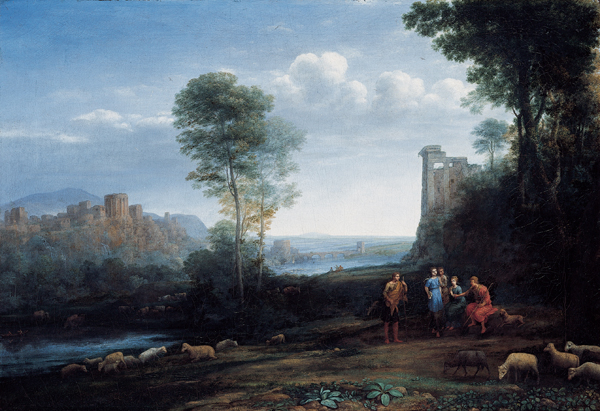
The most immediate hallmark of Claude Lorrain paintings is light—often low, golden, and directional, shaping architecture, trees, and ships into a harmonious theater of forms. Claude repeatedly staged sunrise or sunset effects that draw the eye toward a glowing horizon, using tonal gradations to create depth. This approach helped define what later viewers called the “ideal landscape,” where nature appears perfected rather than merely copied.
Can You Guess the Artist?
Three clues. One artist. How quickly can you identify the painter?
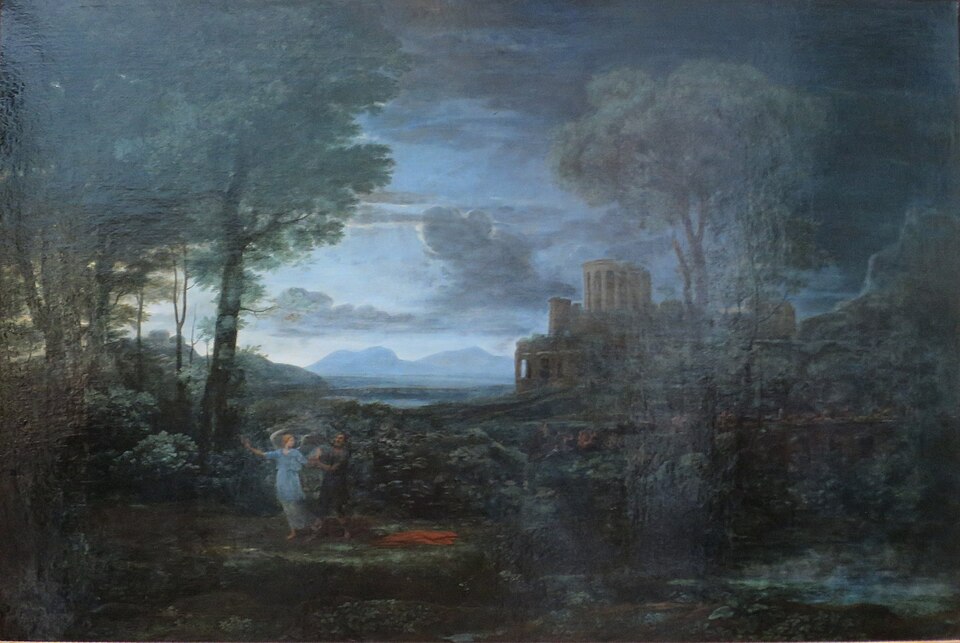
A second defining trait is spatial architecture. Claude often frames the scene with repoussoir elements—dark trees or buildings at the sides—opening toward a radiant middle distance. Ports, temples, bridges, and ruins function as classical props, anchoring the viewer in an imagined antiquity. Figures are usually small, but crucial: they introduce narrative (Aeneas, biblical episodes, pastoral labor) and scale, reminding you that human history is tiny against nature’s vastness.
Claude’s authority also rests on method. He famously kept a record of his finished works in a compilation of drawings known as the Liber Veritatis (“Book of Truth”), created partly to document authorship in an era of copying and workshop versions. The existence of this visual ledger is one reason scholars can attribute Claude’s paintings with unusual confidence. As the Metropolitan Museum of Art notes in its collection materials, Claude’s works were deeply influential in shaping European landscape painting and collecting taste.
Major Themes and Subjects: Harbors, Pastoral Arcadias, and Sacred Narratives
Harbor scenes are among Claude’s most recognizable inventions: ships, columns, and palaces arranged like a set, with the sun hovering over water that mirrors the sky. These paintings channel the early modern fascination with travel, commerce, and empire—yet Claude’s ports are not documentary views of a specific quay. They are ideal spaces, constructed to evoke grandeur, calm, and luminous distance.
Equally important are pastoral landscapes—Arcadian scenes populated by shepherds, travelers, or mythic characters. Claude’s countryside is orderly and serene: paths curve gently, cattle graze, and trees form natural cathedrals. This vision aligned with 17th‑century literary and artistic classicism, where “nature” was a refined ideal. The Louvre, which holds significant European painting collections, places Claude within this tradition of classical landscape that linked painting to poetry and antiquarian learning.
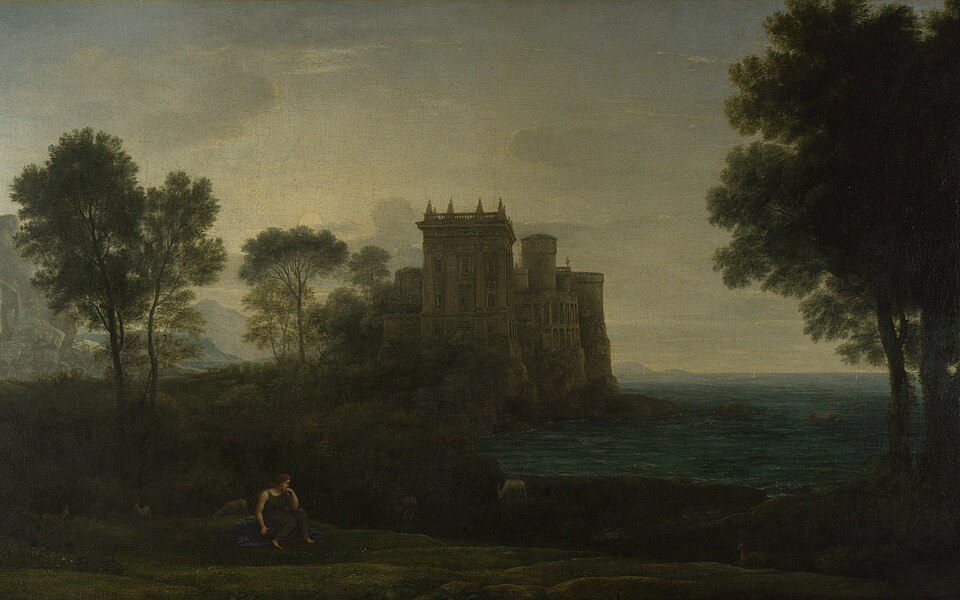
Claude also embedded biblical and mythological narratives into his settings, often making the story almost secondary to the atmosphere. This was not a lack of narrative skill—it was a statement of priorities. The landscape becomes the true protagonist, while the figures provide a moral, historical, or literary key for educated viewers. In this sense, Claude’s paintings reflect a Baroque-era synthesis: drama is present, but sublimated into light, distance, and contemplation.
Key Characteristics of Claude Lorrain Paintings (Summary Table)
| Characteristic | What it Looks Like | Why it Matters |
|---|---|---|
| Luminous horizon light | Sunlit haze at dawn/dusk, glowing vanishing point | Defines mood; creates depth and visual unity |
| Classical framing | Dark trees/architecture at edges, open center | Guides the eye and heightens theatricality |
| Idealized nature | Balanced compositions, perfected scenery | Embodies “ideal landscape” aesthetics |
| Small narrative figures | Myth/bible/pastoral characters, often tiny | Adds learned meaning and scale |
| Architectural motifs | Temples, columns, bridges, ports, ruins | Connects scenes to antiquity and Rome’s culture |
| Authorship documentation | Liber Veritatis drawings | Strengthens attribution and scholarly study |
Influence, Collecting, and the Long Afterlife of Claude’s Style
Claude’s influence is inseparable from the rise of European collecting and the later Grand Tour. Aristocrats and connoisseurs sought landscapes that represented cultivation—knowledge of antiquity, taste, and the ability to “read” classical references. Claude’s paintings, with their measured compositions and lyrical light, became benchmarks. Later artists and collectors treated his works as proof that landscape could rival history painting in prestige.
Museums have played a major role in consolidating Claude’s canonical status. The Metropolitan Museum of Art has long interpreted Claude within the broader arc of European landscape and the development of light-based composition. The Louvre contextualizes him within French and Italian artistic exchange, reflecting his unusual identity: a painter from Lorraine who forged his mature style in Rome and became foundational for later French classicism.
Claude’s impact reached into print culture and pedagogy. Even when collectors could not acquire an original oil painting, engravings and drawn copies circulated his compositions widely. Institutions such as the Victoria and Albert Museum, with its extensive works on paper and design history resources, help illuminate how images like Claude’s shaped visual education across Europe—especially in Britain, where “Claudean” light and composition became central to landscape taste.
Authoritative Quotes (Contemporary Scholarship and Museum Authority)
Museum and scholarly sources consistently emphasize Claude’s primacy in landscape. The Metropolitan Museum of Art describes Claude Lorrain as “one of the greatest seventeenth-century landscape painters,” underscoring his foundational role in the genre (The Met, collection essays and object entries on Claude Lorrain).
Scholars also point to his unique synthesis of observation and idealization. Art historian Michael Kitson, in Claude Lorrain: Liber Veritatis, stresses that Claude’s art combines studied natural effects with an ordering classical intelligence—an approach that made his landscapes both believable and aspirational (Kitson, British Museum/related scholarship tradition on the Liber Veritatis).
Finally, the Louvre’s curatorial framing of 17th‑century classical landscape repeatedly situates Claude among the painters who transformed landscape into an elevated, learned form—an institutional view reflected across its educational materials and collection interpretation (Musée du Louvre, painting department resources).
Frequently Asked Questions
What are Claude Lorrain paintings best known for?
They are best known for poetic, glowing light (often sunrise or sunset), idealized classical landscapes, and carefully staged depth—frequently with mythological or biblical figures placed small within vast scenery.
Where can I see Claude Lorrain paintings in person?
Significant works are held by major museums including The Metropolitan Museum of Art (New York) and the Louvre Museum (Paris). Many other European and North American collections also display his paintings and drawings, and works on paper related to his influence can be studied in institutions like the Victoria and Albert Museum.
What is the Liber Veritatis and why is it important?
It is Claude’s record book of drawn copies of his finished paintings. It matters because it helps confirm authorship, track commissions, and understand how his compositions evolved—critical for scholarship and authentication.
Are Claude’s landscapes real places?
They are typically idealized rather than literal views. Claude drew from real observation around Rome and the Italian countryside but recomposed elements to create a classical “ideal” scene.
How did Claude Lorrain influence later landscape artists?
His approach to light, composition, and classical mood shaped European landscape taste for centuries, influencing collectors and painters who sought “Claudean” atmosphere and harmonious design.
Conclusion
Claude Lorrain paintings endure because they make the natural world feel timeless—structured by classical intelligence and animated by unforgettable light. Rooted in Baroque Rome yet collected across Europe and preserved by institutions like the Met and the Louvre, his landscapes set a standard for beauty, depth, and contemplative storytelling that still defines what many viewers imagine when they think of the “ideal” landscape.
Authoritative sources (selected)
- The Metropolitan Museum of Art (Heilbrunn Timeline of Art History; collection entries on Claude Lorrain) — https://www.metmuseum.org
- Musée du Louvre (collections and educational resources on 17th‑century European painting) — https://www.louvre.fr
- Victoria and Albert Museum (prints, drawings, and histories of image circulation/design culture) — https://www.vam.ac.uk
- Smithsonian Institution (research and educational context on European art history and collecting) — https://www.si.edu
- Michael Kitson, Claude Lorrain: Liber Veritatis (foundational scholarship on Claude’s record drawings)
AI Notice: Some visual content in this article may have been created or enhanced using artificial intelligence (AI) for artistic, editorial or illustrative purposes. Learn more about our approach in our AI & Editorial Principles.