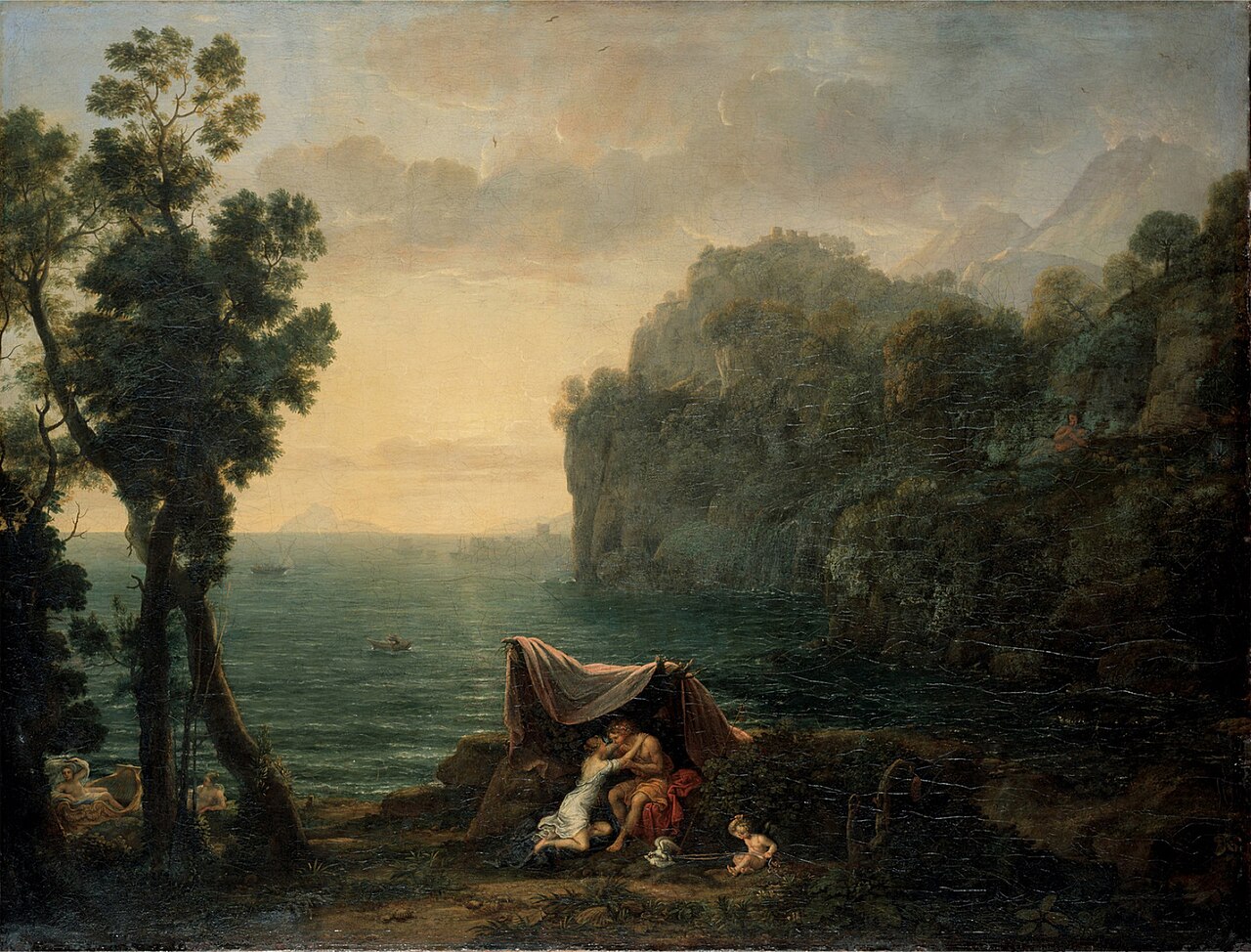
Claude Lorrain’s pastoral landscapes feel like memories you never actually lived: sun-warmed harbors, shepherds paused in conversation, ruins softened by haze, and a sky so luminous it seems to be the real subject of the painting. Yet these scenes were not escapist fantasies in the modern sense. They were carefully constructed images shaped by the intellectual currents of Baroque Rome, by antiquarian interest in the classical past, and by a highly discerning international market of patrons. To understand Claude Lorrain’s pastoral landscape is to see how one artist transformed observed nature into an ideal vision that redefined European landscape painting.
Claude Lorrain in Baroque Rome: Artist, Market, and Method
Claude Lorrain (about 1604/5–1682), born Claude Gellee in Lorraine (eastern France), established his career in Rome in the 17 th century when it was simultaneously a papal capital and a civilization hub for the art world. He was a contemporary of, but also a collaborator (in a sense) with, Nicolas Poussin. While Poussin pursued a screenplay for classical story, Claude invented atmospheric, luminous landscapes.
Can You Name the Masterpiece?
Ten masterpieces. Ten questions. How well do you know the history of art?
For Rome was not for the patrons alone but for its lands and ruins: the Campagna, the valley of the Tiber and the Mediterranean imagining. Outdoors, Claude drew and then reassembled his two-dimensional forms into harmonious and clear worlds. His visions reflect the antiquarian culture of the time, where fragments of Rome and pastoral poetry entered a conversation sustained by the upper classes. The offered a ‘natural’ landscape complicated by art.
Claude also protected his authorship in a way that signals a mature art market. He compiled the “Liber Veritatis” (Book of Truth)—a volume of drawings recording his finished compositions—largely to deter copies and settle attribution disputes. This kind of self-archiving underscores how sought-after his pastoral scenes had become among collectors in Rome and across Europe.
“Claude is the unrivalled master of light.” — J.M.W. Turner (often quoted in discussions of Claude’s influence; see contextualization in major museum scholarship on Turner and landscape)
What Makes a “Claude” Pastoral Landscape: Light, Space, and Classical Calm
Claude also achives this classicising effect through light which is more than light in the ordinary sense and instead acts as one means of ordering the composition. For although there are a number of cloudy and sometimes stormy scenes with no visible light source, there are a great many scenes where the sun is low (often in the bottom half of the picture plane) and defines the composition by providing an illuminative focus. Within the radiating form of the sun, figures, trees or ruins are seen leading into depth where atmosphere blurs the edges of forms, so that the space seems aerated, unbroken and ungraspable.
Can You Guess the Artist?
Three clues. One artist. How quickly can you identify the painter?
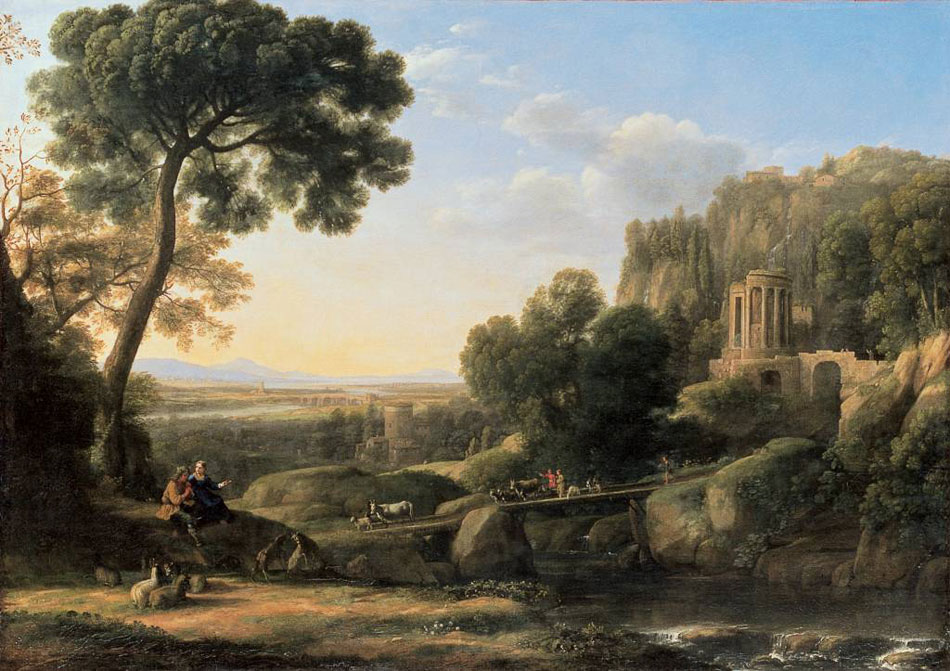
Secondly, there is compositional architecture. More often than not, he will have tall ‘wing’ elements (trees, columns or palaces) flank either side of the composition, encouraging the eye to settle on a wide middle ground. The effect feels theatrical and airy, but less stark than preceding landscape styles. Pastoral staffage (shepherds, boatmen, tramps) are usually miniature and shaded into the background, providing narrative interest without cluttering the image.
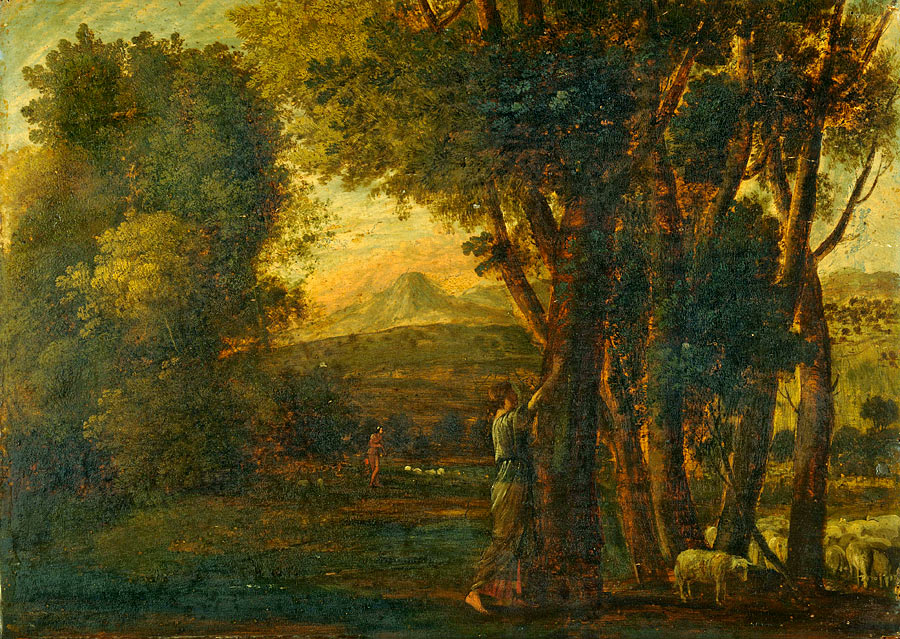
Third is classical resonance. Pastoral in Claude is never purely rustic; it is an ideal countryside touched by antiquity—temples, arches, and ports that allude to the grandeur of Rome and the poetic tradition of Virgil. As the Metropolitan Museum of Art notes in its scholarship on Claude’s paintings and drawings, his works shaped the development of “ideal landscape” by harmonizing observed nature with classical order and poetic imagination (see The Met’s collection essays and object entries on Claude Lorrain).
Key characteristics at a glance
| Characteristic | How it appears in Claude’s pastoral landscapes | Why it matters |
|---|---|---|
| Luminous horizon light | Sunlit haze, glowing sky, reflected water | Establishes mood and spatial depth; signature effect |
| Framing “wings” | Trees/architecture on left and right | Creates balance and a calm, theatrical clarity |
| Small staffage figures | Shepherds, travelers, mythic or biblical actors | Provides scale and narrative without dominating |
| Classical ruins/architecture | Temples, arches, porticoes, harbors | Links the scene to antiquity and learned taste |
| Atmospheric perspective | Softer edges and cooler tones in distance | Enhances realism and poetic distance |
| Idealization | Recombined motifs rather than topographic exactness | Defines the “ideal landscape” tradition |
Institutions, Provenance, and the Making of Authority
Claude’s authority today rests not only on connoisseurship but on robust institutional study. Major collections such as The Metropolitan Museum of Art, the Louvre Museum, and the Victoria and Albert Museum (V&A) have catalogued, conserved, and exhibited Claude’s paintings and drawings, making his technique and influence unusually well-documented. Their object records and collection essays provide primary-level reference points: dimensions, materials, provenance, conservation history, and comparative literature.
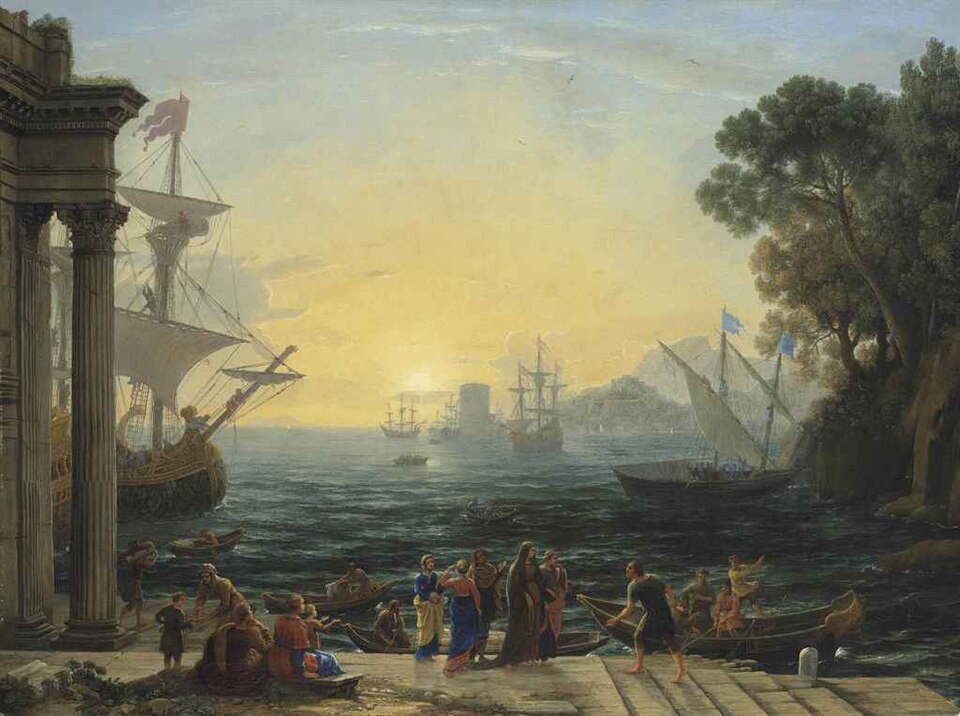
The Louvre in Paris, another of the European hotspots for French and Rome-based classicism, has regularly canonised Claude as part of the European canon of landscape, with Poussin and later academic classicism.517 The Louvre context provides a reason why Claude‘s serene pastoral images continued to be an academic ideal until the 18 thcentury:
In Britain and elsewhere, however, Claude‘s landscapes also became part of debates about taste, tourism, and the “picturesque.” Museums and institutions linked to design and visual culture in particular the Victoria and Albert Museum provide evidence of how Claude‘s landscapes were circulated in prints and collected. And the Smithsonian Institution offers other art historical evidence and explanations about how European landscape painting tradition was received and understood, especially as part of the popular education aims of the “old master” world.
The Metropolitan Museum of Art describes Claude as a leading creator of the “ideal landscape,” blending natural observation with classical composition (see The Met’s online collection and Heilbrunn Timeline of Art History materials related to 17th-century landscape).
Legacy: From the Grand Tour to Turner and Modern Landscape
Claude’s pastoral landscapes became a visual language for European elites during the Grand Tour era (late 17th through 18th centuries), when travelers sought cultural legitimacy through encounters with Roman antiquity and Italian scenery. Claude provided an imagined Italy—sunlit, orderly, steeped in the classical past—that aligned perfectly with this educational pilgrimage. Collectors acquired his works (and later, high-quality copies) as emblems of cultivated taste.
His impact can be felt most strongly in British landscape painting. Artists and collectors compared scenes to “Claudean” standards-balanced masses, glowing backgrounds, poetic feeling. The frequently cited fondness J. M. W. Turner had for Turner can be used as evidence of a wider truth: that even turner‘s brilliant innovations can be viewed as a contemporary reaction to Claude‘s tranquil glow. Museums where Turner and Claude are displayed close to one another often openly address this in their literature and displays.
However, Claude is not only influential. Modern audiences still find themselves soothed by the psychological intelligence of his spaces: the inviting pause of figures, the suspended time at sunrise and sunset, the reassuring hugeness of nature. In an age of so many images, the steady reassurance of Claude‘s natural universe may seem both surprisingly radical and profoundly sane again a compelling case for focus, structure, and light as content.
Frequently Asked Questions (FAQ)
What is a “pastoral landscape” in Claude Lorrain’s art?
It is an idealized countryside scene—often with shepherds, travelers, or small narrative figures—constructed to evoke harmony between human life and nature, frequently enriched with classical ruins or architecture.
Did Claude Lorrain paint real places?
He drew from real observation around Rome and the Italian countryside, but most finished paintings are composites, designed for balance and mood rather than topographical accuracy.
Why is light so central in Claude’s work?
Light organizes space and emotion. Claude’s low sun, haze, and reflections create depth and a contemplative atmosphere—so consistently that “Claudean light” became a critical shorthand in later landscape writing.
What is the “Liber Veritatis,” and why does it matter?
It is Claude’s record-book of drawings after his paintings, used to document authentic compositions. It is a crucial tool for attribution and for understanding his working process.
Where can I see Claude Lorrain’s works today?
Major paintings and drawings are held by institutions including The Metropolitan Museum of Art, the Louvre Museum, and collections documented through institutions such as the Victoria and Albert Museum; the Smithsonian Institution offers broader educational resources on European art and landscape traditions.
Claude Lorrain’s pastoral landscapes are not simple idylls; they are disciplined inventions forged in Baroque Rome, calibrated for learned patrons, and anchored by a revolutionary command of light and space. Supported today by the scholarship and conservation of institutions like The Met, the Louvre, and the V&A, Claude’s work remains a benchmark for how art can transform nature into an enduring ideal—quiet, radiant, and profoundly influential.
Authoritative sources consulted: The Metropolitan Museum of Art (collection entries and art-historical essays on Claude Lorrain and ideal landscape); the Louvre Museum (collection and curatorial materials on Claude Lorrain); the Victoria and Albert Museum (collection documentation and interpretive resources on landscape and print culture); Smithsonian Institution (educational resources on European art and landscape traditions).
AI Notice: Some visual content in this article may have been created or enhanced using artificial intelligence (AI) for artistic, editorial or illustrative purposes. Learn more about our approach in our AI & Editorial Principles.