
Why Apothecary Antique Cabinets Are Suddenly the Most Wanted Home Find
An apothecary antique cabinet is more than an attractive piece of old furniture—it is a surviving witness to the moment when medicine moved from folk practice toward organized pharmacy. These cabinets once held glass jars, ceramic albarelli, dried botanicals, resins, and precious compounds in shops where remedies were compounded by hand. Today, their dense grids of drawers and patinated wood convey a rare combination of utility and romance: the practical order of an early dispensary and the artistry of fine cabinetmaking. For collectors, designers, and historians alike, an authentic apothecary cabinet offers a tangible link to centuries of medical trade, regulation, and craft.
Origins and Historical Context of the Apothecary Cabinet
Apothecary cabinets emerged alongside the rise of professionalized pharmacy in Europe, particularly from the Renaissance into the early modern period (16th–18th centuries). In major trading cities—Venice, Florence, Paris, Amsterdam, and London—apothecaries occupied a respected position between physicians and merchants, relying on imported spices, medicinal plants, and minerals. Storage mattered: drawers separated ingredients by type and potency, and locked compartments safeguarded costly substances like saffron, myrrh, and opium.
Can You Name the Masterpiece?
Ten masterpieces. Ten questions. How well do you know the history of art?
The growth of the cabinet as described here also reflects institutional change. In France, the developing regulation of health trades in the 17 th and 18 th c. promoted the standardisation of practice and therefore orderly storage and labelling; in Britain the Worshipful Society of Apothecaries (London, founded 1617) played an important part in themaking of the apothecary as a professional compounder, a role very much tied to the iconography of drawers, jars and benches. Cabinets were not detached furniture: they formed part of a working system of measurement, record-keeping and controlled access.
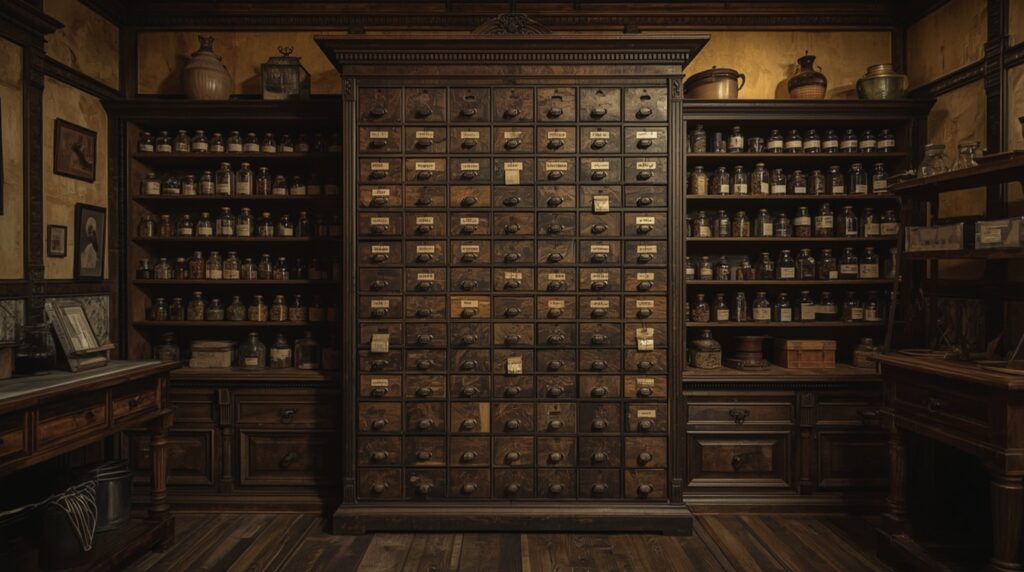
Collections from museums also reinforce the continued depth of combination of pharmacy, craft, and presentation: it remains that important institutions have preserved pharmaceutical vessels, displays of shop fittings, and objects of medical material culture in order to contextualize these Cabinets these include, among others, the Victoria and Albert Museum (V&A), The Metropolitan Museum of Art, the Louvre, and the Smithsonian Institution. By and large, the material collection makes clear that the history of pharmacy was one of both scientific aspiration and aesthetic presentation, using richly-made woodwork and labeled vessels to show professionalism.
Design, Materials, and Craftsmanship: What Makes One “Antique”
A true apothecary antique cabinet is typically defined by period construction and materials—often hardwoods such as oak, walnut, or pine, depending on region and budget—paired with hand-cut joinery. Dovetails (sometimes irregular by modern standards), pegged mortise-and-tenon frames, and later, machine-cut drawer parts in 19th-century examples can help date a cabinet. Hardware matters too: forged iron pulls on earlier pieces, brass cup pulls on later Victorian shop cabinets, and locks that reveal the cabinet’s original security needs.
Can You Guess the Artist?
Three clues. One artist. How quickly can you identify the painter?
Form follows function. The defining feature is a grid of small drawers dozens, hundreds made for sorting ingredients. Original drawers are marked with pieces of paper or painted words. Some cabinets feature a central kneehole workspace, flanking cupboards, a rise at the back providing shelves for jars. All of these operating principles is similar to the way that museum and archives preserve pharmacy objects. Containers are made to be used again and again, and to be labeled and handled comfortably. The V&A sums up these principles in the general history of design with the phrase ’ utility and beauty’. Pharmacy fittings are a high profile example.
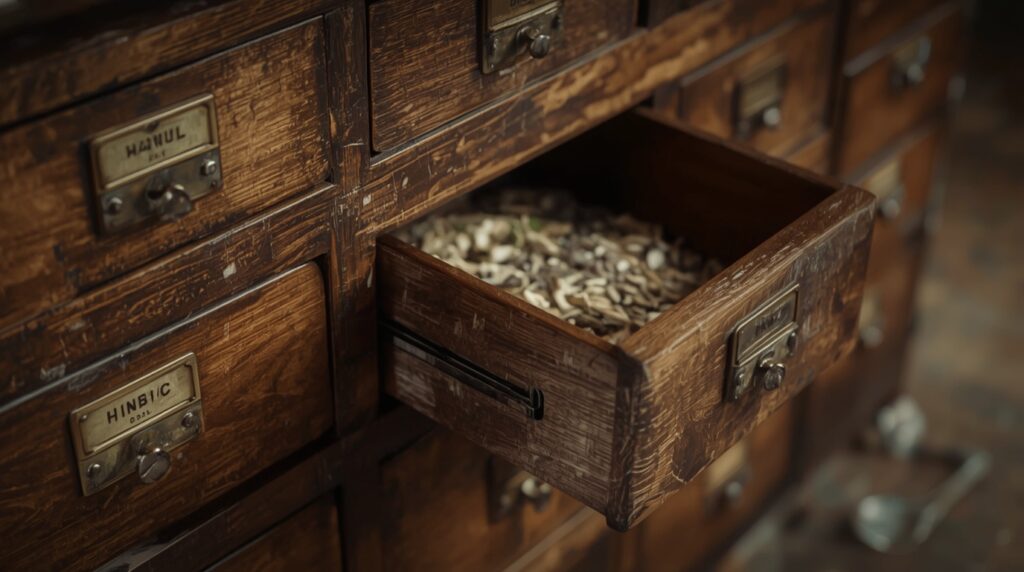
Genuineness reveals itself in the surface and wear. You can feel the patina developed from machine handling: edge and corner roundings, burnished pulls, and patchy lightness where shopfront sunlight poured in. All should coalesce in the mind with age and mileage. Fake disfiguration feels contrived or too symmetrical. Longer established traders will examine the cabinet for regular tool marks and repairs made by people who knew their business, and for wood movement that makes sense with the time no sudden splitting with equally spotless interiors.
Table: Key Characteristics of an Apothecary Antique Cabinet
| Feature | Typical Antique Indicators | Common Later/Replica Signs |
|---|---|---|
| Joinery | Hand-cut dovetails, pegged joints, irregularity | Uniform machine dovetails, staples/screws throughout |
| Wood & patina | Oxidized wood tone, rounded edges, layered wear | “Even” distressing, fresh wood under thin stain |
| Hardware | Forged iron or period brass, old lock plates | Modern screws, identical pulls, shiny new locks |
| Layout | Many small drawers; occasional secret/locked compartments | Oversized drawers, decorative-only grids |
| Provenance | Shop history, labels, invoices, local tradition | Vague backstory, no documentation |
Provenance, Valuation, and Ethical Collecting
Value depends on age, condition, rarity, and—most of all—provenance. A cabinet documented to a specific pharmacy, town, or historic family can command a premium because it anchors the object in verifiable history. Labels, old photographs, shop receipts, or institutional deaccession records strengthen credibility. Without documentation, stylistic analysis becomes more important: does the cabinet match known regional forms (for example, French provincial pharmacy cabinetry versus Anglo-American general-store apothecary drawers)?
Condition is a balancing act. Museums usually focus on preservation of original material; collectors should to. As the Smithsonian Institution might often point out in their advice on conservation “your original surfaces are evidence of the past, and the more you remove in restoration, the less evidence remains”. It might do well to replace every single pull and remove every layer of oxidation with a fine pad and apply a single, thin coat of high gloss spray for resale, but that would be to lessen historical and market value and to effectively transform the piece.
Additionally, collecting ethically involves assurance of legal trade and reassuring protection from recently looted antiquities. Apothecary cabinets are generally not thought of as archaeological objects, and as such, buyers need not be concerned with a recent history of ownership, but for very early pieces and those with obvious institutional provenance, buyers should be able to expect a clear history of prior ownership. Good dealers will be able to offer written condition reports and close inspection. If possible, you should be able to have your cabinet compared with examples of similar form in museum collections and literature, such as those from The Met, the V&A, the Louvre, published collection research is always a useful tool for collectors gaining comfort with period construction and decorative Vocabulary.
Display, Care, and Use in Modern Interiors
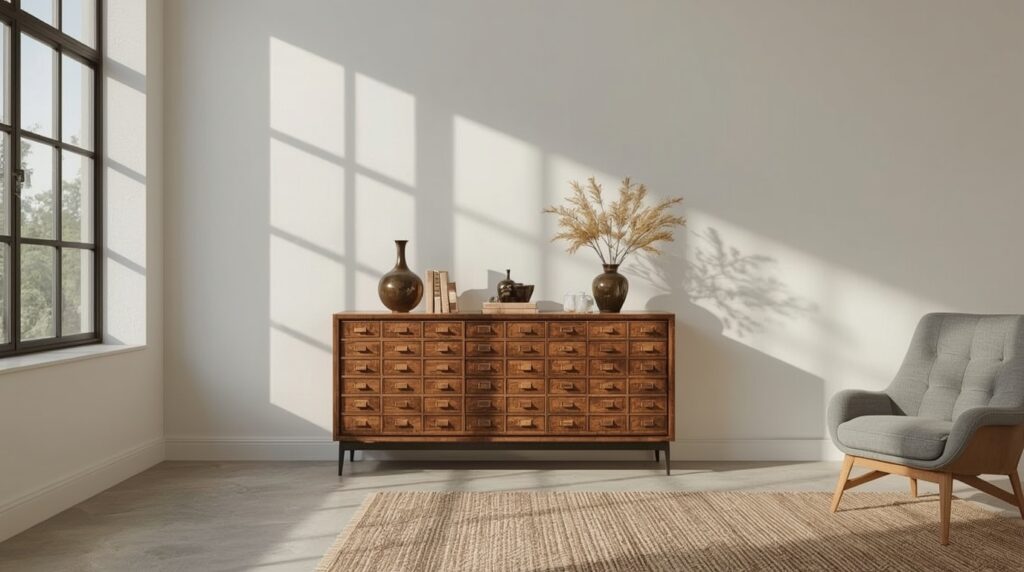
Displaying an apothecary antique cabinet today requires respecting both its age and its original purpose. The cabinet’s drawer-grid aesthetic works in traditional interiors, contemporary spaces, and retail environments—but placement matters. Keep it out of direct sunlight and away from heating vents; fluctuating humidity can warp drawer fronts and loosen joinery. If you live in a very dry or very humid climate, a stable environment is more important than any single cleaning product.
Care should be conservative. Dust with a soft cloth or brush; avoid silicone polishes that can contaminate surfaces and complicate future conservation. If the cabinet has original labels, treat them like works on paper: minimal handling, no wet cleaning, and consider archival protection behind a reversible barrier if you plan to display drawer fronts prominently. For serious conservation, consult a furniture conservator rather than a general refinisher.
Using the drawers is possible, but do so gently. Many antiques were built for daily trade, yet old wood is less forgiving after a century of movement. Lining drawers with acid-free paper can protect interiors if you store textiles, letters, or small collections. If you plan to store herbs, oils, or anything aromatic, remember that wood absorbs odors; museums avoid introducing new contaminants because they can permanently alter an object’s material record.
Authoritative Quotes (Contextual Insight)
“The Museum’s collection is among the finest and most comprehensive in the world.” — The Metropolitan Museum of Art, Collections mission statements and collection overviews (Metmuseum.org)
“The V&A holds a collection of over 2.8 million objects… spanning 5,000 years of human creativity.” — Victoria and Albert Museum, Collections overview (Vam.ac.uk)
“The Smithsonian’s mission is the increase and diffusion of knowledge.” — Smithsonian Institution, mission statement (Si.edu)
These institutional statements matter because they explain why museum documentation is a gold standard for comparing, attributing, and responsibly preserving historical objects like apothecary cabinets.
Frequently Asked Questions
What is an apothecary antique cabinet used for originally?
It was used to store medicinal ingredients—dried botanicals, powders, resins, and prepared compounds—organized in many small drawers for quick access and controlled handling in an apothecary shop.
How can I tell if an apothecary cabinet is truly antique?
Look for period joinery (hand-cut dovetails), consistent patina, appropriate hardware, and signs of long-term use. The strongest confirmation is provenance: documents, labels, or verifiable shop history.
Are “apothecary style” cabinets the same as antique apothecary cabinets?
No. “Apothecary style” usually means modern furniture inspired by the look—often decorative grids without the construction details, wear, or historical context of a true antique.
Should I refinish an apothecary antique cabinet?
In most cases, avoid full refinishing. It can erase original surfaces and reduce value. Opt for gentle cleaning and conservation-grade repairs when necessary.
Where can I research comparable historical examples?
Use museum collection databases and publications from The Metropolitan Museum of Art, the Victoria and Albert Museum, the Louvre, and the Smithsonian Institution, which provide high-quality reference imagery and object records.
An apothecary antique cabinet endures because it sits at the intersection of medicine, commerce, and craftsmanship. Its drawers speak to an era when remedies were compounded by hand and trust was built through order, labeling, and skilled work. Whether you collect for history, design, or material culture, the best approach is museum-minded: verify provenance, preserve original surfaces, and let the cabinet’s honest wear tell its story.
Authoritative sources for further reference: The Metropolitan Museum of Art (metmuseum.org), Victoria and Albert Museum (vam.ac.uk), Louvre Museum (louvre.fr), Smithsonian Institution (si.edu).
AI Notice: Some visual content in this article may have been created or enhanced using artificial intelligence (AI) for artistic, editorial or illustrative purposes. Learn more about our approach in our AI & Editorial Principles.