

Why Vintage Cane Dining Chairs Are Suddenly Everywhere (And How to Choose)
Few furniture forms balance lightness and strength as elegantly as vintage cane dining chairs. With their woven seats and backs, they look airy yet sit firmly in the long lineage of European courtly craftsmanship, colonial-era trade networks, and 20th-century modern design. The best examples feel timeless because they were born from practical engineering: cane breathes in warm climates, flexes under weight, and—when properly made—can last for generations. Today, collecting vintage cane dining chairs isn’t just about style; it’s about owning a small, usable piece of decorative-arts history.
What “Vintage Cane” Really Means (and What It Doesn’t)
Vintage cane dining chairs generally refer to chairs made in the mid-20th century or earlier (often 1920s–1970s) that incorporate cane webbing—typically rattan cane—hand-woven or machine-woven into an open lattice. Cane is not the same as wicker: cane describes the woven sheet (often used as a seat/back panel), while wicker refers to a broader technique of weaving flexible plant materials into a structure. Many buyers conflate the terms, which can lead to mismatched expectations about durability and repair.
Can You Name the Masterpiece?
Ten masterpieces. Ten questions. How well do you know the history of art?
Historically, cane furniture is tied to international trade. Rattan—commonly harvested in Southeast Asia—entered European workshops through maritime routes that expanded dramatically during the 17th and 18th centuries. In Britain and France, cane seating became fashionable for its refinement and comfort, particularly in interiors where textiles might trap dust or heat. The popularity of cane also corresponds with shifts in taste toward lighter, more portable furniture—especially evident in the late 18th century.

Museums reinforce this lineage through their decorative-arts collections. Institutions such as the Victoria and Albert Museum (V&A) and The Metropolitan Museum of Art document cane seating within broader movements—Rococo, Neoclassicism, Arts and Crafts, and Modernism—showing that cane was never merely “casual.” It was a material choice aligned with evolving ideas of hygiene, comfort, and modern living.
A Brief History: From European Workshops to Modern Dining Rooms
Cane seating gained momentum in late 17th- and 18th-century Europe, notably in Britain and France, where chair forms multiplied alongside changing social rituals around meals and salons. French workshops during the reigns of Louis XV and Louis XVI refined chair silhouettes—think cabriole legs and later neoclassical restraint—and cane frequently appeared as an elegant alternative to heavy upholstery. The openwork surface suited well-heated rooms and showcased the woodworking around it.
Can You Guess the Artist?
Three clues. One artist. How quickly can you identify the painter?
By the 19th century, cane chairs were broadly manufactured and exported, including to North America. The Smithsonian Institution has extensively documented American furniture traditions and the industrialization of domestic objects, a context in which cane seating sits comfortably: it became both a mass-market solution and, in higher-quality forms, a continuation of skilled joinery and finishing. This period also saw cane used in cafés and public interiors, where airflow and easy maintenance mattered.
In the 20th century, cane re-emerged as a modernist statement. Designers and manufacturers in Europe—especially in interwar and postwar decades—embraced cane for its visual lightness. The V&A and The Met frequently position such materials within modern design narratives: a move toward honest structure, reduced mass, and an emphasis on how objects are made. In dining rooms, cane’s return aligned with smaller urban spaces and a desire for furniture that felt “open” rather than bulky.
Key Characteristics: How to Identify Quality Vintage Cane Dining Chairs
When evaluating vintage cane dining chairs, start with the frame. The best chairs use solid hardwood (often beech, walnut, oak, or elm in European examples) with tight, well-cut joinery. Look for mortise-and-tenon joints, corner blocks (in some designs), and evidence of careful shaping rather than purely machine-cut profiles. Cane is only as good as the frame that holds it; a sagging chair often reflects loosened joints more than failed weaving.
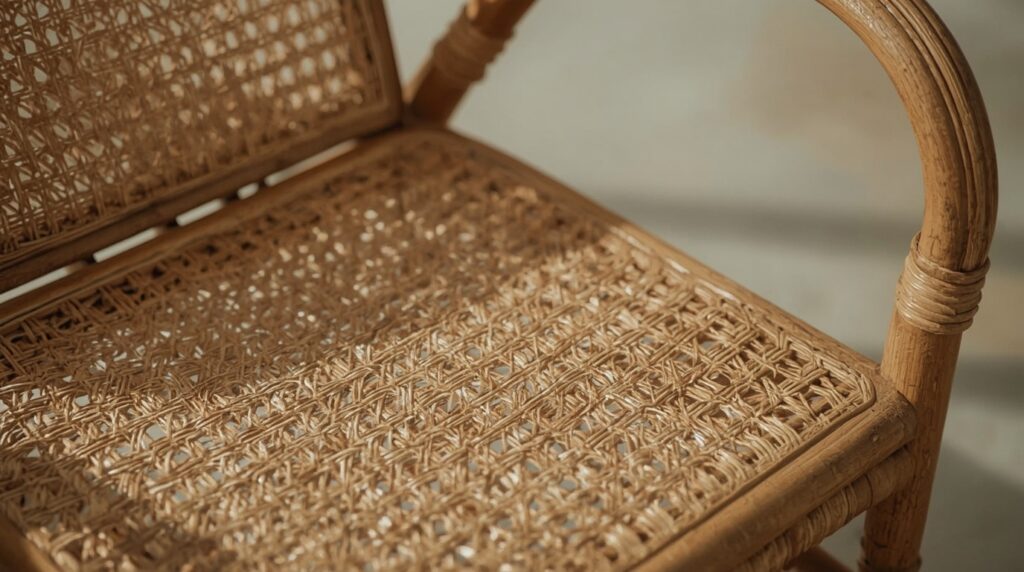
Next, inspect the cane weave. Traditional cane webbing should be evenly spaced, with consistent hexagonal openings and a smooth, taut feel when pressed. Slight variation can indicate handwork; severe irregularity, broken strands, or pronounced sagging usually signals either age-related dryness or poor prior repair. Many vintage pieces have been re-caned—this isn’t automatically a downside if done well, but it affects originality and value.
Finally, consider provenance and stylistic cues. French and Italian chairs may show decorative carving and refined proportions; Danish and other Northern European modern pieces often emphasize clean lines and sculptural woodwork. Museum standards help collectors think clearly about construction and authenticity. The Met notes that careful observation of materials and techniques is central to understanding furniture as an art form, not just a commodity—an approach that applies directly when assessing cane seating in the market.
Table: Key Characteristics of Vintage Cane Dining Chairs
| Feature | What to Look For | Why It Matters |
|---|---|---|
| Frame wood | Solid hardwood; visible grain; sturdy weight | Determines longevity and structural integrity |
| Joinery | Mortise-and-tenon, dowels, tight joints | Loose joinery leads to wobble and failures |
| Cane pattern | Even hex weave; uniform tension | Comfort, strength, and visual quality |
| Edge binding | Neat spline and groove; clean finishing | Indicates professional caning and durability |
| Patina | Honest wear, consistent finish aging | Signals authenticity; affects value |
| Repairs | Well-executed re-caning, stable glue lines | Good repairs extend life; bad repairs reduce safety |
Care, Restoration, and What Museums Teach About Preservation
Cane is strong but sensitive to extremes. It can dry out, become brittle, and crack—especially near radiators or in very low humidity. A museum-informed baseline is to avoid harsh conditions and sudden changes. The Smithsonian and other conservation-minded institutions emphasize controlled environments and gentle cleaning for organic materials; while home conditions aren’t museum-grade, the principle holds: stable humidity and moderate temperatures preserve cane best.

Cleaning should be minimal and careful. Dust with a soft brush and vacuum on low suction using a brush attachment. For grime, use a barely damp cloth and dry promptly. Over-wetting can swell fibers and loosen the webbing. If you must refresh dryness, a very light misting on the underside—followed by thorough drying—can sometimes restore temporary flexibility, but it is not a substitute for proper re-caning when strands are failing.
Restoration is often worthwhile because cane is repairable. Professional re-caning can return chairs to decades of use, and high-quality work respects the original groove, spline, and weave scale. As the V&A’s approach to decorative arts implies—preserve what is original when possible; replace only what must be replaced, and do so with historically appropriate materials. If you’re collecting, document restoration with receipts and photos; transparency supports long-term value.
Buying Vintage Cane Dining Chairs: Authentication, Period Clues, and Value
Start by identifying the chair’s approximate period and place of origin. Mid-century modern cane chairs often have minimalist frames, tapered legs, and maker’s marks under the seat rails. Earlier revival styles may borrow from Louis XVI (straight fluted legs, neoclassical motifs) or Louis XV (curves, carved ornament). Look for labels, stamps, or construction methods consistent with the claimed era.
Value depends on design pedigree, condition, and rarity. Sets of four or six matching chairs generally command a premium, especially if the cane is intact and the frames are solid. However, a well-restored set can be a smarter buy than an “all-original” set with dangerously brittle cane—particularly for daily dining use. Always sit-test (gently), check for racking (side-to-side sway), and examine the underside for repairs.
Authoritative voices in design history repeatedly emphasize the importance of craftsmanship and fit-for-purpose construction. As William Morris, a central figure in the Arts and Crafts Movement (late 19th-century Britain), argued in lectures on design and labor: “Have nothing in your houses that you do not know to be useful, or believe to be beautiful.” That standard fits cane dining chairs perfectly: the best are both structurally intelligent and visually refined.
Frequently Asked Questions
Are vintage cane dining chairs comfortable enough for everyday dining?
Yes—when the cane is taut and intact. Cane has natural flex, which can feel more forgiving than solid wood. Adding a thin tie-on cushion can improve long dinners without trapping too much heat.
How can I tell if cane is original or replaced?
Look for uniformity and age cues: original cane may show even ambering and subtle wear consistent with the frame’s patina. New cane often looks brighter and more uniform. A professional re-caning job may still be desirable; ask for documentation.
Is “cane” the same as rattan?
Cane webbing is commonly made from rattan skin. “Rattan” can also describe thicker structural poles used in frames; “cane” usually refers to the finer weaving material used for panels.
Can I re-cane a chair myself?
It’s possible with pre-woven cane sheets and the right tools, but good results require practice—especially aligning the pattern and setting the spline cleanly. For valuable sets, professional work is usually worth it.
What institutions can I consult for style and period references?
For visual and historical reference, explore online collections at The Metropolitan Museum of Art, the Victoria and Albert Museum, the Smithsonian Institution, and the Louvre Museum, all of which provide object records, dates, and context for furniture and decorative arts.
Vintage cane dining chairs endure because they solve real problems—comfort, ventilation, and elegance—through refined craft. Whether your taste runs toward French neoclassicism, café-era practicality, or modernist lightness, the best examples reward careful inspection of frame quality, cane condition, and honest provenance. Treated with basic conservation-minded care and restored responsibly when needed, a well-made set can remain both functional furniture and a living link to design history.
AI Notice: Some visual content in this article may have been created or enhanced using artificial intelligence (AI) for artistic, editorial or illustrative purposes. Learn more about our approach in our AI & Editorial Principles.


