
Victorian Era Winter Clothing: How 19th-Century Fashion Stayed Warm, Elegant & Surprisingly Luxurious
Victorian winters were not merely cold; they were socially consequential. In an age before central heating and synthetic insulation, what you wore in December could determine whether you stayed healthy, moved freely through soot-laden city streets, and—crucially—whether you appeared “respectable” in public. Victorian era winter clothing was a practical response to damp British weather and a visible language of class, gender, and modernity, shaped by the Industrial Revolution, imperial trade, and rapidly changing urban life in places like London, Manchester, Edinburgh, and Paris.
Climate, Industry, and the Making of Victorian Winter Dress
Victorian winter clothing developed during a period of intense change (1837–1901). The expansion of railways, factories, and department stores altered how garments were produced and sold, while coal smoke and fog (“pea-soupers”) made warmth and protective outer layers essential—especially in London. Winters could be severe, and indoor spaces were often chilly; clothing functioned as portable insulation.
Can You Name the Masterpiece?
Ten masterpieces. Ten questions. How well do you know the history of art?
This account has put textiles at the heart of the tale. Wool, flannel, and heavy broadcloth persisted as popular fabrics, because they held on to body heat and endured dampness better than many of the lighter ones. An expanding choice of machine-woven textiles, as well as the commercial dye industry, provided a greater range of styles at lower prices for some sections of society, although the quality continued to reflect class distinctions. A documentary record survives in London museum collections: the V&A includes clothes that reveal the preponderance of hand-stitched tailoring as well as the dawning of the age of ‘mass production’ in fashionable clothing.
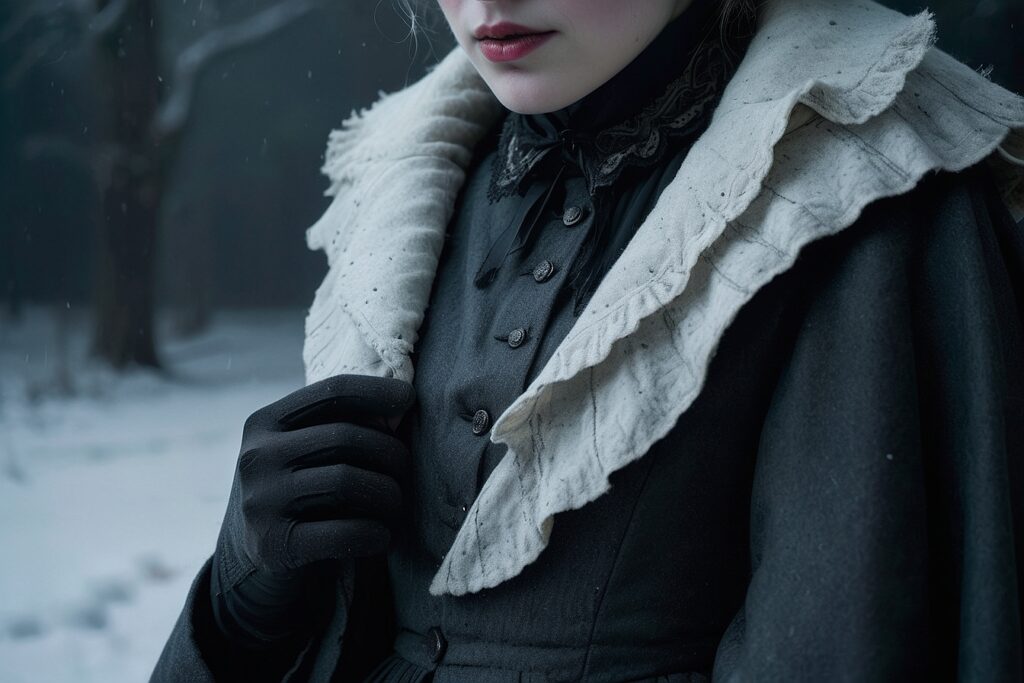
Fashioned Victorian winter dress is also transnational. Textiles and colors, as well as styles were determined by state capitals with Paris Dictating Aesthetic terms, and the empire meeting the needs of a burgeoning fashion industry. The Metropolitan Museum of Art and the Smithsonian Institution studies have demonstrated how fashion became a modern, commercial, seasonal, leadership course, long before the 20 th century.
Materials and Layers: The Architecture of Warmth
The Victorian approach to winter warmth was fundamentally layered. For women, this could mean chemise, corset, multiple petticoats, a dress of heavier fabric, and then outerwear—often combined with shawls or capes. For men, shirts, waistcoats, wool suits, and robust overcoats created warmth through trapped air and dense cloth. This layering was not simply comfort-driven; it created the fashionable silhouette of the day.
Can You Guess the Artist?
Three clues. One artist. How quickly can you identify the painter?
Materials conveyed status as well as function. Handsome broadcloths of fine wool or trimmed with fur indicated wealth, but worker classes wore more utilitarian but cheaper articles rough woolens, knitted items or second hand clothes. The V&A‘s fashion and textile collections show the importance of fiber, weave and finishing nap, fulled wool, lined construction as well as cut.
Victorian winter dressing also saw a rise in the sales of “rational” underwear and warmer foundations. Underclothes made of flannel grew in popularity as the century drew to close, for those interested in health and wellness. “The Met‘s collection shows how the 19th century increasingly treated clothing as both fashion and technology,” indicating the increased importance placed on comfort and hygiene.
Women’s Winter Clothing: Silhouettes, Outerwear, and Respectability
Women’s winter outerwear balanced warmth with the era’s shifting silhouettes. Early Victorian decades favored fitted bodices and full skirts; mid-century crinolines expanded skirt volume; later decades moved toward the bustle and more structured tailoring. Winter versions of these looks often used heavier textiles—wool, velvet, and silk with substantial linings—and incorporated capes, mantles, and fitted coats designed to sit properly over voluminous skirts.
In the mid 1800s, shawls were also centrally important. Heavy, warm wraps, which could even be paiisley pictured here were good for warmth but little affected the desired silhouette. Gloves, muffs and bonnets (or by the end of the century hats) aided in the protection of the fingers and face; for women, a muff was the ultimate sign of affluence and wintertime femininity.
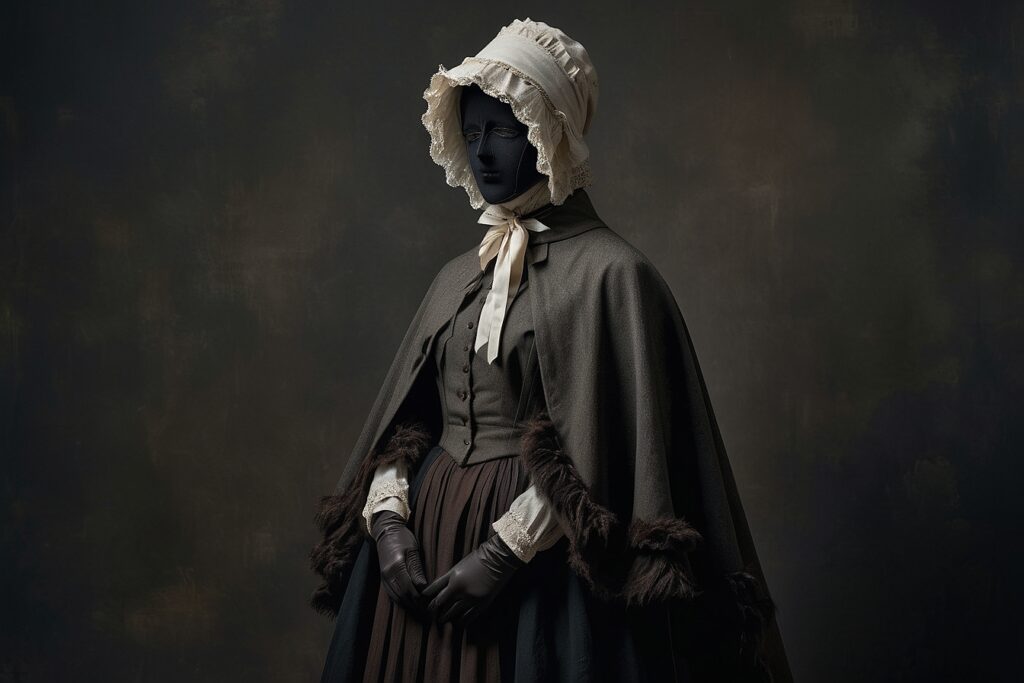
Much of this wardrobe was marked by respectability. In winter, dark hues and modest trims marked them as proper, and expensive furs and vibrant fabrics were worn by the aristocracy. According to the curatorial writing on 19th century dress in the V&A, dress was “a marker of social identity”, particularly in the winter streets, where dress was on display.
Men’s Winter Clothing: Overcoats, Tailoring, and Urban Utility
Victorian men’s winter clothing was anchored by tailoring and outerwear. Overcoats—often in heavy wool—were essential, with styles evolving across decades: caped greatcoats, frock coats, and later more streamlined forms. Practical design features such as high collars, deep cuffs, and layered capes helped block wind and rain, particularly for commuters and those who spent time outdoors.
Accessories were important for utility and for fashion. Gloves, woollen scarves and hats (top hats for dress, and later in the period, bowler hats for everyday wear) helped hang the winter look together. Shoes had to cope with the wet pavements; strongly built shoes, as well as several pairs and improved waterproofs were on offer to them enriched. In an age when one‘s moral character was estimated from his face, a neat, well-cut coat played the sign of discipline and wealth.
Museums and archives back these assumptions with original garments demonstrating such construction techniques as hand finishing, pad-stitching, and sturdy linings that helped make coats warm and durable. Museum pieces like these, stored at the Smithsonian Institution, further explain how mass production ever so gradually increased access to ready-mades until custom tailoring was always the mark of excellence.
Class, Labor, and Regional Variation in Winter Dress
Victorian winter clothing differed sharply by class. For working families, warmth had to be achieved through durability, repair, and layering of whatever was available. Garments were frequently mended, altered, or handed down; outer layers might be worn far beyond their prime. A factory worker or domestic servant could not treat winter clothing as seasonal fashion in the way the wealthy could—yet they still navigated strict social expectations around neatness.
Regional conditions also shaped clothing. In industrial cities like Manchester or Glasgow, soot and damp encouraged darker, hard-wearing fabrics. In the countryside, heavier knitwear and practical cloaks were common. Urbanization added another factor: crowded streets and public transport increased exposure to cold and moisture, making robust outerwear important even for clerks and shop workers.
Institutions across Europe document these variations. The Louvre Museum, while best known for fine art, also contextualizes 19th-century Europe’s broader culture and portraiture—visual evidence showing how winter garments signaled profession and class. As one often-cited maxim attributed to fashion historian James Laver puts it, “Clothes are never a mere reflection of the times; they are part of them,” capturing how winter dress participated in Victorian social systems rather than merely responding to weather.
Key Characteristics of Victorian Era Winter Clothing (Summary Table)
| Aspect | Common Victorian Winter Solutions | What It Signaled |
|---|---|---|
| Core materials | Wool broadcloth, flannel, velvet, lined silk | Wealth (quality), practicality (durability) |
| Layering | Multiple underlayers + structured outerwear | Modesty, propriety, warmth |
| Women’s outerwear | Mantles, capes, fitted coats, shawls, muffs | Respectability, fashion alignment |
| Men’s outerwear | Greatcoats, frock coats, heavy overcoats | Professionalism, class position |
| Accessories | Gloves, scarves, hats/bonnets, boots | Completeness, etiquette, protection |
| Construction | Linings, interlinings, hand tailoring, sturdy seams | Craft quality, longevity |
“Fashion is a form of ugliness so intolerable that we have to alter it every six months.” — Oscar Wilde (reflecting Victorian-era debates about fashion’s pace and social meaning)
Frequently Asked Questions
1) What did Victorians wear in winter to stay warm without modern heating?
They relied on dense fabrics (especially wool), linings, and extensive layering. Women often wore multiple petticoats and wraps; men wore waistcoats and heavy overcoats. Accessories like gloves, scarves, and muffs reduced heat loss.
2) Was fur common in Victorian winter clothing?
Fur trim and fur accessories existed, particularly among wealthier consumers, but wool was more universal. Fur often functioned as a visible luxury marker as much as insulation.
3) Did Victorian winter fashion change across the era?
Yes. Women’s silhouettes shifted from early full skirts to crinolines and later bustles; men’s coats also evolved in cut. Winter garments followed these trends while using heavier materials and linings.
4) How do we know what Victorian winter clothing was really like?
Surviving garments and curatorial research in institutions such as The Metropolitan Museum of Art and the Victoria and Albert Museum provide direct evidence—fabric, stitching, wear patterns, and repairs—alongside photographs, fashion plates, and portraits.
5) Did working-class Victorians dress like the wealthy in winter?
Not in materials or quantity. Working people prioritized durability and repair, often wearing older or altered garments. However, social pressure still encouraged neatness and conformity to basic standards of respectability.
Victorian era winter clothing was an engineered response to cold, damp, and social scrutiny—built from wool, layers, and careful tailoring, and shaped by industrial production and class realities. From the lined overcoat to the shawl and muff, these garments show how Victorians managed climate and identity at once. Museum collections at institutions like The Met, the V&A, and the Smithsonian preserve this history in fabric and thread, allowing us to read winter dress not as costume, but as lived technology and social code.

What Did Victorian People Actually Wear in Winter?
Winter dress was not one mode of dress. Four women experiencing the same harsh winter taking a walk down Mayfair, leaving Manchester at dawn to spend the day at a factory, traveling by train to her job as a middle-class clerk could all be wearing little more alike than similar warm garments.
For the male gender, a heavy wool coat tended to be the main outer garment; this might be, depending on the age and occasion, a frock coat, Chesterfield coat, greatcoat, ulster or other long coat. They tended to be cut very long in order to be placed over several layers.
The rich could afford a coat that used the best quality wool and included a finely finished lining and tailored cut. A working man could own fewer garments, which had robust fabrics that could take a battering over many years of daily wear. It was not only a matter of warmth. Cut, build, fabric quality and state of cleanliness told others about one‘s occupation and class.
The problem was become more complex for women, as all the fashionable Victorian dresses were made of lots of fabric. Over a winter dress women might wear a chemise, corset, petticoats, stockings, bodice, jacket, shawl, cloak or coat. The layers were a great source of warmth, but it was not easy to move in them.
The winter dress of the Victorian era was thus a fine balance between comfort and protection against the elements, accompanied by an attempt to remain as fashionable as possible.
Women’s Winter Clothing Was Heavy—and Surprisingly Complex
A lady might still have had other clothing on before she put her coat on. Beneath the dress there were other layers of clothing which were to shape the form of the woman and still provide modesty and warmth. Petticoats could, in some periods, provide a good deal of warmth around the legs, woollen stockings serving as a further layer against cold floors and outdoor conditions.
As outerwear, they wore cloaks, capes, mantles, jackets and pelisses, and later, small coats. Shawls were especially handy because they could be worn to keep warm without the need to get all dressed up again.
The iconic Victorian silhouette was not scrapped just because it was cold.
Instead, the winter fashion adapted the silhouette.
Thicker fabrics would strengthen the fashionable shape, but it is the fur trimming, velvet collars, braid, embroidery and lavish closures that raised the serviceable garments to one of luxury.
So for the rich women, even though their winter coating was meant toprovide warmth to the body, it could still be presented as a visual spectacle.
Shawls, Capes, and Cloaks
The shawl was responsible for the greatest variety of sartorial response among Victorian women, until the modern era of the tailored winter coat.
The garments worn by women in the Victorian Era are, in stark contrast to contemporary ideas of good winter wear, glitzy and showy.
The large cashmere and woollen shawls were light and were used to protect the shoulders and torso from cold when worn over contemporary clothes. The open design meant they could be used as required.
A shawl could be thrown loosely over her indoors, bundled tightly while on the move or placed over a stylish evening dress she moved in between the coach and the building.
Cloaks and capes provided an alternative. Their flowing form could more comfortably accommodate the masses of material from the earlier Victorian skirts than the narrow shape of the coat.
The rationale behind this is crucial to interpret historical garments as these were not made in isolation. The outer layer needs to accommodate the silhouette beneath it.
Changes in skirt shapes over the course of the nineteenth century from wide, bell-like forms to the careening silhouettes of the late nineteent also led to a change in winter outerwear.
Not even the coat hem escaped winter protection.
The streets in the Victorian era were often muddy, wet, rutted and very polluted with horse droppings and industrial fumes. It was therefore a vital practical issue to have shoes that kept your feet dry.
Leather boots also gained a regular place in winter everyday dressing men and women both wore them. –. Women adopted similar boot styles but men‘s shoes, with buttoned and laced varieties, were often more robust than increasingly fragile indoor footwear.
Shoes had to crawl through two worlds.
It had to endure the street, but also had to be tolerable once the wearer entered shop, office, railway station, theatre, church or private house.
This is why Victorian shoes could look so elegant but still be useful. This is not just a shoe for outdoors. The shoe was also an element of a social costume.
Gloves Were Essential in Cold Weather
Gloves particularly specified in winter dress were another feature of this Victorian winter dress.
Gloves were already a sign of etiquette and respectability for middle- and upper-class men and women. In the winter they had an additional evidently practical function of protecting cold hands.
Leather gloves were specifically linked with outdoor apparel, while woollen gloves and mittens could achieve greater warmth without the expense of more serious pursuits.
Winter gloves, however, protected the hands, and so reinforced the period‘s concern with the behavior of women and the presentation of the proper lady. For example, if we take the typical winter costume, it could be constructed from a variety of covering items, all of which give a very stylish look:
In Victorian society, there was also often a blurry dividing line between practical and decorative clothes.
A piece of clothing could serve both purposes at the same time.
Authoritative sources (recommended starting points): The Metropolitan Museum of Art (Heilbrunn Timeline of Art History; Costume Institute resources), Victoria and Albert Museum (Fashion, Textiles & Accessories collections and essays), Smithsonian Institution (material culture and industrial-era collections), and contextual European visual culture resources associated with the Louvre Museum.
AI Notice: Some visual content in this article may have been created or enhanced using artificial intelligence (AI) for artistic, editorial or illustrative purposes. Learn more about our approach in our AI & Editorial Principles.