
Antique Hand Fans: The Surprisingly Valuable Treasures Hiding in Plain Sight
Long before air conditioning, a simple flick of the wrist could send a breeze across a powdered face—and also convey flirtation, rank, or political allegiance. Antique hand fans are far more than dainty accessories; they are miniature time capsules that preserve fashion, global trade routes, craftsmanship, and social codes from centuries past. From gold‑threaded Chinese brisé fans to French Rococo painted scenes, each fan tells a layered story about the people who held it and the worlds they moved through.
Today, the museums like The Metropolitan Museum of Art in New York City, The Victoria and Albert Museum in London, The Louvre Museum in Paris, and the Smithsonian Institution in Washington, D. C. All keep these precious, fragile objects. Their collections reveal how fans made their way through East Asia to Europe, how they came into use by European Royal courts and ultimately arrived in the hands of fashionable women (and in some cases men) on two continents as one of the most useful accessories. Collectors, art historians and experts of fans now view these old, ‘eye-candy’ objects as nothing without appreciation of the time and effort dedicated in their production.
Can You Name the Masterpiece?
Ten masterpieces. Ten questions. How well do you know the history of art?
Demystifying antique hand fans necessitates some understanding of context. When were they made, where, what were the significant materials, and how did trends change their appearance? Drawing on museum research and archives, this article examines their history, types and collecting issues and offers advice to the viewer who may wish to buy or clean them.
Origins and Global Journeys of the Hand Fan
Fans have long histories dating back to antiquity. Stiff ceremonial fans some large and with attendants are shown in tomb paintings of the New Kingdom of Egypt (c. 1550 1070 B. C., c. 2520 2150 years ago), where they stood for the absolute power of and divine empowerment of the Pharaohs. In the Louvre there are fragments of fan handles from Egypt made of ivory and inlaid with precious stones, revealing their importance and use among the elite. In ancient Greece and Rome fans called mystra or flabellum are seen in art and on the pages of literature.
The underlying folding fan on which most European antique fans are based is widely thought by academics to have originated in the East. Most believe that the ability to fold fans developed in Japan no earlier than the Heian period (794–1185CE), and that the original fan created was of joined slats of cypress or bamboo (the gi and the suehiro). The Smithsonian Institution states that the courtly Japanese fan of the Muromachi and Momoyama periods (14th–16th century) was a tool for performance as well as for show; Noh, and later Kabuki were, as well as an important part of courtly culture.
Can You Guess the Artist?
Three clues. One artist. How quickly can you identify the painter?
Most of those trade routes, however, would bring fans originating from East Asia to European shores from the 16 th century, (for example through Portuguese traders, who would then be followed by others such as the Dutch) to European towns and ports such as Seville, Amsterdam and Lisbon. By the 17 th century European (notably French, Italian and English) workshops would then begin to mass produce East Asian inspired fan designs, often copying the motifs to be seen in textbooks and Taiwanese/Chinese art. The Victoria and Albert Museum highlight that: ‘fans became emblems of global trade in the early modern period as they wedded Far Eastern and European designs on ivory, mother-of-pearl and gilded paper’.
Materials, Construction, and Types of Antique Fans
Antique fans are typically divided into two broad structural categories: folding fans and fixed (or rigid) fans. Folding fans have a set of sticks and guards joined at a rivet, with a pleated leaf attached across them; they collapse compactly and open in a semi-circle. Fixed fans, including feather and screen fans, do not fold and are often mounted on a single handle or frame. The Metropolitan Museum of Art’s fan collection demonstrates both types, spanning 17th-century lace fans to 19th-century feather examples used at European courts.
Different types of folding fans are also relevant for collectors. The brise fan has no continuous leaf; each stick is shaped, pierced and often decorated with paints and gold before being linked together with a ribbon or thread. The monture-and-leaf fan has a papyrus or silk leaf mounted on a monture of sticks and guards; these often have a larger painted surface area. Cockade fans open into a full circle and collapse into a slim cylinder; these were particularly fashionable in the eighteenth and nineteenth centuries. The different methods of construction influence the longevity, decoration and beauty of the fans.
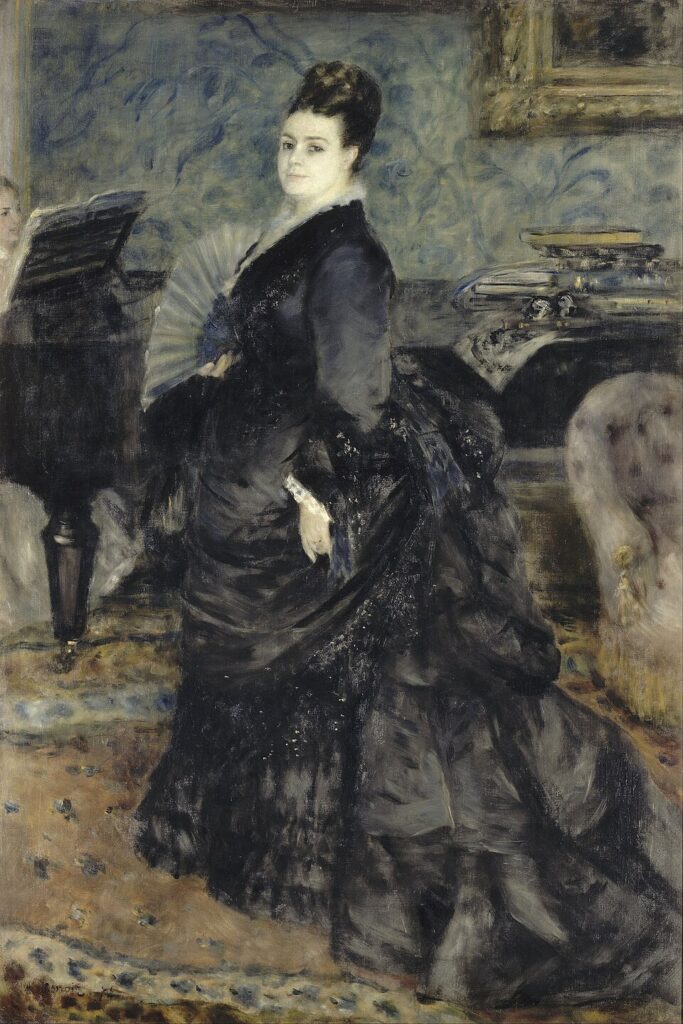
Materials suggest date, place of origin, social standing. European fans of the 18th century used ivory, mother of pearl, bone or often fine woods for sticks, decorated with carving, piercing or inlay of gold or silver foil; the leaves might be painted in gouache, hand coloured in engraved copper plate, contain embroidery or spangles applied. In the Far East, bamboo, sandalwood or lacquered wood were the usual sticks, with silk, paper or parchment leaves. The V&A comments that ‘fans are probably the most elaborate of any personal belongings, with workshop co-ordination involving painters, carvers and jewellers, to produce one finished item..”
Fans as Social Codes and Fashion Statements
In early modern Europe, the hand fan quickly became a marker of rank and refinement. By the late 17th and 18th centuries, it was an essential component of women’s court dress in France, Spain, and Britain. Portraits by painters such as François Boucher and Thomas Gainsborough, many held at the Louvre and the National Gallery, frequently depict sitters with elaborately decorated fans. These fans not only completed the visual composition of a portrait but also signaled the sitter’s wealth, taste, and familiarity with courtly etiquette.
The concept of a codified ‘language of the fan’ is largely romanticized but it is rooted in social practice. Fans enabled women, whose public speech was often limited by codes and constraints, to communicate non-verbally using subtle gestures; shadowing the face, closing the fan, opening it wide or moving it slowly expressed moods and reactions as appropriate in each specific court or salon. Fragments of so-called ‘fan alphabets’ found in 19 th-century manuals are almost certainly exaggerated but consensus among researchers is that fans were widely understood, and socially intelligible. They could be, as the V&A puts it “a mask, a shield and a means of controlled display”.
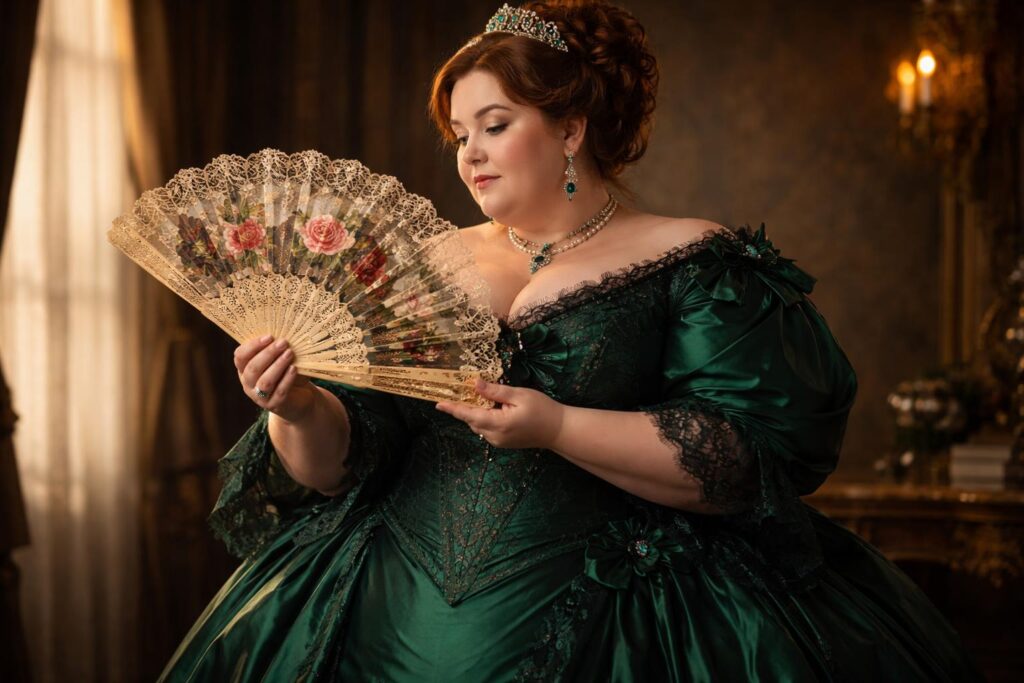
During the 19 th century, fan culture was altered by industrialization and fashion. Fans made mass-produced by printing were more affordable and available for middle-class buyers to purchase (particularly in Paris and London). Fan-makers worked with couture houses (as with Duvelleroy in Paris collaborating with the Second Empire and Third Republic). The Costume Institute at the Met notes: ‘Fans made fashion-plates in magazines including La Mode Illustree and influenced the color and motif as well as the size of fans through the Victorian and Belle Epoque eras’.
Iconography: What Antique Fans Depict
The decoration on antique fan leaves reveals much about the cultural climate in which they were produced. In 18th‑century Europe, Rococo fans commonly feature pastoral scenes, mythological subjects, and fêtes galantes—elegant outdoor gatherings popularized by artists like Antoine Watteau. These subjects reinforced ideals of leisure, romance, and aristocratic grace. Many such fans in the Louvre and the Met show allegories of the seasons, the arts, or love, sometimes including mottoes in French or Latin.
Fans also carried current event and political message. Many fans from the late 1700s commemorated the coronation of Louis XVI, the American War of Independence, or the French Revolution through engraved or lithographed imagery. Many of the fans in the British Museum, which is more closely associated with scholarship at the V&A, commemorated naval victories or royal weddings with patriotic imagery within a wedding band. In the Museum there are “news fans” which functioned increasingly like a wearable broadside allowing the owner to literally hold current events in her hand.

In the 19 th century, the iconography of fans expanded even more. The European craze for Japanese design called Japonisme led to designs with asymmetrical compositions, cranes, cherry blossoms, and fans within fans, taken from Japanese ukiyoe prints being brought to Paris and London. Advertising fans also appeared, with merchants giving fans with images of their wares or of their shop names; these are now collected as examples of early commercial graphic design. The Smithsonian holds examples of fans from American exhibitions, including the Centennial Exhibition 1876 in Philadelphia, showing fans associated with national and international stories.
Regional Traditions: East Asia, Europe, and Beyond
East Asian fan traditions are both older and more diverse than many Western collectors realize. In China, both folding and rigid fans (such as the rounded tuánshàn) developed as tools for scholars, officials, and artists. Painted fans from the Ming (1368–1644) and Qing (1644–1912) dynasties often bear calligraphy, landscapes, and poetry; they could be exchanged as gifts among literati. The Palace Museum in Beijing and the Met’s Asian Art Department hold notable examples demonstrating how fan painting became an esteemed art form, with renowned artists Contributing designs.
In Japan, fans were woven into low ceremonies and performance. Decoratively painted sensu (folding fans) and simple uchiwa (non-folding fans) featured in religious practices, Noh theater, Japanese costume, and even the warrior practice of the samurai, where iron or armored fans (tessen) served a defensive purpose. The V&A notes that by the Edo period, ‘fans were indispensable props in the codified movements of classical dance and theater.. Each gesture has to be precisely choreographed and carrying its own highly specific meaning’, and thus this important tradition differed profoundly from its European courtly counterpart (though there was influence once trade was opened between east and west).
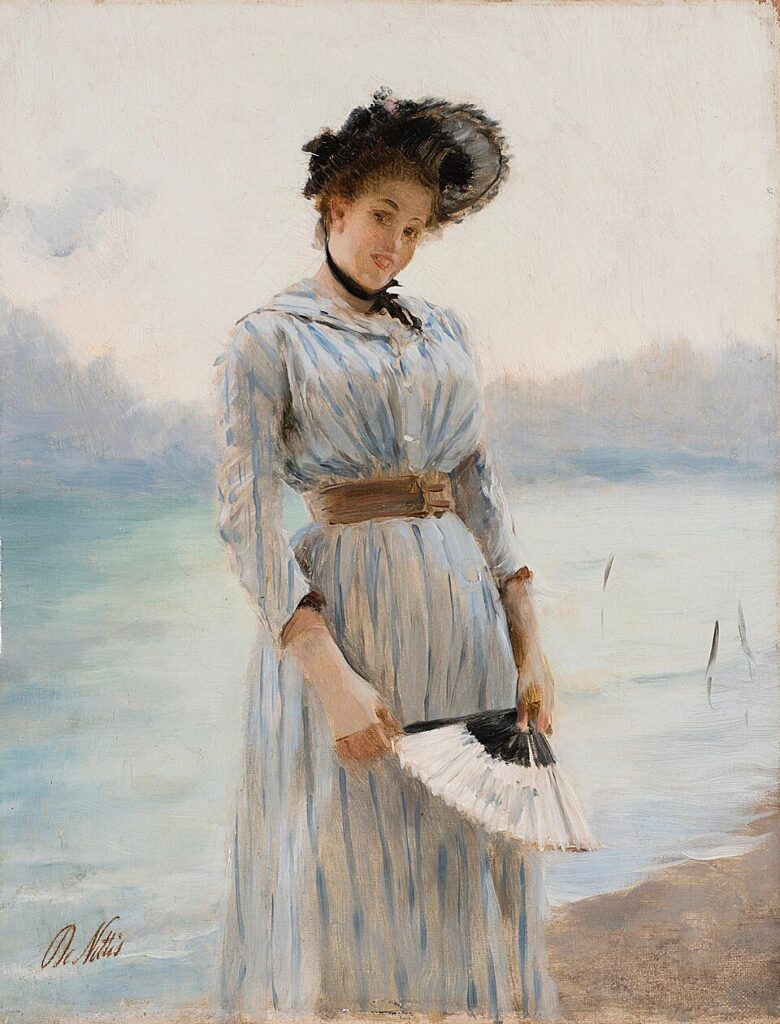
In Europe only France, Spain and England produced the mass of fan making from 17 th to the 19 th centuries. French fans, with their fashionable associations and more luxurious painted scenes, created a fashion trend across Europe; facilities such as the Musee des Arts Decoratifs in Paris and the V&A hold a large number signed by well known fan painters and makers. French fans from the Valencia and Andalusian areas of Spain have a history of lace and wood carving surviving in late 19 th century scapes of flamenco and Spanish regional costumes. Fans made in England are often printed leaves, and encompass Georgian and Victorian tastes from neat Neoclassical studies of foliage and figures to sentimental scenes of lovers.
Evaluating and Collecting Antique Fans
For those considering collecting antique fans, establishing authenticity and quality is key. Age can be estimated by construction techniques (for example, the fineness of carving, the type of rivet, or the way the leaf is attached), materials (ivory versus celluloid, hand‑painted versus chromolithographed), and stylistic details consistent with documented examples from museum collections. Comparing a potential acquisition with cataloged fans in the Met’s Heilbrunn Timeline of Art History or the V&A’s online collections is a practical starting point.
Condition significantly affects both aesthetic and financial value. Collectors look for intact leaves with minimal tears, fading, or overpainting; sticks and guards free from warping, insect damage, or crude repairs; and original cases or boxes where possible. Conservation experts at institutions like the Smithsonian emphasize that “stability is often more important than aggressive restoration” for works on paper and textile, suggesting that gentle cleaning and proper storage may be preferable to attempting full cosmetic repair.
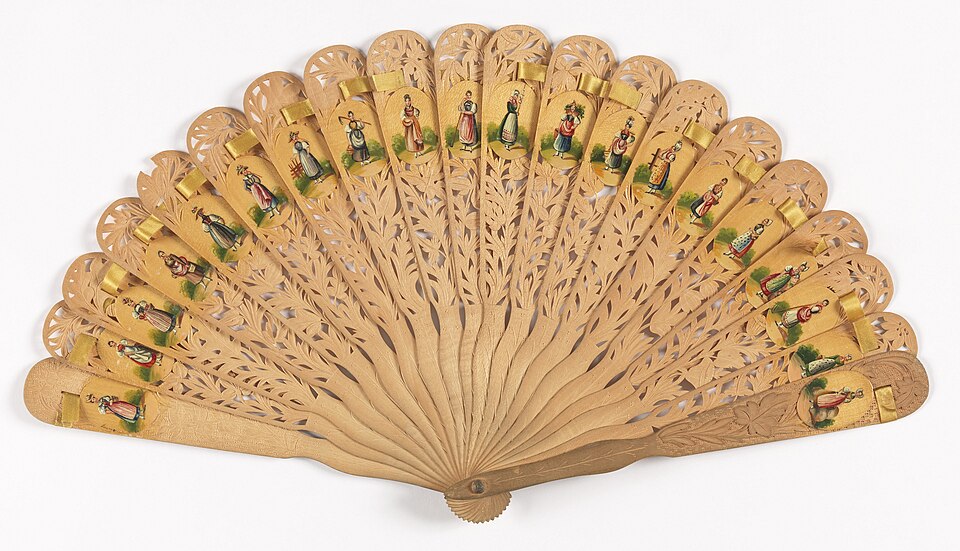
Provenance—the documented history of ownership—adds further interest and value. Fans linked to specific events (such as coronations or exhibitions), to known makers (like Duvelleroy or Ernest Kees), or to notable owners (aristocrats, performers, or artists) are especially attractive. Auction houses including Christie’s and Sotheby’s regularly sell antique fans with catalog notes citing parallels in museum collections. Reviewing past auction catalogs and museum records can help collectors understand market trends and historical significance.
Care, Conservation, and Display
Antique fans are inherently fragile because they combine materials that age differently: paper, textiles, organic woods, ivory, metals, and adhesives. Long‑term preservation depends on controlling light, humidity, and handling. The Met’s conservation department advises that “light is one of the primary agents of deterioration” for works on paper and textiles, which fade and become brittle under strong illumination. Fans should be stored and displayed away from direct sunlight and harsh artificial lighting, ideally at moderate, stable humidity (around 45–55%).
Touching should be avoided as much as possible and hands and/or cotton or nitrile gloves should be used in the case of painted and gilded surfaces. Continual opening and closing can damage the fragile folds and hinges of fan. Various manufacturers make archival storage boxes for fans and, conservators often recommend the fan being kept partially open in custom mounts. Feather fans are more delicate and can be crushed or affected by mold. The archive conservation guidelines of Smithsonian suggest the use of acidfree tissue and stiffeners to provide weight distribution.
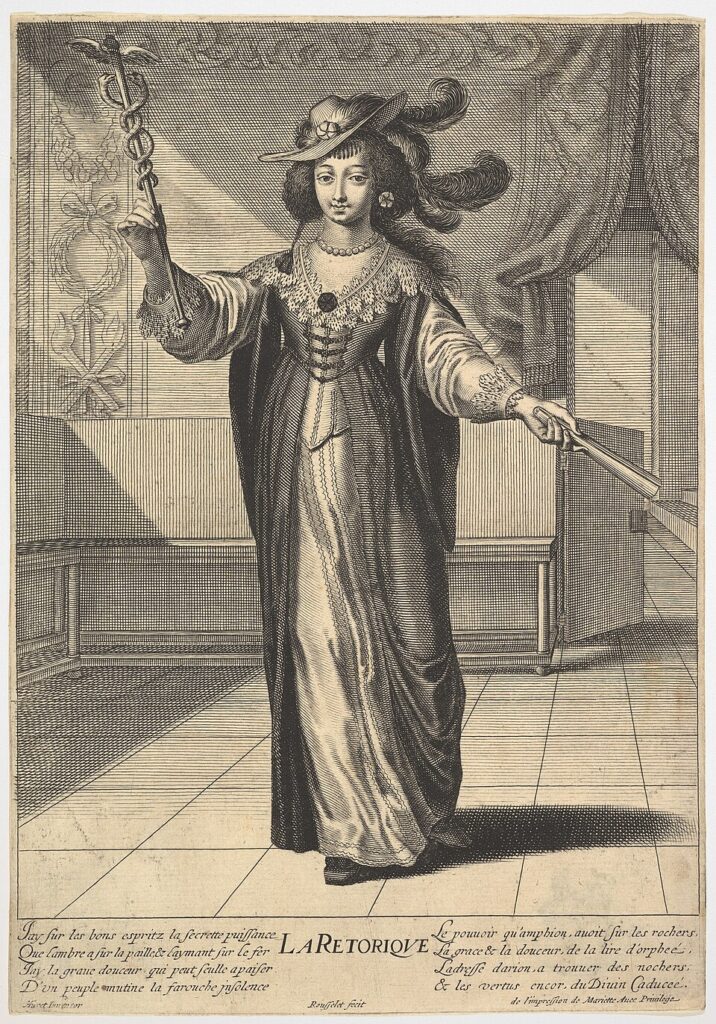
If professional conservation is required for tears, detached leaves, or broken sticks remind to consult a conservator of paper or ethnography/decorative arts, preferably one at the V&A, the Louvre, or a large national museum. An amateur repair of a sticker with tape, contemporary glue, or repaints will irreparably damage the fan and decrease its value as an object of historical evidence as well as value to the owner. Resourcing the fan with good conservation is worth the investment.
Summary of Key Characteristics
| Aspect | Key Points | Why It Matters |
|---|---|---|
| Main Types | Folding (monture-and-leaf, brisé, cockade); fixed (feather, screen) | Helps identify structure, mechanism, and origin |
| Core Materials | Paper, vellum, silk, cotton, lace; wood, bone, ivory, mother-of-pearl | Indicates date, region, and social status |
| Decorative Techniques | Painting, printing, embroidery, gilding, piercing, carving, spangles | Reflects craftsmanship and workshop traditions |
| Major Regions | China, Japan, France, Spain, England, Italy | Shapes style, iconography, and function |
| Key Periods | 17th–18th c. European Rococo; Edo Japan; Qing China; 19th c. industrial | Frames historical and stylistic context |
| Condition Factors | Tears, fading, insect damage, repairs, structural stability | Strongly affects value and conservation needs |
| Display & Storage | Low light, stable humidity, minimal handling, archival materials | Essential for long‑term preservation |
Frequently Asked Questions About Antique Hand Fans
How old does a fan have to be to be considered “antique”?
In the art and antiques trade, “antique” typically refers to objects at least 100 years old. A fan made around 1920 would now qualify as antique, while mid‑20th‑century fans are usually described as “vintage.” However, some specialized collectors and institutions focus primarily on fans from the 17th to 19th centuries, when craftsmanship and social significance were at their peak in Europe.
How can I tell if my fan is hand‑painted or printed?
Examine the surface under good, indirect light. Hand‑painted fans will usually show slight brushstroke texture, subtle variations in color, and sometimes pentimenti (small corrections). Printed fans, common from the late 18th century onward, often reveal dot patterns or uniform lines under magnification, especially in chromolithographs. The V&A recommends comparing suspected printed fans against known engraved or lithographic examples in museum collections to train the eye.
Is ivory on antique fans illegal to own or sell?
Regulations vary by country and are increasingly strict. In many jurisdictions (including the EU, UK, and parts of the U.S.), trade in ivory is heavily restricted, with some narrow exemptions for pre‑1947 or pre‑1918 “worked ivory” when there is clear documentation. Ownership of existing antique ivory is often allowed, but selling or exporting may require permits or be prohibited. Always consult current local and international regulations (such as CITES guidelines) and, if needed, an expert on wildlife trade law before buying or selling fans with ivory components.
Can antique fans still be used, or should they only be displayed?
For genuinely antique fans—especially those with delicate paper, silk, or fragile guards—use as functional fans is not recommended. Opening and closing accelerates wear on folds, rivets, and adhesives. Museum practice is to treat fans as historic objects rather than tools. If you appreciate the aesthetics but want a functional accessory, consider high‑quality modern reproductions and preserve genuine antiques primarily through careful display or storage.
Where can I learn more about fans and see important collections?
Major institutions with notable fan holdings and online resources include:
- The Metropolitan Museum of Art (New York): searchable collection and essays in the Heilbrunn Timeline.
- Victoria and Albert Museum (London): extensive fan collection with high‑resolution images and curatorial notes.
- Louvre Museum (Paris): decorative arts department with 17th–19th‑century French fans.
- Smithsonian Institution (Washington, D.C.): fans across its National Museum of American History and other units, often linked to costume and social history.
Specialized fan museums and societies, such as The Fan Museum in Greenwich (London), also publish catalogs and host lectures that deepen understanding.
Conclusion
Antique hand fans sit at the crossroads of art, fashion, and social history. Each example condenses a web of relationships between East and West, court and street, intimate gesture and public display. By looking closely at their materials, construction, and images—and by drawing on the scholarship of institutions like the Met, the V&A, the Louvre, and the Smithsonian—we can read these objects not as quaint relics, but as eloquent witnesses to changing worlds. Preserved and studied with care, they continue to unfold stories long after their last fashionable flutter.
AI Notice: Some visual content in this article may have been created or enhanced using artificial intelligence (AI) for artistic, editorial or illustrative purposes. Learn more about our approach in our AI & Editorial Principles.