
The Secret Language of Hand Fans: What Every Gesture Really Means
In a candlelit ballroom in 18th‑century Madrid, a young woman raises her fan to her cheek and looks away. Across the room, a nobleman understands instantly: she is interested, but must appear demure. A few minutes later, she taps the edge of the fan against her lips—an urgent warning that a chaperone is approaching. No words have been exchanged, yet an entire conversation has taken place in the flick of a wrist and the angle of a folded leaf. This is the legendary “language of the hand fan,” a blend of myth, social code, and material culture that has fascinated historians, curators, and romantics alike.
What Do We Mean by the “Language of Hand Fans”?
When people speak of the “language of fans,” they usually imagine a kind of secret code: precise gestures with a folding fan that conveyed love, rejection, jealousy, or danger in rigidly policed societies. It appears to be confirmed in the 18 th and 19 th century manuals and etiquette books, mainly in Europe and Latin America: opening the fan wide = you are charming, dropping it = we shall be friends only … Now, however, historians warn that the reality was not so straightforward: a number of these ‘codes’ were only published in later romanticized sources and their use in reality is hard to establish.
Can You Name the Masterpiece?
Ten masterpieces. Ten questions. How well do you know the history of art?
The Victoria and Albert Museum, home of what they recognize as one of the world’s premier fan collections, discusses the possibility of a secret language of the fan and concludes that “while the talk persists of a secret language the existence of a codified one has yet to be proved.” What we do know is that fans, however or whether they spoke or not, were one of the most effective ways of silent expression. In every society in which women‘s speech and movement were increasingly restricted, be it the Bourbon courts of Spain, the salons of Paris, or Victorian London‘s drawing rooms, fans enabled women to communicate their sentiments in an acceptable fashion.
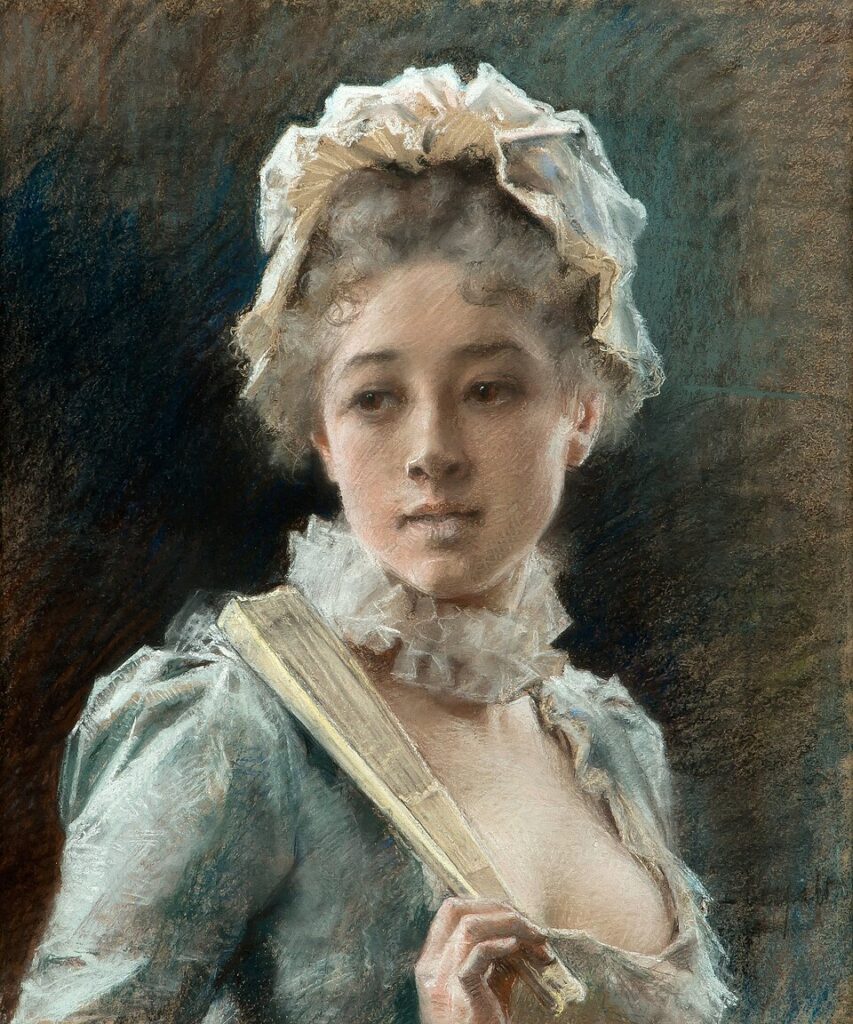
This “language” thus existed on several tiers. There was the codified, usually dramatic gestures designed for fan-languages charts; the additional, un-codified language of gestures between closer friends; and the deeper themes inherent within the option of fan‘s materials, images, and design. Through these three levels we can read the fan not only in terms of fashion, but as, in the words of the metropolitian Museum of Art, “powerful stimuli for the exhibition, influence and social swaying.”
Historical Origins: From Ritual Object to Social Tool
Hand fans have ancient origins. Fixed fans (non‑folding) appear in ancient Egypt, used both as cooling devices and as ritual emblems of status. The Louvre Museum’s collection includes Egyptian flabellum—large, often feathered fans associated with royal and religious ceremony. In China, fans were in use by at least the Han dynasty (206 BCE–220 CE), evolving into both functional objects and surfaces for calligraphy and painting. Japan later developed the folding fan (ōgi or sensu) by the 8th–9th centuries, an innovation that would eventually transform fan culture worldwide.
Can You Guess the Artist?
Three clues. One artist. How quickly can you identify the painter?
Folding fans arrived in Europe through a network of trading routes, diplomatic exchanges and missions. By the end of the 15 th and 16 th centuries imported Asian fans, primarily from Japan and China, had begun to find a market among the European educated elite via Portuguese and later Dutch traders. European artists and craftspeople in Paris, London, and Venice were quick to follow suit, producing ornately decorated fans with painted paper or silk leafs and carved ivory, bone or wood sticks. According to the Smithsonian Institution, by the 18 th century in France and England fanmaking guilds had become “extremely specialized, to include painters, engravers and craftsmen.”
As the fans moved away from luxury imports to essentials of European aristocratic life, they began to serve a new social purpose. Courts at Versailles, Vienna and Madrid established evermore complex rules of civility, where every move was monitored. It is no surprise that in such a context the fan became an extension of the body‘s rhetoric; at the time of the Rococo, as the Met notes, fans “became an essential part of polite femininity, helping women to control heat, concealness, coquetry and even political talk all with an air of erudition.”
The European “Fan Language” Craze
The idea of a codified “language of the fan” crystallized in Europe in the late 18th and, especially, 19th centuries. Spanish and French sources are particularly important. In Spain, where fans (abanicos) became deeply embedded in everyday life, popular culture long maintained that young women were trained from adolescence in a systematic fan code. Nineteenth‑century Spanish fan makers even printed miniature “dictionaries” of gestures with translations such as “Carrying it in the left hand: We are being watched” or “Letting it rest on the right cheek: Yes.”
The code of the fan was even more prevalent in France and Britain, where “the language of the fan” frequently featured in ladies’ magazines, pedestrian etiquette guides, and novelty prints. These instruction books offered three simple moves (drawing the fan across the cheek in a sedate way, flapping it quickly, and flipping it open and shut) so that any lady was able to send a flirtatious or confidant message to any man. The Victoria and Albert Museum remarks that it is quite probable that some of the codes were simply sale devices romancing up the merchandise in a competitive luxury trades.
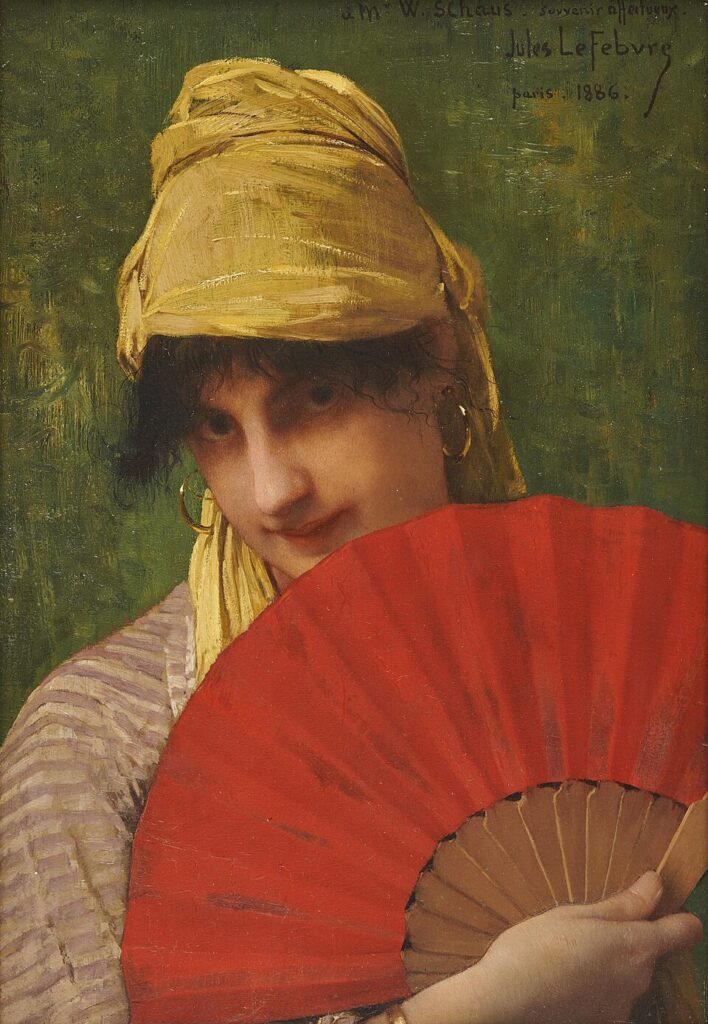
Contemporary academics are divided on the extent to which these codes were actually used in practice. The Smithsonian describes the fan language charts as genuine artifacts, but adds that “there is little evidence that women in 18th- and 19th-century fan culture followed a single, rigid framework.“It is more likely that rather than memorizing set lexicons women simply used the expressive qualities of the fan more loosely, basing their movements on common subconscious body language and the shared social scripts of their particular time and place. Regardless, even the obsession with “fan language” was telling; people knew that fans represented a powerful method of saying things they could not safely say.
Beyond Romance: Power, Class, and Gender
Popular accounts often reduce the language of fans to flirtation. But historical evidence suggests a much wider range of uses tied to power, class, and gender. In the courts of Louis XIV and his successors, fans helped women navigate political factions and alliances. A glance concealed behind a painted pastoral scene could signal allegiance or dissent as effectively as a whispered aside. The Met’s studies of 18th‑century French fans emphasize that they were “mobilized as props in the theater of power as much as in the theater of love.”
Fans also served as ways to reiterate and reinforce class distinction. Everything about the fan collectible materials: ivory, tortoiseshell, motherofpearl, expensive silk as well as the craftsmanship of the carving and painting identified the consumer as wealthy. In 18-century London, the Worshipful Company of Fan Makers, who controlled the quality of the products as well as apprenticeships, remind us of the fan‘s economic and social importance. Women of the upper and aspiring middle classes learned a particular deportment in their handling of the fan: how they held it and moved it set them apart from workingclass women who carried cheaper, massproduced, nonluxurious alternatives.
Most significantly, the fan provided women in patriarchal cultures with that which some historians refer to as ‘tactical agency’. Even if it did not directly challenge male dominance, it allowed women to choose, assent or dissent within limited ranges of action. As quoted in the notes on the V&A fan collection, an etiquette book from the 19th century outlined:‘A lady‘s fan is not a plaything, it is her voice, when her tongue is silent’. The ‘voice’ could merely confirm; a snapshut fan or averted eyes could convey precisely the same message as a flirty flick.
Visual Language: Motifs, Materials, and Meaning
The “language of the fan” was never just about gestures; it was also inscribed on the surfaces of the fans themselves. In the 18th century in particular, fan leaves became miniature canvases for allegorical and narrative painting. Mythological scenes—Venus and Cupid, the Judgment of Paris, pastoral courting couples—signaled themes of love, fidelity, temptation, or jealousy. As the Louvre’s fan holdings demonstrate, classical iconography was common, providing a moral or emotional subtext that sophisticated viewers could decode.
Flowers and animals became more symbols; a fan with roses signalled romantic love, and with forgetmenots, fidelity, and the presence of butterflies pointed to the ephemerality of femininity or regard. Fans imported to Europe from Japan and China boasted motifs such as cranes, peonies, and dragons to further evoke the Far East, but American and European viewers frequently failed to grasp their significance, instead interpreting them as a historical summing-up of the excesses of imported exoticism. Types of materials used also contained messages. Black fans became associations of grief and some types of mourning, while white lace fans evoked virginal wedding imagery.
Curators at the Smithsonian museums, however, stress that fans must be understood in a larger context of visual culture in the period: “Fans shared the same symbolic systems as paintings, prints and clothing.” An example of this is a fan emblazoned with satirical images of Parisian politics in Revolutionary France, which functioned very differently from a Rococo new-world pastoral scene. It follows that the “language of fans” is often used in conjunction with art history, fashion history and intellectual history. Every fan is a microcosm of a time in history, full of important details about possible fears, hopes and values.
Regional Traditions: Spain, France, Britain, and Beyond
While the fan became a nearly universal accessory across early‑modern and modern Europe, regional traditions developed distinct flavors of fan language. In Spain, fans became so culturally embedded that the abanico remains a symbol of national identity. Spanish dances such as flamenco and bolero incorporated fans into choreographed “conversations” of desire and defiance. The often‑cited “lenguaje del abanico” in Spain includes a rich repertoire of meanings that, whether fully historical or partly folkloric, testifies to the fan’s enduring symbolic power.
Fans remained highly fashionable in 18th century France and were linked very much to higher society and the fashionable crowd. Louvre fanmakers enjoyed guild privileges, and exported their fans around the continent. Fan manners and etiquette in France expressed ‘grace, gimlet-eyed restraint and worthy pauses’, in a society where talk and performance were an art in themselves. Indeed, the Victoria and Albert Museum states that most British fans were second-hand items, imported from or inspired by France, and in turn influential on London‘s upper classes.

In Britain and the United States in the Victorian period, there was an even more codified, and occasionally moralising, obsession with nonverbal languages, with social “languages” of nature, flowers, calling cards, parasols, and fans, all with their imaginary “languages.” American collections at the Smithsonian Museum of American History graphically display the fashions adopted and adapted in the 19th century in American collections from European fans. The Japanese and Chinese developed their own aesthetic and codes for fans outside of the West and Europe. For example, in Japan the folding fan was a theatrical prop used in Noh and Kabuki plays, whose complex movements and prescribed use in a variety of actions and gestures expressed particular characters and desires long before the Europeans began to develop “fan languages.”
Table: Key Characteristics of the “Language of Hand Fans”
| Aspect | Historical Reality | Common Myth / Romanticized View |
|---|---|---|
| Existence of a “language” | Flexible, context‑dependent nonverbal signaling | Rigid, universal code used identically by all women |
| Evidence | Portraits, etiquette texts, surviving fans, memoirs | Later charts presented as ancient, secret systems |
| Main functions | Managing attention, modesty, heat, social nuance | Almost exclusively flirtation and courtship |
| Geographic variation | Strong regional traditions (Spain, France, etc.) | Single pan‑European language with fixed meanings |
| Role of design and motifs | Important symbolic layer (myth, flowers, colors) | Overlooked in favor of gestures alone |
| Social implications | Tool of constrained agency within patriarchy | Harmless parlor game with no serious social function |
What Museums and Scholars Say Today
Modern scholarship, often informed by major museum collections, paints a nuanced picture of the fan’s “language.” The Metropolitan Museum of Art’s catalogues stress the fan as an “extension of the body” that shaped and reflected 18th‑ and 19th‑century ideas about femininity, sociability, and spectacle. Rather than chasing a single, fixed code, curators examine how fans functioned within specific settings: court ceremonies, salons, theaters, streets, and private parlors.
The Victoria and Albert Museum the collection of which spans fans from Europe, Asia and the Middle East is particularly interested in the dynamic of continuities and discontinuities. The museum states that the fans of the early 18thcentury “often depicted didactic or moralizing scenes” and “by the late 19thcentury it was not unusual for the scene to be mearly a generic one,” but,” in every period,” the museum points out “fans invite a choreography of the hand that is
intrinsically communicative’, whispering gossip, feinting invitation and repellent self-protection”
Institutions such as the Louvre and the Smithsonian have also brought the global aspect of fan culture to the fore. Display of Asian and European fans in the Louvre reveal how design and technology traveled through trade routes, challenging a single national story. The Smithsonian‘s investigation further emphasizes how fan usage intertwined with imperialism, industrialization, and evolving conceptions of gender. Compared to lonely lovers zapping their romance-loving fan, the additional detailthese professional sources injects into fan studies reframes the story from a nostalgic “secret code” to a historically rich tapestry of actual fan practice in relation to bodies and society.
Frequently Asked Questions About the Language of Hand Fans
Did a universal “language of fans” ever truly exist?
No credible evidence supports a single, universal, fully standardized fan language used consistently across countries and centuries. What did exist were local conventions, widely understood body language, and often playful or commercialized “codes” published in specific times and places. Museums like the V&A and the Met stress that the myth of a rigid, secret code has been exaggerated in later retellings.
Were women formally taught fan language in finishing schools?
There is limited documentary evidence of systematic fan‑language instruction in formal curricula. Young women of the upper and middle classes were certainly taught how to hold, move, and display fans in ways considered elegant and modest, much like posture or dance. Within families and peer groups, particular signals could be agreed upon, but this was more informal social training than a school‑style language course.
Did men use fans and fan language as well?
Yes, though less prominently in later European tradition. In many cultures and periods—such as Ming and Qing dynasty China, or early modern Japan—men used fans as status objects, art surfaces, and performance tools. In 17th‑century Europe, some men carried fans, but by the 18th–19th centuries in Western Europe, fans had become gendered primarily as feminine accessories. Men could still “read” fan gestures, but the performative manipulation was strongly associated with women.
How accurate are the fan‑language charts often reproduced online?
Most of these charts derive from 19th‑century European and Latin American sources, often commercial or humorous in nature. They are valuable as historical curiosities and evidence of how people imagined fan communication, but they should not be taken as timeless, universal codes. Historians recommend treating them as part of the broader mythology around fans rather than as strict guides to past behavior.
Where can I see historical fans in person?
Major museums with notable fan collections include:
- The Metropolitan Museum of Art (New York) – costume and accessories galleries
- The Victoria and Albert Museum (London) – textiles and fashion collections
- The Louvre Museum (Paris) – decorative arts and Asian art departments
- The Smithsonian Institution (Washington, D.C.) – particularly the National Museum of American History and the National Museum of Asian Art
Many of these institutions provide high‑resolution images and scholarly essays on their websites, making it possible to study fans and their “language” online.
Conclusion
The language of hand fans was never just a whimsical Victorian parlor trick. It emerged from centuries of craft innovation, global trade, and finely tuned social performance. While the rigid “dictionary” of gestures popularized in later accounts is largely a romantic construction, the underlying reality—that fans allowed people, especially women, to speak without words in highly constrained environments—is well supported by historical and material evidence. As the Met succinctly puts it, the fan was “a small object with vast social resonance.” To study its language, in all its myth and reality, is to listen more closely to the unspoken conversations that shaped past societies.
AI Notice: Some visual content in this article may have been created or enhanced using artificial intelligence (AI) for artistic, editorial or illustrative purposes. Learn more about our approach in our AI & Editorial Principles.