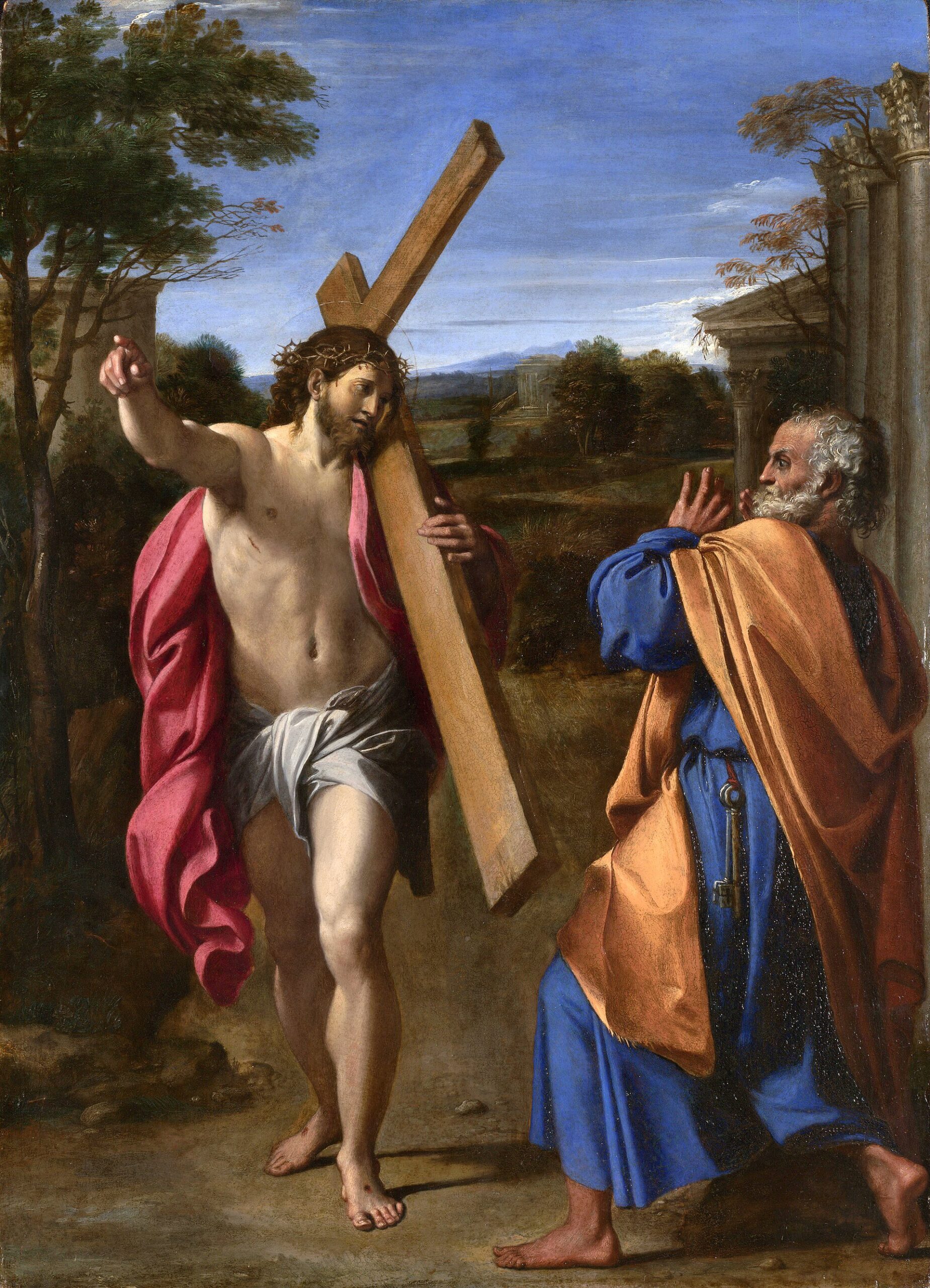
Annibale Carracci’s Domine, quo vadis? is one of those deceptively quiet works that can stop a viewer cold: a brief, intimate encounter on a road becomes a turning point in Christian history, and Carracci renders it with such human immediacy that it feels less like legend than lived experience. Painted at the cusp of a new era in Rome—when artists were rethinking how sacred art should move, teach, and persuade—this image distills the Counter-Reformation demand for clarity into a scene of moral gravity and psychological truth. It is not only a compelling religious narrative; it is also a key to understanding why Carracci mattered so profoundly to the birth of Baroque painting.
Historical and Artistic Context: Carracci in Rome and the Counter-Reformation
Annibale Carracci (1560–1609) arrived in Rome from Bologna at the end of the 16th century, entering the cultural arena shaped by the Catholic Reformation (often called the Counter-Reformation) and its artistic imperatives. The Council of Trent (1545–1563) had insisted that sacred images be intelligible and morally instructive, and Rome—especially through major papal commissions—became the testing ground for a renewed religious naturalism. Carracci’s Roman career is inseparable from this climate, in which emotional accessibility and doctrinal clarity were not merely aesthetic choices but institutional expectations.
Can You Name the Masterpiece?
Ten masterpieces. Ten questions. How well do you know the history of art?
Carracci’s practice combined close study of nature with a learned engagement with classical and Renaissance models. Modern museum scholarship consistently emphasizes this synthesis. The Metropolitan Museum of Art characterizes the Carracci reform as a decisive recalibration of Italian painting, noting Annibale’s role in forging a new language that united observation, classical structure, and narrative force—an approach foundational for early Baroque art (The Metropolitan Museum of Art, Heilbrunn Timeline of Art History). This “reform” is not an abstract label; it is visible in how Carracci stages a sacred story so that it reads instantly and feels emotionally credible.
The subject of Domine, quo vadis? (“Lord, where are you going?”) draws from early Christian tradition associated with the apocryphal Acts of Peter: the apostle Peter, fleeing persecution in Rome, meets Christ on the road and asks the question; Christ’s reply—often understood as “to Rome, to be crucified again”—shames Peter into returning to martyrdom. For post-Tridentine audiences, the moral lesson is sharp: leadership demands sacrifice; faith is proven by action. Carracci’s art is at its most effective when it transforms such doctrinal content into an encounter between two presences—Peter’s fear and Christ’s calm resolve—held in a comprehensible, gripping visual exchange.
Subject, Iconography, and Meaning: A Roadside Encounter with Consequences
In Carracci’s hands, the iconography of the meeting is typically stripped of distractions so that the viewer can read the story immediately. The road becomes a stage for conscience. Peter is often shown halted mid-step—his body angled away from Rome, his head turned back—while Christ advances with steady purpose. The drama is internal as much as external: Peter’s hesitation becomes legible in posture, gesture, and the charged space between figures.
Can You Guess the Artist?
Three clues. One artist. How quickly can you identify the painter?
That emphasis on readability aligns closely with the period’s institutional guidance for religious art. While the Council of Trent’s decrees did not prescribe a single style, they demanded that images avoid confusion and support orthodox devotion. A frequently cited articulation of the spirit of the reform is Gabriele Paleotti’s treatise Discourse on Sacred and Profane Images (1582), which argued that sacred art should teach clearly and move the faithful to piety. Carracci’s narrative economy—few figures, unambiguous action, sober tone—mirrors that insistence on moral intelligibility.
The power of Domine, quo vadis? also lies in its psychological realism. Carracci does not need theatrical crowd scenes or elaborate architecture to communicate stakes; he relies on a credible human response to a divine interruption. This is characteristic of the broader shift from late Mannerist complexity toward the early Baroque’s “affective clarity.” The Smithsonian Institution, in its educational framing of Baroque art, often underscores how Baroque artists sought heightened engagement through direct emotional appeal and legible narrative—exactly the kind of impact Carracci achieves by focusing the viewer on the encounter’s ethical core (Smithsonian educational resources on Baroque art).
Style and Technique: Carracci’s Naturalism and Classical Order
Carracci’s style is frequently described as a balance between naturalism and classical order. Figures have weight and believable anatomy, yet they are composed with a structural calm that guides the viewer’s attention. This is a major difference between Carracci and some contemporaries: where others might push distortions for expressive effect, Carracci tends toward measured proportions and grounded movement. The result is an image that feels truthful without becoming mundane—ideal for sacred narrative that must remain both accessible and elevated.
Museum scholarship situates Carracci at the center of a transition. The Louvre Museum, in its interpretive materials on Italian painting, highlights how artists around 1600 in Rome forged new solutions from Renaissance precedents and direct study of life, generating the visual language that would define the Baroque (Louvre collections essays on Italian painting). Carracci’s contribution was not only technical skill; it was a convincing reconciliation of competing demands—devotional clarity, aesthetic nobility, and human immediacy.
To understand how Domine, quo vadis? achieves its authority, it helps to think in terms of pictorial priorities. Carracci typically emphasizes: (1) lucid storytelling, (2) expressive but restrained gesture, and (3) a compositional “path” that leads the eye to the key exchange. These are not merely stylistic fingerprints; they are strategies. They make the viewer a witness, and they align the act of looking with the act of moral reflection.
Key Characteristics at a Glance
| Aspect | What to look for in Carracci’s Domine, quo vadis? | Why it matters |
|---|---|---|
| Narrative clarity | Few figures; unmistakable encounter on the road | Meets post-Tridentine demands for intelligibility |
| Psychological focus | Peter’s hesitation vs. Christ’s calm resolve | Turns doctrine into human drama |
| Naturalism | Weight, anatomy, believable movement | Enhances credibility and devotion |
| Classical composure | Balanced design, controlled gesture | Maintains dignity and authority |
| Devotional function | Scene invites empathy and self-examination | Supports prayerful, moral engagement |
Reception, Legacy, and Where It Sits in Art History
Carracci’s religious works helped define what compelling sacred art could be in Rome around 1600: not an abstract theological diagram, but a persuasive human story. This mattered to patrons and institutions shaping the city’s visual culture—papal circles, religious orders, and elite collectors—who sought artworks that could function as devotion, instruction, and prestige. Carracci’s influence is visible in the generation that followed, who absorbed his compositional clarity and humane naturalism.
Art historians often discuss Carracci in tandem with other major Roman innovators of the period, particularly Caravaggio, because both responded to the same environment while reaching different solutions. Caravaggio intensified realism through stark light and confrontational immediacy; Carracci pursued a synthesis that retained classical balance. The fact that early Baroque Rome accommodated both approaches underscores how dynamic the period was—and how Carracci’s method offered a durable model for religious narrative painting.
Institutions such as the Metropolitan Museum of Art and the Victoria and Albert Museum place Carracci within a broader European story: the migration of Italian ideas through prints, drawings, and teaching lineages. The V&A’s collections and interpretive resources on Italian art and drawings emphasize how design, draftsmanship, and compositional invention were central to artistic training and dissemination—areas in which Carracci excelled and exerted influence (Victoria and Albert Museum collection resources). In that sense, works like Domine, quo vadis? are not only singular images; they are nodes in the transmission of Baroque visual thinking.
Frequently Asked Questions
What does “Domine, quo vadis?” mean?
It is Latin for “Lord, where are you going?”—Peter’s question to Christ during their encounter outside Rome.
Is the story biblical?
It is rooted in early Christian tradition rather than the canonical New Testament, commonly associated with the apocryphal Acts of Peter. It became widely known through later Christian literature and art.
Why was this subject important in the Counter-Reformation?
Because it communicates a clear moral lesson about duty, martyrdom, and steadfast faith—values strongly emphasized in post-Tridentine Catholic culture.
What makes Carracci’s treatment distinctive?
Carracci tends to combine naturalistic human emotion with classical compositional order, creating a scene that is both believable and elevated.
Where can I learn more from credible museum sources?
Start with curatorial essays and collection materials from the Metropolitan Museum of Art, the Louvre Museum, the Victoria and Albert Museum, and Smithsonian educational resources on Baroque art and religious imagery.
Sources (Selected)
- The Metropolitan Museum of Art, Heilbrunn Timeline of Art History: essays on Annibale Carracci and Baroque painting in Rome.
- Louvre Museum collections and interpretive essays on Italian painting (16th–17th century).
- Victoria and Albert Museum (V&A) collection resources on Italian drawings/prints and early modern artistic practice.
- Smithsonian Institution educational materials on Baroque art and its aims (engagement, emotion, narrative clarity).
- Gabriele Paleotti, Discourse on Sacred and Profane Images (1582), a key Counter-Reformation text on the function and clarity of religious images.
Conclusion
Annibale Carracci’s Domine, quo vadis? condenses a foundational Christian moral drama into a scene of striking immediacy: a frightened man, a resolute Christ, and a decision that reshapes destiny. Seen against the institutional pressures and spiritual ambitions of post-Tridentine Rome, the work exemplifies Carracci’s enduring achievement—making sacred history both authoritative and human, and helping to define the visual language of the Baroque.
AI Notice: Some visual content in this article may have been created or enhanced using artificial intelligence (AI) for artistic, editorial or illustrative purposes. Learn more about our approach in our AI & Editorial Principles.