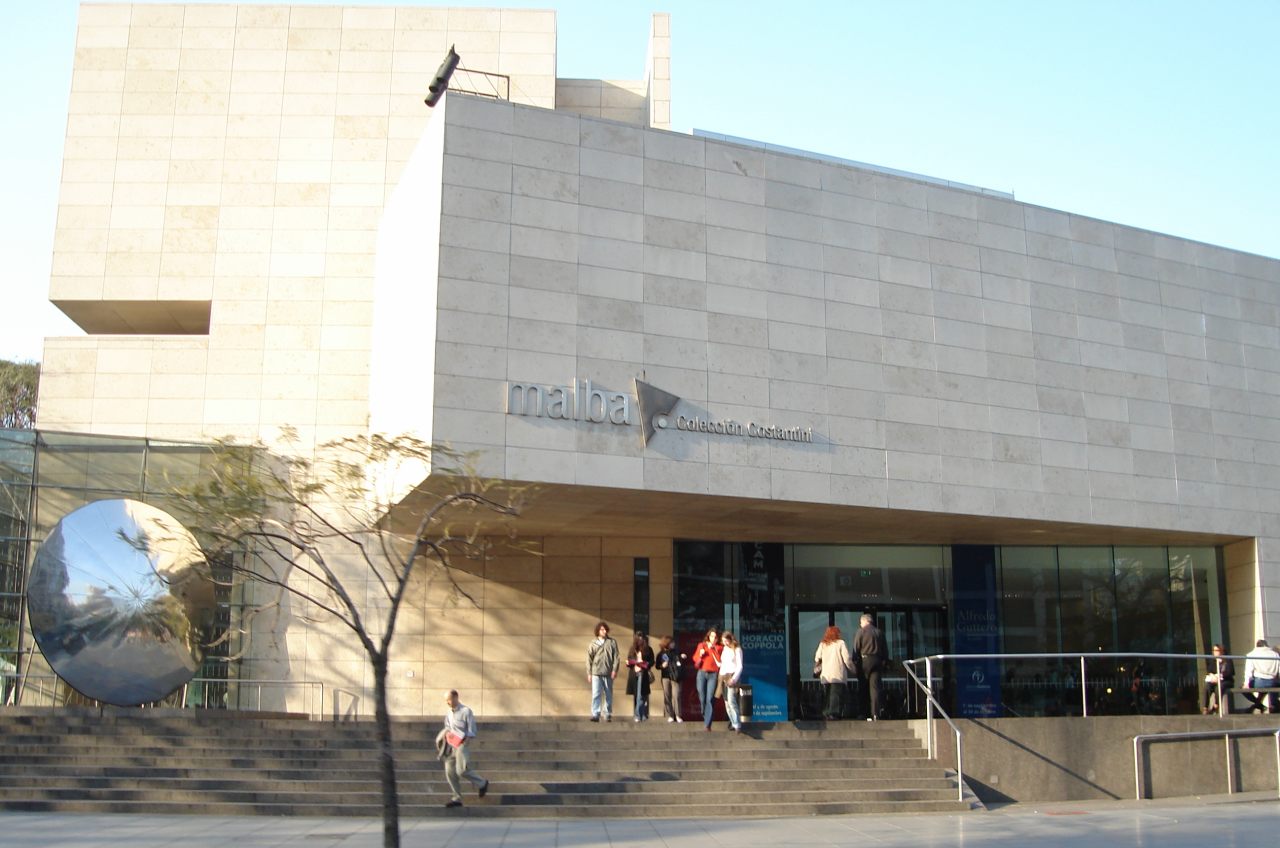
Buenos Aires’ Museo de Arte Latinoamericano de Buenos Aires (MALBA) has selected Mexican architect Frida Escobedo to design a major expansion that will nearly double the museum’s exhibition space. The project will be built beneath the adjacent Plaza Perú and is expected to open in late 2029 or early 2030. It will add new galleries, an auditorium, workshops, multipurpose spaces, storage, a sculpture garden and new public connections while preserving access to the historic plaza. The expansion comes as MALBA marks its 25th anniversary and prepares for a major new phase in its institutional development.
A New Future for MALBA
One of Latin America’s most important museums is preparing for a dramatic transformation.
The Museo de Arte Latinoamericano de Buenos Aires, better known as MALBA, has selected Mexican architect Frida Escobedo to design its long-planned expansion.
The project is ambitious.
Rather than simply adding another building beside the existing museum, the expansion will extend beneath the neighboring Plaza Perú, creating a new network of exhibition and cultural spaces underneath the public square.
The result is expected to almost double MALBA’s exhibition capacity.
For a museum whose collection has grown substantially since its opening, the project comes at an important moment.
MALBA is celebrating its 25th anniversary in 2026, and the institution is simultaneously expanding its collection, strengthening its financial structure and reconsidering how the museum connects with Buenos Aires.
The new architecture is therefore about more than additional galleries.
It is an attempt to reshape MALBA itself.
Why Frida Escobedo?
The choice of Frida Escobedo is particularly significant.
The Mexico City-based architect has become one of the most prominent figures in contemporary museum architecture.
She founded her studio in 2006 and established a New York office in 2022.
Her international profile increased dramatically after she became the youngest architect ever selected to design London’s Serpentine Pavilion, completing the project in 2018.
She is now working on some of the world’s most important museum projects.
Her design for the new Modern and Contemporary Art wing at New York’s Metropolitan Museum of Art recently reached the groundbreaking stage, with the building scheduled to open in 2030.
She is also involved in the renovation of the Centre Pompidou in Paris.
MALBA therefore joins an increasingly impressive list of international institutions working with Escobedo.
But the Buenos Aires project presents a very different architectural challenge.
Here, the architect is not simply designing a new standalone museum.
She has to connect an existing building with an underground expansion while maintaining the character and accessibility of a major public square.
Building Beneath a Public Plaza
Perhaps the most fascinating aspect of the project is its location.
Much of the new museum will be constructed beneath Plaza Perú, next to the existing MALBA building.
That allows the institution to gain substantial new interior space without taking away the public square.
According to MALBA, the expansion is intended to increase exhibition space while strengthening the museum’s cultural mission. The museum has emphasized that the project will not reduce the size of Plaza Perú or restrict public access to it.
This is an important distinction.
Museums often expand by occupying additional land.
MALBA is taking a different approach.
The architecture moves downward.
The public landscape remains above.
And the museum becomes larger without simply becoming a larger object in the city.
A Museum Beneath the City
The underground nature of the project creates an unusual relationship between architecture and urban space.
Visitors will enter a museum that remains visually connected to Buenos Aires while much of the new programme exists below ground.
The expansion will include new entrances and circulation routes intended to connect the original museum, the new spaces and the plaza.
A landscaped courtyard of approximately 600 square metres is planned as part of the development.
There will also be an open garden leading toward a staircase on Salguero Street.
The result is intended to make the museum feel less like an isolated cultural building and more like part of the surrounding city.
That is one of the most interesting ideas behind Escobedo’s proposal.
More Than More Galleries
The expansion will provide new galleries for temporary exhibitions, but that is only one part of the programme.
The project will also include an auditorium, multipurpose spaces, workshops and storage facilities.
These additions matter because a contemporary museum is no longer simply a place where paintings hang on walls.
Museums now operate as cultural ecosystems.
They host lectures.
They organise educational programmes.
They screen films.
They hold workshops.
They bring together artists, writers, curators and researchers.
The new MALBA is being designed to accommodate those activities simultaneously.
Escobedo has described the project as being about more than adding physical space.
Her vision is to create new relationships between the different programmes that have developed at MALBA over the years.
That could ultimately change how visitors experience the institution.
Connecting Art, Film and Literature
One of the most intriguing aspects of the design is its flexibility.
The new layout is intended to allow activities such as film, literature and education to take place alongside exhibitions.
This may sound like a relatively small architectural detail.
It is not.
It reflects a major change in how museums understand their role.
A museum of Latin American art cannot simply preserve and display historical objects.
It can also become a place where contemporary cultural conversations take place.
Film, literature, architecture and visual art frequently overlap in Latin American cultural history.
MALBA’s new spaces could allow those connections to become more visible.
The Sculpture Garden
The expansion will also include a sculpture garden.
That addition provides another opportunity to blur the boundary between museum and city.
Sculpture requires a different kind of space from painting.
Large works can interact with architecture, vegetation, sunlight and visitors in ways that are impossible inside a conventional gallery.
A garden also changes the rhythm of a museum visit.
Instead of moving continuously from room to room, visitors can move between enclosed galleries and open-air spaces.
In Buenos Aires, where public space is such an important part of urban life, that relationship could become one of the defining characteristics of the new MALBA.
A Growing Collection Needs More Space
The expansion is arriving partly because MALBA itself has changed.
The museum was founded by Eduardo F. Costantini, whose collection formed the foundation of the institution.
Over the years, the collection has expanded considerably.
One of the most significant recent developments was the acquisition of the Daros Latinamerica Collection, which includes 1,232 works by 117 artists, primarily dating from the 1950s through the 2010s.
Costantini is also donating additional works from his personal collection to MALBA.
Among them are major Latin American modernist works, including Frida Kahlo’s Diego y yo, Diego Rivera’s Baile en Tehuantepec, Leonora Carrington’s Las distracciones de Dagoberto, as well as works by Remedios Varo and Wifredo Lam.
The growth of the collection makes additional exhibition capacity increasingly important.
A museum cannot fulfil its role if significant parts of its collection remain permanently hidden in storage.
The expansion could give MALBA much greater freedom to rotate and reinterpret its holdings.
A Financial Transformation Too
The architectural expansion is accompanied by another important change.
Costantini has established a $50 million Malba Art Trust intended to strengthen the museum’s long-term financial future.
According to The Art Newspaper, Costantini currently contributes between $3 million and $4 million annually to cover MALBA’s operating deficit.
The new trust is intended to reduce that dependence over time by attracting additional families, institutions and donors.
That means the museum is not simply expanding physically.
It is also attempting to build a more sustainable institutional structure.
For a major museum, that may be just as important as the architecture.
A spectacular building cannot guarantee a museum’s future.
A strong endowment and diversified governance can.
The End of a Founder-Centered Model?
MALBA is also changing its governance.
Members of the Costantini family are expected to become a minority on the museum’s board, creating greater room for outside members.
This represents a significant institutional shift.
Costantini created MALBA and played a central role in its development.
But as the museum enters its second quarter-century, its ambitions are becoming larger than any individual collection or founder.
The goal is to create an institution capable of continuing to grow independently.
That makes the expansion project more than an architectural announcement.
It is part of a broader transition in MALBA’s identity.
A Museum for Latin American Art
MALBA occupies a special position in the international art world.
Its collection focuses specifically on Latin American modern and contemporary art.
That makes its mission different from that of encyclopedic museums such as the Met or the Louvre.
The museum has helped introduce international audiences to artists from across Latin America, including figures whose importance was historically underestimated outside the region.
Its collection includes works by artists such as Frida Kahlo, Diego Rivera, Wifredo Lam, Remedios Varo, Joaquín Torres-García and Antonio Berni.
The expansion therefore has significance beyond Buenos Aires.
More exhibition space means more opportunities to tell the complicated story of Latin American modernism and contemporary art.
Escobedo’s Second Major Museum Project
There is another reason the MALBA appointment is attracting attention.
Frida Escobedo is simultaneously shaping the future of two very different institutions.
In New York, she is designing The Met’s new Modern and Contemporary Art wing.
In Buenos Aires, she is redesigning the spatial relationship between MALBA, Plaza Perú and the surrounding city.
The contrast is fascinating.
The Met is one of the world’s largest encyclopedic museums.
MALBA is much more focused, concentrating on Latin American art.
One project is in Manhattan.
The other is in Buenos Aires.
Yet both ask the same fundamental question:
How should a museum designed for the future relate to the city around it?
Escobedo’s answer appears to involve connection rather than isolation.
From Object to Experience
The new MALBA could also change the way visitors understand a museum.
The traditional museum experience often follows a simple formula.
Enter.
Walk through galleries.
Look at artworks.
Leave.
The new design suggests something more open.
Visitors could move from galleries to gardens, from exhibitions to lectures, from film screenings to workshops.
The building becomes a platform for different forms of cultural activity.
That approach is increasingly common among major museums, but MALBA’s location makes it especially interesting.
The museum will remain deeply connected to Buenos Aires rather than functioning as an isolated cultural monument.
What Happens Next?
The project is still in its early design phase.
Construction is expected to begin in 2027, with the completed expansion targeted for late 2029 or early 2030.
That means there is still considerable work ahead.
Funding will have to be secured.
The design will continue to develop.
Construction logistics will have to be resolved.
And the museum will have to manage its existing programme while preparing for a substantially larger future institution.
But the direction is now clear.
MALBA is moving toward a new physical and institutional chapter.
MALBA’s 25th Anniversary Is Only the Beginning
The timing of the announcement is symbolic.
MALBA opened in 2001.
Twenty-five years later, the museum is celebrating its anniversary with new exhibitions, a growing collection and a major architectural expansion.
One of the anniversary highlights is Viva Frida, an exhibition dedicated to Frida Kahlo that opens in Buenos Aires in September 2026 and brings together more than 365 objects, including personal items, photographs, documents and artworks.
The anniversary therefore becomes a moment of both reflection and reinvention.
MALBA is looking back at what it has achieved.
But the more interesting story is what it wants to become.
A New Landmark for Buenos Aires
If Escobedo’s project is completed as planned, MALBA will gain far more than additional exhibition rooms.
It will gain new public spaces.
New cultural facilities.
A sculpture garden.
New connections with Plaza Perú.
More room for its expanding collection.
And a more flexible architectural framework for future exhibitions and programmes.
The museum will remain recognisably MALBA.
But its relationship with Buenos Aires will change.
The expansion represents a subtle architectural idea with a powerful result: the museum can become larger without simply becoming a larger building.
Much of the transformation will happen below the city.
Above it, Plaza Perú will continue to function as public space.
Between the two, visitors will move through a new kind of museum.
Frida Escobedo’s Latin American Statement
Perhaps the most compelling aspect of the project is that a Mexican architect is being asked to reshape one of the most important museums dedicated to Latin American art.
Escobedo is not designing a generic international museum.
She is working within a specifically Latin American cultural institution, in one of the continent’s great cities, surrounded by a public landscape that will remain part of the project.
That context matters.
The architecture is being asked to respond not only to artworks but also to the city, public space and the cultural identity of the institution.
If the project succeeds, MALBA’s next chapter could become one of Escobedo’s most interesting architectural statements.
Not because it will be the biggest museum she has designed.
But because it may demonstrate how a major cultural institution can grow while becoming more connected to its city rather than more separated from it.
Sources:
MALBA — 25th Anniversary and ExpansionMALBA — Latinoamérica en expansión collection
MALBA — 25th Anniversary and Expansion
AI Notice: Some visual content in this article may have been created or enhanced using artificial intelligence (AI) for artistic, editorial or illustrative purposes. Learn more about our approach in our AI & Editorial Principles.