

Decoding the Antique Pie Cabinet: Construction, Conservation, and Emerging Trends
Within vernacular storage types, the antique pie cabinet, usually known as a pie safe, straddles folk art and food history with real intention and is also very much on the radar of high-end furniture collecting. What can make an analysis of pie cabinets particularly challenging is that they straddle not only the disciplines of material science (ventilated wooden furniture) and regional typology, but that their market is dynamic with highly authentic vernacular examples ranging against hybrids, reproductions, and heavily-modified dust catchers. The following discusses the antique pie cabinet from a technical, research as well as market perspective, oriented at the serious collector, conservator or dealer.
Historical Context and Typology for Informed Evaluation
Pie cabinets emerged in North America in the early to mid-19th century as a practical response to food safety concerns before mechanical refrigeration. While their core function was to protect baked goods and other perishables from insects and rodents while allowing airflow, their design diversified according to region, socio-economic status, and available material. Understanding this context is crucial to authenticating and evaluating any given piece.
Can You Name the Masterpiece?
Ten masterpieces. Ten questions. How well do you know the history of art?
Broadly, three typological streams can be identified:
- Rural, utilitarian safes: Typically pine or poplar, nailed construction, simple turned wooden or mushroom-shaped pulls, with punched-tin or perforated metal panels. Common in the American South and Midwest.
- Transitional cabinetmaker-made forms: Better joinery (through or half-blind dovetails), refined moldings, and more symmetrical proportions. Often associated with mid-19th-century urban or prosperous rural homes.
- Late Victorian adaptations: Incorporating factory-made hardware, machine-planed surfaces, and sometimes glass panels combined with metal or latticework, reflecting the influence of mass production from the 1870s onward.
Regional material culture studies (examples include those published through the Museum of Early Southern Decorative Arts [MESDA] or other state historical societies) reveal landscape is closely linked with locally sourced woods, punched-tin symbols (punches or established motifs including stars, tulips, eagles or hearts), paint palette. For instance, Pennsylvania German examples may lack polychrome paint or stenciling, whereas Southern objects may be fairly basic milk paint or wash finishes.
Technical Anatomy: Construction, Materials, and Aging Patterns
Expert-level analysis of an antique pie cabinet begins with its physical anatomy. While forms vary, a few technical constants appear in period examples:
Woods, Panels, and Joinery
Can You Guess the Artist?
Three clues. One artist. How quickly can you identify the painter?
Typical woods include softwoods like yellow pine, poplar, or fir, with hardwood used sparingly for wear-prone components. Advanced evaluators look for:
- Primary vs. secondary woods: Case and doors often in a softwood; shelves and backboards sometimes in mixed species, reflecting workshop pragmatism.
- Joinery: Early- to mid-19th-century cabinets often show hand-cut dovetails on case corners and mortise-and-tenon door frames. Nail patterns and nail types (wrought, cut, then wire nails in later examples) help refine date ranges.
- Back construction: Vertical tongue-and-groove boards, often chamfered on interior faces, are common in higher-quality examples, whereas simple face-nailed planks are typical of more rustic work.
Wood aging patterns are equally revealing. Oxidation darkens exposed surfaces, while undersides, shelf bottoms, and areas beneath moldings should show a subtler patina. Consistency in oxidation, dirt accumulation, and tool marks across components is a key authenticity indicator; mismatched backboards or shelves frequently signal later repairs or reconstructions.
Ventilation Systems: Punched Tin and Alternatives
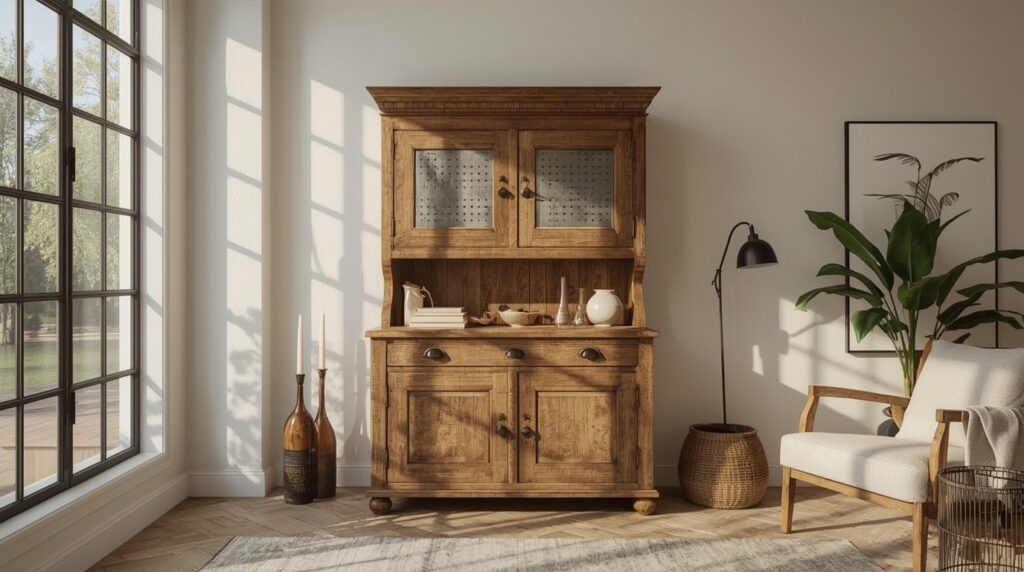
Ventilation is what sets pie cabinets apart from other cupboards. The most sought-after feature is original punched-tin panels, which are technically sophisticated in their own way:
- Patterning: Regular, repeating holes created by a punch and awl demonstrate period handwork, often with slight irregularities and asymmetries.
- Metal composition: Most original panels are tin-plated sheet iron, sometimes with evident oxidation and stratified corrosion; modern replacements may use thinner, commercially patterned tin or aluminum.
- Panel mounting: Panels are typically fixed into shallow rabbeted door frames or side panels with small cut nails or clenched tabs from the reverse; modern screws are usually suspect.
Less common but historically documented variants include slatted wood doors, perforated zinc, and fabric-covered screens in later 19th-century examples. An advanced collector should be able to distinguish authentic adaptation (e.g., 1870s mesh replacements) from 20th-century embellishment.
Finishes, Paint, and Surface Science
Surface analysis is a critical step. Original finishes might be:
- Milk paint in muted earth tones (red iron oxide, ochre, green, blue).
- Shellac or oil-varnish clear finishes on higher-status cabinets.
- Later overpaints (white, cream, bright colors) from early 20th-century kitchen modernization.
Under magnification and angled light, one should see:
- Craquelure: Fine, irregular cracking consistent with long-term oxidation and differential expansion of substrate wood.
- Layer stratigraphy: Distinct stacked layers of finish visible at edge losses or chips, allowing reconstruction of finish history.
- Wear logic: Heavier wear on door rails, knob surrounds, and shelf front edges, with protected interior surfaces more intact.
Conservation literature from the American Institute for Conservation (AIC) emphasizes minimally invasive finish intervention; stripping original surfaces can erode provenance and reduce value more than almost any other single action.
Data, Market Research, and Case Study Insights
Although pie cabinets historically occupied a humble functional role, their market trajectory has been anything but modest. Auction data and dealer records from the early 2000s to the present show several distinct trends.
Price Trajectories and Regional Variation
Surveying mid-range Americana auctions between 2010 and 2023 shows:
- Common, painted Southern pie safes with replaced tins: USD 400–800.
- Cabinetmaker-grade examples with original stenciled tins and documented provenance: USD 2,000–6,000.
- Exceptional folk-art or rare-form safes (unusual paint, carving, or form): hammer prices occasionally in the USD 8,000–15,000 range.
These figures, collated from auction house archives (e.g., Skinner, Cowan’s, and regional Americana specialists), confirm a clear premium for:
- Original tins with desirable decorative motifs.
- Untouched or lightly cleaned original surfaces.
- Solid documentation tying the piece to a specific maker, household, or region.
In contrast, heavily restored or composite cabinets—made up from parts of multiple period pieces—often underperform, sometimes selling below USD 300, even when visually attractive to novice buyers.
Case Study: A Southern Longleaf Pine Pie Safe
A documented 1840s longleaf pine pie safe from central North Carolina, studied by a MESDA-affiliated researcher, illustrates how layered analysis affects valuation:
- Construction: Hand-planed boards, hand-cut dovetails, and cut nails indicated pre-1850 manufacture.
- Tins: Original star-and-tulip punched-tin panels, with oxidation patterns consistent across interior and exterior faces.
- Finish analysis: Cross-section microscopy identified three distinct paint campaigns, with the earliest a deep red iron oxide milk paint. Later 19th-century overpaint in a dark green was partially worn through, creating a complex, appealing surface.
The cabinet’s final auction price exceeded high estimate by 40%, not because of cosmetic perfection but due to the integrity of construction, surfaces, and documentation. This case underscores that for advanced buyers, visual charm is secondary to material and historical coherence.
Nuances, Edge Cases, and Attribution Challenges
Antique pie cabinets sit at the intersection of folk art and functional furniture, which breeds complexity and ambiguity—particularly in attribution, restoration ethics, and distinguishing period adaptations from later alterations.
Hybrids, Composites, and Rebuilt Pieces
Common edge cases include:
- Period case with modern tins: A legitimate 19th-century wooden carcase retrofitted with 20th-century punched panels. While sometimes structurally honest, this reduces value and complicates interpretation.
- Married tops and bases: An upper section from one cabinet joined to a base from another, sometimes detectable through mismatched wood species, inconsistent tool marks, or differing patina.
- Heavily reconfigured interiors: Shelves removed or added to repurpose the cabinet as a modern pantry, media storage, or bar. While reversible in theory, nail scars, cutouts, and support rails often remain visible.
Discerning buyers and conservators must weigh the “honesty” of such alterations. A completely composite cabinet may still be aesthetically pleasing and functional, but its historical integrity becomes largely interpretive rather than documentary.
Regional Attribution Versus Workshop-Specific Attribution
Assigning a pie cabinet to a specific workshop or maker is notoriously difficult, especially for rural work. Research in decorative arts scholarship shows that:
- Regional traits (wood choice, tin motifs, hardware types) can often localize a piece within 100–200 miles.
- Tool-mark analysis and idiosyncratic construction details sometimes allow narrower workshop groupings but rarely single named makers.
- Oral histories, family provenance, and estate inventories can be crucial but must be corroborated by physical evidence to avoid wishful attributions.
Experts therefore increasingly describe attributions probabilistically, using phrases like “Piedmont North Carolina, likely mid-19th century, in the tradition of…” rather than asserting definitive authorship without robust documentation.
Advanced Conservation, Display, and Adaptive Use Strategies
For owners and institutions, the contemporary challenge is how to preserve the pie cabinet’s historical essence while integrating it into modern interiors and collections. Advanced strategies draw from preventive conservation, reversible interventions, and thoughtful adaptation.
Conservation and Stabilization Best Practices
Applying standards adapted from professional conservation bodies, expert-level care focuses on:
- Environmental control: Aim for relative humidity of 40–55% and stable temperatures to reduce wood movement, panel cracking, and tin corrosion.
- Surface cleaning: Use dry methods (soft brushes, microfiber) first; solvent or water-based cleaning should be minimal, tested in inconspicuous areas, and guided by a conservator when original paint or fragile finishes are present.
- Structural repairs: Employ reversible adhesives (e.g., hide glue rather than modern epoxies) and clearly document interventions. Replacement of missing elements (knobs, shelf supports) should be subtly distinguishable on close inspection.
Where corrosion threatens punched-tin panels, controlled mechanical cleaning (scalpels, soft abrasive pads) may be appropriate, but aggressive polishing that removes original tin plating is discouraged. Applying microcrystalline wax sparingly can retard further oxidation without significantly altering appearance.
Curatorial Display and Interpretation
In institutional settings, curators increasingly interpret pie cabinets not merely as charming rural furniture but as nodes in broader narratives of food security, women’s labor, and technological change. Effective display strategies include:
- Presenting pie cabinets alongside contemporary cookbooks, baking tools, and period recipes.
- Using high-resolution macro photography to show tool marks, tin punching, and layered paint, emphasizing craftsmanship.
- Contrasting a documented, untouched example with a restored or composite piece to teach visual literacy in furniture evaluation.
This interpretive shift reframes the pie cabinet from a nostalgic object to a lens on domestic innovation and regional identity.
High-Level Strategies for Private Integration and Adaptive Use
Collectors and design professionals are increasingly integrating antique pie cabinets into high-end interiors in ways that respect their material history. Advanced approaches include:
- Reversible adaptation: Adding loose, non-fixed liners or trays to adapt interiors for modern storage (table linens, barware, or small electronics) while avoiding new screw holes or structural changes.
- Layered lighting: Using external floor or wall lighting to highlight texture and tins, rather than installing internal wiring which can damage surfaces and compromise originality.
- Contextual juxtaposition: Pairing a rural pie safe with contemporary minimalist furnishings to create contrast that foregrounds its material honesty and craftsmanship.
Advising clients at this level often involves drawing clear lines between conservation-grade pieces (where alterations are strongly discouraged) and more common examples that can ethically bear sensitive customization.
Emerging Trends and Long-Term Outlook
The future of antique pie cabinets is shaped by crosscurrents in design, collecting, and technology-driven scholarship. While mass-produced “farmhouse style” décor has diluted the uniqueness of vernacular forms in some markets, it has also introduced a new audience to the visual language of punched tin and painted softwood furniture.
Digital Tools and Provenance Research
Advances in digital documentation and collaborative research platforms are beginning to reshape how experts study and authenticate pie cabinets:
- High-resolution 3D scanning allows detailed comparison of tool marks and construction quirks across geographically dispersed pieces.
- Digital archives of auction catalogs and museum collections permit quantitative analysis of form, dimensions, and decorative motifs over time.
- Emerging AI-assisted pattern recognition may soon help attribute punched-tin motifs or construction patterns to specific workshops or regions with greater confidence.
These technologies could, within a decade, make it possible to map regional production networks of vernacular furniture with a granularity that was previously unthinkable.
Shifts in Taste, Sustainability, and Material Culture
A larger trend towards sustainability and authenticity in culture is recently impacting demand for antique pie cabinets. As consumers turn against the disposable home, the idea of a fully functional, repairable 150 year old storage piece has gained favor. Younger collectors no longer able to afford the high demand for proper formal antiques are finding vernacular furniture desirable conceptually and economically tied to the slow living and heritage food movement.
Similarly, there‘s a danger of the romanticising the rustic too much: artificial ‘distressed’ finishes which try to simulate age may be misleading and undermine markets. Skilled users able to identify real timeworn aging from manufactured patina will be in demand not only among collectors.
In the future, the antique pie cabinet stands at a compelling crossroad of scholarship and design and history of use. As digital forensics advance the knowledge of how andwhere these cabinets were manufactured, as sustainability-conscious consumers purchase tables and cabinets that demonstrate wear and long history of use and repair, the pie cabinet may transition from a specialized Americana collectible to a subtly-essential item in the discourse of domestic technology, foodways, and sustainability. Those who learn to interpret the darkened, gritty wood, the tarnished and dented hardware, the worn paint, and the tightly-fitting drawers as an elaborately-threaded record of use and adaptation will succeed in conserving an object form, but will help set the stage for how the objects of more contemporary history will be anchored to future homes.
AI Notice: Some visual content in this article may have been created or enhanced using artificial intelligence (AI) for artistic, editorial or illustrative purposes. Learn more about our approach in our AI & Editorial Principles.


