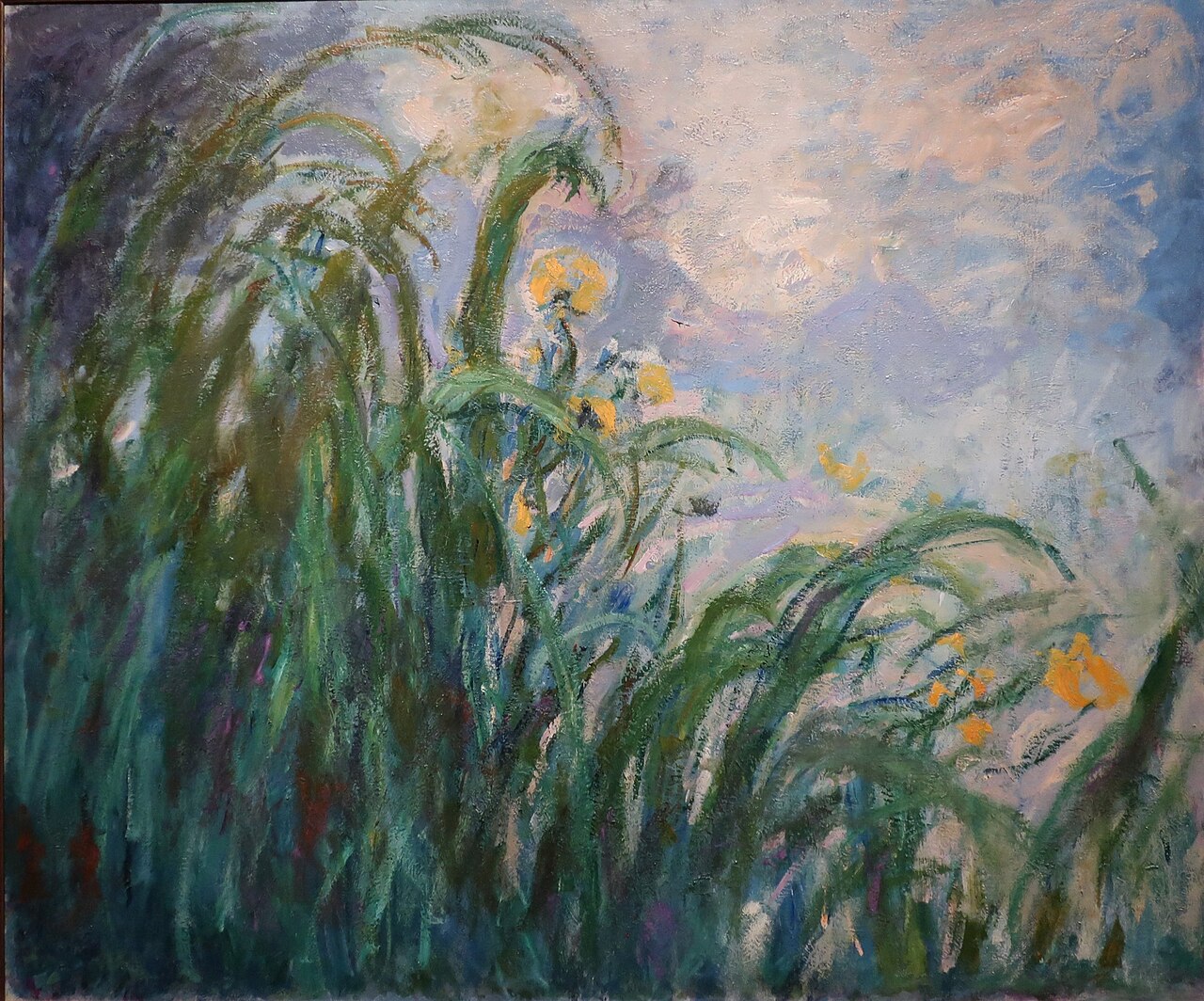
Claude Monet’s monumental Iris, painted in 1924–25 during the final years of his life at Giverny, will be offered at Sotheby’s Paris on October 22, 2026, with an estimate of €22 million to €30 million. Measuring 160 by 180 cm, it is the largest work from Monet’s celebrated Iris series ever to come to auction. If it reaches its upper estimate, it could establish a record for the highest price ever paid for a painting at auction in France. The work leads a 28-lot sale from the long-hidden collection of Jeanne Schlumberger, whose holdings are expected to exceed €40 million in total.
A Monet Hidden From Public View for Decades
One of Claude Monet’s most remarkable late paintings is about to leave a private collection and return to public view.
Iris, painted in 1924–25, will be offered at Sotheby’s in Paris on October 22, 2026.
The estimate is extraordinary: €22 million to €30 million.
At the top end, the painting could establish a new record for the most expensive painting ever sold at auction in France.
But the potential price is only part of the story.
For decades, Iris remained almost completely hidden from public view.
The painting has not been publicly exhibited since it was created.
Its appearance at Sotheby’s therefore represents a rare opportunity to see a major work from the final period of Monet’s career before it potentially enters another private collection.
The Largest Monet Iris Ever to Reach Auction
The painting is particularly significant because of its scale.
Iris measures approximately 160 by 180 centimetres, making it the largest painting from Monet’s celebrated Iris series ever to appear at auction.
That size changes the experience of the subject.
Monet was no longer simply painting individual flowers as botanical objects.
His late garden paintings increasingly became immersive compositions of colour, vegetation and light.
The flowers appear to emerge from an almost abstract field.

The boundaries between individual plants become less important.
What matters is the overall sensation.
That quality is one reason Monet’s late work has undergone such a dramatic reassessment.
Monet’s Late Paintings Were Once Misunderstood
Today, Monet’s late water-lily and garden paintings can command enormous prices.
But when they were first shown, the reaction was very different.
Critics struggled with the increasingly loose brushwork, intense colour and enormous scale of some of Monet’s late compositions.
What now appears radical and modern was initially interpreted by some observers as evidence that the aging artist had lost his abilities.
That historical misunderstanding is crucial to the story of Iris.
The painting belongs to a period when Monet was pushing painting away from traditional representation and toward something much more atmospheric and abstract.
He was painting what he experienced rather than simply what he saw.
A Collector Saw Something Others Missed
Jeanne Schlumberger understood the importance of Monet’s late work much earlier than many other collectors.
Beginning in the 1950s, she worked closely with Parisian dealer Katia Granoff.
Together they developed a collection that was notably adventurous for its time.
Schlumberger did not simply pursue the most fashionable Impressionist paintings.
She was particularly interested in artists and periods that had not yet received universal critical approval.
Her collection included works by Paul Cézanne, Pierre Bonnard, Gustave Moreau, Chaïm Soutine and Georges Rouault.
But her relationship with Monet became especially important.
She acquired Iris at a time when Monet’s late paintings were far less fashionable than they are today.
The Remarkable Michel Monet Connection
One of the most fascinating chapters in the story involves Monet’s son, Michel.
In 1958, Schlumberger used her house as collateral to help Granoff acquire the studio holdings of Michel Monet.
The collection contained paintings from Claude Monet’s final years at Giverny.
At the time, those works attracted relatively little enthusiasm in France.
Granoff recognised their importance and helped place examples with American museums and private collectors.
Schlumberger became one of the early collectors to acquire paintings from the group.
Among them were Iris and Saule pleureur.

The decision proved remarkably prescient.
The paintings that had once seemed unfashionable are now regarded as some of the most ambitious works of Monet’s final period.
Jeanne Schlumberger Was Not a Conventional Collector
Schlumberger came from one of France’s great industrial families.
The Schlumberger name was associated with the international oil-services company founded by her family.
Her social position could easily have led to a conventional collection of celebrated Impressionist works.
Instead, her taste was considerably more adventurous.
She preferred artists who pushed against established expectations.
That makes the collection particularly interesting today.
It does not simply tell us what wealthy French collectors wanted in the middle of the 20th century.
It shows us what one unusually independent collector believed would matter in the future.
In the case of Monet’s late paintings, her prediction was remarkably accurate.
A Collection Hidden Behind Closed Doors
The Monet is part of a larger group of 28 works being offered from the Schlumberger collection.
Together, the works have an estimated value of more than €40 million.
Many have rarely, if ever, been seen by the public.
Schlumberger was known for being highly selective about lending her collection to museums.

As a result, the Sotheby’s sale is effectively opening a private art world that remained largely inaccessible for decades.
The auction therefore has an unusual quality.
It is not simply selling expensive paintings.
It is revealing a collection.
Cézanne, Moreau and Soutine Join Monet
The collection demonstrates the breadth of Schlumberger’s taste.
Alongside Monet are works by some of the most important figures in French modern art.
Three panels from Paul Cézanne’s Paysage romantique aux pêcheurs are among the highlights.
The panels originally formed part of a fresco at the Jas de Bouffan estate in Aix-en-Provence before being transferred to canvas.
Their estimates begin at approximately €400,000.
The collection also includes works connected with Gustave Moreau, Pierre Bonnard, Chaïm Soutine and Georges Rouault.
Together, they reveal a collector who was interested less in fashionable labels than in artistic experimentation.
Another Monet Is Also Going Under the Hammer
Iris is not the only important Monet in the sale.
Another late work, Saule pleureur, will also be offered.
Its estimate is €9 million to €12 million.
The presence of two major late Monets in the same collection tells us something important about Schlumberger’s collecting strategy.
She did not acquire a single fashionable masterpiece simply because it was Monet.
She specifically believed in the importance of his late period.
That distinction makes the provenance of these works particularly compelling.
Why the Record Could Fall
The current auction landscape makes the €30 million estimate especially significant.
If Iris sells at or above its upper estimate, it could become the most expensive painting ever sold at auction in France.
The word auction is important.
This is not a claim that it would become the most expensive painting ever sold in France through any form of transaction.
It refers specifically to a public auction held on French soil.
That distinction matters because the international art market regularly records enormous private transactions whose prices are not publicly disclosed.
The Sotheby’s sale will provide a transparent public test of the market.
Monet’s Late Period Is Having a Moment
The timing is also interesting.
Monet’s late work is receiving renewed attention from museums and collectors.
Tate Modern is preparing its first major Monet exhibition, Monet: Painting Time, opening in London in February 2027.
That exhibition will examine the passage of time throughout Monet’s career and will include a significant group of his later paintings.
The renewed institutional interest adds another layer to the Sotheby’s auction.
The market and the museum world appear to be looking at Monet’s late career with fresh eyes.
From Impressionism Toward Abstraction
One reason these paintings remain so fascinating is that they sit at the boundary between Impressionism and abstraction.
Monet began his career by revolutionising the representation of modern life and landscape.
By the final decades of his life, his paintings could become almost completely absorbed in colour and gesture.
In Iris, the flowers remain identifiable.
But they are also part of a much larger visual field.
The painting does not ask the viewer to identify every flower.
It asks the viewer to experience the garden.
This is one reason Monet’s late work has become so influential for later generations of artists.
The Garden Became Monet’s Laboratory
Giverny was not simply Monet’s home.
It became his artistic laboratory.
He carefully developed the gardens, selected plants and controlled the visual environment surrounding his house.
The garden allowed him to return repeatedly to the same subjects.
But each painting could be different.
Weather changed.
Light changed.
Seasons changed.
Monet changed.
His eyesight also deteriorated in his later years, adding another dimension to the increasingly fluid appearance of his paintings.
Rather than abandoning painting, he continued experimenting.
His garden became a place where observation, memory and perception could overlap.
The Strange Modernity of Iris
Seen today, Iris does not necessarily look like a conventional Impressionist painting.
That is precisely what makes it so interesting.
There is less emphasis on precise drawing.
Colour carries much of the structure.
Brushstrokes become visible.
The surface becomes increasingly active.
The subject almost dissolves into the act of painting.
This is one reason late Monet has been repeatedly reconsidered by art historians.
His work began to anticipate ideas associated with abstraction decades before Abstract Expressionism became dominant.
The painting’s modernity is therefore not simply a matter of fashion.
It is embedded in the way Monet approached perception itself.
A Private Collection Becomes Public History
The Schlumberger sale also demonstrates how private collectors can influence art history.
Museums preserve public collections.
But private collectors sometimes take risks that institutions cannot.
They can buy artists before their reputations are secure.
They can support dealers who champion unfashionable work.
And they can preserve artworks for decades.
Schlumberger’s collection is an example.
Her decisions helped preserve a group of works that later became far more highly valued.
The fact that many of them remained hidden for so long makes the forthcoming auction particularly unusual.
What Happens on October 22?
On October 22, 2026, the Schlumberger collection will come to auction at Sotheby’s Paris.
The sale is titled Le Temps Retrouvé: La Collection Schlumberger.
The auction is scheduled for 6 p.m. CEST.
The collection is estimated at more than €40 million overall.
But most attention will undoubtedly focus on Iris.
Will it reach €30 million?
Will competitive bidding push it even higher?
And will Paris finally record a new auction benchmark for a painting?
Those questions will remain unanswered until the evening of the sale.
More Than a Price
Whatever happens at auction, the story of Iris is about more than money.
It is a story about artistic vision.
Monet continued to experiment late in life even when critics questioned the direction of his work.
Jeanne Schlumberger recognised the importance of those experiments when many others did not.
And now, more than a century after the painting was created, the work is returning to public attention.
That journey is remarkable.
From Monet’s garden at Giverny.
To a private French collection.
To decades away from public view.
And finally to the auction room in Paris.
A Hidden Monet Steps Into the Light
For years, Iris existed almost as a secret.
Its importance was known to the Schlumberger family and to a small circle of specialists.
Most of the public never had the opportunity to see it.
That changes this autumn.
The painting will be displayed in Paris before entering one of the most closely watched auctions of the year.
It arrives with an extraordinary combination of qualities: scale, rarity, provenance, condition and historical importance.
And perhaps most intriguingly, it represents a moment when Monet was moving beyond the Impressionism that had made him famous.
If the bidding reaches the top of Sotheby’s estimate, Iris will not simply become an expensive Monet.
It could become the painting that sets a new French auction record.
But even before the hammer falls, its rediscovery has already reminded the art world of something important:
Sometimes the most interesting masterpieces are not the ones everyone has been looking at.
They are the ones that have been quietly waiting in the dark.
Sources:
Sotheby’s — Le Temps Retrouvé: The Schlumberger CollectionSotheby’s — Paris auctions
Sotheby’s — Le Temps Retrouvé: The Schlumberger Collection
AI Notice: Some visual content in this article may have been created or enhanced using artificial intelligence (AI) for artistic, editorial or illustrative purposes. Learn more about our approach in our AI & Editorial Principles.