Four Times of the Day by Claude‑Joseph Vernet is a celebrated series of four landscape paintings created in the mid‑18th century, each depicting morning, midday, evening, and night. The works show coastal and rural scenes transformed by changing light and human activity. They are significant for Vernet’s masterful atmosphere, poetic observation of nature, and influential role in the development of European landscape painting.
What Are We Looking At?
Four Times of Day, by Claude‑Joseph Vernet is four closely-coupled paintings, rather than one, each one devoted to a different hour: morning, noon, evening and night. As a set of four, they define a visual poem about time, diurnal light, and being human in nature.
Vernet builds each of his scenes as a total world an often lakeside or seaside landscape in which sky, water, buildings and figures follow the cycle of the hour. The composition is almost always in time sequence, with morning at one end and dark at the other, and present this span of time in minutes.

Despite their dispersal into various collections, the Four Times of the Day were uniformly composed with symmetry, staged figures, and a theatrical mastery of lighting that helped to establish Vernet as one of the most fashionable landscape painters of his day.
The Story Behind Four Times of the Day by Claude-Joseph Vernet
Claude‑Joseph Vernet (1714–89) was a French painter noted for marine and landscape pictures that combined close observation with highly arranged theatricality. Four Times of the Day is from his middle period, at which point collectors across Europe enthusiastically purchased series of “time of day” landscapes for ornament.
The idea of dividing a set into different hours became popular in the eighteenth century. For knowledgeable collectors, a time-flow of the day morning, noon, evening and night provided, in addition to visual interest, a tranquil moral scheme: youth and age, business and leisure, illumination and obscurity. Vernet had spent years working over the Italian coast and Roman light, and gained mastery over this type.

In Four Times of the Day he develops this notion into something oddly unified. Instead of just shifting the hue of the sky, he shifts the emotional climate of the whole frame. The mornings seem full of potential, bright and new, midday is crowded and communal, and the evening lays the landscape to rest, either gently or dismally, while the night (in whichever form it takes), ranges from threatening to sacred to contemplative.
Though students will be able to recognize certain specific patron circumstances, the central “story” here is not a narrative story as such, but the story of light: how the identical landscape genre may be so rendered four times by the silent hours of the day.
Look Closer: A Visual Tour Through Each Time of Day
Although compositions vary among different iterations, the logic of the cycle remains strikingly consistent. Imagine walking slowly past the four canvases, hour by hour.
Morning
In the morning scene, Vernet typically presents a tranquil, pearly light. The sky is pale—often a gradient from soft blue to delicate gold near the horizon. Figures are engaged in the first labors of the day: fishermen readying boats, women at the water’s edge, travelers setting out.
Look for:
- Cool, translucent light: Shadows are long but gentle; everything feels freshly washed.
- Crisp silhouettes: Masts, trees, and distant buildings are sharply articulated against the calm sky.
- Subdued activity: The tone is industrious but quiet—human figures do not yet dominate the landscape.
Morning becomes a visual metaphor for beginnings: youthful, clear, promising.
Midday
The midday scene intensifies everything. The sun rises high; contrast sharpens; colors warm and saturate. Vernet often populates this panel more densely—workers, merchants, sailors, or travelers appear in greater numbers.
Notice:
- Short, hard shadows: These anchor the architecture and figures, giving the scene a more assertive geometry.
- Brighter color range: Blues deepen, earth tones glow, and the water becomes a mirror of the fierce overhead light.
- Heightened social life: People trade, converse, unload ships, or move through a marketplace; this is the “public” face of the day.
Midday embodies the peak of energy and productivity, the “noon” of both sun and human ambition.
Evening
In the evening panel, Vernet’s poetic sensibility comes fully into play. The sky drifts through tender oranges, rose, and muted violets. Water lies calmer; smoke or mist may veil the distance. Activities taper: figures gather, rest, dine, or simply watch the fading light.
Look for:
- Long, gliding shadows: These guide the eye diagonally across the composition, infusing it with slow movement.
- Warm‑cool dialogue: Golden light clings to buildings and figures, while shadows cool toward blues and soft grays.
- A contemplative mood: The human bustle of midday gives way to intimacy—small groups, quieter gestures, more inward gazes.
Evening is the hour of reflection; Vernet renders it as a visual sigh, a gentle decrescendo toward night.

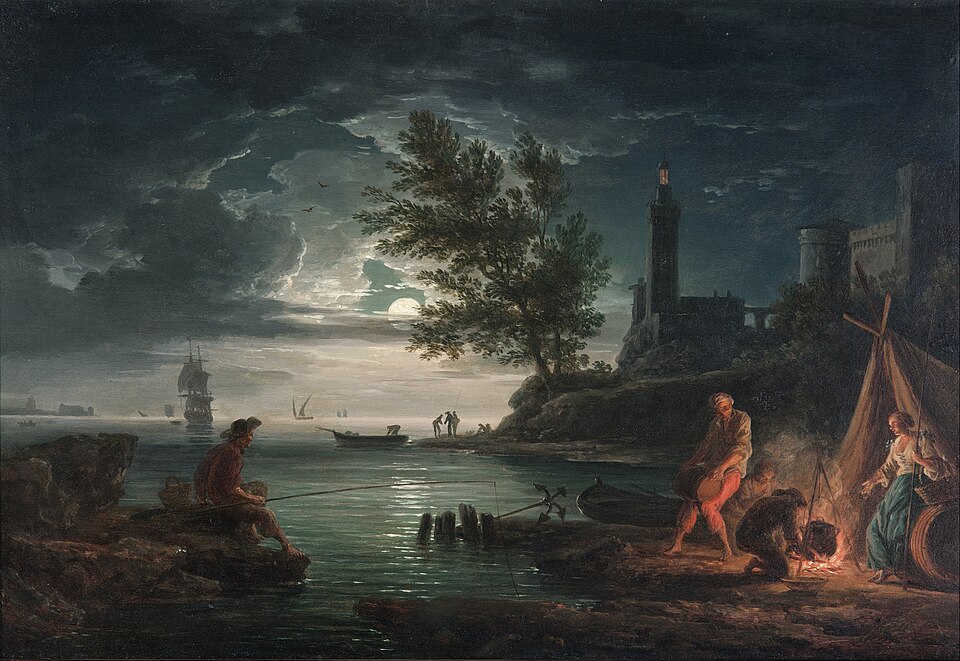
Night
The night scene is the most dramatic. The sun has vanished; light now comes from artificial and celestial sources: torches, lamps, fires, moon, and starlight. Vernet uses this setting to display his virtuosity with chiaroscuro and atmospheric effects.
Observe:
- Concentrated light sources: A fire on shore, a lantern in a boat, or a glowing window creates tight pools of illumination.
- Deep shadows: Large areas of the composition drop into near‑black, punctuating the scene with mystery.
- Shift in subject: Night can suggest danger (shipwreck, storm, smugglers), devotion (pilgrims, religious monuments), or sheer quiet—depending on the version—but always with heightened emotional charge.
Night completes the cycle by plunging the visible world into partial obscurity, reminding us that not everything can be fully known or seen.
Meaning and Symbolism Across the Changing Light
While Vernet does not rely on overt allegorical attributes, Four Times of the Day participates in a long European tradition that understood the times of day as metaphors for the stages of human life and states of mind.
- Morning as youth: New beginnings, learning, and potential. The modest scale of activity and gentle light reinforce a sense of innocence and preparation.
- Midday as maturity: Full energy, labor, commerce, public life. The bright light exposes everything—honor, effort, and human frailty alike.
- Evening as middle age or reflection: A period of gathering, community, and recollection, colored by the knowledge that light is waning.
- Night as old age or the unknown: Darkness can equal danger, but also rest, faith, or philosophical contemplation.
Some art historians also read the cycle as an essay on nature and human dependence on it. The same coast or riverbank persists, but human activity fluctuates—suggesting our vulnerability to time and environment. Vernet’s treatment is not moralizing in a heavy‑handed way; instead, he offers a series of atmospheres that viewers can interpret through their own experiences.
Claude-Joseph Vernet’s Technique: Crafting Atmosphere and Time
Vernet’s reputation rests on his extraordinary ability to paint air, vapor, and light. Four Times of the Day showcases several hallmarks of his technique:
- Layered skies: Thin, translucent glazes create gradations from horizon to zenith, essential for distinguishing the hour. In morning and evening, these veils of color yield subtle tonal shifts; in noon and night, the transitions are starker.
- Orchestrated composition: Vernet organizes each canvas with a clear foreground‑middle ground‑background structure—rocks, trees, or architectural elements frame the edges, directing the eye toward the horizon and sky where the “time of day” is announced.
- Figure integration: His figures are small but telling, scaled to the landscape rather than dominating it. Their gestures and tasks echo the mood of the light, making human life an extension of climate and hour.
- Controlled reflections: In coastal and river scenes, water becomes a secondary light source. Reflections of sky and artificial illumination add shimmering accents that deepen the sense of realism.
All of this is executed with a polished yet lively brushwork, refined enough for aristocratic interiors but vibrant enough to evoke the outdoors.
The Detail You Might Have Missed in Four Times of the Day
One motif repeatedly subtle yet integral to Four Times of the Day is the minuscule figure, or aggregation of figures, who, instead of laboring, bartering, hurrying along, pause to gaze: be out toward the horizon, into the sky, down toward the horizon, across the horizon, or into the blaze blazing in the nocturne.
These viewers reflect the spectator’s own. They are emissaries, silently beckoning us to enter the painting and join in their reflections. In a series that by its subject alone of labor and the marketplace could be read as a paean to everyday rhythms, Vernet includes in a small subtle gesture of meditation on seeing itself the human feeling of stopping and watching.
Why Four Times of the Day Still Captivates Contemporary Viewers
Today we look at Four Times of the Day with appreciation for its poetic beauty and an unexpected sense of familiarity. Through the lens of time‑lapse videos and cell phone vistas, Vernet‘s cycle seems a 21st-century forerunner: a miniature, crafted, analog version of the passing of daylight.
Collectors and museum audiences are drawn to:
Its immersive atmospheric tranformations.
Moves through the frames in a cinematic order.
The tension between escapist glamour and muted metaphysical musing over time, work and repose.
A further argument can be proposed by considering the works’ relevance to current issues of environment and time. Vernet informs us that, ”…the light, the weather and our daily lives are linked, and we are all, knowingly or unknowingly, stuck into a programme that depends on the revolution of the world.”
GRAND BOUDOIR’s Editorial Verdict
Four Times of the Day by Claude‑Joseph Vernet is a masterclass in orchestrated atmosphere, an 18th‑century luxury suite that still feels visually modern. It seduces first with beauty, then lingers as a meditation on time, labor, and the quietly ecstatic act of looking. A cycle to live with, not just to admire.
AI Notice: Some visual content in this article may have been created or enhanced using artificial intelligence (AI) for artistic, editorial or illustrative purposes. Learn more about our approach in our AI & Editorial Principles.