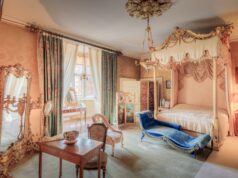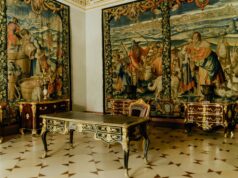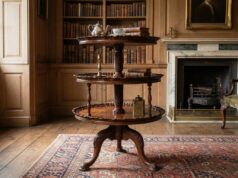

The Pembroke table belongs to the late 18th-century vernacular of English furniture that favored lightness, proportion, and classical refinement. Pattern-books by designers such as Hepplewhite and Sheraton helped disseminate the vocabulary—tapering legs, restrained inlay, and an appetite for well-proportioned utility—that the Pembroke exemplifies. In contrast to the large dining table, the Pembroke was adapted for a room smaller and more versatile: morning room, dressing room, or drawing room, where the rituals of society (tea, needlework, et c., ) could be carried out on a human scale.
The provenance of the name is uncertain, but does not ascend to the aristocracy to justify its widespread use. Increasing urban affluence, social intimacy, and better cabinet-making all combined to make the Pembroke a good solution to changing home life. Its built form is an architectural emulation: classical proportion sit to table for two or four, which disappears without fuss.
Ingenious Form: Folding Leaves and Functional Grace
A Pembroke may initially appear to be quite an uncomplicated piece; a rectangular top supported by either one or two hinged leaves, which are supported on sliding brackets or pull-out flaps. In general, while the gateleg tends to be the heaver of the two, the slender ‘implied’ carriage of the Pembroke, on account of its bracketing rather than the substantial swing legs of the gateleg, greatly lightens up the Pembroke‘s silhouette and, overall, makes it appear slightly more delicate of the two. A further feature of many Pembrokes often quite handily, but not exclusively are shallow drawers, or perhaps even a pair, which seem particularly domestic in their relevance (perhaps used to contain writing utensils, napkins or teawares).

What proportions The geometry of the top is almost rectilinear, the apron is shallow, the legs are slim, so that when the leaves are down the table is a sleek side console; when up it becomes a dining or gaming table. The pull-out stops, figure-matched veneers and smart brass handles are not just decoration but testimony to a craft that achieved economy with sophistication. Any mechanics hinges, sliding supports, dovetailed drawers thoughtfulness.
Materials, Veneers and Regional Variations Explained
Most of the classic Pembroke palette is already established in mahogany, which was admired for its warm, lustrous grain and exceptionally fine polish. The cocktail of the later eighteenth century saw the popularity of the lighter veneers, most notably satinwood, used, often as banding and in delicate work like stringing and inlay. The top would be veneered in the usual manner, over a plank core, the edges seasoned and eased. Finish could range from the deep, shellac-based French polish that enhanced chatoyance in mahogany to more subdued, wax-polished surfaces.

Regional differentiation is not obvious, but the difference a subtle one. The craft workshops of London produced the most elegantly translated, with finesse of inlay, delicate, slender, Neoclassical legs and delicate brassware. Provincials have taken a more brute approach to form, with thicker, more solid tops and plainer veneers but these closer to the truth than their more refined counterparts. In the Americas, Federal period American Pembrokes are similar, but lighter in proportion and sometimes designs reflecting the influence of newly available pattern books. The real clues are the grain, the patina and the construction.
The Pembroke Table in Domestic Ritual and Style
Part of the Pembroke‘s appeal was its articulation with the inconsistent rites of Georgian home life. Tea drinking, letter-writing, amateur music and gaming all encouraged needs for appropriately scaled furniture, which was laid out for conversation in flexible arrangements that accommodated multi function use in a single afternoon. For women in particular, the tables could often be found in the centre of feminine domestic sanctuaries beauty spots of modest treasure and skill, repositories of needlework and letter-writing.
The light masculine classical interior, with its plaster cornices, girandoles, and papered walls is visually polished by the Pembroke. When use as a feminine table or desk was mentioned historically, it was a sensual one senses the sociability of it rather than an effeminate compliment. Contemporary designers embrace this quality; the table is a subtle presence an anchoring and functional space in a vignette or one that can offer a layered historical statement absent from contemporary large-scale pieces.
Collecting, Conservation and Contemporary Revival
Having laid out a Pembroke there is a requirement to examine how authentically it has been constructed; the use of original veneers, minimal clean cuts to the original brasses, and the accurate joinery, all contribute to the pedigree of the item and its value on the open market. The most common entry points of attack concern the veneer lifting, the presence of shrinkage cracks to the top; worm infestations; and historic repair. The primary goal of the restorer should be to preserve the integrity of the item, and not to carry out a total overhaul, with old finishes being left in place where possible and reversing earlier intrusions that threaten the integrity of the object.
Modern revival has been two-pronged: sought after as a patinated antique with a history, but as the taste changes, some of the original details have undergone reinterpretation new Pembrokes have been executed in wood smoked oak or lacquer, with steel legs translating the same utility to new contexts. An interior decorator will use a Pembroke set against a large-scale abstract artwork or a single sculptural lamp, because after all, what better way to maximize the utility of a skimming piece than to offer discrete focal points for fragile intimacy
The ability of the Pembroke table to continue to exist first supported by its disarming combination of good design and sociopolitical sensibility, then by its presentation as a textile of designerly processes, and finally by the fact that each one offers a different, humbling lesson in proportion, moderation, and the artfulness of furniture open to both uses and concealment interested in, holds the secrets of a flexible furniture-laden culture.
AI Notice: Some visual content in this article may have been created or enhanced using artificial intelligence (AI) for artistic, editorial or illustrative purposes. Learn more about our approach in our AI & Editorial Principles.