

Rococo Bedroom Inspiration: How to Bring 18th‑Century Elegance into a Modern Home
Rococo bedrooms are the visual equivalent of a whispered secret in silk: intimate, ornate, and unexpectedly playful. Emerging in 18th‑century Paris as a reaction to the heavy grandeur of Baroque design, Rococo style turned private rooms—especially bedrooms—into luxurious cocoons of comfort and fantasy. If you’ve ever dreamed of a space that feels like a blend of Versailles, a Parisian hôtel particulier, and a modern boutique hotel, Rococo bedroom inspiration offers a rich, historically rooted roadmap. This guide walks you through the key principles, colors, furniture, and decor strategies so you can create a bedroom that feels authentically inspired, livable, and deeply personal—while staying grounded in real art‑historical knowledge.

Quick Answer: What Is a Rococo Bedroom and How Do You Create One?
The Rococo bedroom is a highly ornamented and romantic interior, based on 1730s–1750s French interiors, and the early ideas of King Louis XV (r. 1715–1774). It features the soft, seductive, gentle curves and asymmetrical decoration, pastel shades, gilded features, and intimacy and theatrics inherent in this style. While the last classicist Baroque suit, marked by its grandeur and geometrical perfection, ruled Louis XIV‘s court at Versailles, the Rococo style moved into private Parisian townhouses (hotels particuliers), and valued beauty and pleasure.

Can You Name the Masterpiece?
Ten masterpieces. Ten questions. How well do you know the history of art?
If you want to achieve a Rococo style bedroom now, there are many interesting details to look for. First of all it should include a central bed with an ornate head board, this could either be embroidered, or carved wood. The outlook of the room should use a mainly pastel palette with pale blue, blush, cream and green as the main shades. The room should include abundant layers of textiles, as well as feature pictures such as gilt mirrors and use of delicate molding. Ornate lighting such as crystal chandeliers and silk or linen lamp shades will also help to produce an authentic look.
You don’t require a palace budget or even an 18th century Marais flat to achieve the look. The most important thing is to create a harmonious blend of historic imagery and modern livability: Invest in reproductions or second-hand treasures, indulge in one or two expensive pieces (perhaps the bed or an antique mirror), and reign in the clutter so that the space appears sophisticated rather than gaudy. The decorator’s motto: historic inspiration, modern convenience.
Understanding Rococo Style: Historical Roots and Key Principles
Rococo emerged in early 18 th century France (roughly 1730s-1760s), immediately after the death of Louis XIV. As the aristocracy abandoned Versailles and their courts in favor of private homes and apartments in the city, they commissioned interiors that were lighter, more personal, and, let‘s face it, more fun. According to the Metropolitan Museum of Art, the style “celebrated sinuous curves, asymmetry, and themes of amorousness and leisure,” and was particularly popular in private chambers such as boudoirs and bedrooms. Again, this focus on the private realm is something to keep in mind while drawing inspiration for a bedroom this is not the palace throne room, it‘s the queen‘s personal harem.

Can You Guess the Artist?
Three clues. One artist. How quickly can you identify the painter?
The style then was exported to the courts of Bavaria, Austria and all the German states and into Italy, where variations of the style were developed. A number of these can be seen today at the Victoria and Albert in London, such as Chinese Rococo inspired furniture, which balances the exuberance of French taste with a useful lightness of touch, or the Bavarian Rococo churches, which can be seen on the Smithsonian Institution website, which document the style‘s love of swirling plasterwork and trompe l‘oeil finishing. The vessels of the Key Visual Language are shells (rocaille), scrolls, foliage and whimsical creatures, such as cupids and exotic birds.
Here are some general principles that underpin Rococo as it relates to the interior and might serve as guideline to your bedroom design: firstly, celebrating curvilinear shapes: From headboards to mirrors, flat lines are replaced by Scurves and Cscrolls. Secondly, celebrating asymmetry: decorative elements are often designed to appear in a pair of symmetrical objects, but each one is slightly different, or clusters of ornaments may give the impression that a panel leans either to the right or left. Thirdly, celebrating lightness and movement: the spaces should not be too heavy, but instead give you sense of liveliness or airiness. The fourth principle is creating a sensual comfort: chairs, upholstery, textiles and diffused light were designed to enhance the feeling of encompassing warmth. Remember these four principles whenever you select furniture, decoration and finishing layers.
Color Palettes and Materials: The Foundations of a Rococo Bedroom
Genuine Rococo interiors were elegantly understated with a subtle pastcolorscheme. Period rooms from the Hotel de Crillon at the Louvre Museum and other 18 thcentury houses reveal typical pairings: pale blues, subdued greens, pink blush, ivory and warm creams, often gilded with a flourish of gold leaf. These shades mirrored 18 thCentury technique and fashionable preferences for soft elegance and fragility. In a modern bedroom this would mean pale fabric in subdued shades: a dullishblueor a warm muted offwhite.

In Rococo interiors materials provided a balance of sumptuousness and sensuousness. Wood was heavily covered in paneling, and boiserie was used extensively in French bedrooms, often painted and gilded. Hard woods such as walnut and beech, exotic veneers (kingwood and tulipwood) and intricately inlaid with marquetry were employed. Marble was used on fireplace surrounds and tables. Metals such as gilt bronze, otherwise known as ormolu were used to decorate mounts, handles and other applications. The V&A cites mountings as vital to creating the ‘sparkle’ that met the desire of the Rococo client. Today using painted mouldings, a marble topped nightstand and brass or gold tone hardware you should be able to create an appropriately rich effect.
Textiles are essential. In the 18th century silk damasks, brocades and toiles de Jouy were popular materials used for bed hangings and wall coverings within the fashionable homes of Paris. Although a complete silk-lined wall may not be practical, you can create a similar atmosphere using upholstered fabric wall panels, beds piled with layered bedding, and curtains that pool on the floor. Linen blends with a sheen, cotton sateen, and contemporary jacquards are all long-lasting fabric options that can echo such historic designs as florals, chinoiserie scenes, and fine stripes.
The Rococo Bed: Centerpiece and Statement
In the Rococo bedroom, the bed is the undisputed focus. In past times, the bed was not necessarily merely furniture but could be the centerpiece of the room examples exist of regal chambers at Versailles, or more modest, but still sumptuous, beds in Parisian hotels collected by the Metropolitan Museum of Art. Typical examples were the lit a la francaise, with a position corresponding to the width of the room, and the lit a la polonaise, with a carapace (dome) as a moulded cover, hung by curved poles at each corner. Caravans would have patterned and colored draperies over beds, and many beds were topped with elaborately carved and gilded balustres.
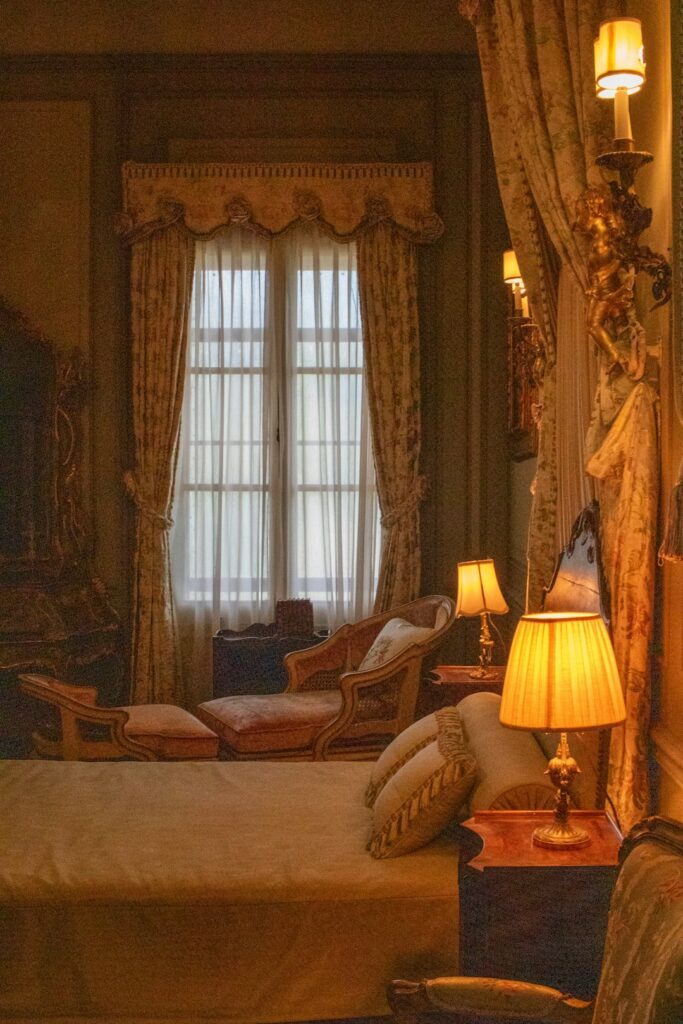
Today you don’t require a museum quality reproduction, yet you do require a bed of visual significance. A prominently high, curvaceous headboard upholstered and tufted, or sculpted wooden with painted and gilded touches, is enough to bring the fashion of the Rococo to the room. Look out for headboards shaped like a scalloped edge, coquille shell motifs and frilly carvings of leaves. Should your ceiling permit it, a canopy or halftester with billowy draperies (which can be scaled down for modern requisites) may be added:
Layered, inviting and not minimalist should be the approach to bedding in your home. A strong foundation of plain linens, and a choice of damask, floral or toile covers will be mixed with the plushness of patterned shams and a coverlet to complement. Euro pillows, bolsters and a carefully selected throw at the foot of the bed will add to the sense of style, without adding chaos. As the Smithsonian institution’s articles on historic domestic life highlight, the bed is a site of both practical design and personal status and taste. Make your bed the place where you splash out on the very best!
Furniture and Storage: Curves, Craftsmanship, and Practicality
Across the room is where the detailing of the sinuous curves come into play. The typical furniture forms of the period are: the bomb revolution (bustled-fronted chest of drawers); the serpentine-fronted dresser; the cabriolepennesside table; small writing cabinets or secretaires. The V & A holds a typical collection of 18 th century France furniture in the hope that you‘ll look out for the signature forms, ‘more modest’ ornament such as the scalloped apron and the gilded bronze mounts that decorate many examples; even cheap reproduction or vintage examples will have the shapely silhouette.

In a bedroom it’s practical storage that is required, so consider how Rococoinspired shapes can be fused with todays needs. A bombe dressing table is an ideal statement item for storing clothes, while a small desk can serve as a double up for a dressing table. Tables with curved legs and small drawers are practical, yet decorative. Space may be limited so choose one or two more elaborate pieces to stand out, whilst keeping the others visually lighter by for example painted colormatched wardrobes that will decline into the Background.
Upholstered seating will increase the comfort and authenticity of the room. An armchair or slipper chair in a small bergere size with carved wooden frames and floral or other pattern fabric will establish a reading corner and references 18thcentury lounge culture. The Met states the Rococo period was characterized by an “unparalleled focus on comfort and adaptability” in seating design so feel free to encourage this practice in your bedroom by choosing plump easy to sit in chairs, workable benches for putting shoes on and storage ottomans for stashing all those miscellaneous items.
Walls, Ceilings, and Floors: Creating an Architectural Shell
The architectural envelope of a Rococo bedroom is as crucial as the furnishings. Traditionally in a French elite interior, walls would be hung with carved wood paneling (boiserie)often painted in pale hues and finished with gold. The Louvre period rooms from the 18thcentury show how panels would be used to surround painted overdoors and mirrors and stretch into areas of textiles creating a seamlessdecorative scheme. Although intensive handcarved wood panels maybe beyond most budgets, you can get the same elegance with applied moldings or wainscoting flanking the bed, or even just using wellplaced picture frame molding painted in the wall color.

Ceilings can also be decorated with painted scenes or with stucco decoration which continues on the upper walls with curves matching to the shape of the room. In a contemporary bedroom, build a decorative ceiling medallion above an elegant chandelier, add delicate crown molding, or paint the ceiling a very gentle color to bring charm and intimacy to the space. Steer clear of the harsh box-shapedness of the all white room, since Rococo ceilings can appear almost like jewelry boxes, with each surface setting the tone for total indulgent grace.
In European interiors of the 1700s, the floors differed from country to country, from town to town: parquetry in French townhouses, wide planking in country houses, and sometimes marble in the grandest rooms. In the bedroom, its happy to stay true to history. Wood feels comfortable and inviting; cover it with a single or double rug ( floral or medallionperhaps in a subtle color scheme) to deaden sound and ground the bed visually. Cover the entire floor with a neutral or pale shade of wallto wall carpet, and use furnishings and accessories for the historical look.
Lighting and Decorative Details: The Finishing Touches
Lighting in Rococo rooms served vital and theatrical purposes. Candle fed gold leaf sconces and the immense chandeliers of cut glass or sparkling crystal showered the room in flattering shimmer. Today electricity has taken their place, but the idea persists; several lowerintensity lighting points around the room make an altogether more Rococo atmosphere than one glaring overhead downlight. An eye catching chandelier or sumptuous pendant above the bed, complemented by wall sconces and bedside lamps, puts you in control of the light levels, from bright to cocooning.

Mirrors are crucial to the look. The Met Museum adds that there was a “significant rise in the popularity of large mirrors as interior adornment during this period”, reflecting and diffusing light and enlarging the room. A gilded overmantel mirror, a decorative pier glass placed between the windows, or even a well-placed large mirror over the dresser, are all a strong visual focus. Look for frames with scrollwork, shells and leaves – vintage frames can be repainted and splashed with gold so use them in your setting.
All the accents, all the details porcelain figurines, pictures in small frames, floral arrangements and art work would bring the arrangements together. Chinoiserie motifs – European versions of imagery from the East were very popular in Rococo decoration, as recorded by the V&A and the Smithsonian Institute. Introduce example of this layer with one or two pair of blueandwhite vases, a chinoiserie print or a silk pillow with birds and branches. Keep a balance for the viewer so the space doesn’t overload, by plucking out certain items and using vignettes and having negative space.
Key Characteristics of a Rococo‑Inspired Bedroom (Summary Table)
| Element | Historical Reference (18th c.) | Modern Application |
|---|---|---|
| Overall Mood | Intimate, playful, luxurious; private retreat of elites in Paris, Bavaria | Cozy, romantic sanctuary with layered textures and soft light |
| Color Palette | Pastels (blue, green, pink), ivory, gilding (Met Museum, Louvre) | Chalky pastels, creams, warm whites, selective gold accents |
| Bed | Lit à la polonaise, carved and gilded headboards, rich hangings | Curved or upholstered headboard, optional canopy, layered bedding |
| Furniture | Bombe commodes, cabriole legs, marquetry, ormolu mounts (V&A collections) | Curved dressers, vintage‑style side tables, subtle inlay or brass |
| Walls & Ceilings | Boiserie, stucco ornament, painted panels (Louvre period rooms) | Applied moldings, painted panel effects, medallions, crown molding |
| Materials | Wood, silk, brocade, marble, gilt bronze | Wood or laminate, silk‑look fabrics, marble or faux marble, brass |
| Lighting | Candlelit chandeliers, gilt sconces (Met Museum examples) | Crystal or glass chandelier, wall sconces, warm‑tone LED lamps |
| Decorative Motifs | Shells (rocaille), scrolls, florals, chinoiserie (Smithsonian research) | Shell and scroll frames, floral prints, subtle chinoiserie touches |
Authoritative Quotes and Sources
- The Metropolitan Museum of Art describes Rococo as a style that “replaces the formality and rigidity of the Baroque with lightness, elegance, and an exuberant use of curving, natural forms,” a guiding principle when selecting furniture and decor for a bedroom.
- The Victoria and Albert Museum notes that 18th‑century French furniture was designed to “offer unprecedented comfort while displaying virtuoso craftsmanship in marquetry and gilt‑bronze mounts,” underscoring the importance of balancing comfort and ornament.
- The Louvre Museum’s overview of its 18th‑century period rooms emphasizes that “domestic interiors became settings for refined sociability and private life,” highlighting the bedroom as an ideal place to apply Rococo aesthetics today.
For deeper study and visual references, consult:
- The Metropolitan Museum of Art – Heilbrunn Timeline of Art History (sections on Rococo and 18th‑century France).
- The Victoria and Albert Museum – Furniture and Woodwork collections.
- The Louvre Museum – Department of Decorative Arts, 18th‑century rooms.
- Smithsonian Institution – Resources on European decorative arts and domestic interiors.
Frequently Asked Questions About Rococo Bedroom Design
Is Rococo the same as Baroque?
No. Baroque (c. 1600–1715) is grand, dramatic, and often symmetrical, associated with Louis XIV and Versailles’ state rooms. Rococo (c. 1730–1770) is lighter, more intimate, and playful, flourishing under Louis XV and in private Parisian homes. In bedrooms, Rococo emphasizes comfort and sensuality over state grandeur.
Can a small bedroom work with Rococo inspiration?
Yes—and in some ways, small rooms are ideal. Historically, many Rococo interiors were relatively modestly scaled private rooms. Focus on one statement piece (often the bed), a soft color palette, mirrors to reflect light, and a few ornate details. Avoid heavy, oversized furniture that overwhelms the space.
Do I need antique furniture to achieve an authentic look?
Not at all. While antiques from the 18th century (or high‑quality 19th‑century revivals) are wonderful if budget allows, well‑chosen reproductions, vintage pieces, and even new furniture with the right silhouettes can capture the essence. Prioritize shapes (curved legs, bombe fronts), finishes (paint, light distressing, brass), and textiles.
What’s the difference between French provincial and Rococo?
French provincial style adapts Parisian and court fashions for the countryside, using simpler forms and more robust construction. Rococo, especially in Paris and at the French court, leaned more ornamental and refined. For a bedroom, you can blend them: use provincial pieces (like simple curved‑leg chairs) with a few high‑Rococo accents (like a gilded mirror).
How do I keep a Rococo‑inspired bedroom from looking overly theatrical?
Choose a restrained color palette, limit the number of highly ornate pieces, and integrate modern elements—such as streamlined bedding or contemporary art—alongside historical references. Think of Rococo as an influence rather than a theme; subtlety and quality materials will keep the look sophisticated.
The Bed Was the Heart of the Rococo Bedroom
In a rococo bedchamber the bed is supposed to feel more like the landmark, both figuratively and literally, than a normal piece of furniture.
This was especially the case in the luxurious interiors of the eighteenth century, where the frilly, embroidered and often sensual draperies, intricately carved wood and even fancy textiles surrounding the bed turned it into a kind of private stage. The French bed was no mere place of sleep. It was a statement of money, femininity, rank and style.
So for a modern Rococo bedroom the bed should be in anyway setting the visual language before anything else.
The effect can be most simply achieved by the addition of an upholstered headboard with a rounded profile; a carved wooden frame brings in a more overtly historical quality and, when gilded with a tasteful restraint, is of a more acceptable intensity, but.
Each element of decoration is at its most effective when softness and ornament are combined.
In a heavily carved bed, pale linen also balances the brass. An ornate upholstered piece can be balanced on relatively silent walls. The clash ensure that the room is not visually exhausting. It is one of the easiest errors to make in a Rococo bedroom to mistake adornment for the style.
Yet, if the focus is on how decoration is distributed, then rococo is very much an ornamental style, precisely because it derives a distinctive character from the movement of ornament across a surface.
The straightest architectural severity is replaced by curving, scrollings, shells, foliage, flower, ribbon, and asymmetrically balanced compositions. Furniture legs are softened, no longer forming stiff classical supports. Mirrors become irregularly framed. Corners are softened.
The French rocaille term for rock or shell ornament perhaps accounts for part of the organic nature of this style:
What it suggests, therefore, is that modern bedrooms need not be packed with something like hundreds of decorative objects if they are going to be taken into the Roccoco; sometimes a single serpentine mirror, curving nightstand, or overly figured headboard can set the mood better than a room full of unrelated antiques.
The most successful Rococo interiors are as decorative but rather less motley.
The Color Palette Should Feel Powdered, Not Loud
Pastels are undoubtedly the most. for the defining characteristic of Rococo interiors, but modern perception of interior decoration is less so. the pastel pairing of baby pink and pale blue was just one of a room.
Soft greens, ivory, cream, light yellow, blue, rose, lavender, and pale orange might go well with gold surfaces and vibrantly colored textiles.
The important characteristic is floating.
Rather than an effort to build intense blocks of contrasting color, the rococo interiors establish a tonal relationship in which wall surfaces, upholstery, curtains, furniture, and the decorative details seem to belong to the same ken.
An ivory or warm cream wall can be used as a good starting point for a contemporary bedroom. Pale blue could then be used in the curtain fabric or upholstery, and blush in a cushion or quilt.
In most cases, gold needs to be used as an accent.
Excessively luminous metallic gold can produce a modern, dramatic feel. Faded or grayish gilding, or what appears to be antikized, is generally more successful in establishing a plausible link with eighteenth-century ornamental art. Wallpaper is a highly successful medium for the production of a Rococo environment, since walls are often seen as a key element of the pictorial structure of eighteenth-century decorative interiors.
So just substitute the wall as just another layer of the room decoration instead of thinking of the wall as an impartial background.
Allover floral designs, fine tendril work, small damasks, motif-based chinoiseries and soft vertical patterns are also suitable. But proportion is significant.
A large contemporary floral design might overwhelm the room in a way that is quite disconnected from historic interiors. A pattern quite as large, but more subtly drawn can create the feeling of a fully-wrapped decorative surface.
To create a more powerful historical influence, the use of wallpaper may be used in conjunction with decorative molding or painted wall panels.
What it does is the multi-leveled architecture that makes an eighteenth century derived room appear much more refined than an assortment of pastel kitchen chairs.
AI Notice: Some visual content in this article may have been created or enhanced using artificial intelligence (AI) for artistic, editorial or illustrative purposes. Learn more about our approach in our AI & Editorial Principles.


