

Anna Ancher
Anna Ancher (1859–1935) stands as one of Denmark’s most accomplished painters of the late 19th and early 20th centuries. A central figure among the Skagen Painters, Ancher developed a distinctive artistic voice rooted in intimate domestic subjects, interior studies, and a singular sensitivity to the effects of natural and artificial light. Her paintings are celebrated for their quiet dignity, modern color sensibility, and the way they combine realist observation with a subtle modernist awareness of form and hue. This article offers a comprehensive account of Anna Ancher’s life, training, career, stylistic development, major works, legacy, market presence, and continued significance for collectors and museums.
Early Life
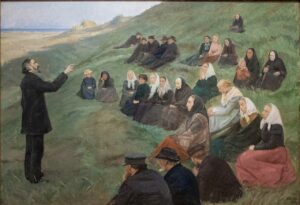
Anna Kirstine Brøndum was born on August 18, 1859, in Skagen, the northernmost town of Denmark. Skagen, a small fishing community at the tip of Jutland, was an environment of rugged coastlines, bright northern light, and close-knit communal life—conditions that would profoundly shape her artistic outlook. Anna was the daughter of Erik Andersen Brøndum, who ran Brøndum’s Hotel (later known as Brøndums Hotel), an informal salon that hosted visiting artists. The Brøndum household offered Anna daily exposure to painters, sketches, and conversations about art, and she grew up surrounded by the members of the emerging Skagen artists’ colony.
Can You Name the Masterpiece?
Ten masterpieces. Ten questions. How well do you know the history of art?
Her upbringing was shaped both by the humble rhythms of provincial Danish life and by the intellectual and artistic energy that visited the hotel. From an early age Anna displayed a keen observational sensibility and an aptitude for drawing. Her place at the center of Skagen’s artistic circle allowed her to learn directly from professional artists and to watch artistic experiments unfold in her own home.

Education and Training
Anna Ancher’s education was largely informal and shaped by the community rather than conventional academic institutions. She learned by association: observing, copying, and receiving guidance from the older, visiting painters who frequented Brøndum’s Hotel. Key influences included Vilhelm Kyhn, Peder Severin (P.S.) Krøyer, and Christian Krohg, among others. These artists provided constructive critique and technical input, while the Skagen environment offered a consistent subject matter—landscapes, interiors, fishermen, and family life.
Unlike many male contemporaries, Anna’s formal access to academies was limited by the gendered educational structures of the time. Women were often excluded from the full curriculum of the Royal Danish Academy of Fine Arts. Nevertheless, Anna found alternative routes to professional growth: private lessons, copying in museums, and practical apprenticeship-like experiences within Skagen’s artistic community. Her marriage to fellow painter Michael Ancher in 1880 further integrated her into an artists’ household where daily practice, critique, and artistic exchange shaped her development.
Career Development
Can You Guess the Artist?
Three clues. One artist. How quickly can you identify the painter?
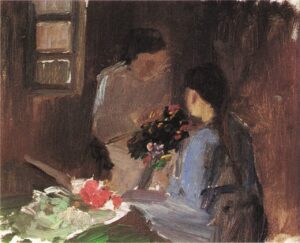
Anna Ancher’s career unfolded gradually and organically. In the 1880s and 1890s she began to exhibit regularly, both in Denmark and abroad, and to receive critical attention. Her early works focused on intimate family and domestic scenes—mothers and children, women at work, and quiet interiors bathed in northern light. Over time her repertoire expanded to include church interiors, bathers, and studies of sunlight as it fell across surfaces and fabrics.
Her work gained institutional recognition as Danish cultural life matured and as the Skagen painters achieved an established reputation. Anna maintained lifelong ties to Skagen, but her reputation reached Copenhagen and national museums. In later decades she participated in exhibitions and received honors that acknowledged her importance to Danish art. Unlike some of her male colleagues who pursued international careers, Anna’s practice remained rooted in Skagen’s social and visual world, and that rootedness contributed to the distinctive consistency and depth of her work.

Artistic Style
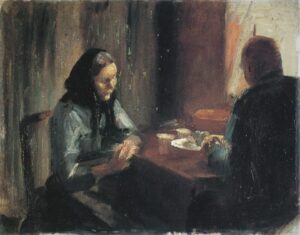
Anna Ancher’s style is best understood through two interrelated qualities: her treatment of light and her compositional restraint. She developed an acute sensitivity to light’s subtle gradations—how sunlight or lamplight transforms color, reveals texture, and enfolds figures in quiet dignity. Her interior paintings are almost studies in luminosity; light becomes the compositional organizer that defines space and the emotional tenor of the scene.
Color in Anna’s work is noteworthy for its clarity and tonal balance. She favored a palette that avoided overt theatricality, instead achieving resonance through careful juxtapositions—soft blues against warm flesh tones, delicate pinks offset by neutral greys. Her brushwork ranges from precise modeling in faces and hands to more diffuse passages that render textiles and backgrounds with economy and suggestion.
Compositional restraint characterizes many of her interiors: she often places a seated figure near the edge of a sunlit window or composes scenes with few objects, allowing the viewer to attend to the interplay of figure and light. The result is an intimacy that is neither sentimental nor detached—but a dignified, observational humanism. Her later work shows increasing simplification of form and sometimes a lean toward abstraction in the way shapes are reported, anticipating modernist tendencies in Nordic painting.
Influences and Inspirations
Anna Ancher’s influences are multiple and include both local and broader European sources:
– The Skagen community: The everyday life of Skagen—its fishermen, inn, cottages, and church—provided the immediate subject matter that pervades her oeuvre. The communal atmosphere at Brøndum’s Hotel created a vibrant cross-fertilization of ideas in which Anna participated actively.
– P.S. Krøyer and other colleagues: Painting alongside figures such as P.S. Krøyer, Christian Krohg, and Michael Ancher exposed her to realist approaches as well as heightened attention to plein-air light and color.
– Dutch and French traditions: Anna’s concern for interiority and chiaroscuro can be traced to Dutch masters and to contemporary French realist painting. The quiet interiors of Vermeer and domestic scenes by 19th-century realists informed her interest in quiet, luminous domesticity.
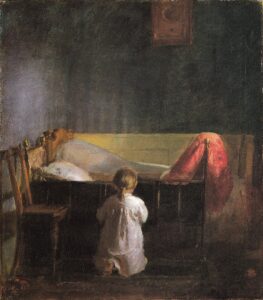
– Scandinavian modernism: While firmly rooted in realism, Anna’s increasing emphasis on color as structural element aligns her with early modernist tendencies in Scandinavia. Her later simplifications of form suggest an acute awareness of contemporary developments in painting across Northern Europe.
Her inspirations were not merely technical; they included social and humanistic concerns. Anna focused on everyday women’s experiences and the poetics of domestic labor, presenting them with respect and psychological presence.
Famous Works
Anna Ancher produced a body of work admired for its consistency of vision and artistry. The following five paintings are widely cited as representative highlights of her career. Museum attributions reflect institutions that hold significant works by her; where specific provenance has varied historically, these attributions indicate major public collections that exhibit her paintings.
1. Sunlight in the Blue Room (Solsken i det blå rum)
– Year: circa 1891
– Medium: Oil on canvas
– Current Museum/Collection: Skagens Museum, Skagen
– Explanation: Sunlight in the Blue Room is one of Anna Ancher’s most celebrated interiors. It captures a domestic interior suffused with cool northern light that animates the blue walls and textiles. The painting exemplifies her ability to render the quiet drama of light as it coheres with form, turning an ordinary moment into a study of color relationships and spatial depth. Figures are integrated into the luminous atmosphere, their presence understated yet deeply human.
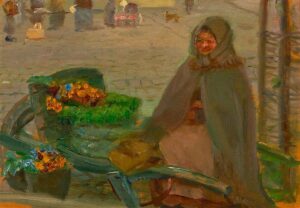
2. Interior with Sewing Woman (Interiør med syende kvinde)
– Year: circa 1890
– Medium: Oil on canvas
– Current Museum/Collection: Statens Museum for Kunst (National Gallery of Denmark), Copenhagen
– Explanation: This painting demonstrates Anna’s recurrent theme of women engaged in domestic labor. Her depiction is neither romanticized nor condescending; instead, the scene is dignified and purely observational. The light falling across the woman and her work highlights textures—the linen, the fabric folds, the hands—creating a composition in which light serves to ennoble routine activity.
3. The Girl in the Kitchen (Pigen i køkkenet)
– Year: circa 1888
– Medium: Oil on canvas
– Current Museum/Collection: Hirschsprung Collection, Copenhagen
– Explanation: The Girl in the Kitchen is an intimate genre scene that foregrounds the everyday life of provincial Denmark. The kitchen interior becomes a stage for the artist’s study of tonal values and tonal contrasts, with warm domestic light modulating the figure and the surrounding objects. The painting is notable for its psychological restraint; the sitter is present without affectation, and the scene feels genuine rather than staged.
4. Anna Ancher at the Window (Anna Ancher ved vinduet) — Self-Portrait Type Interior
– Year: circa 1893
– Medium: Oil on canvas
– Current Museum/Collection: Skagens Museum, Skagen
– Explanation: This interior featuring Anna or a close family member at a window is emblematic of her interest in reflections, secondary light sources, and the contemplative moments of everyday life. The work showcases her nuanced handling of reflected light and the subtle variations of skin tones under diffuse daylight. It also reflects the artist’s propensity for self-referential subjects where private space becomes a site of artistic inquiry.
5. Sunlight and the Church (Kirkelys / Kirkens interiør) — Church Interior
– Year: circa 1909 (circa)
– Medium: Oil on canvas
– Current Museum/Collection: Statens Museum for Kunst / Skagens Museum (works on similar theme are held in both collections)
– Explanation: Anna’s church interiors reveal a different use of light—reverent, cool, and structurally ordered. These works translate the solemnity of ecclesiastical space into formal investigations of architecture, shadow, and soft colored light filtering through windows. The ambiguity of human presence—often only hinted at—heightens the sense of communal ritual while preserving a quiet intimacy.
Note: Anna Ancher’s oeuvre includes many works with close thematic and stylistic continuities; several of her paintings bear similar titles in different languages. Major public collections such as the Skagens Museum, Statens Museum for Kunst, and the Hirschsprung Collection are primary repositories for her most important pieces, and works may travel in exhibitions or be differently catalogued in various museum inventories.
Legacy and Influence
Anna Ancher’s legacy rests on several pillars. First, as a woman artist working in a male-dominated era, she achieved critical and institutional recognition on the basis of artistic merit, becoming a role model for Scandinavian women artists who followed. Second, her focused exploration of light and color influenced the development of modern Danish painting; her restrained modernism contributed to a Scandinavian aesthetic that prized clarity of light and functional compositional harmony.

Her influence extends beyond technique to subject matter: by elevating domestic life and the work of women to the level of high art, Anna participated in a broader cultural reassessment of everyday life as legitimate artistic subject. In museum contexts, her paintings are frequently exhibited to illustrate both the Skagen colony’s achievements and the particular contributions made by women to the modernization of Scandinavian art.
Anna’s work also continues to influence contemporary artists and curators who find in her paintings a model for combining formal rigor with humanist content. Retrospectives and exhibitions in Denmark and abroad have helped to secure her place in Nordic canons and to demonstrate the continuing relevance of her visual language.
Market Value and Collectibility
Anna Ancher’s paintings occupy a respected position in the art market for Scandinavian and Nordic art. Key points regarding market value and collectibility:
– Institutional Recognition: Works by Anna Ancher held by major museums confer prestige and can positively influence market perception of privately held works.
– Scarcity and Condition: As with many 19th- and early 20th-century artists, the market values condition, provenance, and rarity. High-quality interior scenes and well-preserved paintings with direct provenance to Skagen collections command stronger prices.
– Auction Performance: Anna Ancher’s works have appeared in auctions in Denmark and internationally. Prices vary by scale, subject, and provenance; important interior paintings or large canvases with exemplary provenance perform best.
– Collectibility: Collectors interested in Scandinavian art, women artists, or the Skagen colony find Anna’s work particularly attractive because it combines technical refinement with social and historical resonance.
For collectors and dealers, careful authentication, condition reports, and provenance research are essential. Given the prominence of reproductions and similar-titled works, expert attribution and museum consultation can be crucial for high-value acquisitions.
Museums and Collections
Major public collections that hold and display works by Anna Ancher include:
– Skagens Museum (Skagen): The primary repository for the Skagen painters and home to many of Anna Ancher’s most important works. The museum provides extensive context for her career and the broader Skagen community.
– Statens Museum for Kunst (National Gallery of Denmark), Copenhagen: Contains notable works by Anna and places her within the national narrative of Danish art.
– Hirschsprung Collection, Copenhagen: Holds works that relate to the Danish realist tradition and early modern developments in which Anna participated.
– Regional museums and private collections across Scandinavia and Europe: Numerous institutions and private collectors maintain works by Anna Ancher, and her paintings occasionally appear in traveling exhibitions that explore Nordic modernism.
When researching Anna Ancher’s works, it is useful to consult museum catalogues and scholarly monographs, as museum holdings represent the most reliable source of attributions and provenance.
Interesting Facts
– Lifelong Skagen Connection: Anna lived almost her entire life in Skagen. Her native environment—intense northern light and a small artistic community—became the consistent setting for her artistic exploration.
– Marriage to a Fellow Artist: She married Michael Ancher in 1880. Their home became a central hub for painting activity and artistic dialogue.
– Female Perspective: Anna’s focus on domestic interiors, women at work, and the dignity of everyday life offers an early, sustained example of a woman artist giving voice to women’s experiences without romanticizing or aestheticizing them in a sentimental mode.
– Limited Formal Training: Despite limited access to formal academic training because of her gender, Anna cultivated a highly personal and technically nuanced practice through apprenticeship, observation, and collaboration.
– A Modern Sensibility: Critics and historians often note that Anna’s mature work anticipates aspects of modernism in its flattening of space, reliance on color relationships, and compositional economy.
FAQ
Who was Anna Ancher and why is she significant?
Anna Ancher (1859–1935) was a Danish painter associated with the Skagen Painters. She is significant for her intimate, luminous interior scenes, her exploration of light and color, and for being one of Scandinavia’s most accomplished women artists of her era.
What subjects did Anna Ancher paint most frequently?
Anna Ancher frequently painted domestic interiors, women at work, portraits, church interiors, and scenes that capture the unique northern light of Skagen. Her subject matter emphasized everyday life and the dignity of ordinary moments.
Where can I see Anna Ancher’s paintings in person?
Major holdings of her work are at the Skagens Museum in Skagen and the Statens Museum for Kunst in Copenhagen. The Hirschsprung Collection and regional museums in Denmark also display works by her, and pieces appear in traveling exhibitions.
How can I authenticate a painting attributed to Anna Ancher?
Authentication should involve provenance research, consultation with specialists in Scandinavian art, comparison with documented works in museum collections, condition and materials analysis, and, where possible, expert opinion from curators or recognized art historians specializing in Anna Ancher and the Skagen painters.
Are Anna Ancher’s works valuable for collectors?
Yes. Anna Ancher’s paintings are sought after by collectors of Scandinavian art and women’s art history. Value depends on rarity, quality, size, condition, and provenance. Major museum-provenance works and well-preserved interior scenes generally command higher prices.
—
Anna Ancher’s paintings continue to resonate for their perceptive humanism, formal clarity, and extraordinary handling of light. Rooted in a small Danish community yet reaching a timeless universality, her work remains an essential chapter in the history of Scandinavian art and a touchstone for collectors, scholars, and lovers of painting.
AI Notice: Some visual content in this article may have been created or enhanced using artificial intelligence (AI) for artistic, editorial or illustrative purposes. Learn more about our approach in our AI & Editorial Principles.