

This Antique Bookshelf Detail Can Instantly Make Any Room Look Priceless
An antique bookshelf is more than a piece of storage furniture—it’s a surviving artifact of how people once lived, read, displayed knowledge, and asserted taste. From paneled oak bookcases in Georgian London townhouses to glass-fronted vitrines in Second Empire Paris, antique bookshelves reveal a history of craftsmanship and culture that modern mass production rarely matches. When you bring one into your home, you’re not just buying shelves; you’re inheriting design decisions shaped by particular eras, materials, and social ideals—often with a provenance that can be researched, verified, and preserved.
1) What Defines an Antique Bookshelf?
In the strictest market sense, “antique” typically refers to items around 100 years old or more, though exact definitions can vary by jurisdiction and trade practice. For furniture, specialists look at construction methods (hand-cut dovetails, early machine marks, mortise-and-tenon joinery), wood movement, patina, and hardware to assess age and authenticity. A true antique bookshelf often shows a consistent story: wear where hands repeatedly touched doors or shelf edges, oxidation on original brass pulls, and old repairs that reflect long use rather than recent distressing.
Can You Name the Masterpiece?
Ten masterpieces. Ten questions. How well do you know the history of art?
Throughout history bookcases have developed in tandem with literacy and book collecting. With the rise of private libraries among the upper-classes in the late Renaissance and Enlightenment, purpose-designed bookcases became used in institutional and domestic interiors by the 18th and 19th centuries. The change from chained books and lecterns, to freely available shelves reflected changing platforms of knowledge transmission in particular in the major European urban centers: London, Paris, Amsterdam and Vienna.
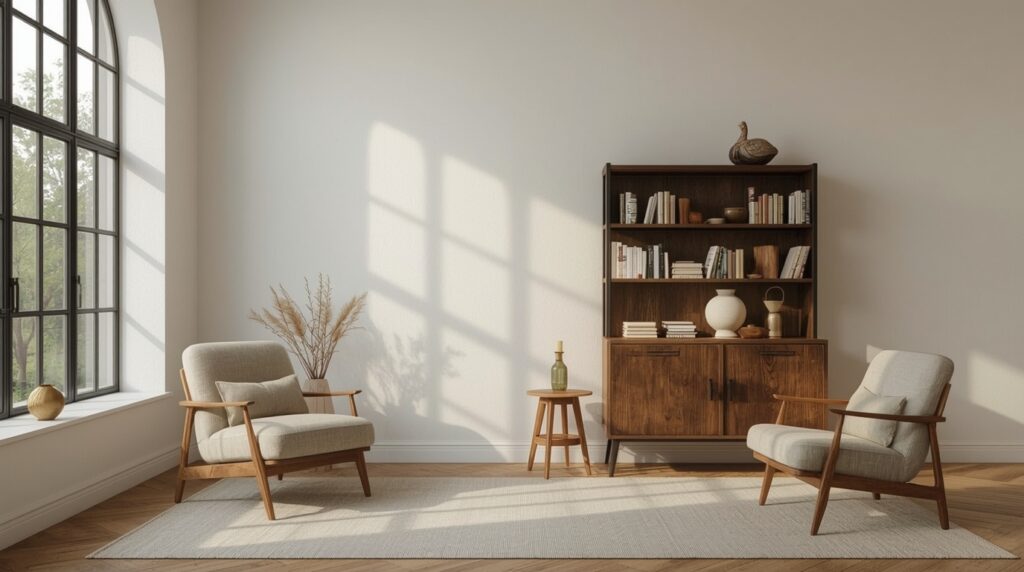
Museums pointed out that furniture is part of context materials, use and fashion of decoration. The Metropolitan Museum of Art (The Met) and the Victoria and Albert Museum (V&A) often objected to subtle but implicit, both European furniture seen as both craft of use, the evidence of social history, where building and decoration indicate region and time. That view is important, if you look at an antique bookshelf: you don‘t just buy an object, you buy a document in it.
2) Major Styles and Historical Periods to Know
The early modern tradition in Northern Europe prized sturdy woods such as oak and walnut, with architectural paneling and restrained carving. In Britain’s Georgian period (roughly 1714–1830), bookcases often expressed classical order—symmetry, cornices, and proportion—reflecting the era’s Palladian ideals. Many Georgian bookcases appear as “breakfront” designs (a central section projecting forward) and can include glazed upper doors to protect bindings from soot and dust.
Can You Guess the Artist?
Three clues. One artist. How quickly can you identify the painter?
In 19th-century France, especially under Napoleon III (Second Empire, 1852–1870), display and domestic comfort converged. Bookcases and vitrines frequently featured ebonized woods, marquetry, ormolu mounts, and glass doors. Parisian cabinetmaking was internationally influential; the Louvre Museum’s collections and scholarship on French decorative arts emphasize how furniture design communicated prestige, technical mastery, and alignment with contemporary taste.
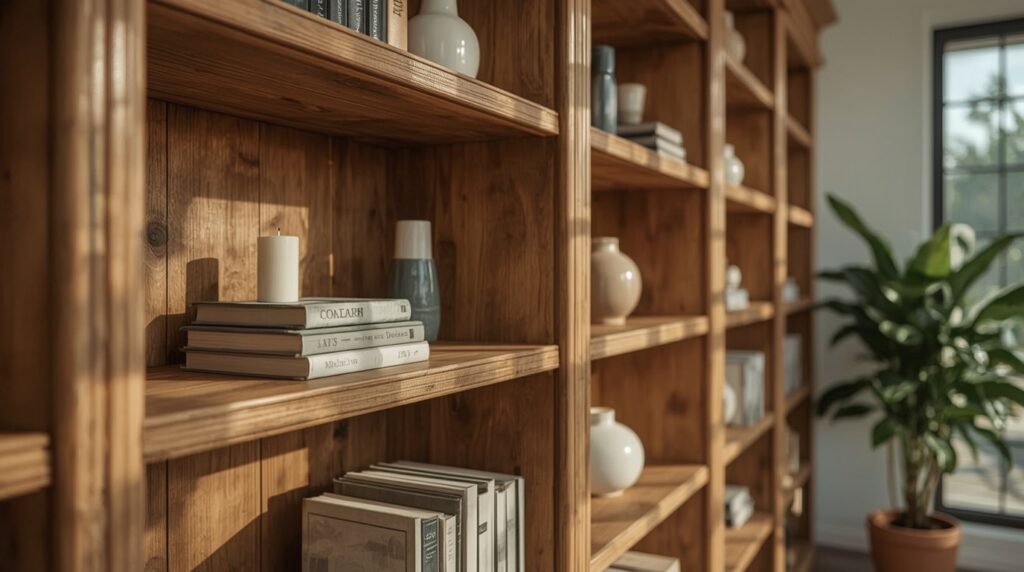
By the late 19th and early 20th centuries, the Arts and Crafts movement (notably in Britain and the United States) reacted against industrialization and revived visible joinery, honest materials, and hand-finishing. Institutions like the V&A and the Smithsonian Institution document this turn toward craftsmanship and reform. An Arts and Crafts antique bookshelf may look simpler than earlier revival styles, but the workmanship—careful joinery, solid timbers, and hand-rubbed surfaces—can be exceptional.
3) Materials, Construction, and How Experts Authenticate
Wood choice is often the first clue. English and Northern European pieces commonly use oak; finer cabinetry might use walnut or mahogany, with secondary woods (like pine) in unseen areas. Veneers—thin slices of decorative wood—were widely used in the 18th and 19th centuries and are not “cheap” by definition; high-quality veneer work can signal sophisticated cabinetmaking. What matters is whether veneer and substrate align with period practice and show consistent aging.
Joinery and tool marks are one of the most obvious indicators: hand-cut dovetails come with tiny inconsistencies in size or the gaps between them; machine-cut or machine-sewn dovetails are more precise looking and the joints may date the piece to a later date (though early machinery was available in the 19th century). Watch out for shrinkage around the panels or insert panels, old blocks of glue, and pegged joints appropriate for the period. Original hardware will be highly prized: tea-cup shaped hinges and pulls are often original, but modern screw heads and early looking aged fittings should be viewed with some caution.

Coaxing the close inspection is often touted as one of the key skills by authoritative bodies. We see in the seminar materials on object study how “identifying the materials and techniques used to make an object is fundamental to the interpretation of its history.” Likewise, good dealers in the trade will use provenance and “similar objects in museum collections” and involve conservation scientists when appropriate. Where appropriate, don‘t expect to hear about provenance alone if dealing with an important claim of age (“18th century Chippendale”).
4) Collecting, Caring for, and Displaying an Antique Bookshelf
Buying well starts with clarity: do you want a statement piece, a practical everyday bookcase, or a collector-grade object? Measure your space, note floor levelness, and consider weight—antique case furniture can be heavy and may need wall anchoring in earthquake-prone regions. Glass-fronted bookcases protect from dust and UV exposure; open shelving is easier for access but requires more environmental control to protect both wood and books.
Assess condition carefully. Wear or diversion from original is inevitable, such as on a century-old os shelf. Find out what to have been undertaken. For instance, refinishing, veneering, substitution of new shelving or new back boards. Preservation of original surface and finish is a general objective in fine conservation and being reversible is its most important feature. The Conservation Department of Met has often publicized the importance of conserving original surface and finish because they can reveal important information of age or history of the object.
Before overseeing a bookshelves, consider their environment for example, keep them away from radiators, bright sunlight and damp exterior walls. For the care of them, maintaining a consistent moisture content is important, as fluctuation can cause veneering to lift and joints to move. They should be dusted with a soft cloth, and not treated with powerful silicone polishes, as these can cause surface pollution and be difficult to remove during future conservations. For a bowing shelve, consider load problems for example the use of book ends, avoid too much weight on one span and think about the possibility of an inconspicuous support that will not involve altering the shelf.
Key Characteristics at a Glance
| Feature | Common in Authentic Antiques | What to Watch For |
|---|---|---|
| Age indicators | Patina, consistent wear, oxidation on hardware | Artificial distressing, uniform “aging” |
| Joinery | Hand-cut dovetails, mortise-and-tenon, pegged joints | Modern screws in primary joints, overly uniform dovetails |
| Materials | Oak, walnut, mahogany; period-appropriate secondary woods | MDF/particleboard, mismatched woods without explanation |
| Doors | Solid panel or glazed upper doors in many periods | Modern float glass without signs of age (not always disqualifying) |
| Finish | Shellac, wax, oil; layered surface history | Thick modern polyurethane over everything |
| Provenance | Dealer records, invoices, estate history | Vague stories, no documentation for big claims |
“A museum’s role is to preserve, study, and interpret objects so they can tell their stories.” — Smithsonian Institution (collections and object-based learning materials)
This perspective is directly applicable to antique furniture: the goal is not only ownership but stewardship—keeping the object legible for the next generation.
“Conservation aims to preserve cultural heritage for the future.” — The Metropolitan Museum of Art, Conservation and Scientific Research (public guidance and essays)
For an antique bookshelf, that means prioritizing structural stability and respect for original materials over cosmetic “like-new” finishes.
Frequently Asked Questions
1) What is the difference between “antique” and “vintage” for a bookshelf?
In many markets, “antique” commonly implies roughly 100+ years old, while “vintage” is newer but still older/collectible (often mid-20th century). Always ask for the basis of dating—construction, labels, provenance, or expert appraisal.
2) Are glass-door antique bookcases historically accurate or a later trend?
They are historically accurate. Glazed doors appear in multiple periods, particularly in 18th–19th century Europe, serving to protect books from dust, soot, and handling while still displaying bindings.
3) Is refinishing an antique bookshelf a bad idea?
It depends. Heavy stripping and modern topcoats can reduce historical integrity and value. Conservation-minded cleaning and minimal intervention are often preferred. If refinishing is necessary for usability, document the work and use period-appropriate finishes where possible.
4) How can I tell if an antique bookshelf is a reproduction?
Look for inconsistencies: modern sheet goods, uniform machine joinery, new hardware paired with “aged” wood, or finishes that look plastic. When in doubt, compare with examples and catalog notes from institutions like the V&A, The Met, or the Louvre, and seek an independent appraisal.
5) What styles are most collectible?
Demand varies, but Georgian and Victorian English bookcases, French 19th-century vitrines, and Arts and Crafts case furniture often attract steady interest. Value depends more on authenticity, condition, size, and documentation than on style alone.
Credible Sources for Further Study
- The Metropolitan Museum of Art (The Met) — Furniture and conservation resources: https://www.metmuseum.org/
- Victoria and Albert Museum (V&A) — Decorative arts and furniture collections: https://www.vam.ac.uk/
- Louvre Museum — French decorative arts context and scholarship: https://www.louvre.fr/
- Smithsonian Institution — Object-based learning and collections stewardship: https://www.si.edu/
An antique bookshelf sits at the intersection of design history, craftsmanship, and daily life—an object built to hold knowledge and, over time, to embody it. By understanding period styles, authentic construction, and conservation-minded care, you can choose a piece that is both functional and historically meaningful—one that will serve your library while preserving a tangible link to the past.
AI Notice: Some visual content in this article may have been created or enhanced using artificial intelligence (AI) for artistic, editorial or illustrative purposes. Learn more about our approach in our AI & Editorial Principles.