
Francesca Caccini (1587–after 1641) stands out as one of the most accomplished musicians of early Baroque Italy—and one of the first women in Western history to compose an opera. Working at the glittering Medici court in Florence, she wrote music that is both theatrically vivid and emotionally exact, balancing virtuosity with rhetorical clarity. Her career also reveals how artistic brilliance could flourish inside the political machinery of court spectacle, diplomacy, and patronage. To understand Francesca Caccini is to glimpse a turning point: when Italian music shifted toward dramatic expression—and when a woman helped lead that change.
Early life and background
Born in Florence, Francesca Caccini grew up inside a professional musical dynasty. Her father, Giulio Caccini, was a celebrated singer-composer associated with the Florentine Camerata, the circle of thinkers and musicians whose experiments helped shape early opera. From childhood, Francesca absorbed the new Baroque ideal that music should “move the affections,” making text intelligible and emotion palpable.
Can You Name the Masterpiece?
Ten masterpieces. Ten questions. How well do you know the history of art?
Her training included not just for singing but also as a perfect court musician a composer, a teacher, and a performer all things that would matter in a world where politics and entertainment were equally sophisticated. The Medici Court would expect no less: intimate chamber songs for private rooms, spectacular intermedi for celebrations, and dramatic works that would flatter powerful patrons. Therefore, Caccini’s early training combined seriousness and innovation with the street smarts to run the place.
And her formative years put her in the crossfire of an aesthetic battle of the time. Late Renaissance polyphony attacked complex counterpoint and the contemporary style of accompaniment with a solo voice. Francesca Caccini developed an ability to compose in service to the language, converting inflection into musical gesture- a quality that characterizes her compositions and makes them psychologically “modern.”
Career and major milestones
Francesca Caccini also became a paid musician for the Medici household. “Not a single woman working there had previously been paid,” she was said to be performing the honor of the family for ambassadors and visiting gentry, teaching aristocratic music students, and arranging music for civic celebrations. These were enormous opportunities for her (and to enhance her profile in Italy), but they also required artful negotiation:
Can You Guess the Artist?
Three clues. One artist. How quickly can you identify the painter?
For her, one of the most important events was when La Grega published her Il primo libro delle musiche (1618). It was an anthology that displayed her command of the new vocal style: to print music was to stake your claim of power, and this was highly dangerous particularly for a woman:
Her most famous stage work, La liberazione di Ruggiero dall’isola d’Alcina (1625), was composed for Medici entertainment and performed in Florence, later reaching Poland—evidence of the court’s international cultural networks. That this opera traveled matters: it signals that Caccini’s music was not a local curiosity, but part of a broader European conversation about theatrical music, spectacle, and power.
Notable works
Caccini’s Il primo libro delle musiche includes solo songs and duets that embody early Baroque expressivity: clear declamation, agile ornamentation, and harmonies that sharpen the meaning of words. These pieces aren’t “pretty miniatures.” They are carefully engineered dramas in small form, where a sudden dissonance can suggest pain, or a flowing melodic line can soften a plea.
The historical importance of her opera, ‘La liberazione di Ruggiero’ as the earliest extant opera by a woman. Drawn from an episode of Ariosto‘s Arabian furioso, it combines a courtly fantasy with clear moral contrasts in its theme in love‘s spell and the working world, seduction and deservedom and in its musical textures, which change sense by sense to delineate character and circumstance, as the lighting changes in to have with the voice: daylight for power, honey-golden for seduction, ‘unlit’ for morality.
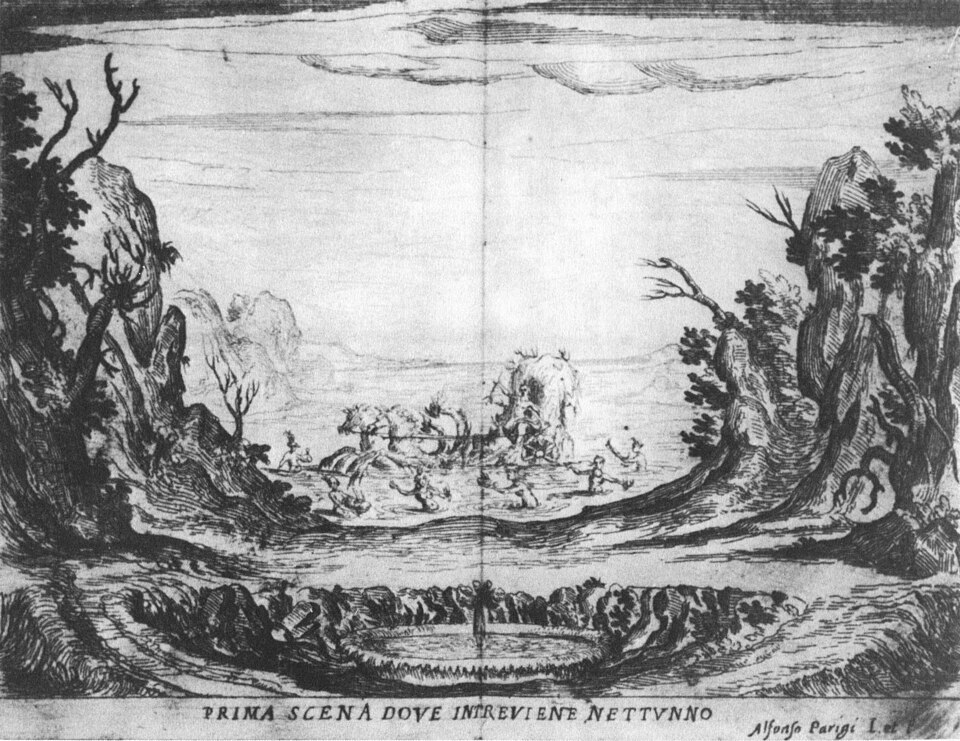
In addition to the above quoted works, Francesca Caccini also composed for court spectacles, theatrical entertainments (some of which are lost) and probably took part in the collaborative production schemes so popular at the time. The missing remains are a defining part of Caccini‘s story: women had less widely preserved output but what has survived is sufficiently distinctive direct, dramatic, text-based to suggest a voice of her own.
Meaning behind his work
Caccini’s music repeatedly explores how language becomes action. In early Baroque aesthetics, the goal was persuasion: to make listeners feel what the text says. Her vocal lines often mirror speech rhythms, so musical beauty is never separate from meaning—it is meaning. When she stretches a phrase or delays a cadence, it can sound like hesitation, desire, or moral resistance, turning syntax into psychology.
The “meaning” in La liberazione di Ruggiero is not merely story, but symbolic. This opera presents a conflict of power: Alcina‘s charms and illusions are challenged by virtue and order. For a Medici audience, this would be a resonant message more than myth a metaphor for ruling, where justice Breaks the spell of seduction (Carnes 81). The musical contrasts support this message: more opulent color and pulsing rhythmic temptresses can distinguish what is seduction; more stable rhetorical music expresses the ethical dilemma.
And agency too, is implied. Opera typically constructs heroes as reactive, to fate or passion; Francesca Caccini brings to light via musical themes the points where decision makes itself heard; She invests moral realizations with musical focus, indicates freedom as helping to function not simply as narrative narrative trick or complication but as a shift towards agency a new more settled and goal-directed phase of cadence, of motion.
Why is he famous
Why is Francesca Caccini famous? Because she occupies and remains at the crossroads of progress and perfection and historic unusualness not as a figure for whom this proved true but as a composer who created an extant work of art. Her opera is a significant landmark; her name now is more and more on craft: she knew how to control development of the drama, how to sculpt vocal lines for expressiveness and how harnony should match text in a similar way to those that characterize much theatrical Baroque writing of a century later.
Secondly, she is positioned at an institutional level. She can serve as proof that women could established legal-musical authority, within a certain hierarchy. That‘s significant for music history: it challenges the story that early opera was entirely male-led experiment, and reflects the way court culture could pander to artists in the right circumstances.
Finally, she is famous because her music illuminates what early Baroque was trying to achieve. Listening to Francesca Caccini makes the era’s ideas tangible—how emotion, rhetoric, and spectacle fused into a new kind of musical storytelling. Modern performances and recordings have accelerated her rediscovery, not as an exception to be admired politely, but as a composer worth programming on purely musical grounds.
Interesting facts
- She was the daughter of Giulio Caccini, one of the most influential figures in the birth of the Baroque solo song style.
- La liberazione di Ruggiero (1625) is the earliest known opera composed by a woman.
- Her 1618 song collection shows her as a composer with a “theatrical ear,” writing mini-dramas for the voice rather than abstract vocal lines.
- She worked within the Medici court’s machinery of diplomacy and spectacle—where art often carried political subtext.
- Some of her stage music is lost, reflecting broader patterns in how women’s creative work was less consistently preserved.
Francesca Caccini still matters because her music captures the moment European composition pivoted toward dramatic truth—when melody, harmony, and rhythm became tools for psychological storytelling. She was not simply “a woman who composed,” but a major court professional whose surviving works reveal a sharp sense of character, rhetoric, and theatrical timing. As performers continue to revive early opera and Baroque song, Caccini’s voice grows clearer: elegant, persuasive, and historically transformative—an enduring reminder that musical innovation has never belonged to only one gender or one narrative.
AI Notice: Some visual content in this article may have been created or enhanced using artificial intelligence (AI) for artistic, editorial or illustrative purposes. Learn more about our approach in our AI & Editorial Principles.