Harald Sohlberg
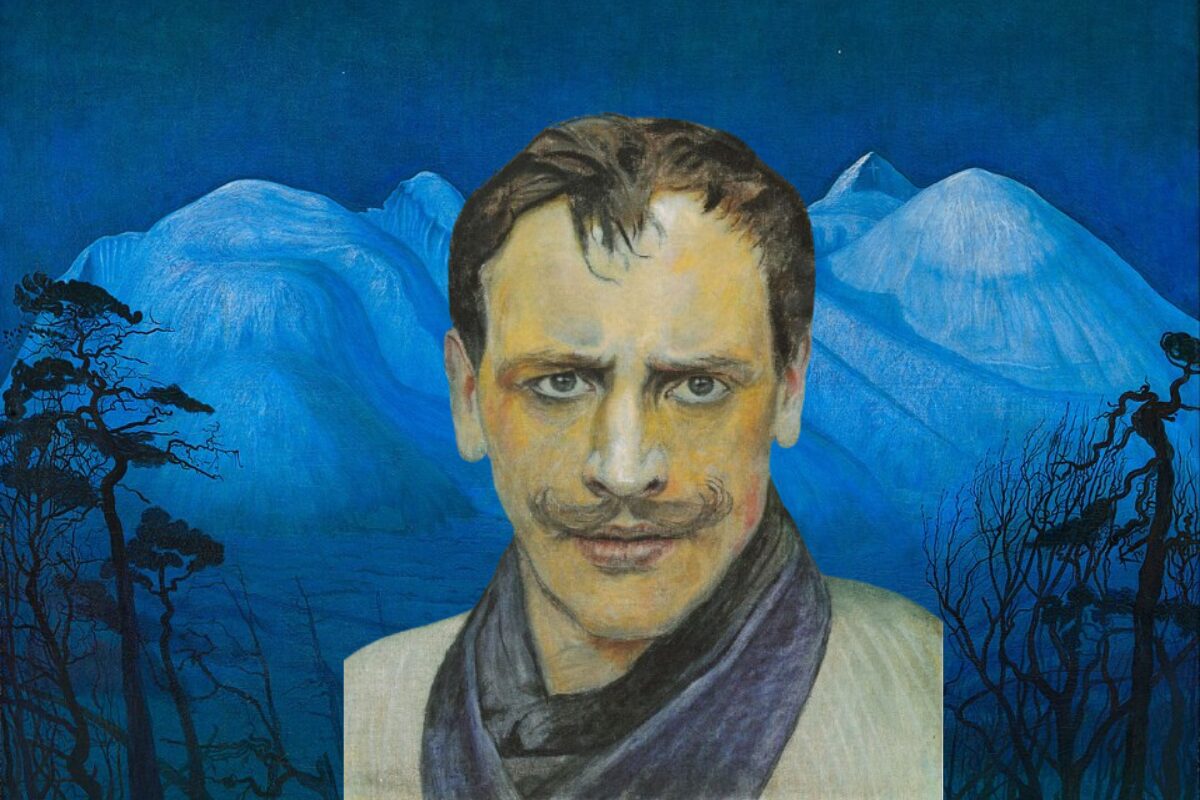
Harald Sohlberg (1869–1935) is widely regarded as one of Norway’s most poetic and distinctive landscape painters of the late 19th and early 20th centuries. Working primarily in oil, watercolor and graphic media, Sohlberg produced a relatively small but highly coherent body of work that combines crystalline color, simplified form and a lyrical, almost mystical relationship to place. His nocturnes and winter landscapes—suffused with a profound sense of stillness and isolation—are emblematic of a modern Nordic aesthetic that bridges Romantic nationalism and Symbolist introspection. This article offers a comprehensive overview of Sohlberg’s life, training, artistic development, major works, market presence and lasting influence for collectors, curators and enthusiastic readers of art and antiques.

Early Life
Can You Name the Masterpiece?
Ten masterpieces. Ten questions. How well do you know the history of art?
Harald Sohlberg was born in 1869 in Norway and grew up during a period when the nation’s cultural identity was being reshaped by artists, writers and musicians. Although details of his childhood environment varied between urban and provincial influences, it is clear that Sohlberg’s formative years were marked by close exposure to the Norwegian landscape—its mountains, fjords and small towns—which became central themes in his mature work. From an early age he showed an affinity for drawing and a sensitivity to mood and atmosphere, traits that later distinguished his depictions of night, snow and isolated architecture.
Sohlberg’s upbringing took place against the backdrop of late-19th-century Norway, a time when national romantic ideas encouraged artists to seek inspiration in local scenery and folk culture. This environment encouraged him to look inward as well as outward, turning natural motifs into vehicles for emotional and symbolic expression.
Education and Training
Can You Guess the Artist?
Three clues. One artist. How quickly can you identify the painter?
Sohlberg’s formal artistic education began at the drawing schools and ateliers available in Norway’s cultural centers. He studied at institutions in Kristiania (modern Oslo), where the curriculum combined academic drawing with instruction in contemporary techniques. In addition to institutional training, Sohlberg worked with established artists and engaged in self-directed study that included travel and close observation of foreign art.
During his development he was exposed to several international currents—Romantic landscape traditions, Symbolism, and the restrained linearity of decorative art. He absorbed technical disciplines such as draftsmanship, color mixing and printmaking while cultivating a personal approach to composition and light. Over time his training evolved from academic competence to a highly individual synthesis of representational clarity and stylized abstraction.
Career Development
Harald Sohlberg’s career unfolded gradually. He participated in regional and national exhibitions in Norway, gaining recognition among critics and collectors for the quiet power of his landscapes. Early work often focused on studies and small compositions; as his visual language matured, so did the scale and ambition of his paintings.
Sohlberg’s most productive period came in the opening decades of the 20th century, when he produced the nocturnes and winter scenes that would become his signature. He exhibited regularly and built a reputation for works that resisted easy categorization: neither straightforward realism nor pure symbolism, they occupied a sensitive middle ground defined by mood, pattern and formal economy.
While Sohlberg did not seek international celebrity in the manner of some contemporaries, his works were collected by Norwegian public institutions and by private patrons who valued the unique emotional resonance of his landscapes. Later retrospectives and scholarly interest have cemented his reputation as a key figure in modern Norwegian art.
Artistic Style
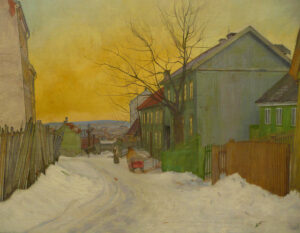
Harald Sohlberg’s style is characterized by a remarkable economy of means joined to a heightened sensitivity to atmosphere. Key features include:
– Palette and Light: Sohlberg favored cool, luminous color ranges—deep blues, silvery greys and muted greens—particularly in his nocturnes and winter scenes. He manipulated subtle color shifts to create depth and a sense of cold clarity.
– Simplified Form: Mountains, trees and buildings are often reduced to strong, emblematic shapes. This simplification increases the pictorial tension between surface pattern and spatial recession.
– Repetition and Rhythm: Sohlberg would repeat certain motifs—rows of trees, steep ridgelines, windows and church steeples—creating musical rhythms across the picture plane.
– Symbolic Ambiguity: While rooted in actual places, Sohlberg’s works carry symbolic overtones. Night scenes and snow-covered landscapes function as metaphors for endurance, solitude, memory and the inner life.
– Mixed Techniques: Alongside oil painting, Sohlberg produced watercolors, pastels and prints. His graphic work displays the same attention to line, pattern and tonal subtlety found in his painted canvases.
– Surface Treatment: He often emphasized flat, decorative areas juxtaposed with carefully modeled features, balancing surface design with suggestion of three-dimensionality.
Sohlberg’s paintings are not dramatic in the conventional sense; their power lies in restraint, formal clarity and an ability to evoke deep feeling through sparse means.
Influences and Inspirations
Sohlberg absorbed and transformed several artistic currents while remaining distinctively Norwegian in his inspiration:
– Romantic Landscape Tradition: The legacy of 19th-century Romanticism—especially the way landscape could evoke spiritual and psychological states—provided a foundational sensibility.
– European Symbolism: Symbolist artists’ focus on mood, metaphor and inner experience influenced Sohlberg’s approach to nocturnes and dreamlike landscapes.
– Folk Art and Ornament: Norwegian folk traditions contributed to his decorative sense and love of patterning; the simplified shapes in his paintings echo stylized motifs found in regional crafts.
– The Nordic Environment: The quality of northern light, long winters and remote mountain interiors are intrinsic to his subject matter and atmospheric solutions.
– Contemporary Norwegian Painting: Sohlberg was part of a generation engaging with national identity through landscape while also responding to international developments in color and form.
He synthesized these influences into an idiom that is at once modern and deeply rooted in place.
Famous Works
Harald Sohlberg’s oeuvre includes a number of paintings that are widely reproduced and studied. Below are five notable works that exemplify his mature style, each with the artwork name, year (or circa), medium and current museum or collection, followed by an explanatory note.
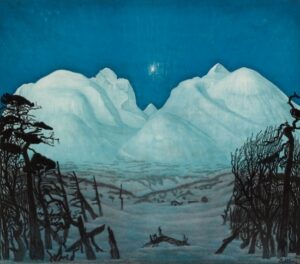
– Artwork name: Vinternatt i Rondane (Winter Night in the Rondane)
– Year: circa 1914
– Medium: Oil on canvas
– Current Museum or Collection: National Museum, Oslo (Nasjonalmuseet)
– Explanation: Widely regarded as Sohlberg’s masterpiece, this nocturne depicts the Rondane mountain range under a cold, star-stippled sky. The composition is notable for its crystalline blues, the geometric simplification of peaks and the feeling of stillness. The painting combines topographical fidelity with a symbolic rendering of the mountains as a place of introspection and sublime solitude. It has become an icon of Norwegian modern landscape painting.
– Artwork name: Vinternatt (Winter Night)
– Year: circa 1904–1910 (series)
– Medium: Oil on canvas and watercolor variants
– Current Museum or Collection: National Museum, Oslo; several variants and studies in regional Norwegian collections
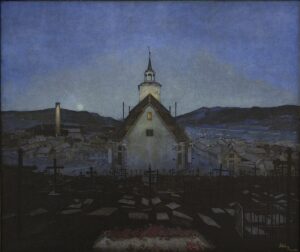
– Explanation: Sohlberg produced several related compositions under the general title Vinternatt. These works explore variations of nocturnal light, snow-covered ground and sparse architecture. The series approach allowed him to refine motif, color and mood—yielding compositions that are at once intimate and monumental. The recurring subject underlines his preoccupation with winter as both visual and metaphysical condition.
– Artwork name: Røros (Townscape of Røros)
– Year: circa 1905–1915
– Medium: Oil on canvas; related watercolors and drawings
– Current Museum or Collection: Trøndelag Art Museum / regional Norwegian collections
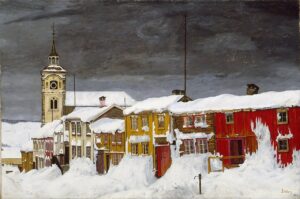
– Explanation: Sohlberg’s depictions of Røros—an old mining town with wooden houses and narrow streets—bring together architectural detail and atmospheric compression. The townscapes are characterized by muted color harmonies and a contemplative mood; buildings are rendered with careful rhythm so that the urban landscape reads as a structured pattern, harboring echoes of folk tradition and local memory.
– Artwork name: Mørkets Sang (Song of the Darkness) [also known under variants of Night or Nocturne]
– Year: circa 1910–1920
– Medium: Oil on canvas
– Current Museum or Collection: Bergen Kunstmuseum (KODE) and other Norwegian public collections
– Explanation: This type of nocturne typifies Sohlberg’s use of shadow and restrained color to suggest melodic quietude. Figures, if present, are small and secondary; the primary subject is the interplay of night, architecture and landscape as emotional instruments. Such works attracted critical attention for their refinement of mood and compositional balance.
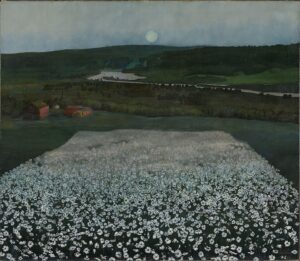
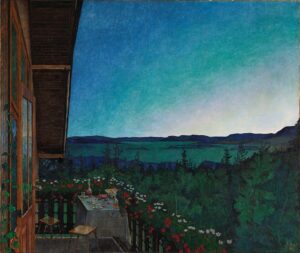
– Artwork name: Sommeraften (Summer Evening)
– Year: circa 1899–1910
– Medium: Watercolor and oil variants
– Current Museum or Collection: Private collections and regional museums in Norway
– Explanation: Less austere than his winter scenes, Sohlberg’s summer evening works show his sensitivity to light’s warm, diffuse qualities. These paintings reveal his versatility in media: watercolors often display a freer hand and a luminosity that complements the more structured oils. The compositions maintain a contemplative silence, underscoring the continuity between seasons in his thematic repertoire.
Note: Sohlberg frequently revisited themes and created multiple treatments of a single subject. Because of this practice, cataloguing his works often requires cross-referencing variants, studies and finished canvases. Many of his most celebrated images exist in several versions—studies, painted variants and prints—each contributing to the artist’s broader investigation of motif and mood.
Legacy and Influence
Harald Sohlberg’s legacy is substantial within Norwegian visual culture and has resonated more broadly among artists and scholars interested in the interaction between landscape and subjectivity. His contributions include:
– Aesthetic Influence: Sohlberg helped define a Nordic aesthetic that emphasizes clarity of form, purity of color and a contemplative approach to nature. Later generations of landscape painters have cited his nocturnes and winter scenes as touchstones for mood-based landscape painting.
– Cultural Iconography: Works such as Vinternatt i Rondane have entered the Norwegian visual canon and are frequently reproduced in books, exhibitions and popular culture. They have become emblematic of Norway’s winter identity—both geographically and mentally.
– Pedagogical Role: Sohlberg’s disciplined approach to motif and variation has been studied in art schools and conservation programs as an example of how formal restraint can yield psychological depth.
– Influence on Printmakers: His graphic work—lithographs and drawings—helped elevate the status of printmaking in Norway as a serious vehicle for expressive landscape.
– Museum Collections and Scholarship: The presence of Sohlberg’s works in national institutions has ensured continued academic attention, cataloguing and critical interpretation, thereby securing his place in art historical narratives.
Sohlberg’s emphasis on inner atmosphere and symbolic reading of place continues to inspire artists working at the intersection of landscape painting and conceptual inquiry.
Market Value and Collectibility
Harald Sohlberg’s works occupy a respected position on the Nordic art market. Collectibility and value are shaped by several factors:
– Rarity and Condition: Because Sohlberg produced a concise body of carefully worked paintings and because significant works reside in public collections, high-quality canvases and studies are relatively rare and command collector interest.
– Importance of the Work: Iconic works—especially major nocturnes and recognized compositions such as Vinternatt i Rondane—are more desirable and, when offered, attract substantial attention from institutions and private buyers.
– Provenance and Documentation: Works with clear provenance, exhibition history and conservation records carry a premium. Given Sohlberg’s practice of producing variants, documentation helps establish authenticity and a work’s place within the artist’s development.
– Market Trends: Interest in Nordic modernism and national romantic painters has grown among international collectors, which has contributed to stronger prices in the primary and secondary markets.
– Prints and Works on Paper: Sohlberg’s prints and watercolors are more accessible to collectors and offer an entry point for those seeking quality works at lower price points than major oils.
For collectors: engage reputable dealers, request provenance and condition reports, and consult auction catalogues and museum collections for comparables. Authentic examples should show Sohlberg’s characteristic handling of color and surface, while conservation assessments will determine any restoration history.
Museums and Collections
Harald Sohlberg’s works are held primarily in Norwegian public collections and regional museums, which play a central role in preserving and exhibiting his oeuvre. Major repositories include:
– National Museum (Nasjonalmuseet), Oslo — holds several major oils and studies, including key nocturnes.
– Bergen Kunstmuseum (KODE), Bergen — contains representative works and graphic material.
– Trøndelag Art Museum (Trondheim) — houses townscapes and regional studies.
– Regional museums and municipal collections — Røros and other local institutions often hold works or related material due to Sohlberg’s thematic ties to particular places.
– Private Collections — A number of significant works circulate in private hands, sometimes entering the market through estate sales or auctions.
International holdings of Sohlberg’s work are limited but include select prints and works in specialist collections and museums with Nordic holdings.
Interesting Facts
– Sohlberg rarely painted figures as focal subjects; when people appear, they are subordinate to the landscape’s mood.
– He frequently revisited the same motif in series, producing multiple variants that allowed him to refine color and atmosphere.
– Night scenes and winter subjects predominate in his most famous work, contributing to his reputation as a “painter of night.”
– Sohlberg was both a painter and a graphic artist; his lithographs and drawings are studied for their economy of line and tonal control.
– His most famous painting(s) became national symbols and are commonly reproduced in publications on Norwegian modern art and national identity.
FAQ
Who was Harald Sohlberg?
Harald Sohlberg (1869–1935) was a Norwegian painter and graphic artist best known for his evocative landscapes and nocturnes. He combined simplified form, crystalline color and symbolic mood to create works that are central to early 20th-century Norwegian art.
What is Harald Sohlberg’s most famous painting?
Vinternatt i Rondane (Winter Night in the Rondane) is widely considered Sohlberg’s most famous painting. Its nocturnal atmosphere, simplified mountain forms and luminous blues have made it an iconic image in Norway’s art history.
What techniques and mediums did Sohlberg use?
Sohlberg worked primarily in oil paint but also produced watercolors, pastels, drawings and prints (including lithographs). His practice showed a consistent interest in the interplay between line, color and tonal atmosphere.
Where can I see Harald Sohlberg’s works?
Major works by Sohlberg are held in Norwegian public collections, especially the National Museum in Oslo (Nasjonalmuseet), Bergen Kunstmuseum (KODE), and regional museums such as Trøndelag Art Museum. Selected works are also found in private collections and occasional exhibitions.
Are Harald Sohlberg’s paintings valuable for collectors?
Yes—Sohlberg’s major paintings are collectible and sought after, particularly his iconic nocturnes and winter scenes. Value depends on rarity, condition, provenance and the work’s importance within his oeuvre. Works on paper and prints may be more accessible to collectors with limited budgets.
AI Notice: Some visual content in this article may have been created or enhanced using artificial intelligence (AI) for artistic, editorial or illustrative purposes. Learn more about our approach in our AI & Editorial Principles.