

Victorian Shawls: Luxurious Wraps That Shaped 19th‑Century Fashion
Few garments capture the drama, romance and social codes of the 19th century as vividly as the Victorian shawl. Draped over crinolines, wrapped around travel-worn shoulders or carefully folded in drawing rooms, these generous pieces of fabric were far more than simple accessories. They were status symbols, works of textile art and practical garments all at once. The shawl’s story in the Victorian era charts a fascinating journey from hand‑woven luxury imports to mass‑produced fashion, reflecting global trade, new technologies and evolving ideas about femininity and respectability.
Origins and Early Popularity of Victorian Shawls
The Victorian passion for shawls did not emerge in a vacuum; it grew out of an earlier European obsession with the Kashmir shawls imported from India at the end of the 18th century. Officers of the East India Company brought finely woven cashmere shawls back from campaigns and postings, where they quickly caught the eye of fashionable women in Britain and France. The Metropolitan Museum of Art notes that these early Indian shawls, woven from the soft under-fleece of the Capra hircus goat, were “among the most luxurious and coveted textiles of their time,” commanding astonishing prices in European markets.
Can You Name the Masterpiece?
Ten masterpieces. Ten questions. How well do you know the history of art?
By the 1830s and 40s in Britain, France and other countries the shawl was an every-day accessory in a fashionable woman‘s wardrobe. Its large size was well-matched to the expanding circumference of the early Victorian skirt and its thick fabric helped in drafty rooms and unheated carriages. As women‘s fashion became increasingly enfolding and their range of action narrowed, the shawl had the distinction of combining elegance and veiledness with comfort and coverage. The V&A sees the shawl as “one of the most important symbols of middle and upperclass respectability” worn for day and evening.
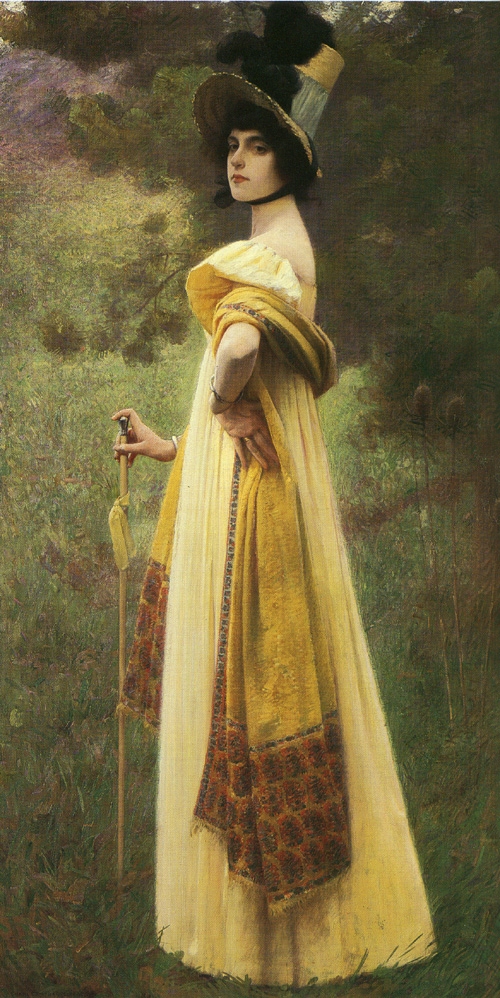
However, it is precisely their rise to popularity in the early decades of the nineteenth century that can be situated within the wider Victorian enthusiasm for the exotic and the imported in general. Shawls expressed imperial reach and global distribution of luxury commodities. To own an authentic Kashmir shawl was to indicate ownership of international commerce and the wealth to be able to afford it. Even when European producers began to imitate Indian shawls, the reputation of their authentic Indian counterparts continued to lend a shawl some attraction well into the reign of Queen Victoria (1837 1901):
Kashmir to Paisley: Global Trade and Local Innovation
The movement of shawls from the Kashmir region to European drawing rooms was part of a larger web of 19th‑century global commerce. Centers such as Srinagar and the surrounding Kashmir Valley had long produced high‑quality shawls, often featuring intricate boteh (pinecone or teardrop) motifs and elaborate borders. European merchants and colonial officials helped create a new kind of demand, one that influenced both design and scale of production. As orders multiplied, patterns grew more elaborate and color palettes adjusted to Western tastes, showing how consumer fashion in London and Paris could reshape artisanal traditions thousands of miles away.
Can You Guess the Artist?
Three clues. One artist. How quickly can you identify the painter?
As the demand outgrew the supply and the import costs of Indian shawls, European industries took the lead. Certainly no place better identified with the Victorian shawl than the Scottish town of Paisley. By the middle of the 19 th century, the town’s textile mills were churning out thousands of patterned wool shawls based on Kashmiri designs. To such an extent was it linked that the boteh himself was known throughout North America and Europe as the “Paisley” pattern, an unforgettable example of the way in which industrial manufacture can have the effect of repackaging and rebranding a non-European decorative tradition.
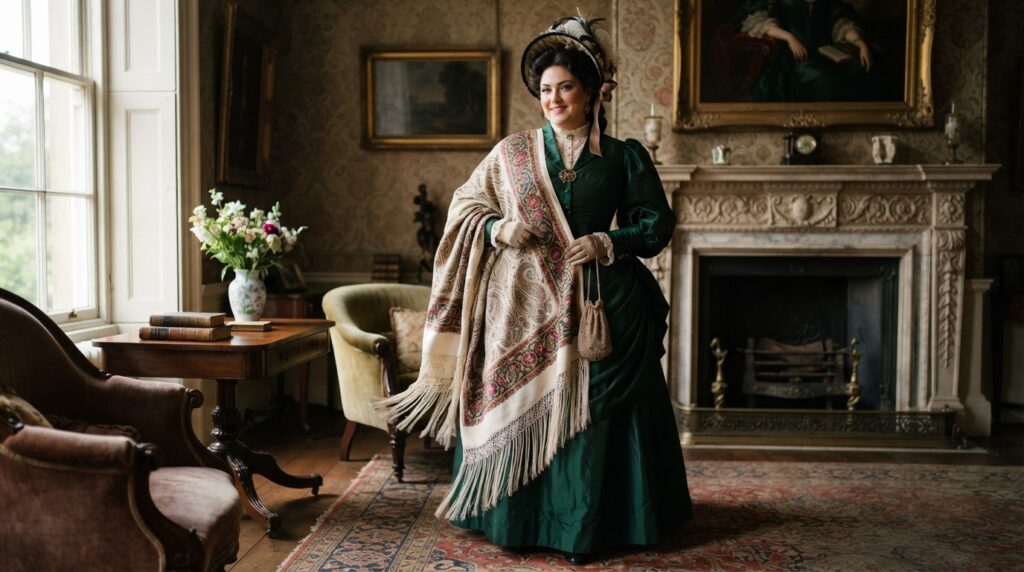
The Smithsonian Institute has noted that the increase in popularity of th Paisley shawl reflect a phenomenon of the nineteenth century, which was the movement from expensive, hand-woven imports to cheaper, mechanized fashion products. Jacquard looms and other technological innovations aided weavers of the Paisley shawl, as well as that of the similarly made products of Lyon and Vienna, to create complicated patterning at a lower cost. Although the connoisseur was still able to distinguish between an Indian original and a European forerunner on the basis of fineness, for the Victorians, the sameness of pattern was no longer merely a material factor.
Materials, Motifs and Making: The Craft Behind the Cloth
Victorian shawls varied widely in quality, price and intended use, but they shared some core material and technical characteristics. At the luxury end were shawls woven from cashmere or fine merino wools, sometimes mixed with silk for added sheen. Everyday versions might be made of coarser wool, cotton or blends suitable for travel and outdoor wear. The V&A’s textile collections show how manufacturers exploited new aniline dyes from the 1850s onward, creating vivid reds, magentas and purples previously difficult to achieve and maintain in wool.
Patterns on Victorian shawls frequently incorporated multiple sources: Indian boteh (Paisley) patterns designed in symmetrical European fashion, neoclassical borders designed against sprays of flowers, or even gothicinspired motifs that catered to the more adventurous of fashionistas. “The shawls themselves became a blank slate, a means by which influences from around the world, new technical breakthroughs and aesthetic trends could be expressed,” as is documented in textile historians’ researches into 19 th century fashion. Double faced, many shawls could be reversed and feature color contrasts that could adapt a shawl to a variety of ensembles, increasing its usefulness in a small wardrobe.
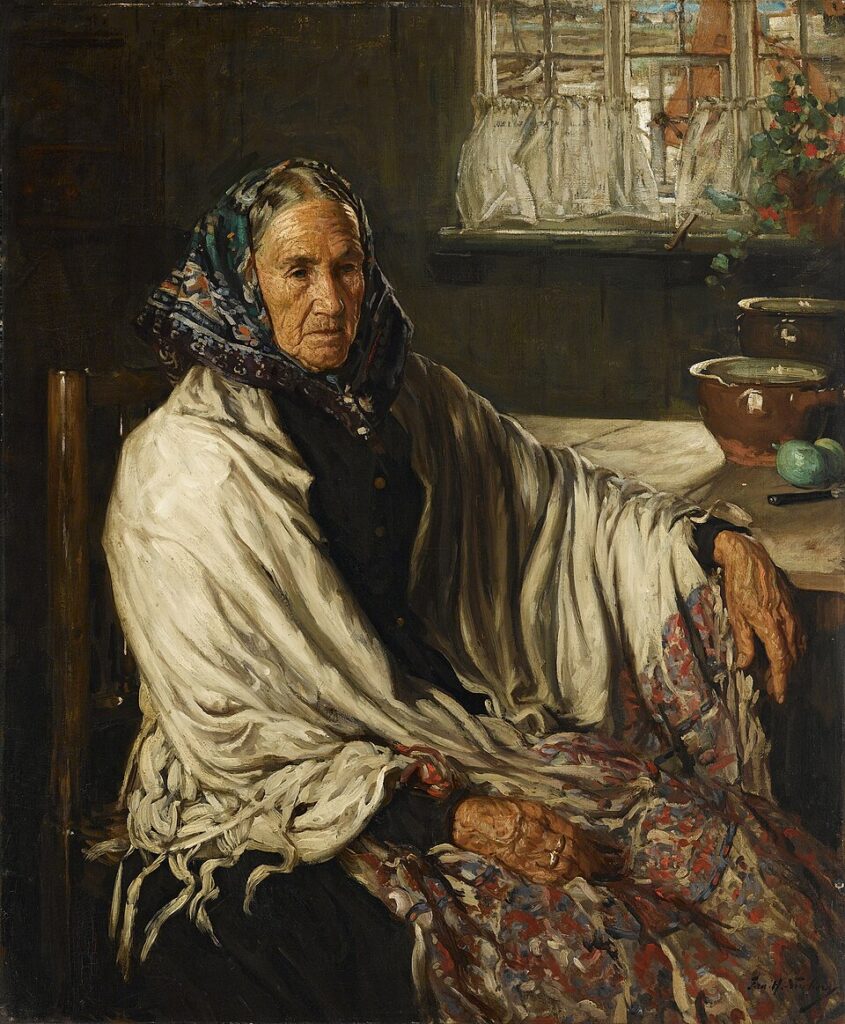
Both artisanal skill and industrial organization went into making these shawls. In Kashmir, weaving was a locally specialized craft complex twill tapestry techniques could only be executed with a crew of weavers working from detailed pattern ‘cartoons’ but paisley and other European centers had evolved to a technology advanced enough to encode woollen patterning onto punch cards of the type used in the prototype Jacquard loom, as the Louvre Museum points out as on the cusp of the age of automation. Hence once a design had been designed, the production could be scaled, and the once rare craft object a commodity, but yet still requiring trained folk to run the looms and trim the fringes.
Wearing the Shawl: Fashion, Etiquette and Social Meaning
How a Victorian woman wore her shawl communicated as much as the shawl itself. Draped symmetrically over a crinoline, it framed the wearer’s silhouette like an ornate picture border. Folded and wrapped tightly, it signaled practicality and modesty, suitable for church or outdoor promenades. In portraits from the 1840s to 1860s, including many in the Metropolitan Museum of Art, shawls frequently appear as central compositional elements: a crimson Paisley shawl thrown over a dark silk dress or a pale cashmere shawl softening a structured bodice, visually balancing the formality of the gown beneath.
Period etiquette books and fashion magazines sometimes mused over the ‘propriety’ of displaying the shawl. An overly expensive Kashmir shawl in a casual or country setting might have appeared vulgar, whereas neglecting to don the shawl or cape in particular social settings might have been construed as lax or immodest. Shawls and capes performed a dual role they shielded the wearer from draughts, and her reputation from censure. As a 19thcentury critic observed, “A lady‘s shawl is her shield, at once against the weather and the world.”
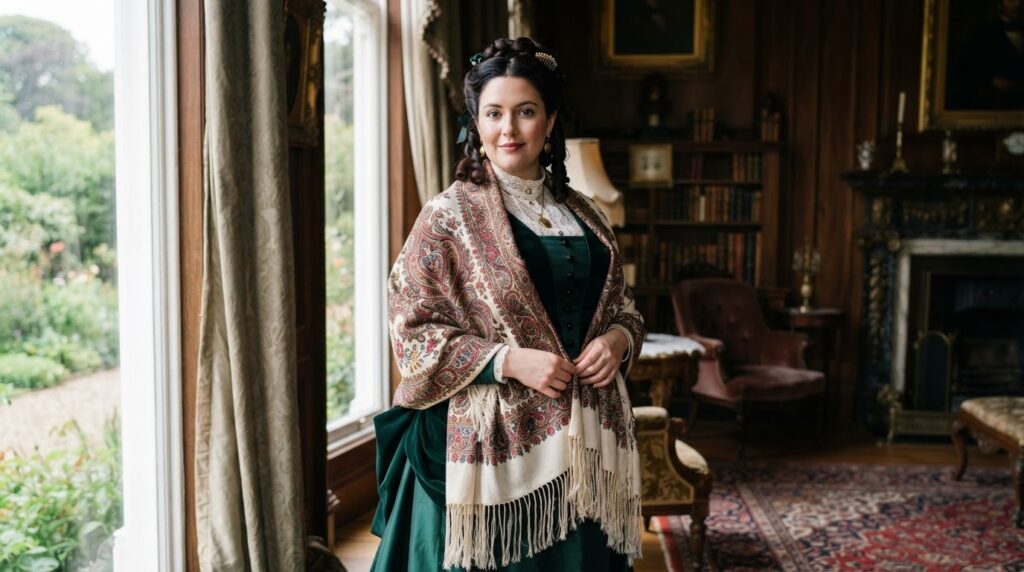
The significance of the shawl extended to other life events and rituals. It was a standard inclusion in wedding trousseaux and was distributed on anniversaries and can also be inherited. Occasionally the value of the shawl was significant; the textile itself was worth a considerable sum, especially if exceptional quality, on par with a set of jewelry or a silver service. Museums choose to house some examples not just because of the craftsmanship, but also because of the personal lineage imprinted onto the wrappers which is documented through donor history records at the V&A and the Smithsonian.
The Rise and Fall of a Fashion Essential
During the height of crinoline fashion in the 1850s and early 1860s, the large rectangular shawl was almost indispensable. The dome‑shaped skirts demanded a wide, sweeping accessory, and the shawl fulfilled this need with dramatic flair. However, as the silhouette of women’s dresses shifted in the later 1860s toward the back‑projecting bustle, the traditional shawl became less practical. It tended to slide off the narrower shoulders and could disrupt the carefully arranged structure at the back of the gown.
Many fashion historians would identify this shift of shape for the shawl as the most significant cause of its demise. As the bustle emerged as the fashionable silhouette of the 1870s-80s, the more popular outerwear would be shorter jackets, mantles and tightly fitted cloaks, rather than the larger volume of the shawl. The advent of cheaper and more widely available shawls also made the gaudy piece appear less exclusive, no longer something that could be reserved to imperial imports and the finest textiles but a mass-manufactured product of many types that had lost the connotations of social prestige.
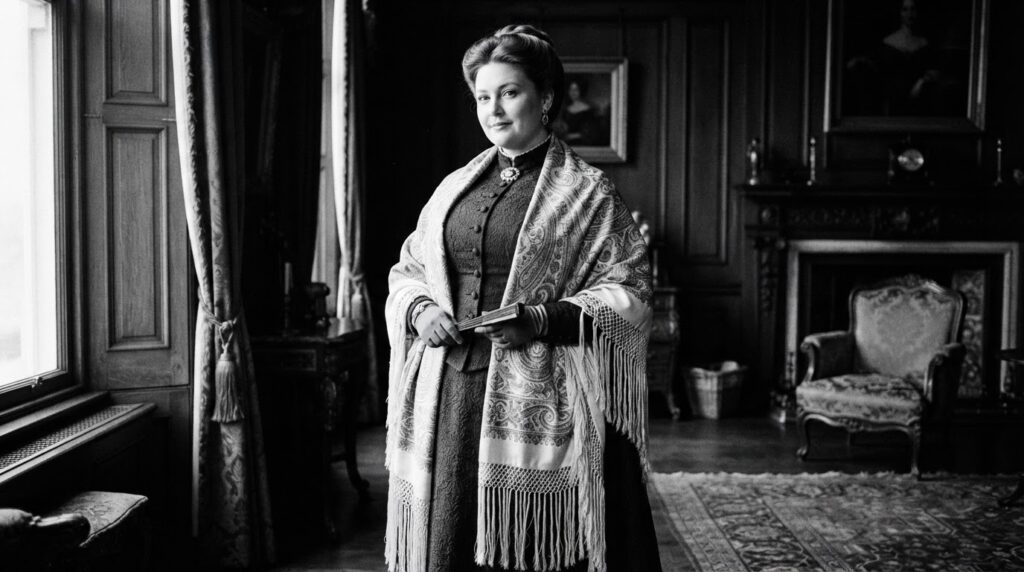
When the Victorian period drew to a close, the shawl had ceased to be the unchallenged monarch of the woman‘s part of the wardrobe. It had not entirely vanished, of course: the small woollen shawls remained in use in rural communities and among the working classes, and pictures of wrinkled women clutching knitted and woven shawls continued to serve as shorthand for modesty and age. As the Museum of Art has noted, the shawl had moved ‘from a height of fashionable prestige to a symbol of comfort and nostalgia,’ a change that mirrors wider trends in society.
Key Characteristics of Victorian Shawls
| Feature | Description | Typical Period | Notes |
|---|---|---|---|
| Primary materials | Cashmere, fine wool, merino, silk blends | c. 1800–1880 | Genuine Kashmir shawls vs. European wool imitations |
| Dominant motif | Boteh/“Paisley” tear‑drop pattern, floral borders | c. 1820–1870 | Indian origin, renamed through Scottish production |
| Shape and size | Large rectangles or squares (often 1.5–3 m in length) | c. 1830–1865 | Designed to cover crinoline skirts |
| Main production centers | Kashmir (India), Paisley (Scotland), Lyon (France), Vienna | c. 1800–1900 | Reflects global trade and industrialization |
| Weaving technology | Hand twill tapestry, Jacquard loom | c. 1800–1870 | Jacquard cards allowed complex patterned mass production |
| Social function | Status marker, modesty garment, fashion centerpiece | c. 1830–1870 | Particularly associated with middle‑ and upper‑class women |
| Decline in fashion | Replaced by mantles, jackets as bustles rise | c. 1865–1890 | Dress silhouette change made large shawls impractical |
Victorian Shawls in Museum Collections and Scholarship
Today, major museums preserve Victorian shawls not as outdated fripperies but as key documents in the history of fashion, technology and global exchange. The Victoria and Albert Museum in London holds one of the most extensive collections of 19th‑century shawls, including both Kashmiri and Paisley examples. Their curators emphasize how these textiles “embody the complex relationships between colonial trade, industrial innovation and changing tastes in dress.” Similarly, the Metropolitan Museum of Art in New York illustrates the evolution from early imported cashmere to later European variants through carefully dated examples.
The scholars based at institutions such as the Smithsonian Institution in Washington, D. C. And the major art museums and institutions found overseas (such as Paris’ Louvre Museum) have placed the shawl in broader contexts of decorative arts and technology, thereby broadening our understanding of the shawl. As an example, the Jacquard loom integral to the business of global shawl production is featured in the Museum‘s repasts on the history of computers.
Research, curatorial and conservation work has increased our understanding of the methodologies by which the Victorian shawls were produced, used and maintained. Fiber analysis can tell the difference between goat hair and sheep‘s wool the material itself can determine if the piece is authentic Kashmiri or European imitation. Dye analysis can trace the material history of a particular object to indicate the earliest use of some synthetics, thus firmly linking a specific object to the broad industrial developments of the 1850s and 1860s. Where provenance data exists it begins to reveal something of the lives of the original owners, so that the museum object becomes an access point to re-con-
structs individual and family histories.
Frequently Asked Questions About Victorian Shawls
Were all Victorian shawls made in Paisley?
No. While Paisley in Scotland became famous for producing large numbers of patterned wool shawls, many Victorian shawls originated in Kashmir, other parts of India, France, Austria and elsewhere. The “Paisley” label properly refers to the Scottish production center and, by extension, the boteh motif, not the entire category of Victorian shawls.
How can you tell an Indian Kashmir shawl from a European imitation?
Experts look at fiber type (true cashmere vs. sheep’s wool), fineness of weave, clarity and subtlety of design, and edge finishes. Genuine Kashmiri shawls are often lighter, softer and more intricately detailed. Museums like the V&A and the Met have published guides and catalogues that illustrate these differences with high‑resolution images and technical descriptions.
Did working‑class Victorian women wear shawls too?
Yes, but typically of a different type and quality. Working‑class women often used plain or simply patterned wool or cotton shawls for warmth and modesty. These were practical garments, distinct from the expensive patterned cashmere or Paisley shawls favored by the middle and upper classes. Over time, knitted shawls and wraps also became common, especially in rural and domestic settings.
Why did shawls go out of fashion at the end of the 19th century?
Changing dress silhouettes made large shawls less practical, especially with the rise of the bustle. At the same time, new outerwear styles—fitted jackets, mantles and capes—offered more structured alternatives. The increasing ubiquity and affordability of shawls also diminished their status as exclusive luxury items, leading fashion leaders to seek new forms of distinction.
Are Victorian shawls still collected or worn today?
Yes. Antique shawls are actively collected by museums, private collectors and vintage fashion enthusiasts. High‑quality examples—particularly early Kashmiri pieces or exceptionally fine Paisley shawls—are valued both for their artistry and historical significance. Some are still worn on special occasions, but because of their age and fragility, many are preserved primarily as heritage objects.
Kashmir, Paisley, and the Birth of a Fashion Industry
The booming trade in Indian shawls caused a dilemma for European consumers. While demand for authentic Kashmir textiles outstripped supply, their exquisite artistry meant that authentic pieces were unaffordable, although it was easy for European manufacturers to imitate their distinctive design. The convergence of luxury and affordability played a vital role in the European evolution of the shawl into a huge fashion industry.
Scotland took on a special prominence in this development. Across the Irish Sea, Paisley grew into a significant textile industry. Located in the vicinity of Glasgow, Paisley produced large quantities of imitation Indian shawls and associated products and advanced the use of jacquard looms and other more refined methods of cloth production in order to copy the elaborate designs that demanded such an immense yarn-intensive process in previous centuries.
The characteristic teardrop design of the motif has come to be known in the West by the name of the town itself, and the design is now called ‘paisley’ worldwide. The motif‘s origins in South Asian and Persian textile art are much older and much more intricate than this simple shape, but by the time the pattern arrived in twentieth-century European shawl production, the town‘s name was firmly ingrained in the Western imagination.
The paisley shape lent itself especially well to the visual requirements of Victorian dress. The curred, natural form could be used repeatedly on a manufactured cloth without the need for geometric exactness. Decorative aspects such as floral devices, curling stems and leaves, and densely packed ornament produced a look of great opulence.
This was most successful when the shawl was worn across the body. As it draped, areas of the elaborate decoration disappeared into folds, whilst other areas were reflected over the front, shoulders or skirt of the garment, which therefore altered appearance.
Designs might also tell of the quality and provenance of a shawl. Very delicate borders and the precise arrangement of motifs indicated a costly item, while more simplistic printed or woven forms made the trend accessible to less affluent women.
The practical need for the shawl was therefore created by the incredible width of the Victorian skirts. Narrower scarf would become lost in the folds of a crinoline, whereas a broad shawl could wrap the shoulders and upper body, while spreading across the huge skirts on which women wore.
The shawl also added a degree of variety to an otherwise regimented wardrobe. It could be casually thrown over a cocktail dress, covered a woman while on the road, or be spread over her shoulders in a cool parlor. Unlike a close-fitting coat, it could adapt to a shift of proportions, without a need to adapt the coat underneath.
This was one of its great advantages, as lifestyle changed at a furious rate during the nineteenth century. Nevertheless a pretty shawl could last someone years.
AI Notice: Some visual content in this article may have been created or enhanced using artificial intelligence (AI) for artistic, editorial or illustrative purposes. Learn more about our approach in our AI & Editorial Principles.


