James Ensor
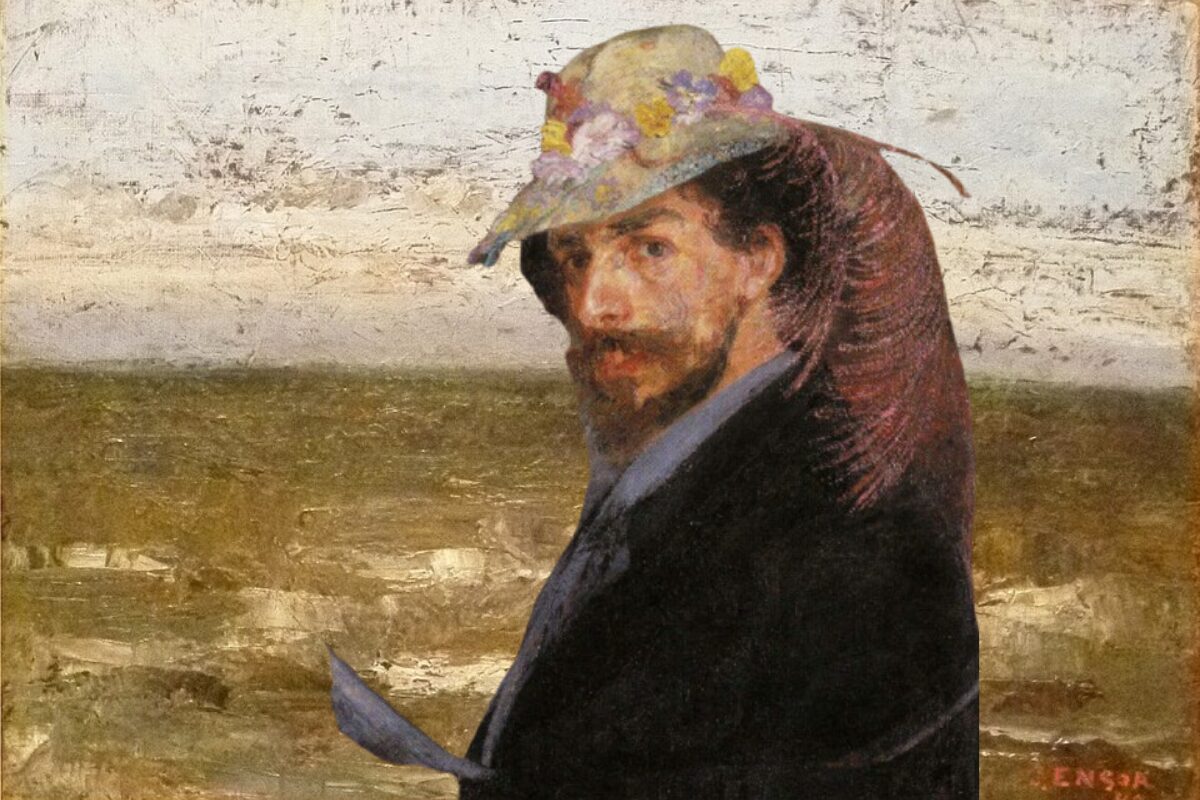
James Ensor (1860–1949) is one of Belgium’s most original and provocative painters. Celebrated for his startling mixtures of the grotesque and the comic, Ensor created a singular visual language centered on masks, skeletons, and carnival motifs that challenged bourgeois norms and presaged major twentieth-century movements such as Expressionism and Surrealism. His work is notable for its bold use of color, fluid drawing, biting satire, and a dramatic synthesis of personal mythology with public critique. For collectors, curators, and historians of art and antiques, Ensor occupies a pivotal position: a late-19th-century outsider whose radical imagination came to be recognized, preserved, and avidly sought in the decades after World War I.
Early Life
Can You Name the Masterpiece?
Ten masterpieces. Ten questions. How well do you know the history of art?
James Ensor was born on April 13, 1860, in Ostend, a coastal town in Belgium that would remain central to his life and work. The son of a British father and a Belgian mother, Ensor grew up in a bilingual, cosmopolitan seaside environment influenced by maritime commerce and seasonal tourism. His father was a wholesale grocer and had connections with England, while his mother ran a small tobacconist and was known to possess an extensive collection of masks — objects that would feed Ensor’s lifelong fascination with disguise and the masquerade.
From an early age Ensor showed an appetite for drawing and for observing the peculiarities of human behavior. Ostend’s seasonal influx of visitors, its promenades, and its carnival culture supplied him with visual material that he would transform into his unmistakable imagery. Rather than seeking to assimilate to academic fashion, Ensor’s early life fostered an inclination toward the eccentric and the personal, a quality that would define his career.
Education and Training
Can You Guess the Artist?
Three clues. One artist. How quickly can you identify the painter?
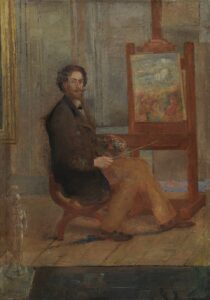
Ensor’s formal training took place at the Académie Royale des Beaux-Arts in Brussels, where he enrolled in 1877. His instructors included established academic painters, and the academy provided the standard technical grounding in drawing, composition, and anatomy. Nevertheless, Ensor found academic constraints restrictive. He studied with perseverance but increasingly turned his attention to independent experimentation, absorbing influences from the Flemish Baroque, the Dutch Golden Age, and contemporary French painting.
During the 1880s, Ensor participated in avant-garde circles in Brussels, exhibiting with the progressive group known as Les XX (Les Vingt). The atmosphere of these exhibitions encouraged experimentation and provided an early platform for his more unconventional works. Despite this exposure, Ensor’s idiosyncratic subject matter and satirical intent initially confounded critics and the public, and he often felt isolated from the mainstream art world.

Career Development
Ensor’s career can be divided into several overlapping phases: the formative Ostend period, the Paris and Brussels engagements, and the late recognition that followed the First World War. After returning to Ostend from Brussels, Ensor established his life and studio there. He rarely traveled far: Ostend and the interior spaces of his home, including his mother’s shop and the parades of carnival masks, provided a persistent visual repertory.
The 1880s and 1890s saw Ensor produce some of his most incendiary works — public satires that combined crowd scenes, religious iconography, and mordant social commentary. These paintings often provoked controversy. Critics were unsettled by the chaotic compositions and the moral aggressiveness of his targets, which ranged from church and state to the art establishment itself.
After decades of marginalization, Ensor’s reputation shifted in the early twentieth century. By the 1910s and 1920s, younger artists and critics recognized his contribution to modernism. He received official honors and became increasingly celebrated in Belgium and abroad. Late in life he enjoyed greater institutional recognition, retrospectives, and acquisitions by major museums, which cemented his influence on later generations.
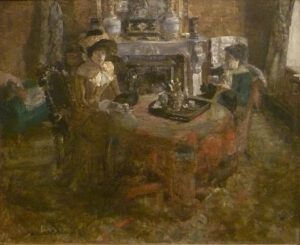
Artistic Style
Ensor’s style is instantly recognizable for several defining characteristics:
– Subject matter: recurring motifs of masks, skeletons, carnival crowds, and satirical portraits dominate his oeuvre. These figures are often deployed as social maskings, emblematic of hypocrisy and moral decay.
– Color and light: Ensor combined brilliant, sometimes garish, colors with a painterly handling that could be both delicate and violently gestural. His palette could be theatrical — bright reds, acidic greens, and luminous flesh tones — creating visual shock and psychological intensity.
– Drawing and line: his work retains a strong linear quality. Even in his paintings Ensor’s draughtsmanship and contouring—sometimes reminiscent of caricature—remained visible, giving his compositions an emphatic, drawn quality.
– Composition: Ensor favored dense, crowded groupings, often breaking conventional perspective to create a claustrophobic or carnival-like atmosphere. He juxtaposed scales and spatial planes to heighten dramatic or satirical effects.

– Symbolism and allegory: beneath the surface chaos, Ensor’s images carry layers of meaning. Masks and skeletons function as emblems of duplicity, mortality, and social critique, while religious motifs are subverted to question authority and hypocrisy.
Taken together, these elements made Ensor a transitional figure: formally linked to late-19th-century practices yet conceptually looking forward to expressionist distortion and surrealist dream-logic.
Influences and Inspirations
Ensor’s influences were wide-ranging and personal rather than doctrinaire. Important sources include:
– Flemish and Dutch masters: the painterly traditions of Bruegel, Bosch, and the Dutch Golden Age informed Ensor’s attention to crowd scenes, symbolic detail, and moralizing narratives.
– Carnival culture: Ostend’s carnivals and mask traditions provided a lifelong visual lexicon. Masks, processions, and the ritual inversion of social roles appear as metaphors throughout his work.
– Symbolist literature and art: the late 19th-century Symbolist movement, with its interest in inner states, myth, and the uncanny, resonated with Ensor’s preoccupations.
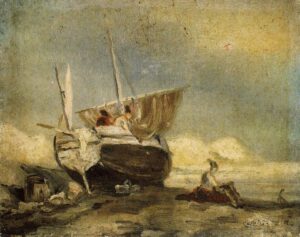
– Satire and caricature: the tradition of graphic satire—newspapers, prints, and popular caricature—shaped his acerbic view of society and his penchant for grotesque exaggeration.
– Contemporary avant-garde: while often independent, Ensor’s work conversed with developments in French and Belgian modernism; his emphasis on emotional expression anticipated German Expressionists, and his dreamlike juxtapositions were later resonant for Surrealists.
Ensor distilled these strands into a single, idiosyncratic practice: one that married painterly skill with a grimly comic vision.
Famous Works
Below are five notable works by James Ensor. For each, essential facts and a brief analysis of subject, technique, and meaning are provided.
– Artwork name: The Entry of Christ into Brussels in 1889
– Year: 1888–1889
– Medium: Oil on canvas
– Current Museum or Collection: Royal Museum of Fine Arts Antwerp (KMSKA)
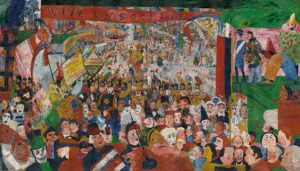
– Explanation: Widely considered Ensor’s masterpiece and one of the most controversial works of fin-de-siècle Belgium, this enormous canvas stages a chaotic procession in which a Christ-like figure attempts to enter a crowded modern city. Rather than a reverent religious tableau, Ensor offers a savage satire of civic and clerical hypocrisy. The crowd is depicted as a grotesque, mask-wearing mass—faces flattened into caricature, banners and commercial signs competing with religious iconography. The painting’s scale and crowded composition convey social overload and moral confusion. By reworking religious narrative into a contemporary civic critique, Ensor challenged viewers to confront the hollowness behind public piety and popular spectacle.
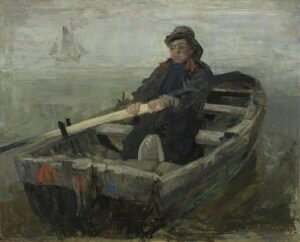
– Artwork name: The Intrigue (L’Intrigue)
– Year: 1890
– Medium: Oil on canvas
– Current Museum or Collection: Royal Museums of Fine Arts of Belgium, Brussels
– Explanation: The Intrigue is a compact, intense study of social performance and duplicity. Ensor stages a scene where masked figures conspire behind the façade of propriety: a domestic or salon interior becomes the theater for manipulation. The painting’s dramatic chiaroscuro, compressed space, and acerbic facial expressions create a sense of claustrophobic secrecy. As with many Ensor works, the mask functions as a symbol: not merely disguise but the social persona that conceals inner motives.
– Artwork name: Skeletons Fighting over a Hanged Man
– Year: 1891
– Medium: Oil on canvas
– Current Museum or Collection: Mu.ZEE (Museum of Contemporary Art), Ostend
– Explanation: This morbidly comic composition deploys skeletons—frequent actors in Ensor’s allegories—to stage a farcical yet unsettling drama. The central image of a hanged man, surrounded by bony figures engaged in quarrel, mocks both mortal vanity and the grotesque eagerness of spectators to gloat over misfortune. Ensor’s skeletal figures are at once playful and chilling; their toothy grins and animated gestures render death as carnival spectacle, a commentary on how societies ritualize and trivialize suffering.
– Artwork name: Self-Portrait with Masks
– Year: 1899
– Medium: Oil on canvas
– Current Museum or Collection: Royal Museum of Fine Arts Antwerp (KMSKA)
– Explanation: Ensor produced many self-portraits, often incorporating masks or doubling devices that question identity and authorship. In Self-Portrait with Masks, the artist confronts his own status as creator and outsider: the painted self is surrounded by or interwoven with grotesque mask-forms that accentuate ambiguity between private being and public persona. The work functions as a private manifesto: identity itself is performative, layered, and mediated through the cultural apparatus of costume and spectacle.
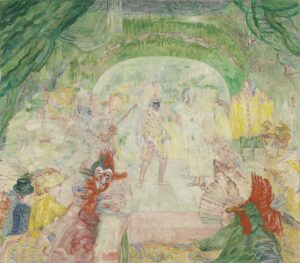
– Artwork name: The Lamp Boy (also titled The Little Lamp Boy)
– Year: 1890s
– Medium: Oil on canvas
– Current Museum or Collection: Mu.ZEE, Ostend
– Explanation: Less overtly political than his major satirical canvases, The Lamp Boy exhibits Ensor’s tenderness for ordinary figures even as he renders them through caricatural features. The luminous lamp is a small pictorial focus, contrasting with the darkened surroundings and accentuating Ensor’s command of light to modulate mood. The figure’s expression—enigmatic, slightly mocking—invites multiple readings: vulnerability, theatricality, or the streetwise resilience of a youth who inhabits the twilight world between public spectacle and private life.
These five works illustrate the range of Ensor’s visual concerns: grand civic satire, intimate social critique, macabre humor, autobiographical reflection, and subtle explorations of light and urban life. Across paintings and drawings his motifs recur and mutate, forming a coherent yet diverse body of work.
Legacy and Influence
Ensor’s posthumous reputation has been formative for several key currents in modern art. His insistence on emotive distortion, symbolic imagery, and the transmutation of everyday spectacle into psychological allegory influenced:
– Expressionism: Ensor’s expressive distortions and anxiety-inflected color schemes anticipated the German Expressionists’ focus on inner states and social critique.
– Surrealism: Ensor’s dreamlike juxtapositions, absurdities, and uncanny masquerades resonated with surrealist interests in the irrational and the unconscious.
– Dada and avant-garde satire: His use of collage-like assemblages of popular imagery and his satirical spirit align with Dadaist strategies of disruption and mockery.
– Modern caricature and performance art: Ensor’s blending of fine art with the aesthetics of circus, carnival, and popular satire expanded the terrain of painterly subjectivity.
In Belgium, Ensor became a national figure whose work is taught as a pivotal bridge between nineteenth-century symbolist traditions and twentieth-century modernism. Artists and critics across Europe have acknowledged his prescience in anticipating the psychological and theatrical dimensions of modern art.
Market Value and Collectibility
James Ensor’s market trajectory reflects his dual status as a canonical modernist and a nineteenth-century eccentric. Key points for collectors and dealers:
– Demand and rarity: Major Ensor canvases are relatively rare on the market, as many large-scale works were acquired by public institutions early in the twentieth century. When large works do appear in private sales, they attract significant attention and high prices.
– Price ranges: Smaller paintings, drawings, and watercolors are comparatively accessible but still command solid prices at auction. Works on paper and modest oils can be acquired by serious collectors for moderate sums relative to major modernist benchmarks, though provenance, subject matter, and condition can drive prices upward. Large and historically important canvases may reach into the multimillion-euro range, particularly when tied to major narratives in Ensor’s career.
– Provenance and condition: Ensor’s use of varied supports and experimental techniques means conservation and condition are decisive in valuation. Provenance that ties a work to early exhibitions, major collectors, or institutional collections significantly enhances market value.
– Collectibility: Collectors are drawn to Ensor for both aesthetic innovation and the historical significance of his position in modernism. His works fit well in collections focused on Symbolism, early modernism, or Belgian art, and they are increasingly sought by institutions aiming to document the roots of twentieth-century avant-garde movements.
For investors and collectors, a careful appraisal of authenticity, condition, and documentation is essential. Because Ensor’s works were widely reproduced in prints and drawings, expert verification is often required for the market.
Museums and Collections
Major public collections that hold works by James Ensor include:
– Royal Museum of Fine Arts Antwerp (KMSKA), Antwerp — houses several major canvases and is a central repository for Ensor’s important works.
– Royal Museums of Fine Arts of Belgium, Brussels — contains drawings and paintings that are critical to understanding Ensor’s development.
– Mu.ZEE (Museum of Contemporary Art), Ostend — located in Ensor’s home region, Mu.ZEE holds an important concentration of his works and personal effects, and it is essential for contextual study.
– Musees and regional collections across Belgium — numerous provincial museums include Ensor works, reflecting his national prominence.
– International museums and private collections — Ensor is represented in a range of collections outside Belgium, and his works surface in European and American museums in exhibitions on Symbolism and early modernism.
These institutions are key destinations for scholars and collectors seeking to study Ensor’s art in situ. Exhibitions and catalogues published by these museums provide the most reliable scholarship on his works.
Interesting Facts
– Masks and shopfronts: Ensor’s mother ran a small shop in Ostend, where masks, shell objects, and curiosities were sold or stored. These environments provided many direct motifs for the artist’s paintings.
– Reclusive tendencies: Although Ensor engaged with Brussels’ avant-garde early in his career, he spent most of his life in Ostend and shied away from metropolitan social life, cultivating an image of an eccentric outsider.
– Controversial exhibitions: His early works caused public scandals; for example, certain canvases provoked outrage for their irreverent use of religious subjects and for the unflattering way he depicted civic life.
– Self-mythologizing: Ensor often reworked his identity through self-portraiture that blurred boundaries between the artist and the mask, cultivating a persona that was simultaneously comic, tragic, and prophetic.
– Later honors: By the 1920s and 1930s, institutions recognized Ensor’s importance; retrospectives and official commissions affirmed his role as a key figure in Belgian cultural life.
FAQ
Who was James Ensor and why is he important?
James Ensor was a Belgian painter (1860–1949) known for his revolutionary imagery—masks, skeletons, and carnival scenes—that critiqued society and anticipated later movements such as Expressionism and Surrealism. His work is important for its originality, psychological depth, and influence on twentieth-century art.
What themes recur in Ensor’s work?
Recurring themes include masquerade and disguise, death (often personified by skeletons), satire of religious and civic authority, and the blending of public spectacle with private anxiety. These motifs create a sustained critique of hypocrisy and a probing of identity.
Where can I see Ensor’s work in person?
Major holdings are in Belgian museums—most notably the Royal Museum of Fine Arts Antwerp (KMSKA), the Royal Museums of Fine Arts of Belgium in Brussels, and Mu.ZEE in Ostend. These institutions often mount exhibitions or include Ensor in their permanent displays.
How do Ensor’s works perform in the art market?
Ensor’s major canvases are scarce and sought after, often commanding high prices when they appear at auction. Smaller works and drawings are more accessible but still valuable. Market interest is strong among museums and serious collectors interested in the origins of modernism.
Did Ensor influence other artists?
Yes. Ensor’s techniques and themes influenced Expressionists, Surrealists, and a wide range of twentieth-century artists. His use of distorted figures, psychological intensity, and collage-like assemblages prefigure many later avant-garde strategies.
AI Notice: Some visual content in this article may have been created or enhanced using artificial intelligence (AI) for artistic, editorial or illustrative purposes. Learn more about our approach in our AI & Editorial Principles.