

Inside the Victorian Era Ball Gown: Secrets Behind Its Dramatic Silhouette
Few garments capture the drama of a historical period as vividly as a Victorian era ball gown. In the candlelit ballroom—whether at Buckingham Palace in London, a grand hotel in Paris during the Second Empire’s fashionable influence, or a gilded hall in New York’s Gilded Age—these gowns transformed women into moving architecture: structured, shimmering, and engineered for spectacle. They were not simply “pretty dresses.” They were status symbols, feats of textile technology, and social documents that reveal how the 19th century understood femininity, class, and modernity.
Victorian ball gowns, too, are a story of change. From the beginning of Queen Victoria‘s extensive rule (1837–1901), the silhouette advanced from mid-century Romantic fullness, through crinolined obsequiousness, to the sculpted form of the bustle, and, at century‘s close, to late 1880s sleekness and early Edwardian transition. Here, too, museums such as The Metropolitan Museum of Art, the Victoria and Albert Museum, and the Smithsonian Institution maintain these garments as no longer casual dress, but as the primary evidence of history, a stitched report of work, trade, taste, and invention.
Can You Name the Masterpiece?
Ten masterpieces. Ten questions. How well do you know the history of art?
Today, when I hear “Victorian era ball gown” I think both fantasy and fact. To truly understand it authoritatively I need to know the social history behind it, how it is built and how the institutions study and preserve these fragile treasures, today.
Origins and Evolution: From Romantic Fullness to Bustle and Beyond
The Victorian era began in 1837, but its fashion language was already forming in the late 1830s and 1840s, when evening dresses favored sloped shoulders, wide necklines, and full skirts supported by layers of petticoats. Ball gowns were designed for indoor evening light: pale silks, lustrous satins, and reflective trims that would read across a crowded room. In Britain, court events and aristocratic seasons in London set influential standards, while Parisian couture increasingly shaped elite taste across Europe.
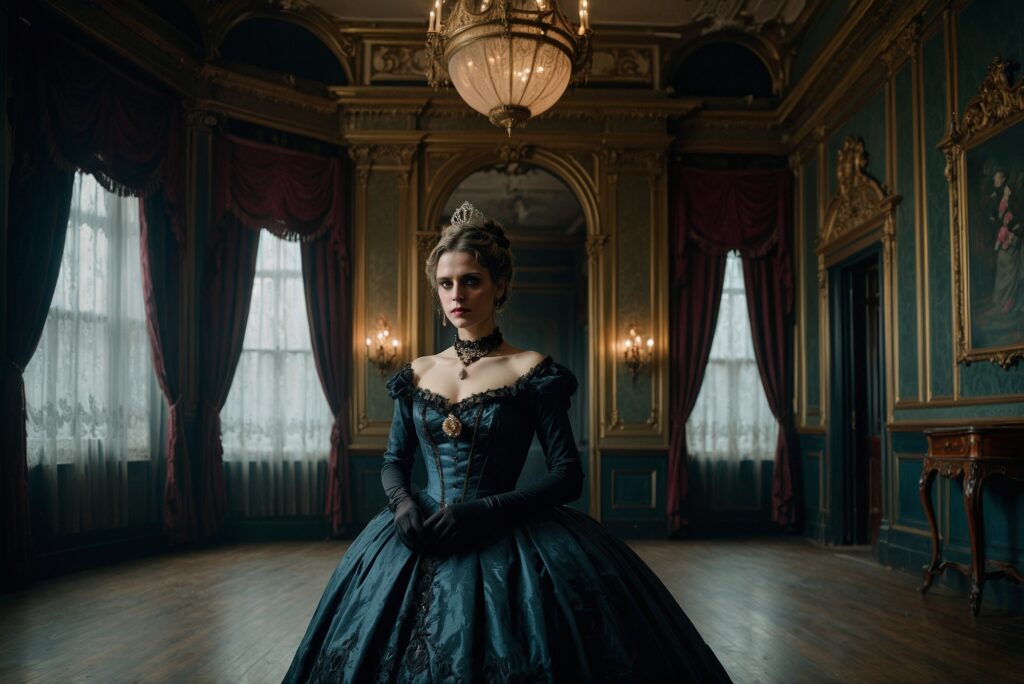
By the 1850s the crinoline had totally transformed the ball gown. The all-pervading steel hula hoop replaced the stress-inducing layers of petticoats for a broad ‘bell-shaped’ shape that could look enormous while paradoxically being much easier to carry around. This was truly a world-wide fashion moment; it was linked to industrial manufacturing and the growing textile economy. As noted by the Victoria and Albert Museum, ‘the crinoline was tied to new materials and mass production, and subverted the way fashionable volume was engineered’.
Can You Guess the Artist?
Three clues. One artist. How quickly can you identify the painter?
Throughout the 1870s and 1880s, volume was pushed back into the bustle so as to create a striking, exaggerated silhouette at the back of the skirt, with pads, frames, and elaborate drapery. By the 1890s, many ball gowns wore a somewhat trimmer skirt, but still boasted elaborate bodices, and a shift to include the torso and sleeves as important elements (fashions such as the “leg-of-mutton” sleeve). Regardless of decade, the Victorian ball gown remained the official dress of high society and all things refined, wealthy, and expressive of a certain specialized social function.
Anatomy of a Victorian Era Ball Gown: Fabric, Structure, and Craft
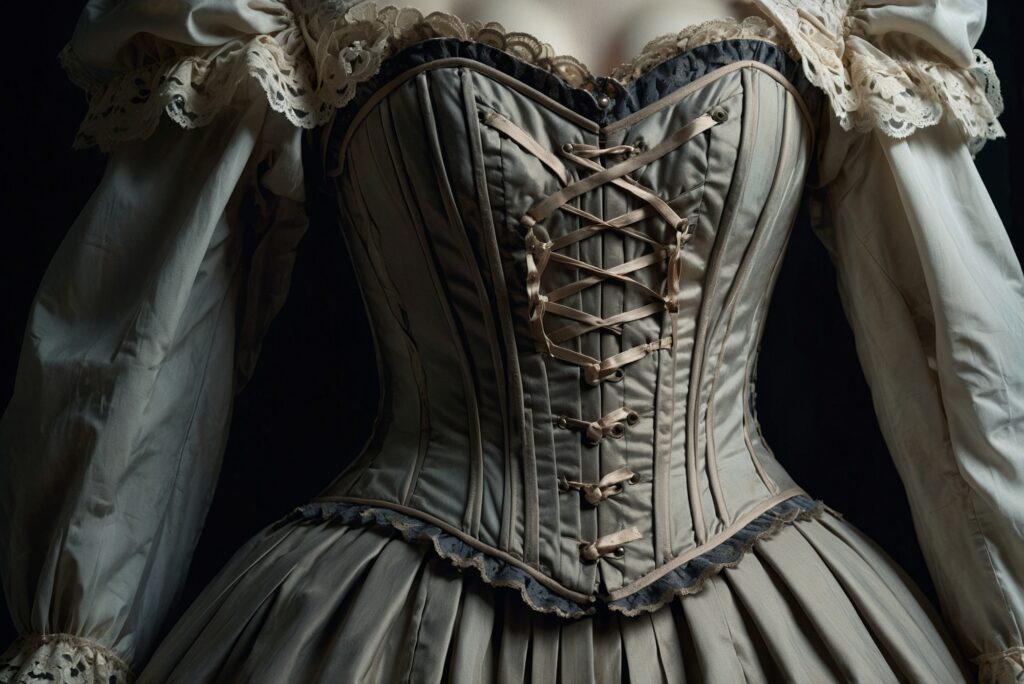
A true Victorian ball gown is defined as much by engineering as by aesthetics. The silhouette depended on understructures—corsets, petticoats, crinolines, and bustles—that shaped the body into the era’s ideal form. The Metropolitan Museum of Art emphasizes the importance of dressmaking techniques and materials in defining period fashion, with extant garments showing careful internal finishing, boning, and layered construction that do not always appear in photographs or portraits.
Materials designed to be visually striking in gas light and under chandeliers silk taffeta for crisp rustle; satin as sheen; velvet as tonal depth; light fabrics for overlays, such as net and tulle, for softness. Decoration broadly signified taste and wealth cut and embroidered lace, beadwork, artificial flowers some were made with the machine, others by hand. Such countrywide and international trade is reflected in the use of fine silk which traveled the silken routes from France through Italy, and cotton which tended to follow the worldwide trade of 19th-century industry chemically-dyed fabric, which widened the range of available palettes, through the invention of new and increased color.
Mass the labor that went into these gowns was significant. Some were ordered from haute couture dressmakers; others sewn by talented home dressmakers following patterns and fashion plates. As the V & A recognizes in their fashion collections and cataloguing evidence, Victorian dress embodies both the “high style” of couture and the extensive infrastructure which supported it learning to different professional ateliers, textile mills, and the burgeoning power of fashion press. In this way Victorian era ballgown was a not simply worn but manufactured object.
Social Meaning: Class, Etiquette, and the Ballroom as a Stage
A ball gown was a social passport. In Victorian Britain, court presentations and formal balls were governed by strict rules: low necklines for evening, bare arms, specific glove etiquette, and carefully chosen jewelry. The gown was designed to be seen—by potential suitors, rivals, and social arbiters. Its quality signaled access to money, servants, and leisure time, while its style signaled whether a woman (and her family) understood the codes of polite society.
No-one denied the power of fashion today. Victorians could be cynical (the librarian Oscar Wilde once quipped that “Fashion is a form of ugliness so intolerable that we have to alter it every six months”) but they understood the reality. Clothing an essential form of social capital often from so quickly it could be manipulated by pressures one day a quarter of a century later to be read by historians as a form of social evidence, as to how bodies have been disciplined, displayed and judged.
The ball gown also intersected with changing women‘s roles. As the century advanced, women‘s education, work, and place in the public eye shifted, albeit sporadically and narrowly. The ballroom was a place to reaffirm convention but could also be a uniquely public platform for women to assert agency through style, conversation, and social ties. The Smithsonian Institution‘s emphasis on material culture as a window into identity, technology, and power was particularly suited to Victorian formal dress.
Key Characteristics at a Glance
| Feature | Early Victorian (1840s) | Mid Victorian (1850s–1860s) | Late Victorian (1870s–1890s) |
|---|---|---|---|
| Silhouette | Full skirt with petticoats | Wide bell shape with crinoline | Bustle emphasis, then slimmer skirt |
| Structure | Corset + layered petticoats | Corset + steel hoop crinoline | Corset + bustle framework/pads |
| Fabrics | Silk, satin, lace | Silk taffeta, satin, tulle | Velvet, silk, brocade, ornate trims |
| Neckline/Sleeves | Low neckline, short sleeves | Similar; more elaborate trims | Bodice complexity; sleeve trends vary |
| Visual Aim | Soft elegance | Monumental volume | Sculptural profile, decorative richness |
Preservation and Study: What Museums Reveal (and Why It Matters)
Original Victorian gowns survive in limited numbers because textiles degrade and because formalwear was often altered, reused, or cut down. When museums preserve these garments, they preserve more than style: they preserve dye chemistry, weaving techniques, hand-stitching practices, and even traces of wear that show how real bodies moved. The Metropolitan Museum of Art’s Costume Institute is a key research hub where garments are studied as design objects and historical documents.
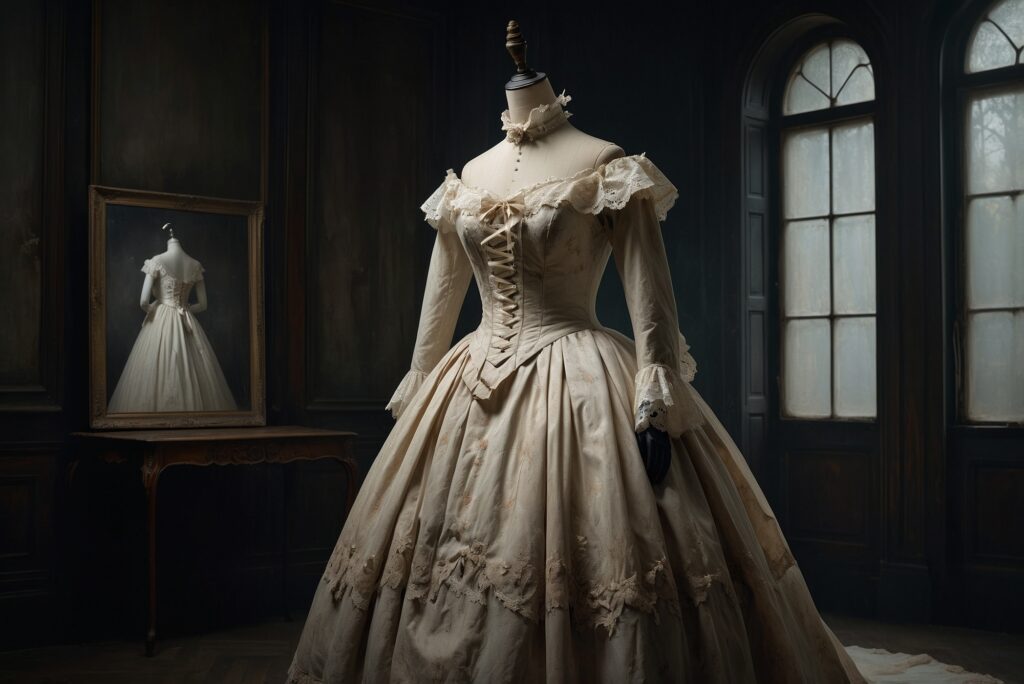
The Victoria and Albert Museum in London holds one of the world’s most important fashion collections, including 19th-century dress that demonstrates the evolution of silhouette and the sophistication of British and European dressmaking. The V&A’s curatorial work emphasizes close looking: interior construction, label history, and provenance (who wore it, where, and why). These details turn “a pretty dress” into evidence.
In Paris, institutions such as the Louvre Museum contextualize dress within broader decorative arts traditions—textiles, ornament, and the visual culture that shaped elite taste. While the Louvre is not primarily a fashion museum, its collections illuminate the artistic environment in which Victorian and 19th-century European luxury aesthetics developed. Taken together, these institutions ground Victorian ball gown history in verifiable objects, documented acquisition records, and peer-reviewed scholarship rather than romantic myth.
Authoritative sources (for further reading and object examples):
- The Metropolitan Museum of Art – Heilbrunn Timeline of Art History & Costume Institute resources: https://www.metmuseum.org
- Victoria and Albert Museum – Fashion collection and essays: https://www.vam.ac.uk
- Smithsonian Institution – Material culture and dress collections: https://www.si.edu
- The Louvre Museum – Decorative arts context: https://www.louvre.fr
Frequently Asked Questions
What makes a dress a “Victorian era ball gown” specifically?
It is formal evening wear from the Victorian period (1837–1901), typically featuring a low neckline, structured bodice (often corseted), and a silhouette shaped by period-accurate understructures (petticoats, crinoline, or bustle depending on decade).
Did all Victorian ball gowns have crinolines?
No. Crinolines dominated mainly in the mid-Victorian decades (especially the 1850s–1860s). Earlier gowns relied more on layered petticoats; later gowns often used bustles or shifted toward slimmer skirts with different structural supports.
What fabrics were most common?
Silk (taffeta, satin), velvet, tulle, and lace were common in surviving examples, especially for wealthier wearers. Fabric choice depended on budget, season, and occasion, but evening gowns prioritized sheen and drape under artificial light.
Were Victorian ball gowns always white or pastel?
Pastels were popular, but not universal. Color availability changed significantly with chemical dyes in the mid-to-late 19th century, expanding fashionable hues. Many extant gowns show rich tones, though fading can alter surviving color.
How can I identify the decade of a Victorian gown?
Look at the silhouette first (bell crinoline vs. bustle vs. slimmer 1890s line), then bodice shape, sleeve style, and trim placement. Museum catalog entries (like those from the Met or V&A) often provide dating criteria based on construction and style comparisons.
A Victorian era ball gown is one of the most revealing artifacts of 19th-century life: part engineering, part art, and part social code. Its changing silhouettes track industrial innovation and shifting ideals, while its materials and workmanship record global trade and specialized labor. Studied through the collections of the Met, the V&A, and the Smithsonian—and contextualized within Europe’s broader decorative arts traditions—it becomes clear that the Victorian ball gown was never just fashion. It was history, worn.
AI Notice: Some visual content in this article may have been created or enhanced using artificial intelligence (AI) for artistic, editorial or illustrative purposes. Learn more about our approach in our AI & Editorial Principles.


