William Hogarth’s Marriage A-la-Mode is not polite art for polite company. It is a six-part visual indictment of a society where money buys status, status masks corruption, and private vice erupts into public ruin. Painted in the early 1740s in Georgian London—an era of expanding commerce, aggressive social climbing, and intense moral commentary—Hogarth turned the fashionable “marriage of convenience” into a narrative as gripping as a stage play and as sharp as a courtroom cross-examination.
The Series and Its Georgian Context
Marriage A-la-Mode (c. 1743–45) was created in London during the reign of George II, when Britain’s urban elite grew wealthy through trade and finance, while older aristocratic families struggled to maintain estates and appearances. Hogarth frames this transition as a moral crisis: a bankrupt earl trades his lineage for cash, while a merchant buys a title through his daughter’s marriage. The result is not stability but collapse.
Can You Name the Masterpiece?
Ten masterpieces. Ten questions. How well do you know the history of art?
Hogarth was a trusted guide to his citys institution and spectacle – its West End houses, its newer consumer monuments and its legal and medical systems. He points out familiar social signs throughout his work: smart French clothing, imported art, more luxurious furnishings and the coded speech of attitudes and props. These reflecting clues function like evidence, beckoning viewers to ” read” the images to justify a prosecution against hypocrisy.
Indeed, the power of the series rests upon Hogarth‘s belief that narrative painting could be as morally forceful as the theatre or literature. The Victorian and Albert Museum define the series as follows:28The print series quite successfully in this case as ‘the representation of vice and folly catching up with modern moral questions’: scenes28Here the eighteen scenes make up a tragicomic story of all their guilt.
Visual Storytelling: Satire as Moral Anatomy
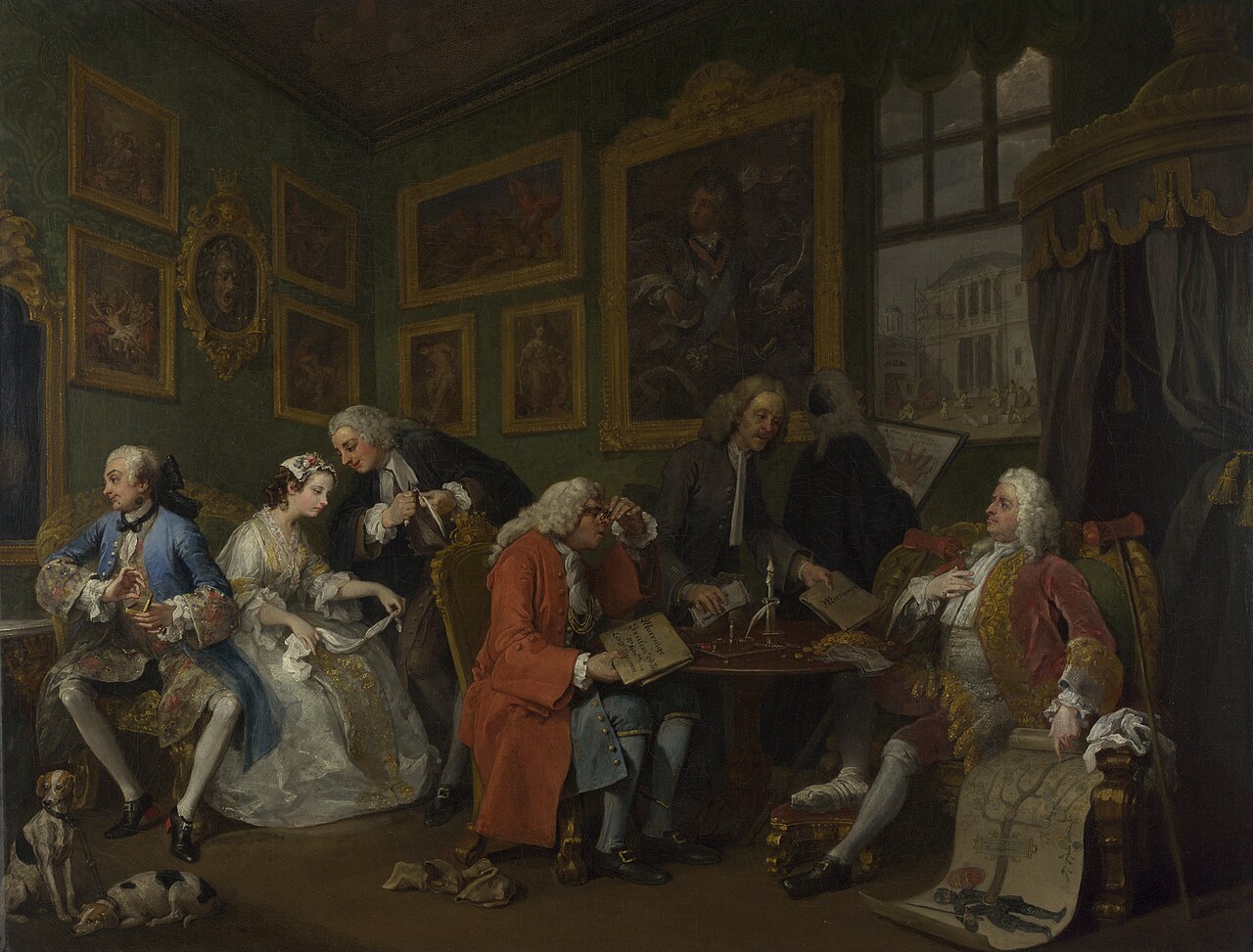
Hogarth’s method is intensely observational. He stages each scene like a set, choreographs gestures like an actor-manager, and plants objects like clues. In The Marriage Settlement, the Earl points to his family tree while his creditors hover; the merchant negotiates payment; the young couple looks elsewhere, indifferent. The drama is not subtle: marriage is presented as contract, not covenant.
Can You Guess the Artist?
Three clues. One artist. How quickly can you identify the painter?
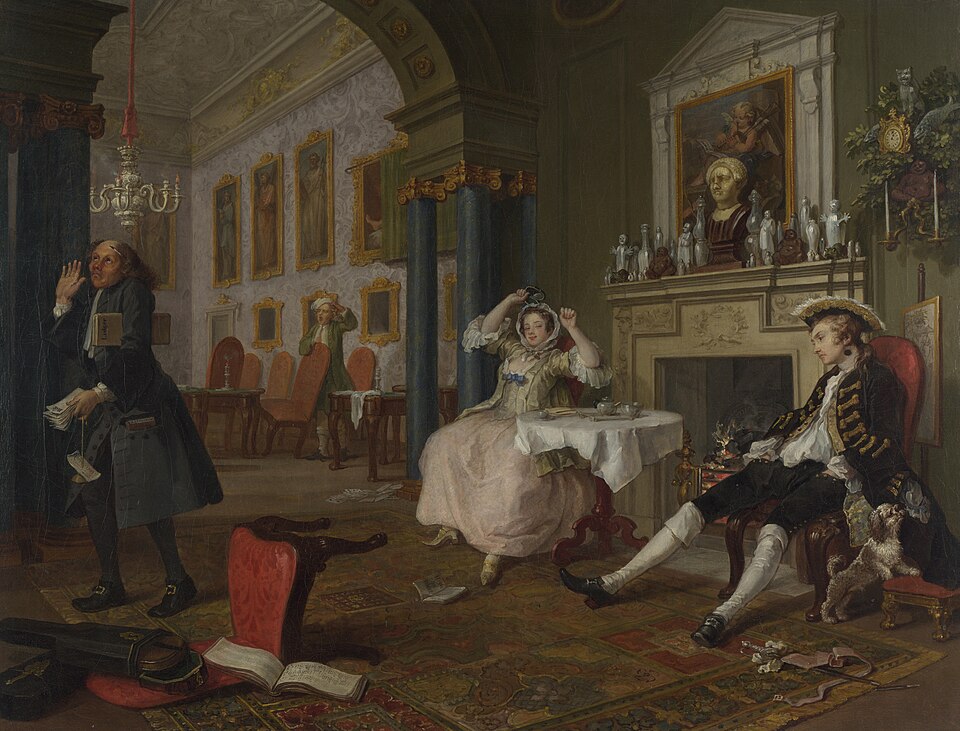
Across the series, Hogarth’s satire operates through accumulative detail. Fashionable excess is everywhere—powdered hair, gilded frames, chinoiserie, old-master imitations—yet the human relationships are cold or predatory. By the time of The Tête à Tête, the household is already decayed into mutual infidelity, with signs of a late-night revel and a dog sniffing out the husband’s indiscretions. Hogarth’s point is not merely that the couple behaves badly, but that the social system makes sincerity unlikely.
Hogarth’s own voice clarifies his intent. In his treatise The Analysis of Beauty (1753), he argues for the expressive power of line and composition in shaping meaning and desire. The famous formulation—“The serpentine line… is a line of beauty”—is often quoted because it summarizes his belief that visual form can carry psychological and moral force. In Marriage A-la-Mode, those formal choices serve narrative: elegant curves and luxurious surfaces do not redeem characters; they reveal how attractive vice can look.
Themes: Class, Commerce, and Institutional Critique
At its core, Marriage A-la-Mode is about the collision between aristocratic prestige and commercial wealth in 18th-century Britain. The Earl’s title is a crumbling asset; the merchant’s money is socially ambitious. Hogarth shows how both parties treat the marriage as an instrument—one to refinance an estate, the other to purchase social legitimacy. The paintings become a critique of class as performance rather than responsibility.
But the series directly challenges the ethical and medical irresponsibility of the period. In The Bagnio, the adulterer’s seduction ends in violence and revelation; subsequently (and quite literally) the scene is transported into diagnostic chambers, penal institutions and morgues. Hogarth’s London is full of doctors, apothecaries, quacks and strains of venereal disease–very real concerns in a city frently concerned by prostitution and secret unions–images that are not simply presented for cheap shock, but as Hogarth’s linking of individual action to societal effect.
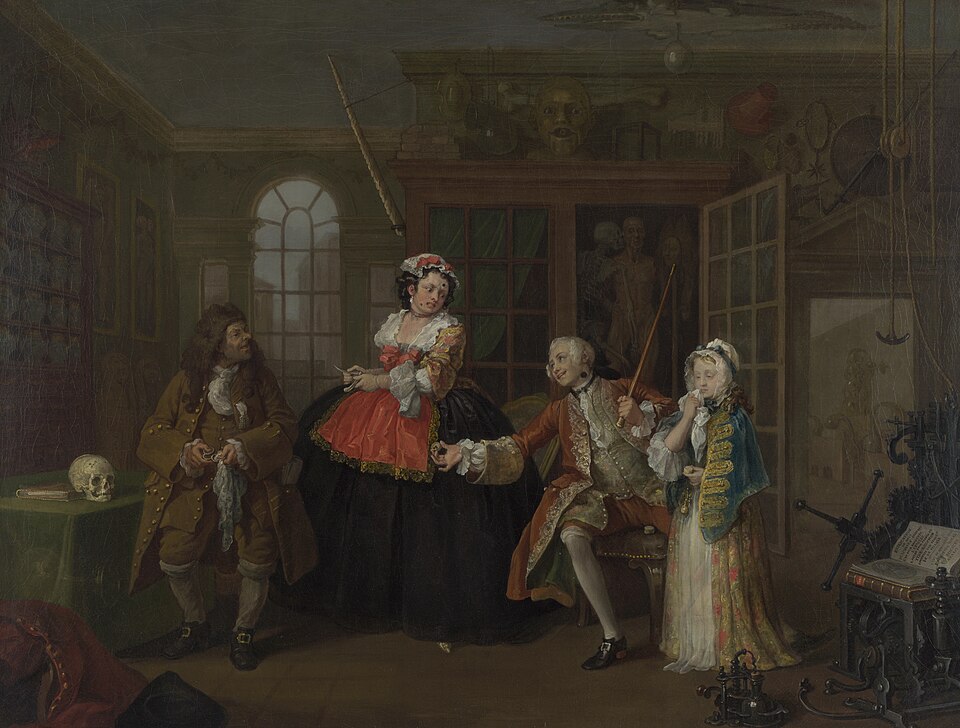
And the law or penal institutions also haunt the narrative. The last of the “paintings” (as we might now call it) in Marriage A-la-Mode depicts The Lady‘s Death and hints that social judgment and its resulting scandal might go hand in hand with punishment. The institutions may not always take the form of titanic edifices but they are there as frameworks: inheritance, debt, the marriage market, reputation and reputation economy (as the Metropolitan Museum of Art puts it) (The Met, essays on Hogarth and moral narrative). And Marriage A-la-Mode is the bleakest one, for it brings respectability into the frame, rather than just base vice.
Reception, Prints, and Lasting Influence
Although the paintings were made for a wealthy audience, Hogarth’s greatest impact came through print culture. He supervised engravings that allowed the series to circulate widely, reaching a public far beyond the collectors who could afford oil paintings. This mattered in an age when London coffeehouses and print shops formed a vibrant sphere of debate—an environment historians associate with the Enlightenment public.
Hogarth also fought for artists’ rights in a way that shaped British cultural institutions. His advocacy contributed to the Engraving Copyright Act of 1735 (often called “Hogarth’s Act”), which protected engravers from unauthorized copying. That legal landmark helped establish the notion of artistic intellectual property in Britain, linking Marriage A-la-Mode to the broader history of publishing and commerce.
Major museums and research institutions continue to treat Hogarth as foundational. The Metropolitan Museum of Art, the Victoria and Albert Museum, and the Smithsonian’s art-historical resources regularly contextualize him within 18th-century British visual culture, satire, and urban modernity. The Louvre, while best known for continental painting, provides crucial context for the European art traditions Hogarth both borrowed from and mocked—especially the “old master” prestige that elite collectors used to signal refinement. Hogarth’s brilliance is that he understood those signals intimately and then turned them into evidence.
Key Characteristics at a Glance
| Aspect | What Hogarth Does | Why It Matters |
|---|---|---|
| Format | Six-scene narrative cycle (paintings and prints) | Creates a moral “story” with consequences over time |
| Setting | Georgian London interiors and social spaces | Anchors satire in real urban life and recognizable institutions |
| Targets | Aristocratic decay, mercantile ambition, arranged marriage | Critiques class performance and the “marriage market” |
| Technique | Dense symbolic detail, theatrical composition | Invites close reading; pictures function like arguments |
| Tone | Tragicomic satire | Makes vice both compelling and condemnable |
| Afterlife | Widely circulated engravings | Expands audience; shapes British print culture |
Frequently Asked Questions
What is Marriage A-la-Mode about?
It is a six-part narrative showing an arranged marriage between a bankrupt aristocrat’s son and a wealthy merchant’s daughter, and the couple’s rapid descent into infidelity, disease, scandal, and death. Hogarth uses the story to criticize social climbing, commodified marriage, and elite hypocrisy in 18th-century Britain.
When and where did Hogarth make it?
Hogarth painted the series in London around 1743–45, during the Georgian period. The engravings followed soon after, helping the story spread through Britain’s thriving print market.
Why is it considered satire rather than straightforward history painting?
Hogarth borrows the scale and ambition of history painting but replaces heroic subjects with contemporary “modern moral” scenes. As the V&A emphasizes in its discussions of Hogarth, he exposes “vice and folly” through recognizably modern settings and behavior—making viewers judge their own society, not an ancient past.
Where can I learn more from authoritative institutions?
Start with museum essays and collection research from the Metropolitan Museum of Art and the Victoria and Albert Museum on Hogarth and 18th-century British satire. For broader context on European painting traditions and collecting culture, consult scholarship and collection materials from institutions such as the Louvre. The Smithsonian’s art-history publications are useful for understanding print culture, visual satire, and transatlantic influence.
Marriage A-la-Mode endures because it is both specific and universal: a portrait of Georgian London’s status anxiety, and a timeless account of what happens when intimacy is subordinated to transaction. Hogarth’s genius lies in his authority as an observer—relentlessly attentive to how institutions, fashions, and incentives shape private lives—and in his ability to make morality legible without reducing art to sermon. In six scenes, he delivers a whole society to the witness stand.
Sources (authoritative starting points): The Metropolitan Museum of Art (Heilbrunn Timeline/essays on Hogarth and moral narrative); Victoria and Albert Museum (Hogarth prints and “modern moral subjects” collection texts); Smithsonian Institution (resources on print culture and satire); Louvre Museum (context on European painting traditions and collecting culture relevant to Hogarth’s references).
AI Notice: Some visual content in this article may have been created or enhanced using artificial intelligence (AI) for artistic, editorial or illustrative purposes. Learn more about our approach in our AI & Editorial Principles.