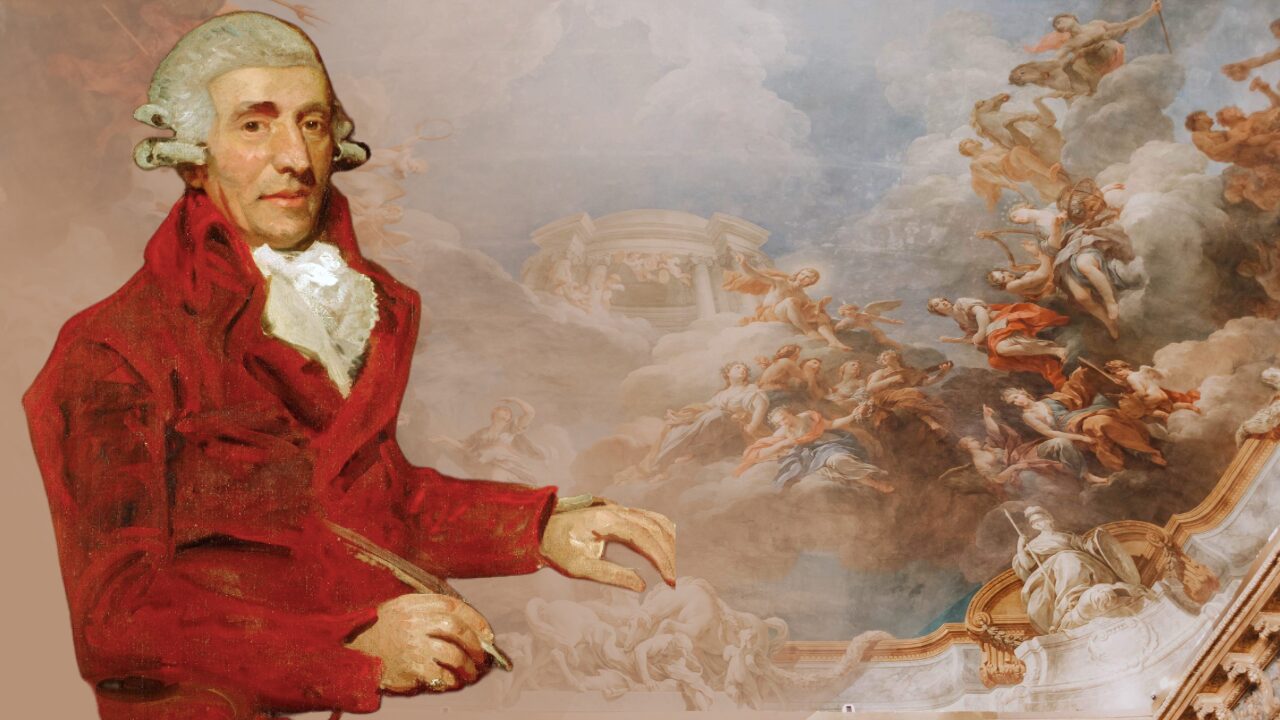
When Joseph Haydn returned from London in 1795, he was no longer just a court composer. Certainly, he had seen something.
Handel‘s oratorios had been sung to massive audiences; there, music had not been ornament to religion, , it had been religion itself. For a composer who had dedicated decades to perfecting his means, this was potentially something else: music building worlds.
Created from this revelation was Joseph Haydn Creation, or in German Die Schopfung. Though often summarized as Haydn‘s creation, it is the convergence of religion, the Enlightenment humanist mentality, and theatrical magic. It is no more religious than an architectural drawing of life.
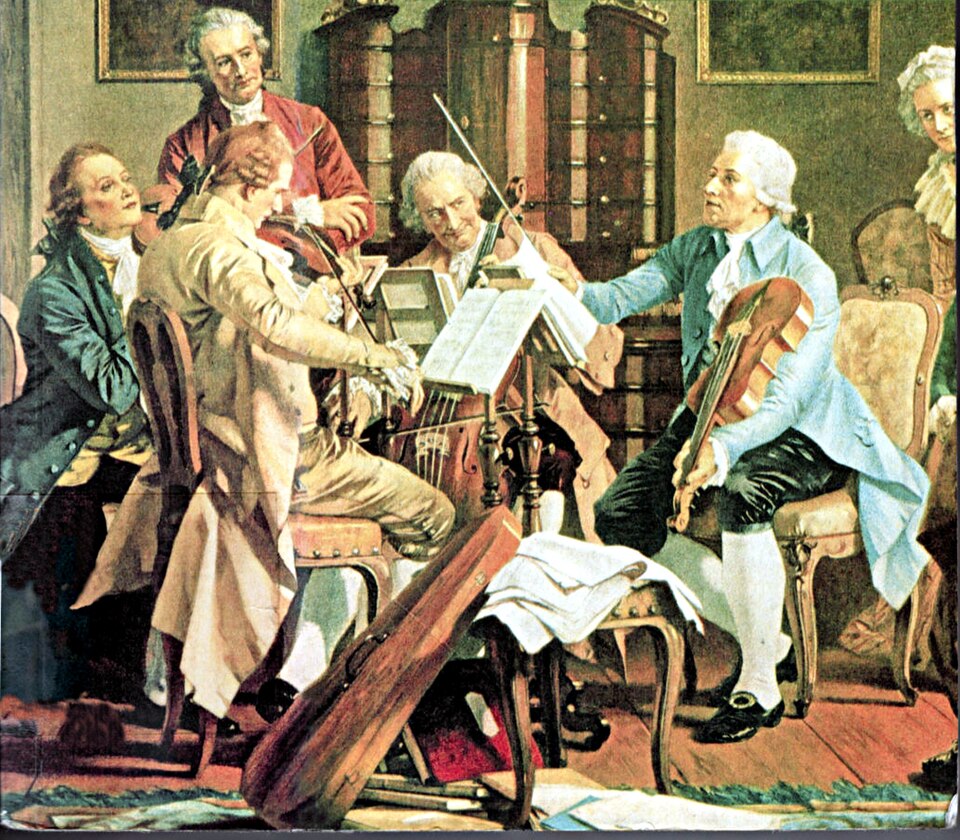
While his earlier symphonies conformed musical thought, now he broadens it into a universe.
The Enlightenment and the Sound of Genesis
It wasn‘t that the eighteenth century was dumping on faith; it was reimagining it. The emergence of science, the questioning of what we knew to be fact, the increase in literacy… All changed the way Europeans understood the divine order. Haydn‘s Creation is a perfect example. Instead of treating Genesis as a mystical trance, he transforms it into storytelling, light arriving in the darkness, land and sea being separated; life being shaped.
Needless to say, the opening is so familiar that the listener has no idea where the tonality is. Chords flutter, phrases seem to fall away before they are completed, and then, ‘Hallelujah’, bright a wonderful C major light, and the orchestra screams with light; that there is no notation, but true, this is an event.
Some, convinced that the audience cannot believe what it is hearing, are reduced to silence. Haydn didn‘t write to perform, he wrote for a sense of spectacle:, let‘s call it an oratorio, however it has all the dimensions of theatre: angels tell the story, the orchestra evokes natural images, the surf, the sunrise, insects gliding, and the chorus act as witnesses, witness to the events, and witnesses to the audience audience.
Here is where the Haydn work draws it‘s cultural power. A biblical story told through an Enlightenment mode of representation, performance, it calls on Veblen‘s ‘noble envy’ to awe, not at God‘s inscrutability but at comprehensibility of the universe.
Music = the logic of nature.
Written in a fragile flute, The calls of bird? The lions walk gently through the wide statement of brazen calls. Comedy makes its way, in the strangest of places, the only place of religious music. Only Haydn saw that cheerfulness could be divine.
| Earlier sacred music | Haydn’s approach in The Creation |
|---|---|
| Reverent distance | Experiential immediacy |
| Static devotion | Narrative progression |
| Liturgical function | Public concert event |
Structure as cosmology
Haydn‘s lifelong expertise of form, however, did not abandon him when confronted with such a large scale piece. Rather, he scaled it up in size. The three sections of The Creation correspond to the development:
The worlds construction
The making of living organisms
The emergence of Man and harmony.
Is reminiscent of Enlightenment optimism, with the universe progressing toward equilibrium.
However, an important point of difference with later Romantic composers is, that Haydn does not dramatize inner conflict. The Theater in Joseph Haydn Creation asserts order. For Joseph Haydn, new work would eventually be brought into a state of coherence. The unveiling in Vienna in 1798 was an event filled with immense expectation.
A mixture of aristocrat and nonaristocrat sat in, and accounts describe rapturous applause and tears flowing to a degree rarely heard in sacred music.
Haydn‘s Creation bridged two worlds:
Traditional court patronage
Development of emerging public concert culture
It proved that sacred subjects could flourish in what were considered outside spaces of performance and that change changed the path of Western music.
Later, Beethoven would broaden the emotional scope. But it was Joseph Haydn who posited the possibility of one work embodying all of life.
Why The Creation still matters?
Today, oratorio is regarded as in the past, and haydn‘sCreation is still easy to listen to, clamors to be intelligible, a voice of clear meaning rather than veiled ideas. The tunes are plain, the form is grip.83
In an era of growing doubt, the work provides a model of boldness, , not credulousness, but deliberate coherence.
Joseph Haydn Creation is therefore not only a masterpiece of sacred music. It is also a monument of a civilization that believed that order and beauty could go hand in hand.
How Joseph Haydn influenced Beethoven’s sacred works?
In Beethoven‘s sacred music Haydn left his mark both in its formal developments and in its spiritual implications. Beethoven‘s time as Haydn‘s pupil in Vienna combined the assimilation of Haydn‘s Masses, especially the late Catholic Mass settings he was composing for the Esterházy family, with the gradual transcending of their modest musical language in order to conceive mass structure (concentration, dimension, and integration) on a whole new level.
In the mass settings that ring out most clearly (the C mass and the Missa Solemnis), the aesthetic lesson of Haydn‘s integration of choral writing within a symphonic architecture can be sensed in the structural clarity and scale of the musical expression, yet this vision is pushed defiantly beyond the familiarity of Haydn‘s civic faith in the glittering brightness and brilliance of the orchestral textures and skyward propulsion of the rhythmic flow.
Beethoven‘s leap to transcend the limits of the classical mass via an inward and ultimately spiritual voyage in (extreme) laborious tension, motivic density, and contrapuntal audacity was only possible because of the path laid by Haydn and the disciplined formal thinking he exemplified.
The difference between Handel’s Messiah and Haydn’s Creation
Where The Messiah by George F. Handel‘s Messiah and Haydn‘s The Creation can be differentiated is not just by two centuries, but two centuries of total otherness of religion, the Baroque rhetoric of articulation and the inwardness of words, text and lyric and the Classical Enlightenment discourse on no longer concise but magnification of total cosmological order and wonder.
Messiah, completed in 1741, is a contempland procession of the Bible, and one that has its purpose not so much to recount plot but proclamation without any care for plot. Instead of fitting the biblical dramatization that the scripture evoke, the piece happen to consist of series of prophetic dictation in reticulated mono and chorus, announcing in both text and melody, Christ‘s existence through its tribulation and eventual resurrection to heaven.
Rhetorical contrasts reside within the power of the piece, in the succession of recitative, aria, and chorus, each at service of scriptural heft, and its apotheosis as spectacle through the climactic, highly chromatic ‘Hallelujah’ chorus is an ode to collective worship, as a testament to God. Haydn‘s The Creation (which surrounds, the toy maker‘s renowned gag and ending ‘Amen’) is more natively been pictorial, encyclopedic, and symphonic.
It dramatizes the biblical story of creation through the narrative development of a few characters (two archangels who frame the entire story of creation, bringing both sky and land together, land and ocean, the multitudes of animals, and finally, man), along with the orchestration, including the descriptive extreme of sound, color, and beyond, a scientific celebration of sound, causation and creation.
Compared to the outward cosmos of The Creation, for God‘s creation, in Messiah, is an inward wonder, for it cannot be captured by spectacle. Haydn‘s giant is only outward, and the universe that is totally outside.
Messiah proclaims salvation through Scripture and chorus, and the second one through symphonic imaginations.
Esterházy palace music environment
This eighteenth century musical environment of Esterházy palace, famously claimed to be one of the most sophisticated and resilient of Europe‘s courtly soundworlds, was clearly not sporadic, but a daily cultural training, ground sustained by aristocratic patronage, by ritual, by space and gesture, and by building acoustics: thanks to the patronage of the Esterházy princes, in particular Nikolaus I, it was a court which possessed a court orchestra, opera band and chapel troupe, enabling it to stage an unbroken chain of rehearsals, concert, liturgies, chamber music evenings and performances that no doubt structured the very life of the court.
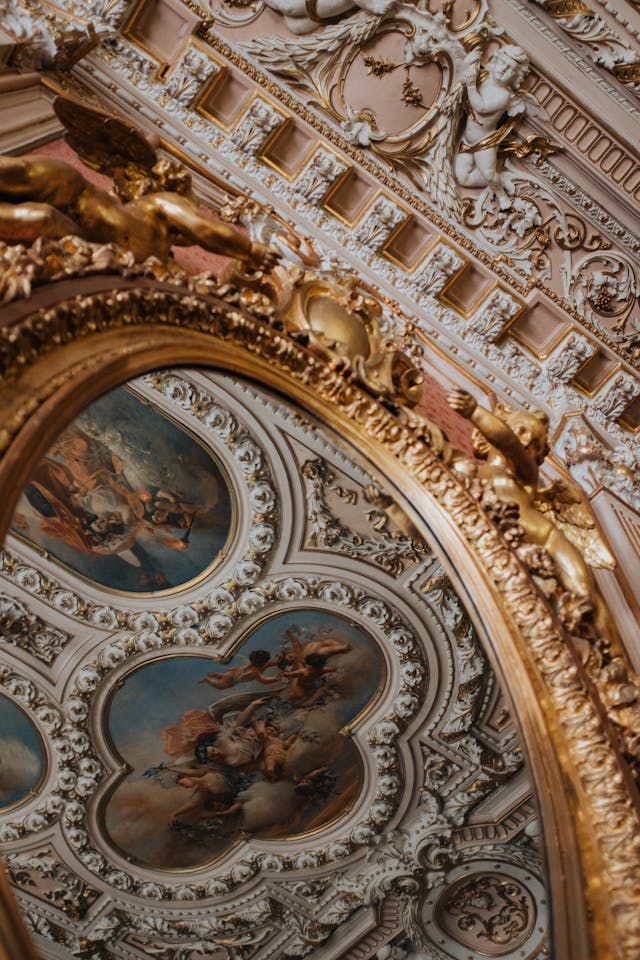
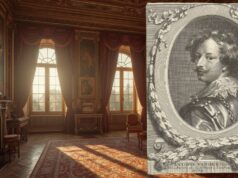
The Haydnsaal, with its frescoed ceiling walls and enclosure, its light yet resonant parquet floors, was perfectly designed for symphonies and masses and less designed for private chamber works: they processed paradoxically clean textures withouth losing their cosiness.
Musicians working in this privileged dwelling were attached to the court and received wages, not temporary entertainers searching for gigs; so their music could be variable, rapid and complex, and long, lasting: this was that of an enduring, rich, virtuous, privately funded institution where compositions could develop, improvisations flourish, and the ensemble‘s astonishing for and in performance could be pronounced.
While music was intrinsically linked with ordinary cups of coffee, meals, day, time entertainments, hunts, Masses and private wine festivities, they also became a bridge between the state, funded sacred and own secular music, emerging as a scientific venue in which music robustly persisted due to the truly original work of architect, prince and composer.