
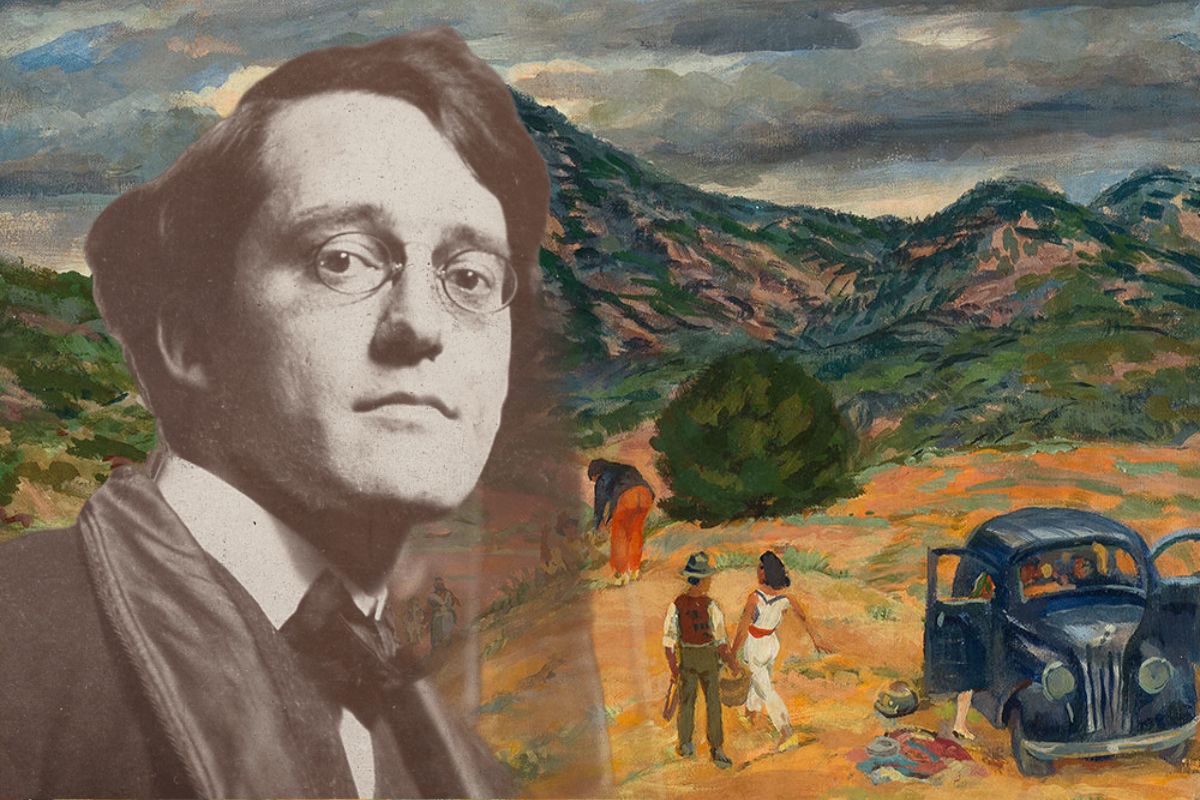
John Sloan
John Sloan (1871–1951) stands among the central figures of early 20th-century American art. A leading voice of the Ashcan School and one of the most astute chroniclers of urban life, Sloan translated the rhythms, conflicts, and intimacies of city streets into a body of work that encompasses painting, drawing, etching, and illustration. His paintings—sharply observed, empathetic, and often candid—documented the everyday theater of New York City and helped shape a distinctly American realism. This article surveys Sloan’s life, training, stylistic development, notable works, market presence, and lasting legacy for collectors, curators, and enthusiasts of American art and antiques.
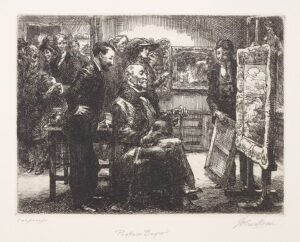
The Picture Buyer
1911
Etching
Early Life
John French Sloan was born on February 2, 1871, in Lock Haven, Pennsylvania, and grew up in the working- and middle-class neighborhoods of Philadelphia. He came of age during a period of rapid urbanization and industrial expansion in the United States; these social changes would provide the subject matter and human context for his mature work. Sloan’s early years were shaped by practical necessity more than formal privilege. From adolescence he prepared for a career in commercial art—apprenticing as a lithographer and working in print workshops—an experience that grounded him in draftsmanship, direct observation, and the discipline of producing work for broad public consumption.
Can You Name the Masterpiece?
Ten masterpieces. Ten questions. How well do you know the history of art?
Family life and neighborhood life in Philadelphia introduced Sloan to the crowded streets, tenements, and street-corner dramas that he would later portray in New York. His modest upbringing and early trade work fostered an interest in representing ordinary people and scenes with integrity and immediacy rather than as subjects of idealization.
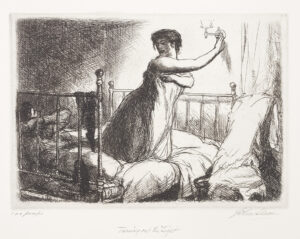
Turning out the Light
1905
Etching
Education and Training
Sloan’s formal artistic education was limited and largely pragmatic. His training began in the commercial arts: he apprenticed in lithography and worked as an illustrator for Philadelphia newspapers and publishing houses. This practical education emphasized speed, clarity of line, and the translation of visual events into reproducible images—skills that informed his later easel work.
Sloan also benefited from the informal mentorship of contemporaries and teachers who helped bridge the world of commercial art and fine art. In the early 1900s he associated with artists and instructors who were shaping a new American approach to painting—most notably Robert Henri, whose emphasis on painting modern life and depicting the vitality of the city resonated deeply with Sloan. While Sloan never pursued a prolonged academic program, his combination of workshop training, self-directed study, and the influence of mentors and peers equipped him with both technical competence and a philosophical approach to subject matter.
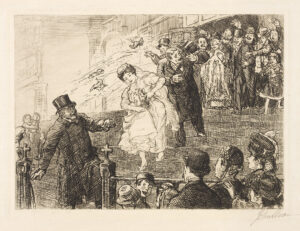
The Little Bride
1906
Etching
Can You Guess the Artist?
Three clues. One artist. How quickly can you identify the painter?
Beyond painting, Sloan taught himself and cultivated a major secondary practice in printmaking—etching and lithography—learning the technical and expressive possibilities of these media and thereby broadening his reach and impact.
Career Development
Sloan’s professional trajectory moved from commercial illustration toward independent artistic practice in the first decade of the twentieth century. At a time when illustrated magazines and newspapers provided steady employment, Sloan honed an eye for narrative composition and the human detail that gives anecdotes visual life. By the early 1900s he had begun to pursue painting and printmaking more openly.
A pivotal moment in Sloan’s career was his association with the group known as The Eight (1908). This loosely affiliated group of painters—Robert Henri, William Glackens, George Luks, Everett Shinn, Arthur B. Davies, Ernest Lawson, Maurice Prendergast, and Sloan—challenged institutional restrictions on exhibitions and championed subjects drawn from contemporary urban life. Although the stylistic range within The Eight varied, the group’s public presence and their protest against conservative exhibition policies helped to foreground realist approaches to American subjects.
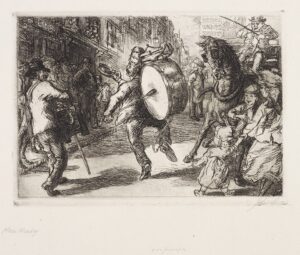
Man Monkey
1905
Etching
Sloan settled into New York City’s Greenwich Village and other urban neighborhoods where he made immediate contact with the everyday scenes that would populate his work: streetcars, elevated railways, saloons, sidewalks, shop windows, and tenement interiors. His acute observation, coupled with a steady output of small oils, drawings, and graphic works, quickly established him as a primary visual chronicler of urban life. He exhibited widely, contributed to print culture, and took on teaching and public roles that broadened his influence.
Throughout his career Sloan remained prolific and versatile—equally comfortable producing intimate oil studies, candid street scenes, or technically confident etchings. He maintained a lifelong commitment to portraying modern life with psychological nuance and social sympathy.
Artistic Style
Sloan’s style is a distinctive blend of realist narrative, expressive draftsmanship, and an economy of means that betrays his commercial-art origins. Several formal characteristics mark his mature work:
– Subject matter grounded in urban life: Sloan focused on the everyday experiences of city dwellers—commuters, shopkeepers, domestic interiors, and street crowds—often privileging moments of quiet interaction or subtle narrative tension.
– Cropped compositions and unusual vantage points: Influenced by contemporary photography and print traditions, Sloan often used off-center framing, truncated figures, and oblique views. These choices create immediacy and the sense that the viewer is a casual observer of life’s theater.
– Muted but rich palette: Early work tends to favor a tonal, earthy palette—grays, browns, olive greens—appropriate to city streets and interiors. He sometimes punctuated these with brighter accents to draw attention to focal details.
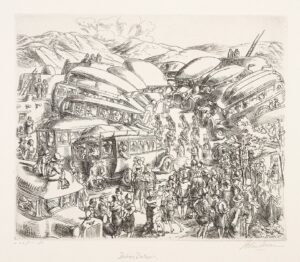
Indian Detour
1927
Etching
– Loose but disciplined brushwork: Sloan’s paint handling is assured and economical. He built forms with confident strokes, avoiding superfluous detail while preserving narrative clarity.
– Graphic construction and line: His background in lithography and illustration shows in the strong contouring and compositional clarity of his work. In prints, his etchings reveal an exceptional command of line.
– Psychological observation: Beyond mere reportage, Sloan’s compositions capture social relations, class disparities, and private emotions in public settings. His paintings hover between sympathy and social critique.
Sloan’s commitment to realism did not preclude experimentation. He adapted ideas from Impressionism, Post-Impressionism, Japanese composition, and photography when they served his aims, but he never abandoned his focus on human experience and narrative.
Influences and Inspirations
John Sloan’s influences were both personal and cultural. Key influences include:
– Robert Henri and the Ashcan circle: Henri’s call to paint modern life and to value direct, unvarnished observation profoundly shaped Sloan’s commitment to urban realism. The camaraderie of artists in this circle provided both intellectual stimulus and professional support.
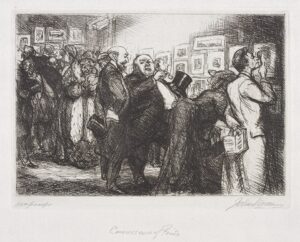
Connoisseurs of Prints
1905
Etching
– Photography and print media: The composition and cropping found in contemporary photography helped shape Sloan’s approach to framing and abrupt viewpoints. His training in lithography attuned him to visual shorthand and compositional economy.
– Japanese prints: Like many Western artists of his generation, Sloan absorbed compositional strategies—flattened space, unusual cropping, and strong diagonals—from Japonisme, employing them to intensify the immediacy of urban scenes.
– European modernists in moderation: Sloan respected modern developments in Europe for their formal innovations but adapted them selectively. He remained committed to figuration and narrative as primary artistic ends.
– The city itself: Perhaps the most decisive influence was the urban environment—its architecture, crowds, transportation, and rhythms—which functioned as both stage and subject. Neighborhood interactions, labor, leisure, and the built environment repeatedly provided the material for his images.
Sloan’s inspirations were thus a fusion of technique, peer encouragement, and the vibrant social fabric of American cities.
Famous Works
Below are five notable works by John Sloan. For each, the entry includes the artwork name, year, medium, and the museum or collection where it is held, along with interpretive commentary.
– Hairdresser’s Window
– Year: 1907
– Medium: Oil on canvas
– Current Museum or Collection: The Metropolitan Museum of Art, New York
– Explanation: Hairdresser’s Window exemplifies Sloan’s interest in urban street life and window imagery. The painting focuses on a storefront tableau: a hairdresser at work, a model head, passersby glimpsed through the glass. Sloan compresses distance and flattens planes to create a theatrical stage of commerce and display, emphasizing the intersection between private service and public spectacle. His careful rendering of reflections and interior detail shows both his observational finesse and his ability to render social rituals with restraint.
– McSorley’s Bar
– Year: 1912
– Medium: Oil on canvas
– Current Museum or Collection: Smithsonian American Art Museum
– Explanation: McSorley’s Bar captures a storied New York saloon with warmth and documentary authority. Sloan portrays patrons and bartenders in the compressed, smoky interior of a neighborhood bar, emphasizing the intimacy and ritual of public drinking spaces. The painting is notable for its strong diagonals, patchy light, and the naturalistic sense of community among its subjects. As an investigation of urban sociability, it ranks among Sloan’s most direct and sympathetic interiors.
– Sixth Avenue Elevated at Third Street (also often titled Sixth Avenue El)
– Year: 1912–1916 (date varies by version)
– Medium: Oil on canvas
– Current Museum or Collection: Whitney Museum of American Art, New York
– Explanation: Sloan painted multiple works that engaged the elevated railways threading through Manhattan. Sixth Avenue Elevated at Third Street (one of Sloan’s variants on the theme) dramatizes the elevated line as both physical structure and social presence—its steel columns and platforms slicing through everyday life. Sloan’s depiction of crowds on the sidewalk, the interplay of light and shadow under the ironwork, and the cropped perspective all evoke the sensory overload of the modern city.
– The Wake
– Year: 1907
– Medium: Oil on canvas
– Current Museum or Collection: Philadelphia Museum of Art
– Explanation: The Wake is an example of Sloan’s interest in public ritual and communal mourning, rendered without melodrama. The painting shows a wake held in a modest interior—family members, neighbors, and the accumulation of domestic details create a poignant tableau of communal care. Sloan’s tonal subtlety and attention to everyday gesture transform a conventional subject into a humanizing portrait of working-class life.
– Interior—Night (also known as Night Windows)
– Year: 1910
– Medium: Oil on canvas
– Current Museum or Collection: Art Institute of Chicago
– Explanation: In Interior—Night, Sloan uses windowed interiors as a device for narrative compression and sociological observation. Lit interiors with silhouetted figures, domestic clutter, and the contrast between interior warmth and exterior darkness underscore themes of privacy, urban isolation, and the thin membrane separating public and private life. The painting’s interplay of light and shadow and its suggestive, rather than explicit, gestures invite viewers to imagine the narrative beyond the frame.
Note: John Sloan produced multiple versions and related compositions on certain themes (e.g., elevated trains, bar interiors, hair salons), and collections often hold different variants. Museum holdings can vary by title and date; readers are encouraged to consult current museum catalogs for precise accession details.
Legacy and Influence
John Sloan’s legacy is multi-layered. Artistically, he helped legitimize an American realist tradition that prioritized the life of the city, the dignity of ordinary people, and a direct, unsentimental mode of observation. His work provided a foil to both academic historicism and the more abstract impulses rising in modern art, asserting that contemporary life was itself a deserving subject for serious painting.
Sloan’s influence extended through his teaching and public presence. He taught and mentored younger artists, edited and contributed to art publications, and participated in exhibition reform movements that reshaped American curatorial practices. His printmaking—etchings and lithographs—helped disseminate his images to broader audiences and contributed to the establishment of American printmaking as a respected art form.
For later generations, Sloan’s intimate, humane portraits of urban life offered a model for social realist tendencies and narrative painting. Contemporary scholars and curators continue to engage his work as both a historical document and a study in the ethics of representation: how an artist depicts class, gender, labor, and the crowd without resorting to sensationalism or sentimentalism.
Market Value and Collectibility
John Sloan’s works are actively collected and represented in major American institutions. The market for Sloan’s paintings and prints has been consistently strong among collectors of early 20th-century American art, especially those focused on Ashcan School artists and urban realism.
– Paintings: Prices for Sloan’s oils vary widely depending on subject, size, condition, provenance, and rarity. Small study oil paintings and genre scenes tend to sell in the mid-range market, while mature, iconic urban scenes or large works that are museum-quality can command significantly higher prices at auction and in the dealer market.
– Prints and Drawings: Sloan’s etchings and lithographs are more accessible to collectors and often trade at moderate prices relative to his paintings. Condition and edition status (for prints) are critical considerations. Drawings, especially those with strong provenance, are sought after for their directness and draftsmanship.
– Provenance and Exhibition History: Works with clear provenance, inclusion in important exhibitions, or published scholarship typically achieve premium prices. Museum-quality pieces that have been exhibited or illustrated in major catalogs raisonné or monographs are particularly desirable.
– Authentication: Given the popularity of Sloan’s work, authentication and condition reports are important. Buyers should seek expert advice, documented provenance, and condition assessments from qualified conservators or dealers specializing in American painting.
For collectors focused on Ashcan School material culture—paintings that capture an era of American urban transformation—John Sloan remains a central figure whose works offer both cultural resonance and investment potential. The market fluctuates with broader trends in interest for American modernism and museum attention to realist traditions.
Museums and Collections
John Sloan’s works are represented in major public institutions across the United States. Notable museums holding Sloan paintings, drawings, or prints include:
– The Metropolitan Museum of Art, New York
– Whitney Museum of American Art, New York
– Smithsonian American Art Museum, Washington, D.C.
– Philadelphia Museum of Art, Philadelphia
– Art Institute of Chicago, Chicago
– Museum of Fine Arts, Boston
– Brooklyn Museum, New York
– National Gallery of Art, Washington, D.C.
These institutions provide public access to Sloan’s key themes—urban life, interiors, and printmaking—and maintain archival resources for scholars. Many regional museums and university collections also hold Sloan’s work or important examples by contemporaries of the Ashcan movement.
Interesting Facts
– From Commercial Art to Fine Art: Sloan’s apprenticeship in lithography and early career as an illustrator provided technical training that made him an unusually versatile artist—comfortable in both graphic media and painting.
– Chronicler of the City: Sloan is often described as a visual journalist of urban life; he painted not grand allegories but the humdrum and humane moments of everyday existence.
– Prolific Printmaker: Besides oil painting, Sloan produced hundreds of etchings and lithographs, helping to popularize modern printmaking in America.
– The Eight and Exhibition Reform: Sloan’s association with The Eight helped catalyze changes in exhibition practices and broadened opportunities for artists working outside academic constraints.
– Teacher and Writer: Sloan lectured and wrote about art, helping to shape public understanding of modern American painting and to mentor younger artists in realist traditions.
FAQ
Who was John Sloan and why is he important?
John Sloan (1871–1951) was an American painter, illustrator, and printmaker associated with the Ashcan School. He is important for his vivid, unsentimental portrayals of urban life in the early 20th century and for helping to establish a realist tradition in American art that emphasized contemporary subjects and the dignity of everyday experience.
What are the defining characteristics of Sloan’s artistic style?
Sloan’s work is characterized by its focus on urban subject matter, cropped and photographic compositional devices, muted tonal palettes with strategic color accents, and an economy of brushwork informed by draftsmanship. He balanced narrative clarity with psychological depth, rendering public scenes with subtle social insight.
Which museums have important John Sloan works on view?
Major institutions with significant Sloan holdings include the Metropolitan Museum of Art, the Whitney Museum of American Art, the Smithsonian American Art Museum, the Philadelphia Museum of Art, and the Art Institute of Chicago. Availability varies; check museum catalogs or online collections for specific works and exhibition schedules.
How do I evaluate or authenticate a John Sloan work?
Authentication should involve provenance documentation, exhibition and publication history, technical analysis (materials, canvas or paper type), and expert consultation. For prints, verify edition numbers and publishers. Working with reputable dealers, museum curators, or accredited appraisers is essential, and conservation reports can identify later alterations or restorations.
Are John Sloan’s works a good investment?
Sloan’s works are desirable in the market for collectors of American modernism and Ashcan School art. Paintings by Sloan can range widely in price depending on size, subject, and provenance; prints and drawings are generally more accessible. As with any art investment, value depends on condition, rarity, and market demand; collectors should seek expert guidance and document provenance carefully.
—
John Sloan’s art remains a compelling record of a rapidly changing America—an artist who translated the pulse of urban life into images that continue to resonate with clarity, compassion, and historical insight. Whether encountered in museum galleries, auction catalogues, or scholarly writing, Sloan’s work invites sustained attention to the ordinary dramas of city life and the formal strategies that make those dramas visible.
AI Notice: Some visual content in this article may have been created or enhanced using artificial intelligence (AI) for artistic, editorial or illustrative purposes. Learn more about our approach in our AI & Editorial Principles.