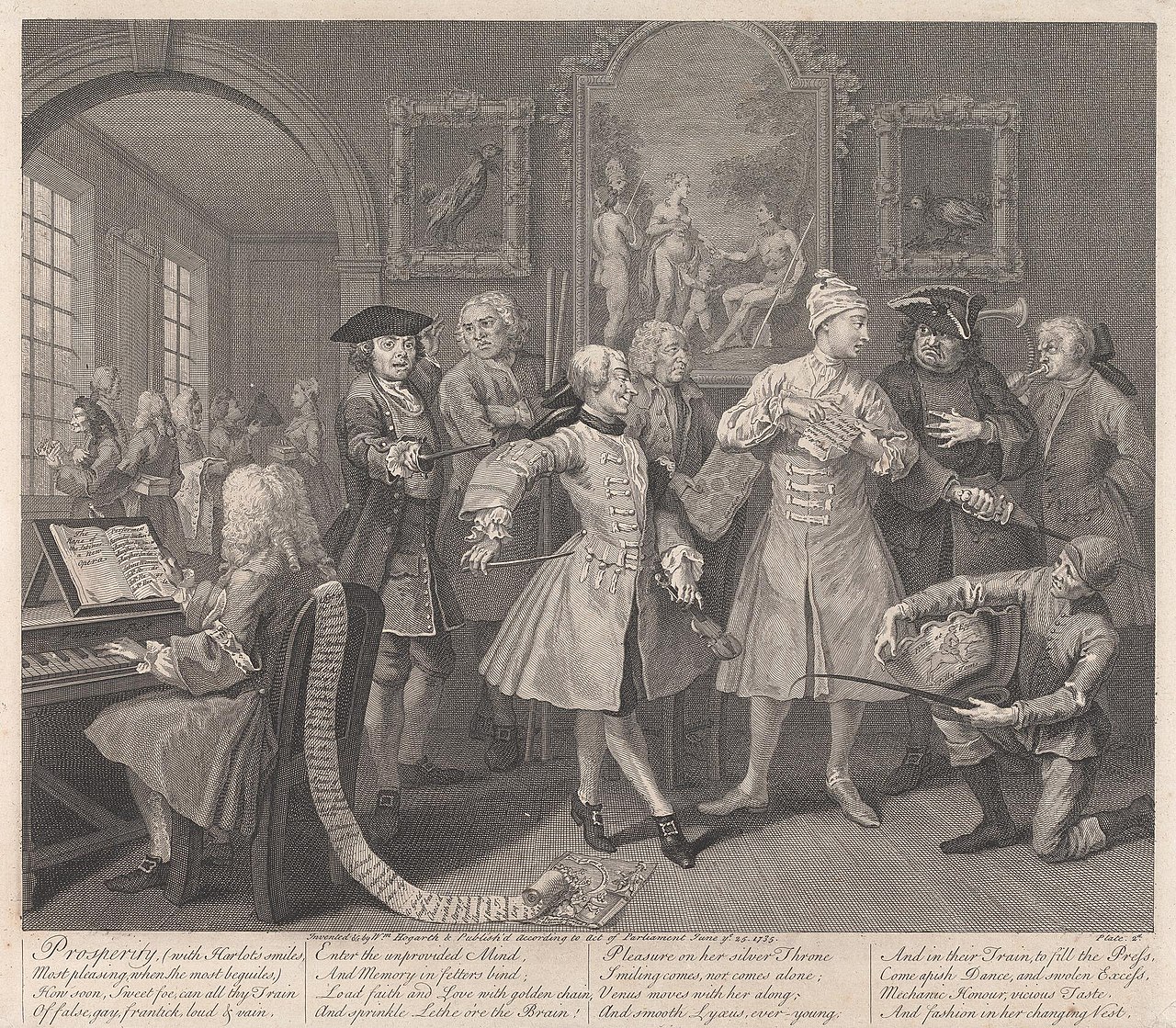
William Hogarth’s A Rake’s Progress (1734–35) is not simply a sequence of satirical pictures—it is one of the sharpest moral instruments ever forged in British art. In eight scenes, Hogarth tracks the swift collapse of Tom Rakewell, a young heir who trades responsibility for spectacle and ends in madness. The story is intensely specific to Georgian London—its pleasure gardens, debtors’ prisons, and bustling streets—yet it remains unnervingly modern in its account of consumption, status-seeking, and self-deception. Hogarth makes the viewer complicit: the images invite laughter, then turn that laughter into recognition.
Hogarth, Georgian London, and the Birth of Modern Satire
William Hogarth (1697–1764) worked in a Britain transformed by expanding commerce, print culture, and urban life. London in the early Georgian period (reigns of George I and George II) teemed with new entertainments and anxieties—credit booms, speculative bubbles, and stark inequality. Hogarth’s art emerged from this city, and it speaks in the city’s dialect: street signage, fashionable dress, legal documents, and recognizable institutions. He trained as an engraver and understood the power of reproducible images at a time when prints could circulate widely beyond elite collectors.
Can You Name the Masterpiece?
Ten masterpieces. Ten questions. How well do you know the history of art?
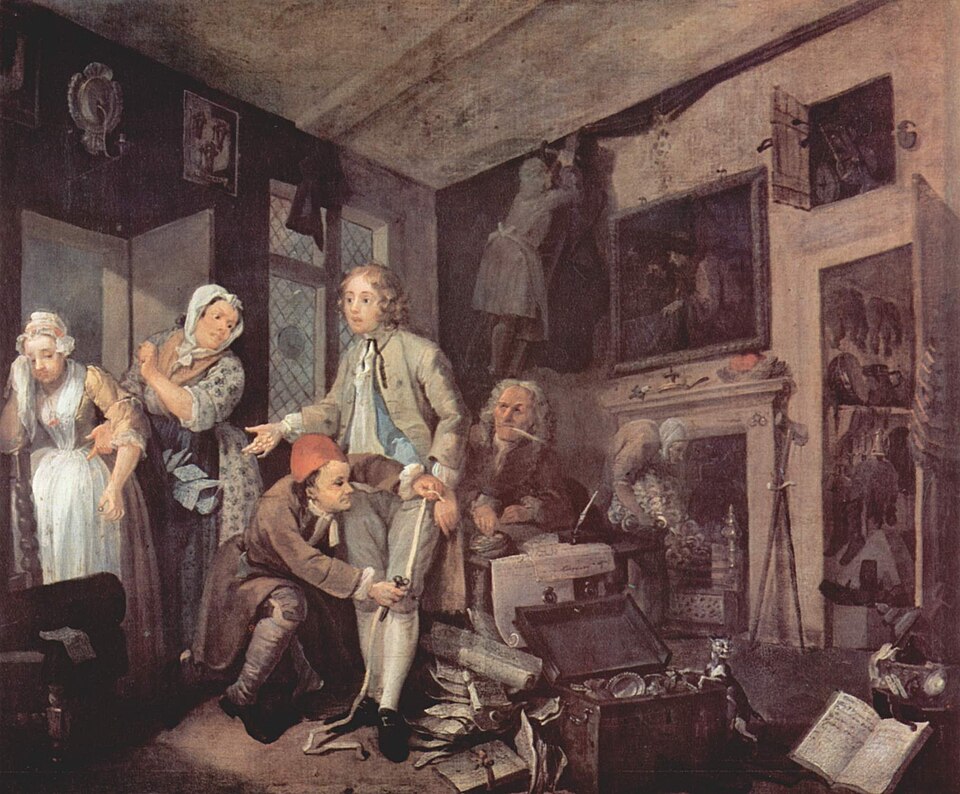
A Rake‘s Progress is one of Hogarth‘s innovative “modern moral subjects,” narrative series created to be read as a comic strip or graphic novel. Hogarth first painted the work, then issued engravings which exponentially increased its circulation. The best-known painted set is owned by London ‘s Sir John Soane‘s Museum, the focal point of the series’ afterlife and related scholarship. The engravings, in contrast, (continues).
Hogarth was clear about what he was trying to do. “His treatise The Analysis of Beauty (1753) laid down rules that helped images be attractive and readable for the normal viewer, not just specialists.” In simple terms, the Metropolitan Museum of Art distills what used to be a complex argument: Hogarth “created a kind of pictorial satire that combined the didactic with the comic. He spread it with engravings.” That mixture the moral (or didactic) property plus mass-market impact may be why A Rake‘s Progress continues to be seen and to inspire.
The Narrative Arc: From Inheritance to Bedlam
The series begins with sudden wealth. Tom Rakewell inherits his miserly father’s fortune, and the first image establishes the moral equation: money without discipline becomes moral freefall. From there, Hogarth moves through spaces that many eighteenth-century Londoners would recognize—tailors, gaming houses, theaters, and brothels—each rendered with documentary relish. The rake’s decline is not abstract; it is built out of contracts, bills, pawned possessions, and compromised relationships.
Can You Guess the Artist?
Three clues. One artist. How quickly can you identify the painter?
Hogarth‘s London contains real institutions that were integral to the city experience. Threats of debt cases and imprisonment hung over every london dwelling and the series ends with the grim logic of that system: oneglad rake is anotherglad creditor, and oneglad creditor is another glad sentencer and the glad sentencer is oneglad prise de corps. The infamous Fleet Prison, for example, signified the world in which debts could most readily be transmogrified into a life sentence. Hogarth makes the city itself seem like just such a machine, machinescaping vanity into catastrophe, without letting Tom off the hook.
The final scene, in Bethlem Royal Hospital, “Bedlam”, affirms the moral. Bethlem was an established London institution, drawing widespread curiosity and spectacle that contributed to the voyeurism surrounding the mentally ill. Hogarth‘s decision to depict the end in this setting is provocative: Tom‘s death has been replaced by exposure, “madness in full view”. The image compels an audience to consider whether they are condemning Tom, forgiving him, or sharing the very voyeurism that doomed him.
Visual Storytelling: Symbols, Details, and Social Critique
Hogarth’s authority as a storyteller lies in his density of detail. Every scene is crowded with objects that function like evidence: unpaid bills, scattered instruments, fashionable accessories, legal writs. He builds meaning through juxtaposition—fine clothing against moral squalor, religious imagery against cynical behavior, luxury goods against human cost. This is narrative painting that thinks like investigative reporting.
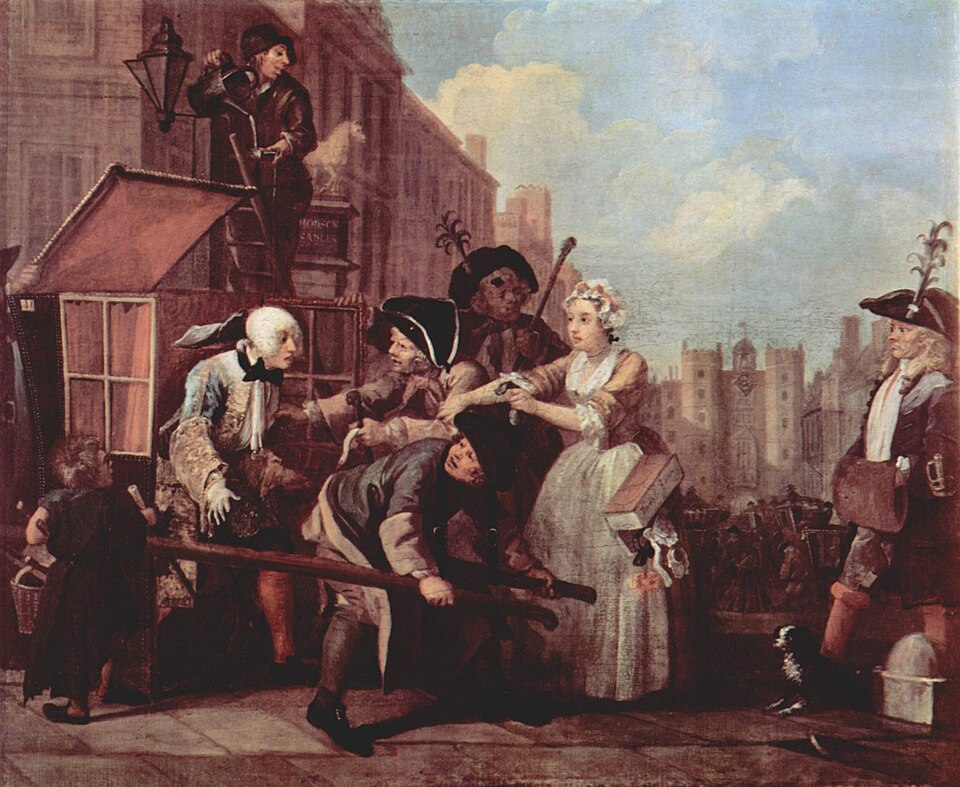
This also offers a critique of performance and social climbing. There are merchants everywhere in Tom‘s world: lawyers peddling salvation; servants selling fidelity; merchants vending identity; friends offering pleasure. The rake is not merely “led astray”; he is an enthusiastic consumer. Marketplaces and institutions fuse: taste is a product and moral conduct is an exchange. The Victoria and Albert Museum, which has a significant collection of British prints and has long studied Hogarth‘s graphic work, stresses how the prints fitted into the burgeoning consumer culture of London.
Hogarth‘s satire is also honed by his technical choices Engraving is a process that allows repetition and repetition fuels debate, and before the term “photography,” an engraved print can be a mass medium. Throughout the Smithsonian Institution‘s essay on print culture, there are a number of aside comparing the publishing power of print to that of other well known mass media “images could reach a multitude of readers, influence thought, and help circulate ideas to a wide audience in the eighteenth and nineteenth centuries.” Hogarth understood that reproducibility was not a detraction from meaning but was part and parcel of the moral project.
Key Characteristics of A Rake’s Progress (Summary Table)
| Aspect | What Hogarth Does | Why It Matters |
|---|---|---|
| Narrative structure | Eight linked scenes with clear plot progression | Makes moral argument feel inevitable and “readable” |
| Setting | Specific Georgian London spaces (pleasure venues, courts, prisons, Bedlam) | Grounds satire in real urban life and institutions |
| Medium | Painted originals plus widely distributed engravings | Expands audience; anticipates modern visual media |
| Tone | Comedy fused with moral warning | Lures viewers in, then confronts them with consequences |
| Detail | Documents, objects, gestures, signage | Turns scenes into social evidence and historical record |
Reception, Legacy, and Where to See Hogarth Today
When Hogarth issued the engravings of A Rake’s Progress in the 1730s, he was operating in a sophisticated print market and a lively culture of theater, journalism, and political satire. The series was popular precisely because it worked on multiple levels: immediate entertainment, moral lesson, and pointed social observation. That layered readability helped secure Hogarth’s reputation during his lifetime and shaped later British graphic satire.
And so the works find themselves blurring between the disciplines of art history and social history. Museums present them as much more than aesthetic successes, but as primary texts of eighteenth-century experience. The Metropolitan Museum of Art offers approachable learned commentary on Hogarth and eighteenth-century British print culture; the Victoria and Albert Museum follows suit with interpretation of his graphic legacy in design and popular culture. The Louvre Museum is undoubtedly dominated by French concerns, but it too provides a wider European perspective on eighteenth-century visual culture as a whole an aspect enabling the understanding of how Hogarth assimilated and struggled against he Continental paradigm.
Contemporary culture tends to focus on the fact that Hogarth is not just a moralist. He is a diagnostician of systems. The Tom Rakewell‘s downfall is individual, but it is equally structural: credit, law, the marriage markets, and the monoculture of cheap entertainment comprise an interrelated machine. Hogarth‘s enduring impact can be appreciated in the editorial comic strips, graphic novels, and continuous visual stories of today. He follows a formula: Tell the truth, make it funny and make the joke sting.
Frequently Asked Questions
What is A Rake’s Progress about?
It tells the story of Tom Rakewell, who inherits money, wastes it on pleasure and status, falls into debt and disgrace, and ends in Bethlem Royal Hospital. Hogarth uses the plot to critique vice, consumer culture, and social hypocrisy in Georgian London.
Is A Rake’s Progress a painting or a print series?
Both. Hogarth created painted versions first and then produced engraved prints for wider distribution. The print edition made the story broadly accessible and helped establish his fame.
Where can I see A Rake’s Progress today?
The painted series is famously associated with the Sir John Soane’s Museum in London. Major museums and print rooms also hold impressions of the engravings; institutions like The Metropolitan Museum of Art and the Victoria and Albert Museum provide collection records and scholarship on Hogarth and related prints.
Why does the series end in “Bedlam”?
Bethlem Royal Hospital was a real London institution and a cultural symbol of madness and social failure. Hogarth’s ending is a moral and social judgment: the rake’s self-made ruin culminates not only in suffering but in public exposure.
Authoritative Sources (Selected)
- The Metropolitan Museum of Art (Heilbrunn Timeline of Art History), essays on William Hogarth and eighteenth-century British prints.
- Victoria and Albert Museum, collection and interpretive materials on Hogarth’s prints and British satirical engraving.
- Smithsonian Institution, resources on printmaking, visual culture, and the historical role of prints in public discourse.
- Louvre Museum, contextual material on eighteenth-century European art and visual culture (comparative context).
A Rake’s Progress endures because it is more than a moral tale: it is a meticulously observed anatomy of a city and an economy of desire. Hogarth’s Georgian London—its institutions, entertainments, and punishments—feels historically precise, yet the series’ deeper subject is timeless: how a life can be spent like money, and how quickly spectacle can turn into sentence.
AI Notice: Some visual content in this article may have been created or enhanced using artificial intelligence (AI) for artistic, editorial or illustrative purposes. Learn more about our approach in our AI & Editorial Principles.