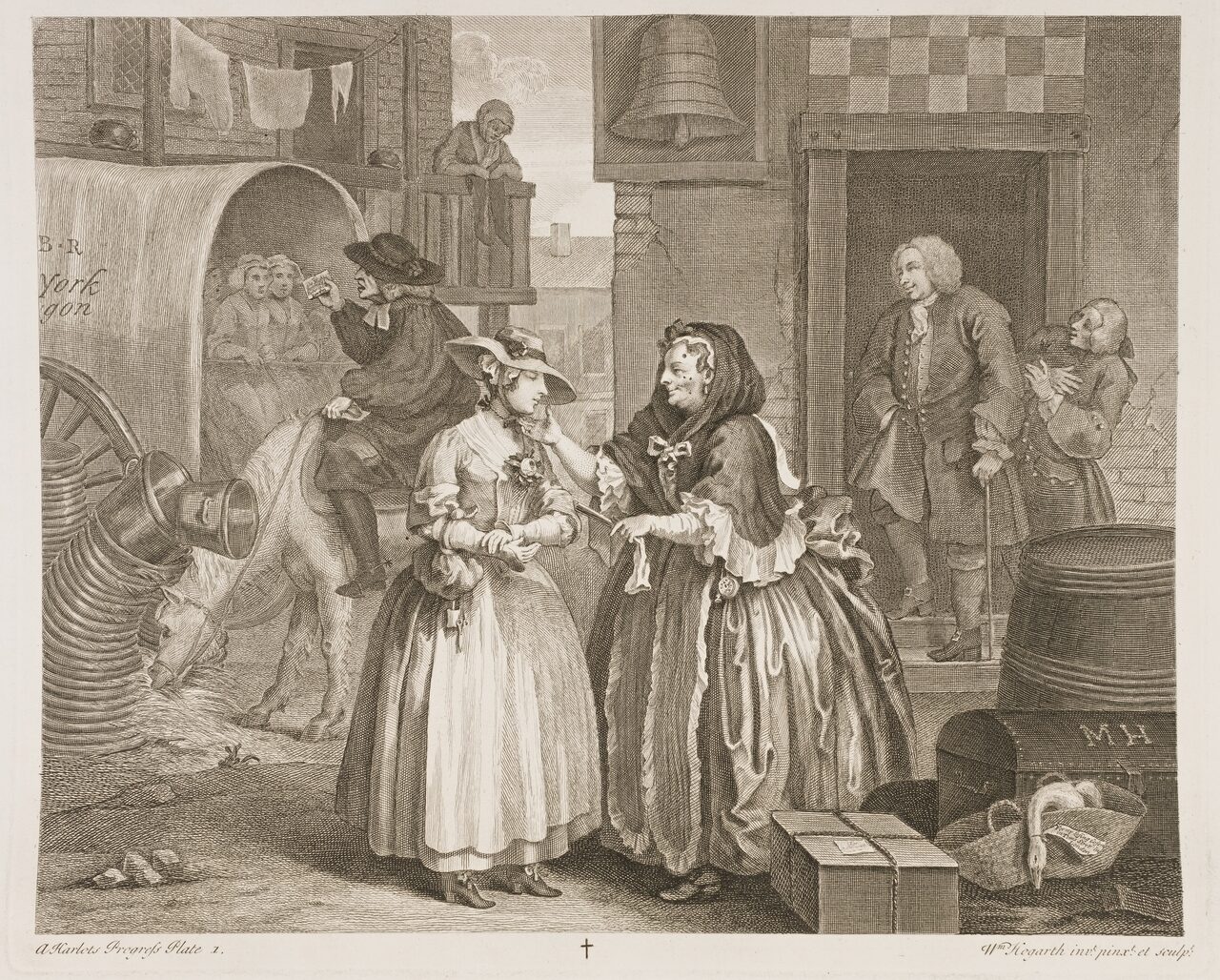
William Hogarth’s A Harlot’s Progress is not merely a famous set of images—it is an unflinching, cinematic indictment of how 18th‑century London could devour the young and poor. In six tightly structured scenes, Hogarth follows a country girl newly arrived in the city and shows, with brutal clarity and dark wit, how sexual exploitation, consumer temptation, disease, and the criminal justice system interlock. The result is both gripping storytelling and social history: a work that helped define the moral “progress” narrative in British art, shaped the emerging public sphere of Georgian London, and still reads today as a warning about predatory economies.
1) Hogarth and the World That Made A Harlot’s Progress
William Hogarth (1697–1764) worked at the center of Georgian Britain’s commercial and cultural boom. London in the 1720s–1730s was Europe’s fastest-growing metropolis: a city of new wealth, print shops, coffeehouses, theatres, and a widening gap between rich and poor. Hogarth understood that modern life was being formed in streets, markets, and bedrooms—and that prints could circulate those realities far beyond elite patrons. His “modern moral subjects” translated the energy of London into sequences that felt like visual journalism, but engineered with the pacing of theatre.
Can You Name the Masterpiece?
Ten masterpieces. Ten questions. How well do you know the history of art?
The institutional landscape of the period mattered to the series’ bite. Policing and punishment were public and theatrical: Bridewell (a London prison and house of correction) disciplined “disorderly” women, while executions at Tyburn drew crowds. Venereal disease and quack medicine thrived in the same consumer marketplace that sold luxury goods. In this environment, a young woman’s vulnerability was not simply personal; it was structural—tied to labor scarcity, migration from the countryside, and the sexual double standard embedded in law, custom, and church discipline.
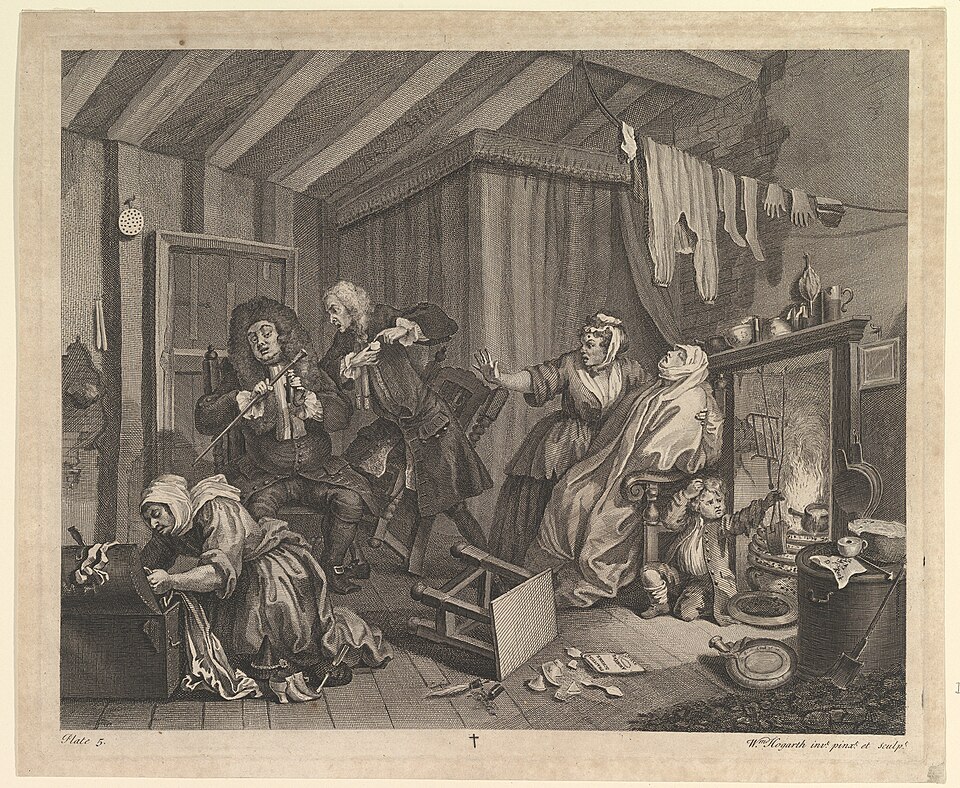
Hogarth was also a sophisticated businessman. The series first appeared as paintings (now lost), then as engraved prints in 1732 that could be sold and collected. The demand was enormous, and the piracy of Hogarth’s images became so rampant that it helped spur legal change. The 1735 Engravers’ Copyright Act—often called “Hogarth’s Act”—is historically linked to his efforts to protect printmakers, showing how A Harlot’s Progress sits not only in art history but in the history of intellectual property and the modern art market.
“I have endeavoured to treat my subjects as a dramatic writer: my picture is my stage.” —William Hogarth, Anecdotes of William Hogarth, Written by Himself (published 1833; reflecting Hogarth’s stated artistic aims)
2) Reading the Six Plates: Story, Symbols, and Social Critique
The narrative tracks a young woman—commonly identified as Moll Hackabout—who arrives in London and is quickly drawn into sexual commerce. Hogarth compresses a life into six scenes: seduction and recruitment, “kept” status, decline, arrest, disease, and death. The power of the series lies in its specificity: clothing, furnishings, gestures, posters, and street signs all function like documentary evidence. Hogarth expects viewers to “read” images the way they read newspapers or plays, decoding moral and social information from details.
Can You Guess the Artist?
Three clues. One artist. How quickly can you identify the painter?
Hogarth’s satire does not spare institutions or audiences. Pimps and procurers are not the only targets; so are consumers of vice, corrupt officials, and a public that treats misfortune as entertainment. In the later plates, the machinery of punishment and poverty closes in—debt, incarceration, and illness become almost inevitable outcomes. The point is not simply that “sin leads to ruin,” but that the city’s economy profits at every step: from sexual exploitation to imprisonment, from quack cures to funerary spectacle.
Museums emphasize how Hogarth used print as mass media with moral ambition. The Metropolitan Museum of Art describes his narrative series as “modern moral subjects,” underscoring how they offered contemporary stories with didactic force rather than classical myth. The Victoria and Albert Museum likewise situates his prints within London’s booming print culture, where images operated as commentary on current life. Seen in that context, A Harlot’s Progress becomes an early, highly influential example of sequential visual storytelling—an ancestor of editorial cartooning and even graphic narrative.
“Hogarth’s serial narratives… were unprecedented in British art and had an enormous influence.” —The Metropolitan Museum of Art (collection and interpretive materials on Hogarth and his narrative prints)
3) Craft, Publication, and the Rise of the Print Public
Technically, A Harlot’s Progress demonstrates Hogarth’s mastery of engraving as an instrument of tone: crisp line for texture and character, dense crosshatching for moral darkness, and compositional staging that guides the eye like a director’s blocking. Because prints were relatively affordable compared with paintings, they could enter homes, taverns, and shops—places where arguments about morality, gender, and class were already active. In effect, Hogarth turned the marketplace into a forum for public ethical debate.
The series also reveals the era’s complicated relationship with sexuality and spectacle. Viewers could condemn Moll while also consuming the titillation of her story; Hogarth plays on that hypocrisy. His audience included the very classes who benefited from the city’s sexual economy, and the prints invite uncomfortable self-recognition. That double address—moral warning and commercial entertainment—helps explain why the works spread so widely and why later artists and writers treated Hogarth as foundational to British social satire.
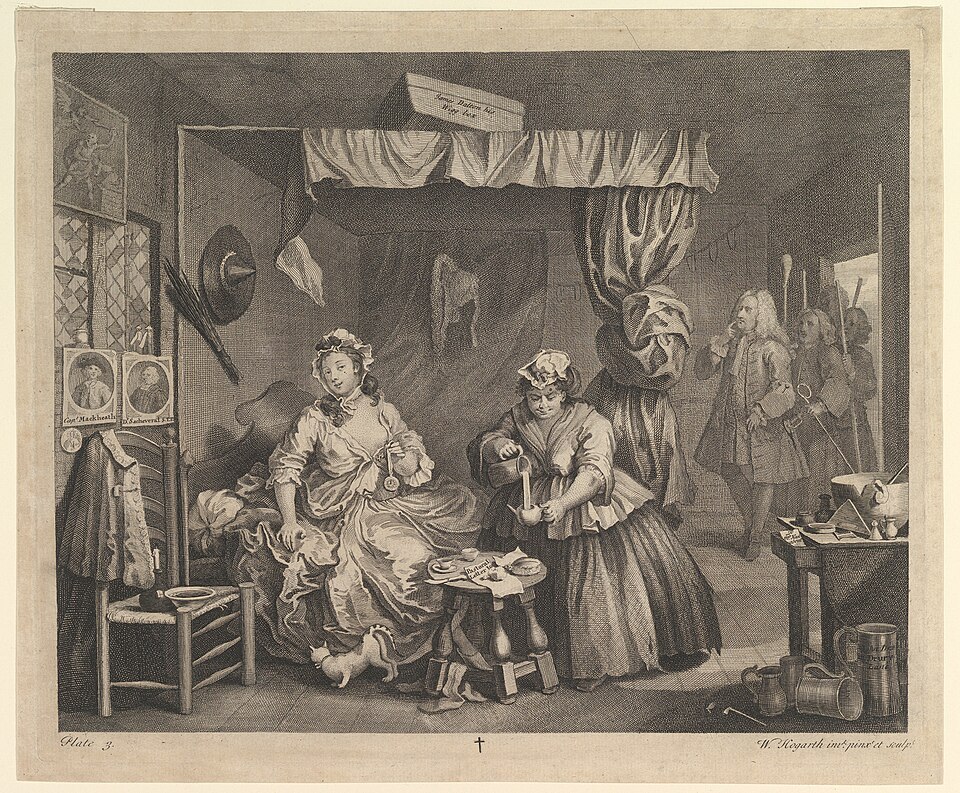
Major institutions continue to interpret Hogarth through this dual lens: art and social document. The Smithsonian Institution’s discussions of satirical prints in the 18th century highlight how graphic art functioned as public commentary—an essential tool for understanding political and social attitudes. The Louvre Museum, while better known for continental painting, also collects and interprets works on paper that demonstrate how European print culture shaped modern visual literacy. Placing Hogarth among these collections clarifies his international significance: London’s “modern moral subject” became a European model for narrative satire.
“Satirical prints were a powerful form of mass communication in the eighteenth century.” —Smithsonian Institution (interpretive essays and collection materials on prints and visual satire)
Key Characteristics of A Harlot’s Progress (Summary Table)
| Aspect | What it is | Why it matters |
|---|---|---|
| Medium | Engraved print series (after paintings) | Enabled wide distribution and repeat viewing; helped shape a mass audience |
| Structure | Six sequential “plates” | Early landmark of sustained visual narrative and moral progression |
| Setting | Georgian London (notably its streets, interiors, and institutions) | Anchors the satire in real urban systems: vice markets, prisons, and commerce |
| Themes | Exploitation, hypocrisy, consumerism, punishment, disease | Moves beyond personal vice to social critique of structures and incentives |
| Style | Satire with dense symbolism and theatrical staging | Encourages close reading; blends entertainment with moral argument |
| Historical impact | Linked to debates on piracy and copyright | Contributed to the 1735 Engravers’ Copyright Act (“Hogarth’s Act”) |
Frequently Asked Questions
1) What is A Harlot’s Progress about?
It is a six-image narrative following a young woman’s arrival in London and her rapid descent through sexual exploitation, arrest, illness, and death. Hogarth frames the story as a “progress” in the ironic sense: a step-by-step route to ruin shaped by the city’s predatory economy.
2) When was it made, and why did it matter then?
The engraved series was published in 1732, during the Georgian period when London’s print market was booming. It mattered because it used an affordable medium to deliver a vivid contemporary story to a broad public, helping define what museums now call Hogarth’s “modern moral subjects” (The Metropolitan Museum of Art).
3) Is the series purely moralistic?
It is moral, but not simplistic. Hogarth condemns vice while also exposing how institutions and consumers profit from it. The prints implicate viewers in a culture that turns suffering into spectacle—an angle that aligns with museum interpretations emphasizing Hogarth’s social critique (V&A; Met).
4) Where can I see works by Hogarth or learn more from credible institutions?
The Metropolitan Museum of Art and the Victoria and Albert Museum provide accessible scholarship and collection information on Hogarth’s prints and context. The Smithsonian Institution offers broader interpretive resources on satirical prints and visual culture. The Louvre Museum’s works-on-paper resources help situate printmaking within a European tradition.
5) How did A Harlot’s Progress influence later art?
It helped establish sequential visual storytelling as a serious vehicle for social commentary. Its mix of narrative pacing, symbolic detail, and topical critique influenced British satire, caricature, and later forms of visual journalism.
Authoritative Sources (Selected)
- The Metropolitan Museum of Art — essays and collection entries on Hogarth and “modern moral subjects.”
- Victoria and Albert Museum — collection research on Hogarth’s prints and 18th‑century British print culture.
- Smithsonian Institution — interpretive materials on satirical prints and mass communication in the 18th century.
- Louvre Museum — works-on-paper and printmaking context within European art history.
A Harlot’s Progress endures because it is simultaneously art, narrative, and evidence. Hogarth captured Georgian London with an almost forensic attention to detail, then arranged those details into a story that exposes how a modern city can monetize vulnerability at every stage. Museums from London to New York continue to treat the series as foundational—not only for British satire and printmaking, but for understanding how images can shape public conscience in an age of mass media.
AI Notice: Some visual content in this article may have been created or enhanced using artificial intelligence (AI) for artistic, editorial or illustrative purposes. Learn more about our approach in our AI & Editorial Principles.