
Artemisia Gentileschi’s Susanna and the Elders is one of the most searing images to survive from early Baroque Italy—not because it is sensational, but because it is unmistakably intelligent. Painted by a young woman working in a culture that treated female artists as anomalies, the work turns a familiar biblical subject into a psychologically precise scene of coercion and fear. Rather than presenting Susanna as a decorative nude (as many artists did), Gentileschi makes the viewer feel the pressure of unwanted scrutiny and the imbalance of power. The painting’s authority lies in its clarity: it does not ask you to admire Susanna; it asks you to understand what is happening to her.
A Baroque Masterwork Reframing a Familiar Story
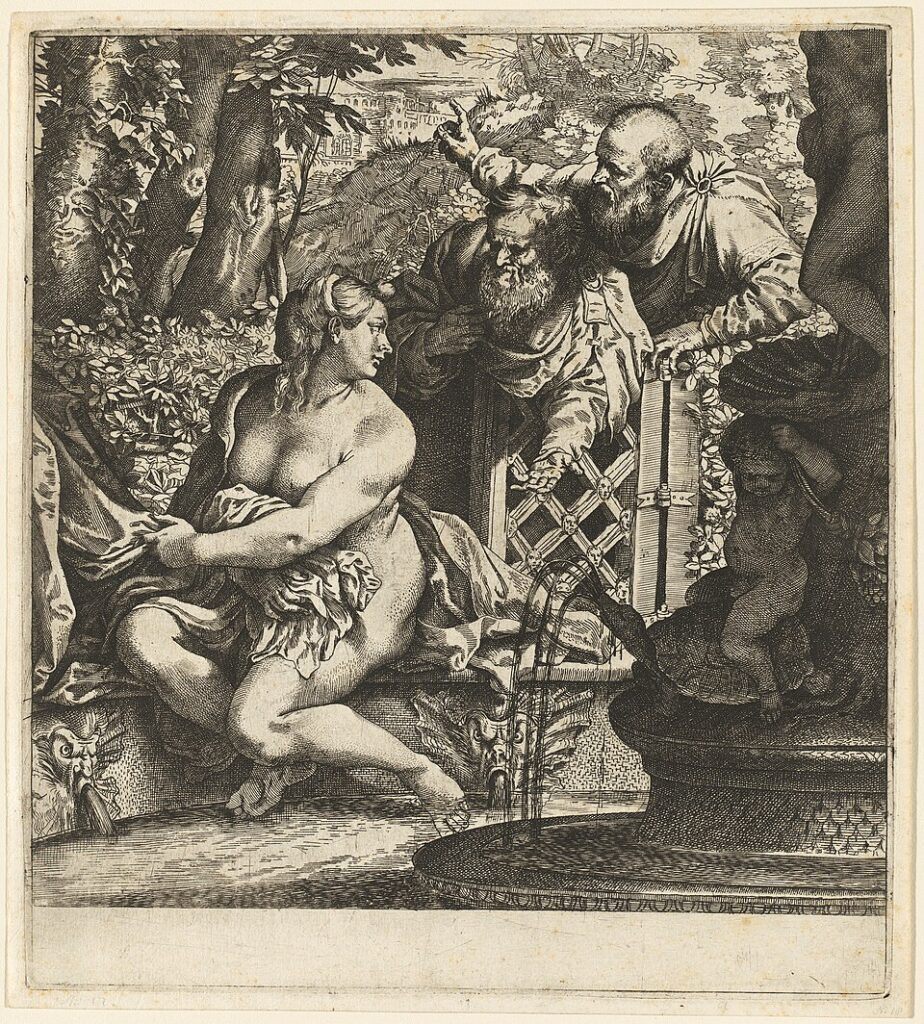
This theme, borrowed from the Book of Daniel (and circulated in early modern Europe via the apocrypha), presents Susanna as being watched while bathing and then accosted by two elders who ask for sex on pain of blackmail. Renaissance and Baroque painters took the theme as an excuse to present the female nude, often painting Susanna in a composed or even alluring pose with the men serving only as plot mechanisms. Gentileschi breaks with this tradition. Susanna‘s pose is recoiling, twisting and protective.
This is also closely in line with what scholars and museums describe as Artemisia‘s unique contribution to Baroque painting: her realism of psychology, her willingness to recenter women‘s experiences. The Met calls her paintings full of “dramatic intensity” and agency and emotional power for heroines (Heilbrunn Timeline of Art History essays on Artemisia Gentileschi; Italian Baroque painting). In Susanna and the Elders, that intensity is, rather than dramatic or spectacular, physiological: an anatomy of resistance.
The painting also belongs to a broader historical moment: early 17th-century Rome, when Caravaggism and naturalism reshaped European art. Artemisia—trained in her father Orazio Gentileschi’s workshop—absorbed the era’s taste for strong contrasts, credible figures, and narrative immediacy. Yet her realism is ethical as much as optical: the event reads not as erotic entertainment but as a crisis unfolding in real time.
Artemisia Gentileschi: Training, Rome, and a Professional Identity
Artemisia Gentileschi (1593–c.1654) came to painting in the Rome of the Counter-Reformation. The chief projects are dictated by papal contracts, orders, and rich families. Her father, Orazio Gentileschi, was a celebrated painter in the orbit of Caravaggio. Her earliest securely attributed paintings exhibit assured draughtsmanship and mature handling of flesh, drapery and spatial setting: clear evidence that they are from an apprenticeship, not the amateur studio.
Her career took her to many of the best-known artistic centres of Europe Florence, Rome, Venice and Naples all connected by courts and centres of learning. In Florence she was the first woman to become a member of the Accademia delle Arti del Disegno, a detail often mentioned in the institutional biographies and exhibition catalogues an indication of how her professional status was accepted, especially given that women in her era were systematically barred from access to artistic education and networks.
Contemporary institutions have helped solidify this early reinterpretation through writing and exhibitions. The Victoria and Albert Museum mentions Artemisia in its treatments of Baroque art and women‘s work, and the Smithsonian has recognized her as a key figure in revising existing old master canons several times. Combined, the Metropolitan Museum of Art and the Louvre Museum, all of whom have collected, researched, and exhibited Artemisia or her artistic circles, add curatorial evidence to support the contemporary interpretation over legend.
Visual Analysis: Composition, Gesture, and Power
Gentileschi’s composition is built around compression and intrusion. The elders crowd Susanna from above and behind, closing the space and leaving her with no open exit. Their proximity is not incidental; it is the mechanism of intimidation. Susanna’s body turns sharply away, her shoulders tensing as she pushes back into the corner of the frame—an arrangement that makes physical what the narrative describes: the elders weaponize proximity and surveillance.
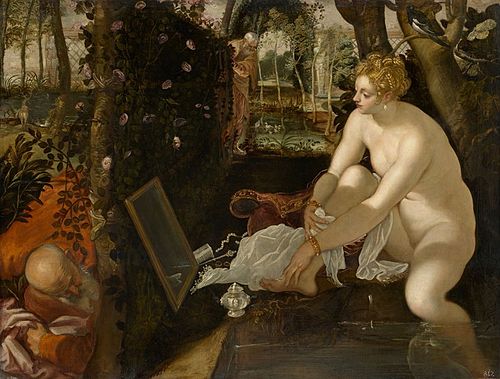
Light and texture further this reading. Instead of an idealized, luminous nude offered for consumption, Susanna’s skin is rendered with weight and vulnerability; shadows carve her torso, and the color contrasts emphasize strain rather than softness. The elders’ faces and hands become instruments—whispering, pointing, pressing—while Susanna’s raised arm becomes a barrier. The painting’s drama does not depend on nudity; it depends on gesture, the Baroque language of emotion.
This interpretive direction is echoed by authoritative art historians. In Artemisia Gentileschi (Yale University Press), Mary D. Garrard argued that Artemisia’s early work can be read as unusually attentive to women’s experience and to the dynamics of sexual threat—an approach that distinguishes her treatment of Susanna from many male contemporaries. In another widely cited assessment, curator Keith Christiansen (long associated with the Met’s scholarship on Italian painting) has emphasized the “dramatic naturalism” and narrative immediacy that situate Artemisia at the forefront of the Baroque. The force of Susanna is precisely that: drama in the service of truthfulness.
Key Characteristics at a Glance
| Aspect | What to look for | Why it matters in Artemisia’s Susanna and the Elders |
|---|---|---|
| Subject tradition | Susanna as a bathing nude | Gentileschi shifts focus from erotic display to coercion |
| Composition | Tight space, elders looming | Visualizes intimidation and lack of escape |
| Gesture | Susanna twisting away, arm raised | Reads as refusal and self-protection, not invitation |
| Emotional tone | Tension, discomfort | Prioritizes psychological realism over decorative beauty |
| Baroque style | Naturalism, strong contrasts | Connects to Caravaggism while asserting her own viewpoint |
| Historical significance | Woman artist in early 1600s Italy | Challenges old master canon and conventional narrative framing |
Reception, Scholarship, and Where to See Related Works
Artemisia’s reputation has undergone major historical swings. In the 17th century she was admired as an exceptional painter; by the 18th and 19th centuries, she was often minimized or filtered through anecdote. The late 20th and 21st centuries—especially through feminist art history and major museum exhibitions—restored her to the center of Baroque studies, not as a curiosity but as a master who shaped the period’s visual language.
Museum scholarship has been crucial here. The Metropolitan Museum of Art offers accessible, peer-informed essays that situate Artemisia within Roman and Neapolitan painting and analyze her handling of biblical heroines. The Louvre Museum, a foundational institution for European painting history, has helped contextualize Italian Baroque art in relation to broader continental developments, including the spread of Caravaggesque naturalism. The V&A and Smithsonian likewise play a public-education role—bridging academic research and broad audiences—by foregrounding women artists and documenting the material culture and institutional barriers of early modern Europe.
For readers seeking authoritative grounding, start with:
- The Metropolitan Museum of Art, Heilbrunn Timeline essays on Artemisia Gentileschi and Italian Baroque painting (metmuseum.org).
- Mary D. Garrard, Artemisia Gentileschi (Yale University Press).
- Exhibition catalogues from major institutions (where available), which provide technical analysis, provenance research, and comparative images.
Frequently Asked Questions
Is Susanna and the Elders a feminist painting?
It can be read through feminist frameworks because it centers Susanna’s distress and shows coercion without romanticizing it. However, “feminist” is a modern term; it is more precise to say the painting is unusually attentive to power dynamics and female vulnerability within a Baroque biblical subject.
How is Artemisia’s version different from earlier Renaissance depictions?
Many earlier depictions treat the story as an excuse for a nude, often presenting Susanna as calm or even complicit. Gentileschi emphasizes intrusion, fear, and resistance—using gesture and compressed space to make the threat unavoidable.
What art historical style does the painting belong to?
It belongs to the Italian Baroque and shows the impact of Caravaggist naturalism—credible bodies, dramatic lighting, and immediacy—while developing a distinct psychological and narrative focus.
Why do museums consider Artemisia Gentileschi so important today?
Because she was a major professional painter in 17th-century Europe whose work stands up to the highest standards of the period, and because her career illuminates how women navigated (and sometimes penetrated) institutions like academies, workshops, and court patronage systems.
Where can I learn more from credible institutions?
Begin with the Metropolitan Museum of Art essays and collection entries; consult the V&A and Smithsonian for broader context on women artists and early modern visual culture; and use the Louvre Museum as a reference point for European Baroque developments and comparative works.
Conclusion
Artemisia Gentileschi‘s Susanna and the Elders is preserved from being simply decorative in that she does not want a morally charged tale reduced to ornamental appeal. Her composition, gestures, and understanding of power show us that the familiar biblical story has become an encounter we may not misinterpret. In the context of the Roman early Baroque, yet so much larger than that, it serves as a standard for what can be achieved when technical mastery and psychological insight align on one canvas.