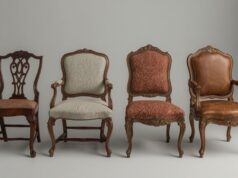

Vintage furniture has a way of making a room feel “collected” rather than merely decorated—and few pieces do that as efficiently as a vintage skinny bench. Long, narrow, and visually light, it can slip into tight spaces where a full settee would overwhelm, yet still deliver real function: a perch for putting on shoes, a landing spot for bags, or an elegant punctuation mark at the end of a bed. The best examples also carry the subtle evidence of craft—aged timber, hand-cut joinery, patinated metal, or upholstery techniques tied to specific eras and workshops.
A vintage skinny bench is not one single style so much as a format that appears across design movements: from Louis XVI-inspired neoclassical lines to early-20th-century modernism and mid-century minimalism. Understanding that lineage helps you buy well, place it confidently, and care for it correctly. As the Victoria and Albert Museum notes in its broader collecting perspective, furniture is “a record of changing tastes, technologies and ways of living” (Victoria and Albert Museum, Furniture collections). A skinny bench makes that record visible—quietly, but unmistakably.
What Defines a Vintage Skinny Bench?
A skinny antique bench is usually skinny (10–14 inches / 25–36 cm) and long and has a light visual weight, that is, a bench intended to accent a circulation path rather than hinder it. “Antique” often describes pieces that are about 100+ years old, though the market frequently places pieces as young as 20 years in the “antique” category (and uses the term “vintage” very broadly). But the best way to classify the bench is to look at the materials, construction, and stylistic clues, not the tag.
The construction itself reveals authentic period furniture from Reproductions, so as you‘re evaluating potential purchases, pay attention to mortise and tenon construction (and maybe pegs), the tool marks on the underside of pieces, and the right materials. For earlier European furniture, you‘re looking for walnut, oak, beech, and mahogany. With the rise of Modernism, tubular steel and plywood appeared. In the mid-century, you can expect hardwood frames and bespoke upholstery. For example, museum collections are an excellent educational resource: the Metropolitan Museum of Art and the V&A each contain collections of furniture, and you can search on-line for details of the construction and materials used in each item.
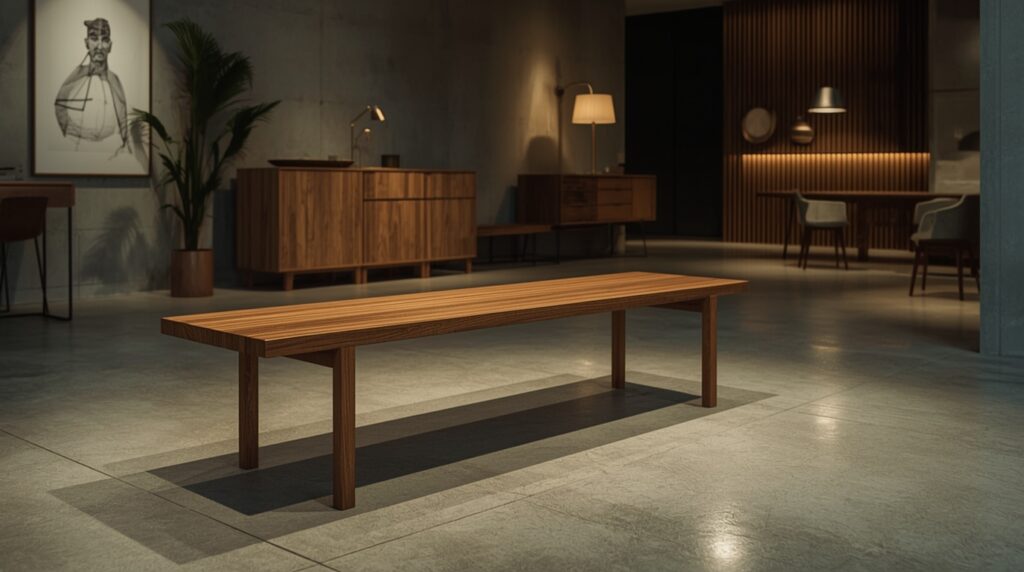
Last of all, skinny doesn‘t have to mean flimsy. A lot of these skinny benches were designed for entryways, hallways, and bedroom footboards high-traffic areas that needed a solid frame. As any trip through the Smithsonian design collections, which are as likely to feature an everyday object as a luxury item, proves, function and design walk hand in hand, and this skinny bench is proof: it addresses a problem of space while giving a hint of the era‘s taste.
Historical Roots: From Neoclassical Halls to Modernist Interiors
The skinny bench has credible roots in European interior traditions where corridors, antechambers, and salons demanded elegant, low-profile seating. In the late 18th century, Neoclassicism—associated with France and Britain—favored straight legs, restrained ornament, and balanced proportions. Benches and stools aligned with the era’s architectural clarity, influenced by the rediscovery and study of antiquity. The Louvre Museum, through its collections of decorative arts and period rooms, situates this classical revival within the broader cultural context of European court taste and craft specialization (Louvre Museum, decorative arts).
By the 19th century, the Industrial Revolution expanded access to furniture, but it also triggered debates about quality and honesty in design. The British Arts and Crafts movement (late 19th century), centered in places like London and the English countryside workshops, emphasized visible craftsmanship and integrity of materials. Narrow benches in this spirit often feature sturdy oak, simplified silhouettes, and hand-finished surfaces. The Victoria and Albert Museum is a key authority on Arts and Crafts design and documents how these ideals shaped furniture forms and domestic interiors (V&A collections).
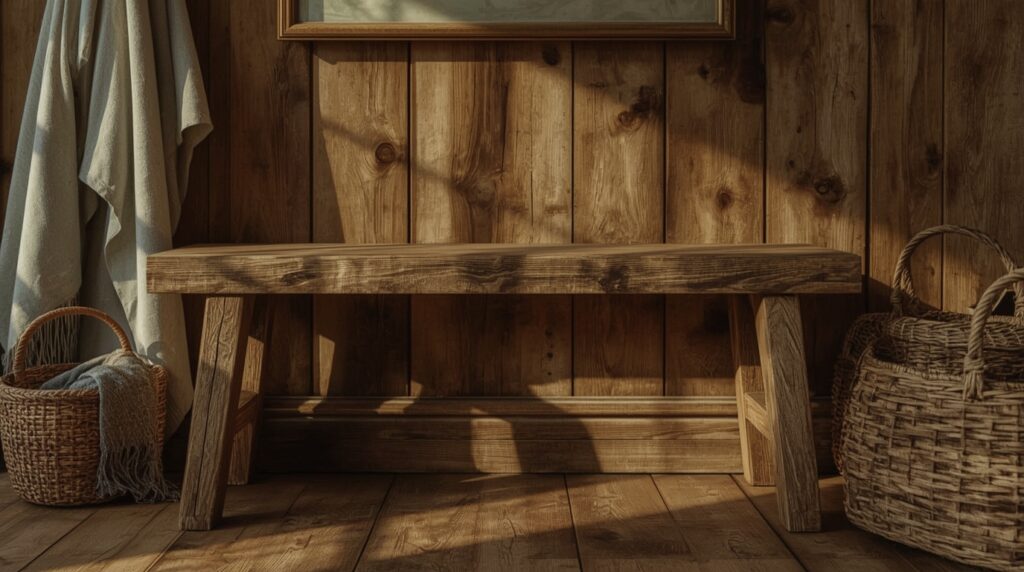
In the 20th century, modernism reframed the bench as a rational object: minimal volume, maximum function. Bauhaus-influenced work in Germany, Scandinavian modernism in Denmark and Sweden, and mid-century American production all produced slim benches suited to apartments and efficient plans. The Metropolitan Museum of Art and the Smithsonian both provide public cataloging and scholarship that show how modern materials—bentwood, tubular steel, engineered boards—reshaped furniture after 1920, and how mid-century design became both refined and widely distributed.
Materials, Construction, and Key Characteristics (with Table)
Materials is the most direct hint of time period and craftsmanship. Earlier benches may consist solely of wood with hardwood elements and standard joinery, while later vintage models would be framed in hardwood, with webbing, foam, and upholstery materials typical of the 1950s or 60s. Wrought iron or steel bases might allude to a more industrial, modernist design, while carving and gilding could hint at a Neoclassical revival or other historical design. The decorative arts scholarship at the Met is a great resource for identifying woods, finishes and construction methods through time (The Metropolitan Museum of Art).
What of the upholstery? You can tell quite a lot here, too. Are those hand-tacked edges? A primitive coil-spring suspension, or do you think you can see stuffing? Possibly hair (an even earlier material) rather than foam or synthetics? Reupholstered isn‘t necessarily the kiss of death many original frames were designed to be repaired but the frame needs to be good, and the upholstery appropriate. Materials age in varied ways, as we at the V&A prove on a daily basis.
Use the table below as a practical snapshot of what to look for when evaluating a vintage skinny bench:
| Characteristic | What to Look For | What It Suggests |
|---|---|---|
| Depth & proportion | 10–14 in depth; long, narrow stance | Designed for halls, bed ends, tight circulation |
| Frame joinery | Mortise-and-tenon, dowels, pegging; consistent tool marks | Higher-quality construction; likely older or well-made |
| Materials | Solid hardwoods, wrought iron, tubular steel, bentwood | Era indicators (18th–19th c. wood; 20th c. steel/engineered) |
| Finish/patina | Wear consistent with use; layered finishes; natural oxidation | Authentic age vs. artificially distressed surfaces |
| Upholstery method | Hand tacks, older springs, webbing; later foam | Helps date or confirm restoration |
| Maker marks | Labels, stamps, hardware signatures | Potentially traceable provenance |
Styling and Placement: Using a Vintage Skinny Bench Well
A vintage skinny bench excels in transitional spaces: entry halls, stair landings, narrow bedrooms, and behind-sofa runways. In an entry, it provides a controlled “pause” point for shoes and bags without visually crowding the door swing. At the foot of a bed, a slim bench can anchor the room like a tailored line—especially when the depth is modest enough to preserve walking clearance. Museums demonstrate this spatial logic in period rooms, where furniture placement often prioritizes movement and conversation rather than maximizing seating (a principle visible across historic interiors in institutions like the Met).
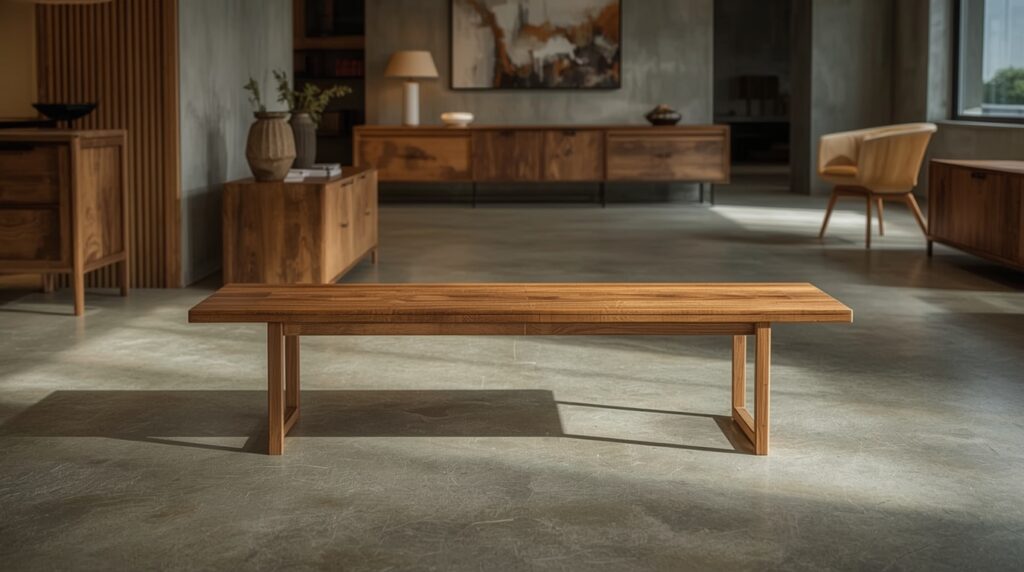
Styling should respect the bench’s era without turning your home into a stage set. A neoclassical or Louis XVI-inspired bench reads best with quiet symmetry—paired sconces, balanced art, and restrained textiles. A mid-century bench can pair with clean-lined ceramics and graphic textiles, while an Arts and Crafts bench can handle textured linens, leather, and handmade pottery. The goal is coherence, not imitation: let the bench supply historic character while the surrounding elements keep the room current.
Scale and negative space are the advanced tools. Because a skinny bench is low and narrow, what surrounds it becomes more visible—baseboards, flooring, rug borders, and wall planes. Choose a rug that extends beyond the bench length to avoid a “floating” look, and keep accessories minimal: one structured tray or a single cushion can be enough. As the Smithsonian’s design-focused collecting often underscores, everyday objects become most powerful when they are thoughtfully edited and used, not merely displayed.
Buying, Authenticity, and Care
Authenticity is best approached as evidence-gathering. Ask sellers for detailed photos of underside construction, joinery, and any labels or stamps; request dimensions and weight; and ask what restoration has been done. Provenance matters—an invoice from an estate sale in Paris, a dealer record from Copenhagen, or documentation tied to a known maker increases confidence. Use museum collection databases (Met, V&A, Louvre, Smithsonian) to compare silhouettes and details with documented examples before purchasing.
Condition issues are normal, but they should be priced honestly. Hairline cracks in old wood can be stable; loose joints, active woodworm, or severe warping are red flags unless you’re budgeting for conservation-level repair. Upholstery can be renewed, but inspect the frame first—if the frame is compromised, new fabric won’t save it. In conservation practice, the aim is stabilization and respect for original materials; museums routinely prioritize minimal intervention, a useful mindset for private owners who want longevity without erasing history.
Care is straightforward but disciplined. Keep the bench away from direct heat sources and strong sunlight; control humidity to reduce wood movement; and use felt pads under feet to protect floors and reduce stress on joints. For wood, avoid heavy silicone polishes—use a gentle wax sparingly if appropriate. For upholstered benches, vacuum with a brush attachment and consider professional cleaning for delicate textiles. When in doubt, consult a qualified furniture conservator—the same kind of expertise relied on by major institutions to preserve objects for decades.
Frequently Asked Questions
What size is considered “skinny” for a vintage skinny bench?
Typically 10–14 inches (25–36 cm) deep. Length varies widely, but many range from 36–60 inches (90–150 cm).
Is reupholstery acceptable on a vintage bench?
Yes. Many benches were meant to be refreshed. Value depends on the quality of the frame, the appropriateness of the new materials, and whether original features were preserved.
How can I tell a reproduction from a true vintage piece?
Check underside construction, joinery, wear patterns, hardware, and materials. Compare with documented museum examples in the Met, V&A, Smithsonian, or Louvre databases.
Where does a vintage skinny bench work best in a home?
Entryways, narrow halls, the foot of a bed, under a window, or behind a sofa—anywhere you need function without bulk.
What’s the safest way to clean it?
Dust regularly; avoid harsh cleaners. Use a conservator-approved approach for fragile finishes or historic upholstery.
A vintage skinny bench is a rare combination: historically grounded, spatially efficient, and stylistically flexible. By learning its defining proportions, tracing its roots through movements documented by institutions like the Met, V&A, Louvre, and Smithsonian, and buying with evidence-based confidence, you can bring home a piece that works hard every day while quietly carrying the design intelligence of earlier eras.