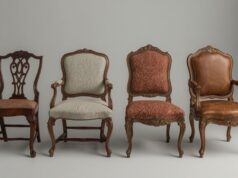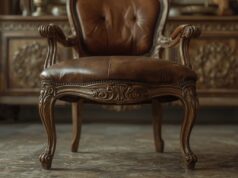

But in the decorative arts, vintage is less an age marker and more an historical standing: a piece‘s interaction with industrial techniques, home-making ideals, and the stylistic vocabularies of its era. The 1920s through the 1970s make sense as a period in the dining room suite context, for instance, because these decades coincide with the proliferation of the dining room in the middle-class home, industrial production breakthroughs, and a sequence of design philosophies that had material and visual footprints. A table and chairs from the 20th century might be read as a record of a family‘s conception of conviviality, from rites of communal consumption to the burgeoning culture of informality.
So the diners of the 1920s and 1930s were a response to urbanization, to smaller city apartments, and to the prestige of revival styles that had already been around for a long time. Even where the companies streamlined and cheapest out of historical style, there was a regard for finish, for proportion, for hardware that often exceeds production of today‘s budget ranges. By the postwar years, and particularly after 1945, diners were a site of experimentation with a modern aesthetic. Lighter visual weight, more thought for ergonomics, and a turn to materials like plywood (shells, bent wood for seating, teak for stability) signaled progress.
But the 1950s and 60s were, perhaps, the zenith of alignement between ideas and production capability. In Germany and Italy, in Scandinavia, in the U. S., the chain of designers, cabinet makers and industrial manufacturers learned to produce joinery, lamination and finishing with predictable quality. Dining tables, photographed relentlessly in home magazines, were stages to enact taste, signals not only of income, but of loyalty to “good design” championed by exhibitions and institutions, as well as shops and sellers.
By the 1970s, tastes fragmented, production globalized, and that definition became tricky. The dining sets from the 1970s are a mix: some are the end of the mid-century tradition in its high-quality iteration; others reflect the increasing pressures of budget and fleeting fashion. “1920s–1970s” makes sense as a shorthand, not just to the historian, but to the prospective buyer, because furniture in this range generally has good structural bones and a clear design heritage, but is still seen frequently on the market (not just in museums).
Style Lineages: Mid-Century Modern, Art Deco, Scandinavian Modern, and the Rustic Farmhouse Ideal
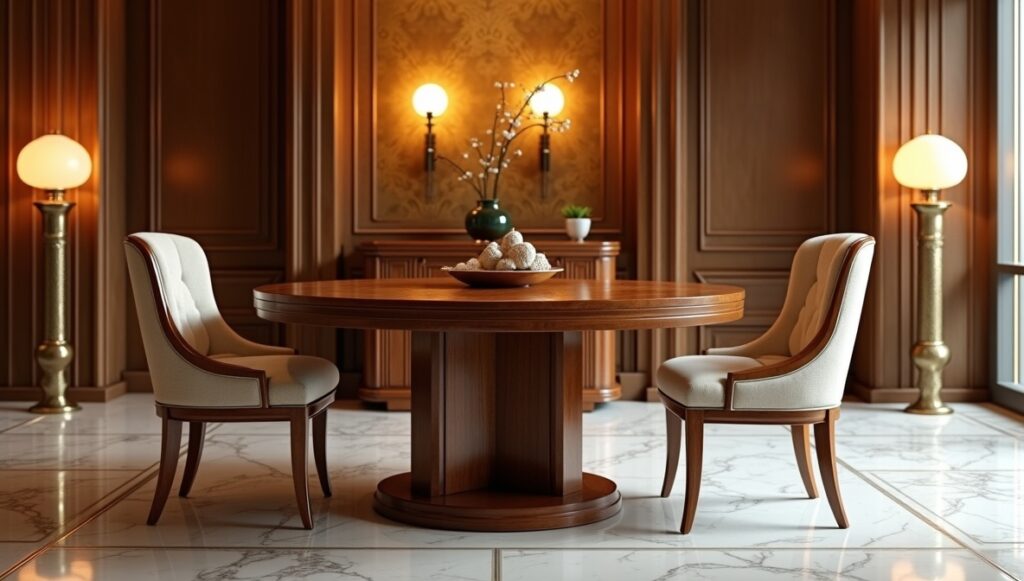
Art Deco dining tables, especially late 1920s–1930s styles, don‘t whisper, they declaim; geometric forms, stepped outlines, bookmatched veneers, and lacquered or high-gloss finishes assert themselves, marrying the craft of the cabinetmaker with a reverence for speed, city lights and the automobile. Even in a museum setting, Art Deco dining furniture is a visual vocabulary of contemporary luxury, and at home, it was about the swagger that came with owning the 21st century. Think dramatic, eye-catching veneers (walnut, mahogany) set in optically compelling patterns for tables, and chairs that hold their shape like buildings but are upholstered in plush fabrics.
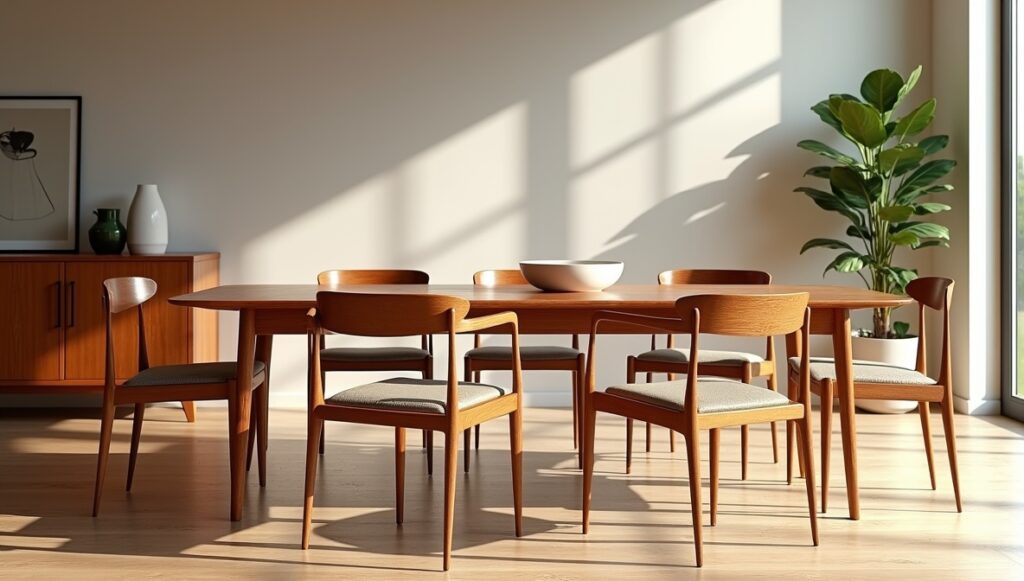
The loose but powerful movement that came to be known as mid-century modern, mostly the latter half of the 1940s through the 1960s, is not a fixed style, but rather a common ethos a conviction that structure is clear, material is true, and form resolves itself without apparent effort. In the US, in particular, the dining set epitomizes this turn toward the casual; eating in from now on, not merely performing it. Long and serene lines were the signature of this relaxed approach: legs tapered and became less weighty, tops seemed to float over their substructures, edge profiles softened, and chairs invited the body, rather than the ritual posture. In the marketplace, anything “mid-century” goes, but with a little scrutiny one sees how American walnut dining sets have their own signature, distinct from Scandinavian teak, both different again from the more sculptural Italian dining suites.
Though often folded in with mid-century modernism, Scandinavian modernism must be examined on its own terms for its social context. Whether Danish, Swedish, or Finnish, furniture makers and designers of this era conceived their creations as a democratized art form: beautifully constructed, scaled appropriately for human living in smaller, brighter rooms. Here, one finds beautiful teak and rosewood veneers, precise joinery, and a controlled sense of proportion. What the archives and museums (e.g., Designmuseum Danmark, Copenhagen) make clear is that the craft education and public-private partnerships that formed these pieces ran deep. A Scandinavian chair might look unassuming, but within its slim lines often exist acutely angled supports and lumber chosen purposefully.
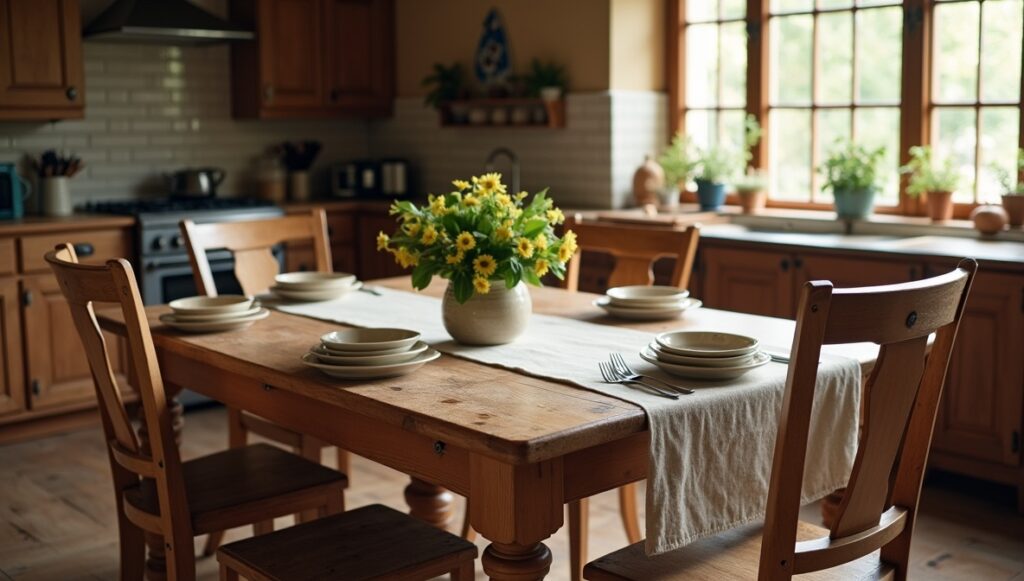
Even the farmhouse table set actual, later replica or something in between works more as symbolism than structure. In the real early to mid–20th century, it might stand for rural continuity and utility, with its rough-hewn thick tops, turned legs, sturdy stretchers, and unpretentious finish that can handle spilled milk and dropped forks. Then, after World War II, “farmhouse” starts to serve as an urban and suburban recreation of authenticity, a way for people in sprawling suburbs or cramped city apartments to inject the authority and authenticity of craft and heritage into their lives. Historians distinguish the two kinds of object the one born of utility versus the one that replicates patina and imperfections for its style value even if their appearance online is indistinguishable.
Materials and Technologies: Teak, Walnut, Oak, Bentwood, Chrome, and Upholstery as Evidence
Wood is one of the easiest indicators of a brand or designer‘s intent and origin. Teak is heavily correlated with Scandinavian (and some British) mid-century production. It‘s desired for its stability and its grain which is fairly warm and uniform. It can read modern and natural. Walnut, a fixture in American mid-century design, is darker and a richer grain. It‘s used often with simplified forms so it doesn‘t look too heavy. Oak has a more traditional, long history but is also seen modern if a designer desires an honest grain and a lighter stain.
Bentwood and molded plywood are technologies as much as materials, with different histories. Bentwood chairs harken back to early 19th century Central European innovations in particular Thonet‘s industrial bending of wood, which created a light and durable seating that lived through the 20th century. Molded plywood came to its full realization and popularity in the mid-20th century, enabling chairs to be molded into complex, curved forms with few components and a new visual language of curves and planes. In collections like that at the Vitra Design Museum (Weil am Rhein), the evolution of these experiments in wood laminating and molding can be seen as changing the face of the modern home.
It‘s at its clearest in the Art Deco and postwar modern eras: chrome and tubular steel offer hygiene and modernity alike surfaces one could readily clean, surfaces that suggested building materials. But it comes with other considerations: the welds; the state of the plating; whether the metal will pit or rust in a damp storage unit. That highly polished, “like new” chrome base might be in great shape on the internet, but the welds could be stressed, or the whole thing might be slightly twisted, only noticeable when the chair is placed on a level floor.
Upholstery of the seat and back (present on the whole range of vintage pieces) can tell stories of home comfort and fabric trends. Springs, webbing, horsehair, foam, and finally, the various kinds of synthetic wadding, all mark different historical moments in technological advancement. On the underside of a chair usually unexplored by the average buyer it‘s possible to identify whether original padding has been maintained, replaced or refurbished, and if the materials make sense according to the chair‘s claimed age. Fabrics as cultural artifacts: Colors and weaves speak of fashion, commerce and the new possibilities in fiber after the war.
Craftsmanship and Construction: Reading Joinery Against Mass Production
Construction is where the decorative arts get investigative. Most vintage dining sets especially those from pre-late-20th-century, let‘s call it “peak cost-cutting” era use joinery meant to hold up: Mortise and tenons, well- fitted doweled joinery, corner blocks, well-placed screws that give and move with the grain rather than fighting it. Under a table. Inside the corners of aprons. Where chair legs attach to rails. These are usually the first place to look to see if an item was crafted with care and patience, or quickly tacked together to hit a selling price point.
In comparison, mass-produced furniture today often focuses on ease of construction and shipping, flat-packing, and common parts. Staples, plastic cam locks, particleboard cores, and less support can work for a short product lifecycle, but these won‘t hold up to the lateral stresses that are applied to a dining chair daily. This is less about sentimentality and ethics and more about changing retail systems, labor expenses, and customer demands. A dining chair is one of the most physically abused objects in the house rocking back, scraping across floor, constantly occupied and the way it‘s built says a lot about how long the manufacturer intended it to last.
Veneer work is another clear area of evidence. Good vintage veneer is capable of being beautifully detailed: bookmatched patterns, balanced cores, lipped edges with solid wood. Dining tables from the Art Deco period can have boldly patterned veneer applied for stage effect; Scandinavian modern tables have veneer handled with more discipline, the grain used as a textured effect instead of decoration. Modern reproductions may have the visual look of veneer, but they often use a thin, cheap layer and poor edge detail, which chips and bubbles.
Hardware and finishes also help date a piece. Head shapes of screws, older adhesives, and the nuances of the type of finish (oil or lacquer) can provide hints. Evidence of a finish that has softened, micro-crazed, and worn in a pattern that looks used is a sign of age. But be aware that distressing can be used to achieve this effect. And again, as my friend the historian would remind you, an artifact is never dated with a single characteristic. It is dated by the sum total of the wood, how it was made, how it is worn, and its style.
Design Characteristics That Signal Authenticity (and How Reproductions Give Themselves Away)
Truly vintage dining sets show harmony between shape and structure: legs join aprons mechanically, chair backs echo body structure, and shapes seem complete instead of trend-driven. On the Mid-Century Modern front, look for minimal, consistent tapering of legs, deliberate shaping of edges, and well-thought-out curvature of chair backs. With Art Deco, be aware of symmetrical veneer patterns, sharp, stepped profiles, and confident contrasts of polished vs. matte.

Copies fail in the “grammar” of the design. Proportions aren‘t quite right a table top too thick, a chair a little too fat, legs too straight as modern manufacturing reworks and scales designs for various materials and prices. Details are also smoothed out what could have been an intricately carved corner becomes a plain radius, what could have been an elegant join is a more obvious bracket, what was a laminated curve is made from a flat piece of wood with a glued shape applied to it.
Labels, stickers, and manufacturer‘s stamps can be useful, but consider them just one bit of evidence, not the final word. Some makers are meticulous with markings; others less so. Marks can be removed during refinishing, and reproduction pieces can have stickers, but when possible try to compare an object to others in a museum collection or archives of design. MoMA‘s permanent collection, for instance, features numerous examples of major 20th-century furniture designs that can offer comparative examples for silhouettes, materials, and manufacturing clues, even if the piece you are considering is not in the museum itself.
Wear itself is a subtle tells. A genuine vintage chair, not an “antiqued” imitation, will have soft rounded edges on the underside of its arms (from hands hefting it), a little wear on the stretcher bars, and slight indentations along the front of its seat. A tabletop will have a constellation of tiny scratches not Hollywood-style carving from being used for dining and cleaned on a regular basis. Artificial aging is always a little too perfect more staged than suffered through.
Evaluating Condition: Structural Soundness, Veneer Health, and the Chair as a Stress Test
So before buying any table or chairs, here are the first things you should consider: Is the set solid? With tables, the best first thing to do is push. Does it wobble or rack? If it has extendable leaves, is there any play to the slides? Do the leaves fit tightly, without gaps? Do the apron rails have newer splits around the screws, which can happen if they‘ve been tightened over and over again? And look on the bottom of tables for blocks of wood or other repairs.

Chairs demand a higher level of consideration than tables, as they are the more vulnerable and more important piece. Try leaning back from the backrest and sliding side to side; any sideways movement is likely due to dry glue or compressed dowels. If there are stretchers, look closely for breaks and repairs, and closely scrutinize the area where the rear legs connect to the back supports. If you see that half a dozen chairs are the same, but one or two are just a slightly different height or angle than the others, one or two have been replaced.
The surface condition can be read more than it can be purely judged aesthetically. An old oil finish may appear dry, but its structure might still be strong; a heavy latter day polyurethane finish may appear “perfect” but hide the woods character and pose challenges to conservation in the future. Check veneer lifting and bubbling at the edges and corners, look for missing chips. A small amount of lifting to veneer can usually be dealt with by a professional conservator, but extensive delaminating generally shows poor storage/water damage and can become an expensive, time consuming problem.
Upholstery adds a layer of possibility and problem. Vintage dining chairs were re- upholstered throughout the years and if it was done well and looks good as is, well, for your own home it‘s perfectly fine but it is a loss of historical interest. If you collect and want authenticity, check what‘s underneath the current fabric what kind of webbing, the tack placement, and any former layers is it appropriate for the period? Smell and staining are the great unknown when shopping online and affect condition.
Common Mistakes When Buying Vintage Dining Sets Online
We make the same mistakes over and over, mostly because we confuse visual style for historical reality. EBay listings will refer to a piece as “mid-century” or “Danish” or “Art Deco” labels that may be evoking a vibe more than a concrete origin. Without the measurements, photos of the undersides, and details on the joints, you‘re buying a silhouette, not a tangible thing. A dining chair can be visually “right” from the front and structurally unsound underneath. A tabletop can look great until you get to the veneer lifting at the edges.
scale. Many dining tables and chairs were made in the earlier part of the 20th century for smaller homes and entertained less formally; tables could be narrower, shorter, and lower than today‘s standards, and chairs could be lower and shorter relative to table height. (Some extension tables, of course, could be so wide they‘d take up your entire apartment.) Don‘t hesitate to ask for exact dimensions (table height, apron height, chair seat height, chair height, chair width), and measure.
Shipping risk is another hidden pitfall for buyers. Dining chairs splinter if you don‘t load them straight a “bargain” that costs thousands to fix (if you can find someone who matches vintage veneer) is not a bargain. Table legs can split and corners can be smashed. Find out what protections they use on corners and legs; how will they secure moving parts?
There‘s a final pitfall, that of a “set” being a unified entity. Chairs have been refinished and reupholstered over time, usually not all at once. This is a nice patina, perhaps, but should be disclosed and reflected in price. Ask if the chairs are original to the table, if the finishes are the same when examined in bright light, if parts have been replaced. For a collection, you want them to make sense. For a decorating scheme, harmony might make sense just be clear about it.
Restoration and Refinishing: Conservation Ethics, Practical Repairs, and When Value Is Lost
Restoration is not a single act but a spectrum—from gentle conservation to aggressive alteration. In a museum-oriented framework, the aim is to preserve original material and finish wherever feasible, stabilizing rather than reinventing. For private owners, daily use introduces legitimate needs: chairs must be safe; tables must function; surfaces may need protection. The critical question becomes: can the work be done in a way that respects the object’s period character and does not erase the evidence of its making?
Refinishing is the most common point where value is lost, especially for sets with collector interest. An original finish—even if worn—often carries the subtle tonalities and surface textures that define a period object. Stripping to bare wood and coating with a modern, glossy finish can flatten these qualities and, in some styles, make the piece look newly made in the wrong decade. For teak and walnut mid-century sets, heavy sanding can also thin veneers, soften crisp edges, and permanently alter profiles that were central to the design.
That said, not all refinishing is vandalism, and not all originality is sacred in domestic furniture. Some pieces have already been refinished poorly; others have suffered water damage, paint, or severe staining that compromises both function and legibility. In such cases, a careful, historically informed refinishing—matching sheen, color, and method as closely as possible—may restore coherence. The distinction lies in intent and skill: work that preserves lines, respects veneer thickness, and avoids overbuilding can be compatible with stewardship.
Structural repairs to chairs—re-gluing joints, replacing missing corner blocks, renewing webbing—are often appropriate and do not necessarily reduce value when executed competently. In fact, a chair that cannot be safely used is functionally deaccessioned from domestic life. The collector’s preference is typically for reversible, well-documented interventions. Keeping records of repairs, saving replaced parts when feasible, and photographing before-and-after work aligns private restoration with conservation best practice, even outside institutional settings.
Demand, Pricing, and the Collector’s Eye: What the Market Currently Rewards
Vintage dining sets, in particular, have become an increasingly valuable segment of the market, both from the point of view of a more sophisticated understanding of 20th-century design and a more down-to-earth need for household goods. Vintage design is favored by interior designers on aesthetic terms: it has an aura proportion and patina that cannot be faked. Collectors may see dining sets as objects of functional sculpture and documentary evidence, specimens in how modern life was posed, photographed and enacted.
A set‘s price is ultimately determined by a combination of its era style, manufacturer identification, quality of construction, condition and completeness. Scandinavian modern pieces in good shape especially those with a good provenance or high manufacturing standards tend to consistently do well. Art Deco sets are especially variable, with fine veneer and bold forms pricing them up. American mid-century walnut sets are also well sought after, but there‘s a growing market divide between high-quality originals and “mid-century style” knockoffs.
Chairs are often the deciding factor when it comes to how a suite sells. A table that would otherwise be brilliant but matched with a wobbly set of chairs is less appealing than a suite that might not be the absolute best table/chairs combo but looks right and holds up. Condition of upholstery affects value, but not always necessarily the direction you expect. Original upholstery might be desirable to purists, but less so for someone who wants to sit on it right away; recovered can give broader applicability, but sometimes fewer collector options. The sweet spot is historically correct but also functional, not precious.
But the rarity of a typology also matters. Even if there are plenty of extendable tables in teak, the table with the unique backing on its chairs, or an attested link to a famous designer, or it‘s made of a wood not commonly associated with the piece all these can elevate its value for collectors. But the historian‘s caveat is important here: what‘s valuable in the market comes and goes. And often, what endures has good construction a piece that can stand up, legible design, well aged wood.
Where Vintage Dining Sets Are Found: Shops, Estates, Auctions, and Online Archives of Everyday Life
A benefit of dealing with vintage stores and unique antique vendors is the same benefit museums afford the opportunity to actually touch, turn over, and test. I love being able to flip a chair, get up close to the joinery, and see how pieces compare under stable light. And merchants, at their best, are de facto archives they know local makers, standard construction, and the stories of who owned something before, stories that don‘t always show up in private transactions. The downside is that there‘s overhead for retail and inventory, and those costs are often built into the price.
House clearance and estate sales offer another type of personal history. You find a dining set in situ, beside matching sideboards, linens and evidence of a family. So it makes sense to buy it as part of a household‘s habitat rather than a stand-alone product. You may find evidence of how the piece was cared for pads, polish jobs, repairs. Not all these sales contain full information. And you don‘t have much time.
The auctions can be little rooms at a local hall auctioning off homecontents to venerable auction houses which document design more like art history texts. What‘s great about auctions is they document when buyers enter the fray the transparency of competition and at times, better sourcing documentation. What can be deceptive is auction lighting and previewing time can hide damages and buyers need to be well versed on buyers premium and transport.
Digital marketplaces are now an important channel the bazaar in the age of information. Here, genuineness and misrepresentation stand side-by-side. For the historian, they are cultural documents, indicating not only which styles are in circulation and how domestic heritage is articulated, but also by what language. If we must engage, let each listing stand as an invitation to an interview give me construction photos, measurements, chain of provenance, and disclosures of repairs.
Conclusion: Why Vintage Dining Sets Still Matter
Vintage sets last because they lie in the intersection of home and history. Tables and chairs aren‘t merely objects to be used; they‘re furniture stages for ritual, family dinners and divorces, Thanksgiving tables and Tupperware parties, all designed to align with the social visions of the day. Step into any vintage set from the 1920s to the 1970s, and you‘re going to see views of modernity, home, gender, housekeeping, and the performance of culture: look at the warm solemnity of teak, the dazzling Art Deco veneer, or the cool sterile promise of chrome.
While some of the current market‘s fascination is fad-driven, there is genuine respect for the fact that many of these pieces were made to be durable through skilled craftsmanship. Smart acquisition, therefore, is as much an act of cultural decipherment as it is consumerism, reading building, use, and style as cues, rejecting facile categorization, and recognizing restoration as stewardship rather than reinvention. Buyers cherish them as scarce and consistent, but even the non-buyer contributes to cultural preservation in living with these design relics.
At a time of disposable furniture and mass-manufactured interiors, the vintage dining set is still a useful archive. And an archive we can not only see, but touch, use, mend, and research. Its value is not nostalgia, but continuity: a demonstration that the home is, and always has been, formed by thought, work, and material decision and that the history of our daily lives is most often found not behind a display case, but at a dining room table.