
The vintage brass and glass coffee table is often remembered as a shorthand for late-20th-century luxury: reflective metal, transparent surface, and a poised presence that made even modest living rooms feel architecturally staged.
But its roots are not exclusively planted in the disco years. Brass-and-glass tables solidified themselves in the mid-century, when interior design turned the living room into a kind of stage: a space where furniture had to convey meaning above and beyond functionality as an expression of modernity, leisure, and sophisticated urbanity.
Lightness, optically at least, was increasingly the order of modern interiors. Open frames, planes suspended in space, walls that didn‘t weigh down the room the aesthetic called for a lightness of touch. Glass, formerly confined to shopfronts, conservatories and display cases, entered the home as advances in standardized, tempered safety glass were readily available. Brass, which was conventionally used in lighting, hardware and fittings, became a standard construction material for frames and bases. And the coffee table proved an ideal test bed for such designs, central, low, easily viewed bringing structure and material (metal) and space and emptiness (glass) together.
They weren‘t just coming from one country or one ideology, but from a constellation of late modernisms the Italian design appetite for slick engineering and glowing materiality; the American appetite for high rise living and the designed interior; and the continuing ghosts of Art Deco and neoclassical revival codes who had found a new home in gleaming brass. The effect was a furniture language that was at once modern yet also deeply referential. With its shimmering quality referencing the earlier languages of ornamented metal work, but its transparency speaking of modern life.
Museum and archival collections provide a window into this movement from architectural material to domestic icon. Institutions like The Museum of Modern Art (MoMA) in New York and the Victoria and Albert Museum (V&A) in London hold objects by designers of the post-war era who started to conceptualize furniture as a system of materials and graphic impact. Although many such brass and glass coffee tables were industrially made instead of design objects in their own right, they nonetheless inhabit this history.
Brass as a Decorative Metal in the 1970s–1980s: Warmth, Status, and the Politics of Shine
And to explain brass‘s boom through the 70s and 80s, it‘s helpful to think of it not as an object but as a cultural marker. Brass is not gold, but it is an allusion to gold‘s warmth and status; it‘s an alloy tied to music-making, boat fittings, and functional fixtures, but polished its a signifier of urbane sophistication and ornamentation. As a tool to furnish the home, brass provided a shortcut to glamour a way of “lighting” a room with reflections when the illumination was far from dazzling.
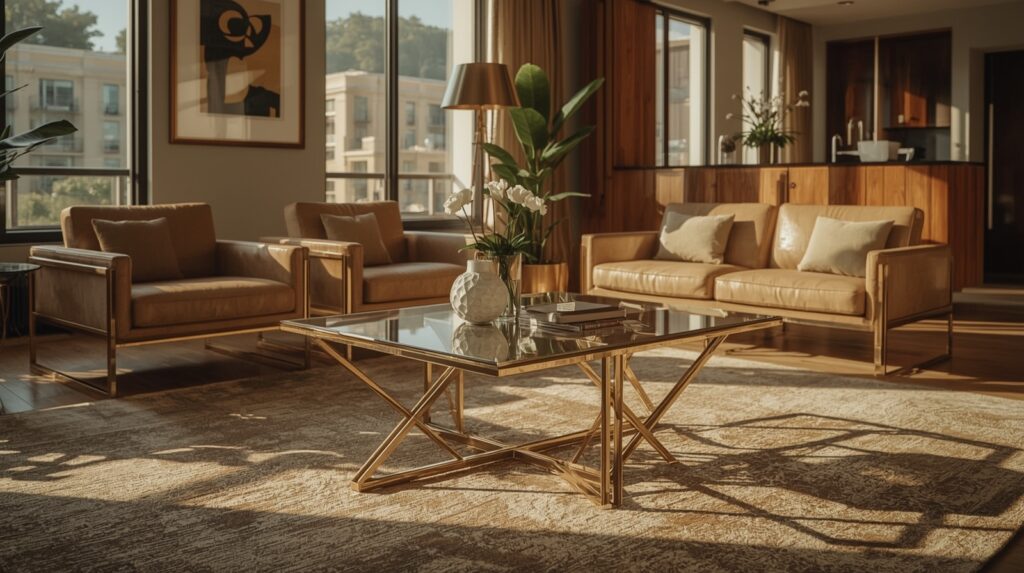
Tensions of the 70s were manifest also in interiors oil crises, uncertainty and a shift ofsocial life towards the more private entertaining. In this context the decorative effects of reflective surfaces, like mirror, lacquer, smoked glass, chrome and brass, served as a compensatory function hinting at opulence, rather than material wealth. Vintage brass and glass coffee table, lit by a lamp, threw multiple highlights around the living room and created a sense of staging. Designers welcomed brass as a contrast between the clear, cold metal look of steel and chrome and the heaviness of antique pieces.
Brass found another home by the late 1970s and 1980s in the global language of the “executive” interior: lobbies, penthouse apartments, sales offices and developer models. Cities boasted luxury apartments with the veneer of restrained opulence: nondescript upholstery, slick stone, polished mirrors, and brass trim. Coffee tables of brass and glass were suited to the moment, offering affordability and an air of wealth along with their carefully observed rectilinear design.
A brass-and-glass table spoke a kind of double truth: that of post-war transparency (glass equals openness, cleanliness, space) and that of old-world metal status (brass equals permanence, worth, and protocol). The tables sat squarely in the middle of the living room, providing an altar for magazines, ashtrays, cut-glass bowls and objects d‘art, all of which showed taste, by the late 20th-century code of domestic culture, through exhibition. The coffee table thus became the place around which to look, rather than to sit.
Italian Modernism, Hollywood Regency, and the Luxury Apartment Interior
The brass and glass coffee table is, in its vintage way, at the convergence of at least three streams of stylistic influence. First, there was Italian modernism, its focus on proportions, precisely engineered joints, and sharp geometries. The kind of elegant clarity achieved by carefully constructed not by ornamentation. There was a preference by Italian designers and manufacturers for frames of metal that appeared as pure line, glass as an element to show structure. The table was like a small structure: clear, logical, deliberate. Meanwhile Hollywood Regency mid century American glamour and a film-industry notion of theatrically-domestic environments sustained a longing for gleam and contrast, and a splash of extravagance. The Regency flavor greeted the presence of brass, the not-unwelcome brother to gilt, beside mirrors and glass, alongside velvets and satins. Within this aesthetic space, the brass-and-glass coffee table was a reflecting focal point, amplifying a room‘s light-dance: flashes from lamps, shining metal, and the mirrored emptiness of space behind it all.
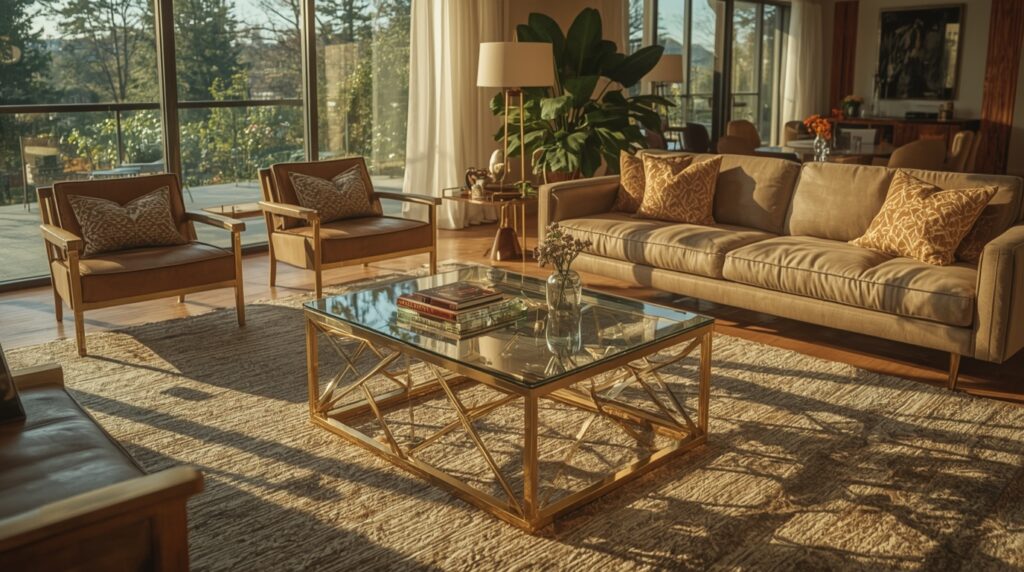
The third factor at play was the ubiquitous notion of the luxury apartment interior. Whether New York or Los Angeles, Chicago or Miami, postwar apartment life represented a new kind of selfhood urbane, streamlined, and airy. Glass tables fit into a limited size because they didn‘t appear to occupy much space, while brass frame exuded the confidence and value of the aspirationally designed. With the help of developers, designers and shelter magazines, a new set of visual cues became standardized: neutral seating, statement art, and shiny details. And of course, the floating coffee table.
It‘s not that these currents were segregated from each other, they blended together in showrooms and homes. A brass and glass coffee table, say, vintage and ornate, would have the geometry of “Italian,” the finish of “Regency,” and the context of “penthouse.” And maybe this mixed-and-matched quality is why the category has always held such a strong appeal. It‘s the cultural bridge between the clarity of modernism and the human need to sparkle.
The reason for the hybridity is also the reason it can be hard to attribute many of these tables, which were made by the hundreds and sometimes only half-marked. Styles moved across borders at lightning speed. Instead, researchers often find the most meaning not in any particular maker‘s mark, but in the evidence they unearth in archives: catalogs from the period, trade journals, photographs in interior magazines. In a way, it‘s as if tables demand a type of material culture research, read not only in the context in which they are made but also in the manner in which they circulated and were used.
Craftsmanship and Materials: Polished Frames, Geometric Bases, and Tempered Glass
The very nature of a vintage brass and glass coffee table is the dialogue between top and base. The top surface will usually be a heavy sometimes tempered sheet of glass, selected for both durability, safety and transparency. There can be edge treatment. Polished. Or beveled. Where edges are beveled, it offers a brilliant refraction on the periphery, a subtle pointer to quality. In many of these original vintage tables, the weight of the glass itself is also a factor.
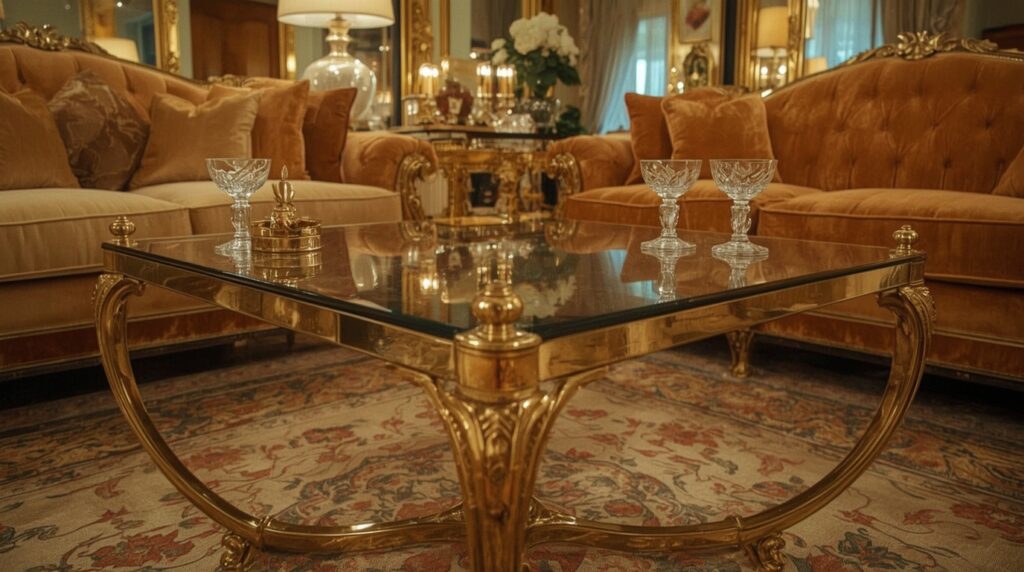
In the case of brass frames, that means they could be made of solid brass, brass-plated steel, or brass-colored finishes of some other kind of metal. Here‘s where the history comes in: Solid brass offers unique ways of aging and a different kind of weight “ring” compared to plating, and numerous mid-priced tables use plating to get the “right” look at less expense. They will be made with welded joins, brazed seams, or mechanically secured corners with screws and brackets. Examine the underside of any frame to see the reality.
Bases tend to work as geometric patterns boxes within boxes, X-shapes, arcs, tiered parallel rails and these serve functions of weight distribution and preventing racking (that wobbly left-to-right movement). In the best ones, there‘s a sense of well-chosen proportion, open enough to read as light but solid enough to brace the flat glass. Stretchers sometimes create a sort of “cage” or “gallery” surrounding the objects, making the top itself a place for objects to be seen.
Material Finishes are an important part of the material aspect too. Period brass often has a lacquer to retard the tarnishing. Other times it can be much more exposed and thus develop patina. Surface is often pitted with little nicks and dulled corners from decades of rubbing with a polish, being handled and being exposed to air. These aren‘t flaws they are what can mark the passage of time.
It‘s from a museum perspective that‘s interesting, this expression of architectural thinking to a domestic scale. The glass in the top is equivalent to a roof, and the brass structure to a skeleton. We want to peer into the thing, and around it, and underneath it. That late modernist idea that structures shouldn‘t be hidden, but should be transparent when these things are put into very glam surroundings, they are still that basic modernist idea structure as clear message.
Design Variations: Square, Rectangular, Oval, and Sculptural Bases
Square and rectangular glass and brass coffee tables were prevalent as their shape lends itself to sitting areas, where you‘ll find sofas, rugs and room structures all working on the same geometric lines. Rectangles tended to have long horizontal rails or nested frames that added dimension from a bird‘s eye perspective. In rooms dressed as they originally were, tables in these shapes served as a device to bring seating areas together and create an axis around which magazines and drinks and conversation revolved. Their Geometry also related to the sharp, linear shapes of case goods and modular seating from the late twentieth century.
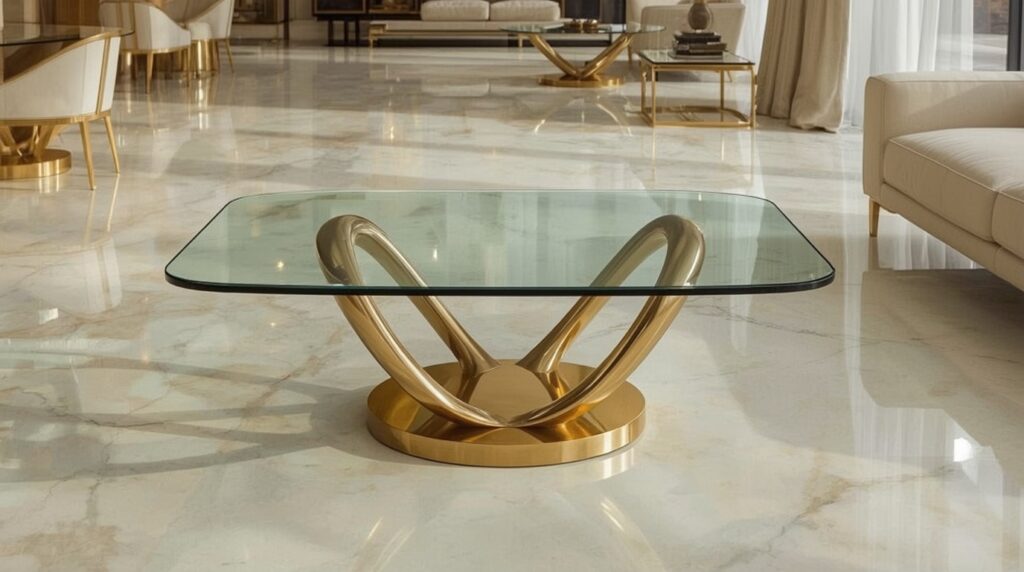
Oval and circular versions provided a lighter, more “social” profile. In a tight apartment or high-traffic area, rounded corners limit bumping and create a softer flow. Oval glass top tables with an arc or ring base are reminiscent of the period‘s obsession with fluid, unbroken lines in lighting, barware, and decorative items. You could also say that the oval table is more ‘Regency’ or ‘glamour’ than the rectilinear table which feels more ‘modernist’ or ‘architectural’ (however those labels are imperfect).
Further sculptural bases intertwined circles, waterfall curves, gilt bamboo-inspired accents or stacked geometric plinths show how the form could morph into statement furniture pieces. The bases have something of the public artwork about them, the glass top acting as a blank canvas that enables the brass to sing through. The coffee table no longer becomes a silent workhorse but rather a centre of attention in the room, akin to the 70s and 80s demand for eye-catching pieces.
There are also hybrids: two-tier versions with a glass bottom shelf; versions in smoked or bronzed glass; versions that match up brass with glass inmirrored applications. But each choice changes the object‘s symbolic language. For instance, clear glass signals modernist transparency; smoked glass signals intimacy and ambiance; mirrors signal theatricality. The collector learns to recognize these as signs of their time, not just decoration.
Such distinctions raise classification issues inataloging circles. It‘s the job of the design historian to look at comparative evidence from vintage magazine ads, to department store catalogs to trade show literature to trace a flow of form and surface ornamentation. Design library holdings (home-furnishing magazines, interior trade magazines) and archive holdings would become indispensable. For the expert, the table is, therefore, much more than a “style”; it‘s a trace of the diffusion of design thought from chic showrooms to the marketplace.
Vintage vs. Modern Reproductions: Material Truths and Historical Surface
Authentic vintage brass and glass coffee tables and their vintage reproductions will differ in terms of how they behave materially. Real vintage brass, especially if it‘s solid or heavily plated, can develop subtle signs of wear hairline scratches, softer reflections and tarnishing in recesses. New reproductions may have a uniformly shiny and “young” brassy look or coatings that can take on a more “plastic” appearance. It‘s less about seeking out the perfect example of aging (which may not even be all that appealing on the surface) and more about finding historically realistic surfaces.
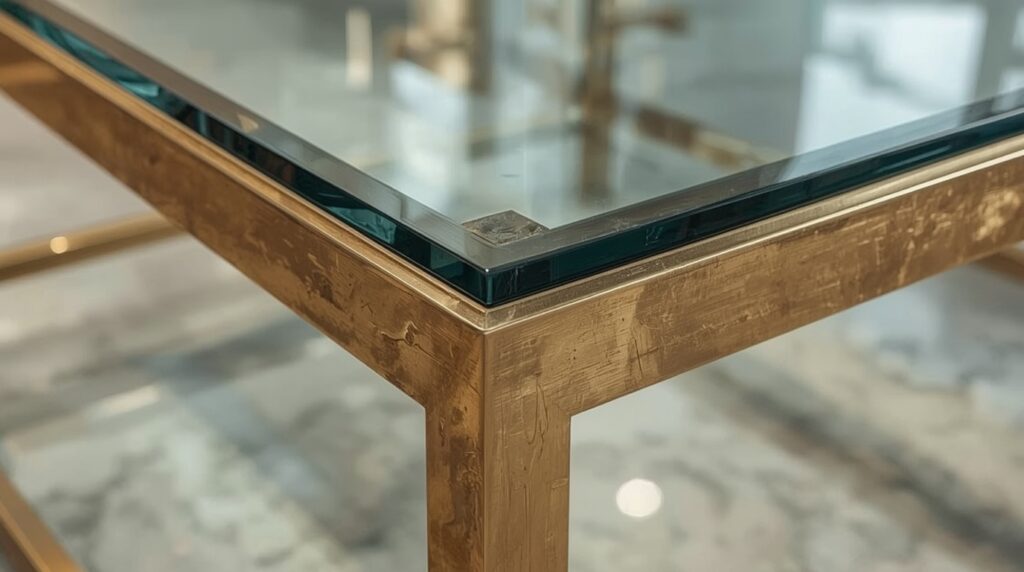
The way the table is constructed is also a clue. Vintage models, for the most part, were made with thicker-gauge metal and strong joinery in comparison to the often-cheaper replicas you see on the market today. Look for brazed joints, heavy-duty welds, large corner brackets on older frames, as opposed to the thinner tubing, and smaller welds or fasteners found on many modern pieces. It‘s about how the table feels, as much as how it looks. Vintage tables tend to have a solid, undeniable weight and rigor to them.
Glass is another area where you‘ll see differences. Original glass tabletops could be rather thick with beautifully polished edges. Some modern reproductions might be a bit less thick to save on glass and shipping weight, which could affect the “floating plane” look of the table and the light refractive qualities of the edge. The fit of the glass and the frame can also tell a story: period reproductions might have the original rubber or plastic bumper that has aged while modern ones might rely on a more noticeable cushion or looser tolerances.
Provenance and labeling are useful, but they are not always reliable. Quite a few authentic period tables are unsigned; several contemporary tables go so far as to suggest lineage with abstract branding. The expert, therefore, takes in the piece as a whole the surface, weight, joints, glass, the logic of its structure rather than hunting for a single decisive detail. That‘s the same approach used in decorative arts attribution; connoisseurship involves careful observation and comparative analysis.
From a cultural-history point of view, they are distinct in what they are about. Antique tables come out of a specific cultural moment‘s visual syntax: they were part of a set of practices of entertaining, of smoking and reading magazines, of putting on a performance of home life. Replicas usually try to borrow the look, but not replicate the entire set of disciplines that made the originals look real. It is exactly that distinction that of a historically contingent object from a stylistic reference that makes the old table an object of historical rather than decorative interest.
Collector Identification: Patina, Weight, Hardware, and the Evidence of Use
Patina is how most collectors first get started but seasoned collectors see patina only as a clue not confirmation. Real old brass will grow dark and spotted, generally around hinges, underside of rails, and near the floor where it is less likely to be wiped. You would expect some sort of unevenness that is predictable based on gravity, and human touch and air. Artificially aged finishes will either have a theatrical looking patina or the patina will be on where it shouldn‘t be. The underside of the table will be a dead giveaway as this area of the furniture is rarely ever cosmetically enhanced.
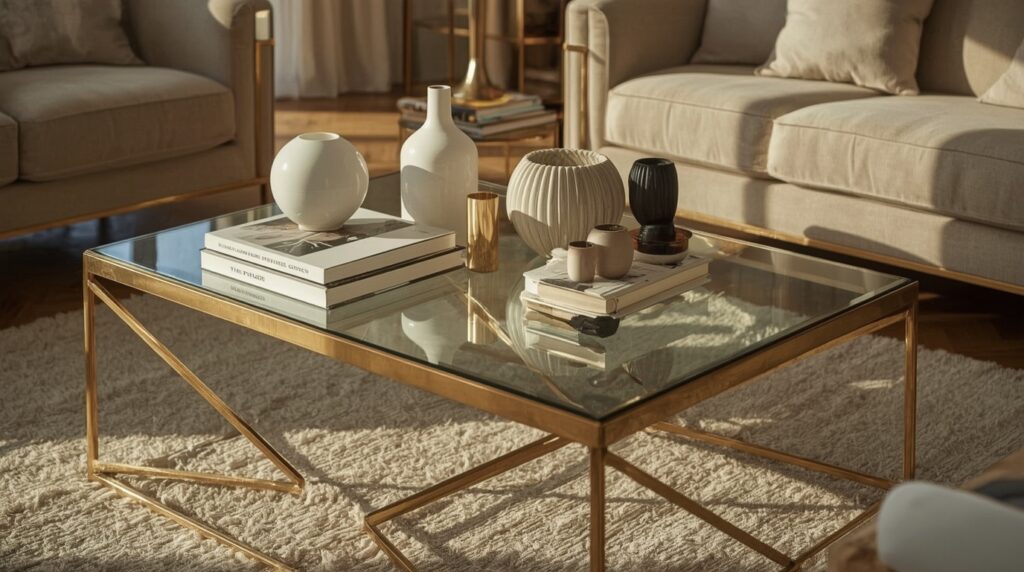
Mass is an easy diagnostic. Most period tables, especially high-quality ones, feel heavier than they look, and the glass may even be unexpectedly thick. If you‘ve got the opportunity to pick up the table (again, if you can, do it with a second person), you might be able to ascertain if the mass feels conservative, in the way that most items from that time were over-built. Flimsy frames, flex or rattling parts point to cheaper, later construction.
Hardware and joinery are another place for collectors to focus. Depending on the period or maker, screws can be slotted or Phillips head; brackets can be hefty; rubber pads can be cracked and flattened. The way in which different components join up can tell a collector a lot. Is there a nice miter? Are fasteners evenly spaced? Is the whole thing structurally triangulated? A table that is beautifully made geometrically but sloppily constructed often reveals itself as a later creation, or as much altered.
Evidence of wear a scratch on the glass, a small dent in the brass, a smoothed-away edge can also lend an object credence. In that regard, the specialist doesn’t automatically subtract points for scratches or dents. They are the narrative. As in other decorative arts, it’s about drawing the line between what‘s an honest sign of use versus structural damage, or “restoration” that removes the past of the surface. The best instances of wear feel like the gentle sanding of a lifetime, rather than abuse.
The last element can be the documentation. A receipt dated from the period, a scanned page of a catalog, a family photo where the table is in the background, inside an old house any of these can contribute to the argument for attribution. If there‘s no label to guide us, these traces are all the more significant. For the historian, the table is an archival fragment its significance emerges as it is confirmed against a constellation of other fragments, visual, material, and documentary.
Condition Issues: Scratched Glass, Tarnished Brass, and Structural Stability
The most frequent problem of “condition” is damage to the glass. Scratches from ceramics, gravel, normal use. Chipping around the edges, particular the corners. Cracks, from an uneven base, a bump. And yet, because the glass is so functional, so prominent, the condition of the glass table has a huge impact on how the table is read. The light that glazes over the marred surface can turn a shimmering space into a hazy haze alter its visuality, and alter its “effect.”
Brass surfaces present their own set of issues. Tarnish is normal, but discolouration can be a sign of cleaning, moisture, or degraded lacquer. Spotting can be from water rings, streaking from polishing with abrasives, dents and bends on thin rails, or when the edges of a frame are proud. Whether the viewer wants these marks of time or sees them as detractive to the piece and its line.
The stability of these pieces can be a problem, but you won‘t really know how stable they are until you use them. Are the joints loosening? Are any of the legs slightly bent? Are levelers missing on any of the legs? Do the legs on a two-tiered version have any of the racking that might happen over time? The visual “crispness” of these pieces is geometry-based, so a slight alignment issue can make a table look “off,” which ruins their clean modernist appeal.
Then, there are also mismatches; a replaced glass top not the right thickness or tint; different bumpers; replated frames that are too vivid, or parts from different tables. They‘re not always immediately obvious in photographs; hence the value of an in-person evaluation. The role of the conservator is to determine if the work isreversible, if it conforms with the object‘s history and if the table is still honest about its own era.
And in the end, all condition assessment comes down to preservation philosophy. With decorative arts, it‘s all about leaving something understandable (the object should look what the maker intended) as well as inauthentic (it should also be in-situ, with the surfaces and construction to prove it was around when and where it‘s from). Vintage brass and glass coffee tables which rely on surface and light so much take this tradeoff down to a finer, shakier art form.
Restoration and Care: Cleaning Brass Without Erasing History
Restoration starts with assessing the finish. Was the piece solid brass, brass plated, or lacquered? (The three are restored differently.) Too often, the table is over-cleaned with hard metal polishes that strip away brass plating, strip away even layers of tone and strip away the evidence that the table is aged. From a conservationist‘s point of view, the least amount of intervention is generally best. It means wiping down to eliminate grime, and then drying thoroughly and protecting. It‘s not an attempt to make the table look factory fresh.
When the brass is lacquered, you‘ll see tarnishing under a failed lacquer, leading to uneven patches which can be an invitation to strip the lot. Stripping is sometimes the right course of action, but it‘s a definitive action which will alter the future patination of the piece. A conservator is likely to suggest a discreet test area, before photographs and deciding if partial stabilization with clean and wax (leaving the patina) is the best option for you.
Generally speaking, glass can be cleaned non-abrasively with very little risk, but scratch removal is another matter. Abrasive polishing to remove scratches can create distortion or distortion through ‘haze’ if not performed skillfully. If the table is precious, new glass cut to size with the appropriate specification tempered (thickness, edge finish, color if applicable) could be specified as an original part, in addition to keeping the original glass carefully documented and conserved. Museum practice prizes keeping original parts, but also supports object use and handling as safely as possible.
The goal of structural repairs is to create a stable chassis without disturbing the design. Fasteners can be tightened and lost bumpers replaced with period-correct ones these things can often be done relatively subtly, and bent panels can often be carefully straightened out. Frame repairs often take the form of welding and brazing, and if it‘s not done expertly it will definitely show. If you‘re unsure consult a conservator or specialized metal worker, not a general mechanic particularly on a plated chassis.
When well restored, the piece can acknowledge its historical essence. We don‘t want to roll back time; we want to age with the table, and keep it in the best possible condition, both visually and structurally. collectors generally prefer tables that have had care and consideration over time been dusted and lightly washed and kept dry, rather than being “refurbished” in one big flourish.
Styling in Contemporary Interiors: Why the Form Still Works
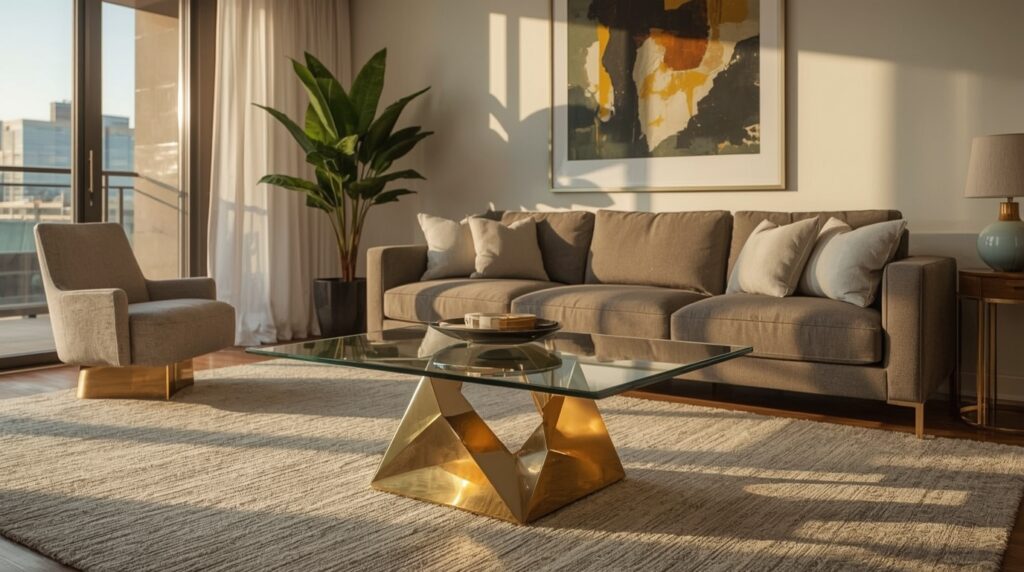
Today‘s coffee tables-a blend of vintage brass and glass-act as translators between different design languages. Their transparency is appropriate for more minimalist spaces, where they leave room for architecture and textiles to play an important role. Yet their brass framing can add much needed humanity and warmth to spaces of concrete, white paint, and steel.
They also play nice with interiors that are mixing it up because they are historically speaking, at least hybrids themselves. The brass-and-glass table can be at home next to a mid-century sofa, a postmodern lamp, or a Persian rug, because it‘s not speaking one language. It has a degree of neutrality openness, even that allows other items books, ceramic bowls, flowers, figurines to act as the exhibition that takes place on its surface, thus picking up where the coffee table left off at the end of the 20th century as a platform for the presentation of domestic life.
What designers are doing now is using contrast to counter the effect, pairing the table with dense fabrics, textured upholstery, and matte surfaces that make the brass‘s glare seem like a design choice, not an accident. They take advantage of the way the table can almost disappear in a small space useful in apartments where an oversized wood table seems to take over. That same magic of going incognito that appealed to apartment dwellers in the 70‘s has continued to appeal to today‘s cramped cities.
But the appeal is not entirely utilitarian. We‘re also seeing interest in the interior as a citation, the room that nods to history without repeating it. The vintage brass and glass coffee table is easily readable as a reference to late 20th-century luxury without becoming so fully realized as to be costuming. It provides a material history without forcing the entire space to be a period piece.
Market Interest and Collector Demand: Value Ranges and What Drives Them
Interest in the vintage brass and glass coffee table has steadily increased due to collectors’ interest in late 20th-century design now moving from “used furniture” into the space of “material culture.” The furniture‘s design aligns with current home interiors trends. Warm metallics are back in style, and there‘s a new understanding that the domestic objects from the 1970s–1980s carry the social histories of class aspiration, city planning, and leisure lifestyle.
Value ranges are wide, and depend heavily on provenance, quality, and condition. As a rough “rule of thumb” (take with a pinch of salt): Unmarked, common examples in fair condition sell for low hundreds. Higher-quality, heavier examples with a substantial thickness of beveled glass and very tight joinery will sell for higher hundreds. Designer-signed, unique or outstanding sculptural pieces can command thousands, particularly if the provenance is clear and the pieces are documented. Local taste, price of shipping and geography are all big factors.
Original intact glass, original finishes that have aged with dignity rather than been overtly refreshed and solid frames are all going to command higher prices with collectors. Replacement glass that doesn‘t match, considerable plate loss and loose joints will all decrease value as they impact both use and historical authenticity. A distinction is often made in the collecting worlds for “bright and new-looking” versus “authentically preserved.” To many collectors, a table that has not been over-polished and retains its tonal variations is preferable to a table that is newly gleaming.
To a specialist, this market is also an indicator of shifting historical interests. When museums and design historians turn their attention to the everyday luxuries not just masterpieces of decorative art, types like the brass-and-glass coffee table grow as cultural markers. They may never be rare in an absolute sense, but fine original examples become more elusive, and that rarity of condition (not just existence) drives competition among collectors.
Why the Vintage Brass and Glass Coffee Table Still Matters?
The vintage brass and glass coffee table endures because it condenses a pivotal late-20th-century negotiation between modernism and glamour. It is a small domestic monument to the era’s faith in material effects—reflection, transparency, geometric clarity—and to the social meanings attached to those effects: cosmopolitan taste, controlled luxury, and the staging of everyday life as a kind of interior theater. Its design is not only attractive; it is historically articulate.
As a craft product, the coffee table demonstrates where the production line and aesthetic taste were once fused in the suburban American house post-war. As a cultural object, it offers evidence of design and taste trends from suburb-living, television-watching living rooms to the commodification of aspirational cues. As an antique, it demands careful attention the patina, the wood grain, the thickness of glass, the scars of repair, becoming markers of authenticity in a field of replication and restoration.
Looking at and caring for these tables is, therefore, touching with recent history in its tangible detail. It is where we are reminded that luxury is not about price so much as representation, performance, the creation of experience from surfaces, and the charting of social desire through design. The brass handrail suspending above, or the floating plane of glass above, the late 20th century has still got a lot to say about light, status, and our eternal wish to lift our everyday room.