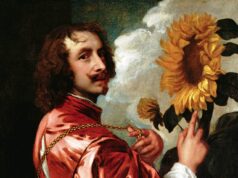
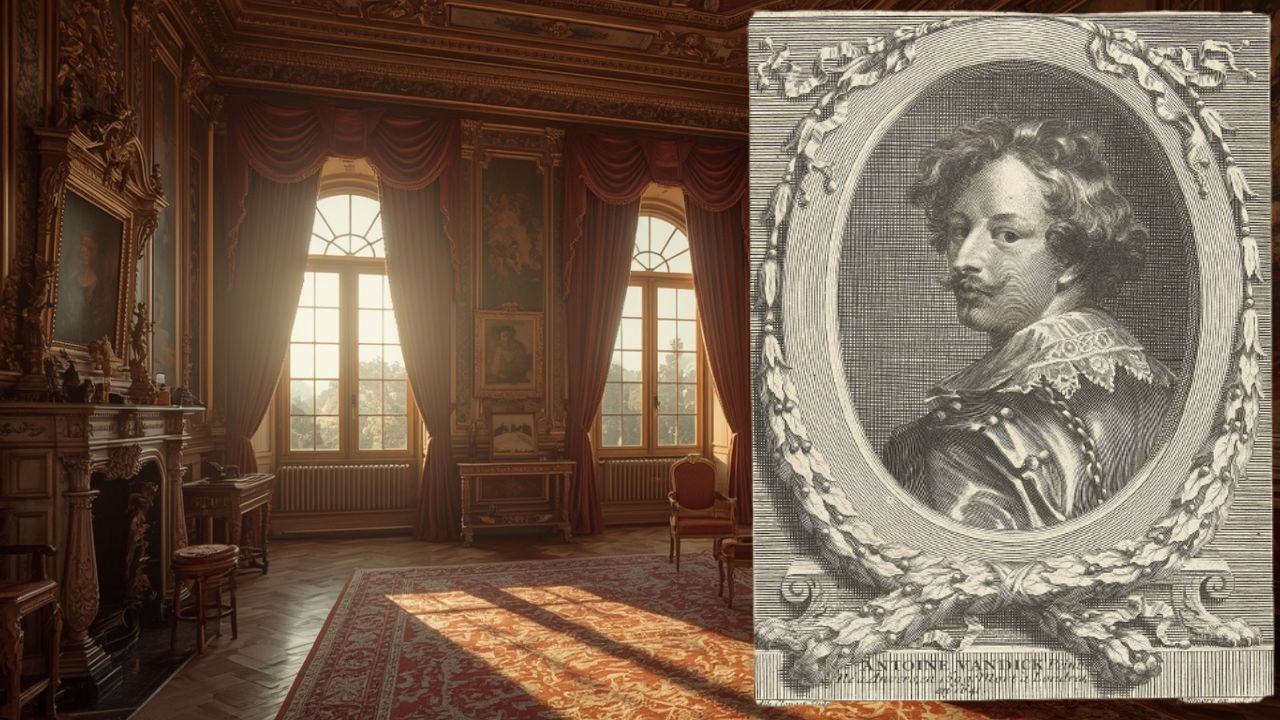
Anthony van Dyck’s paintings don’t simply depict people—they manufacture presence. A single portrait can make a sitter appear at once intimate and untouchable, human and ceremonially elevated. That controlled alchemy is why, nearly four centuries after he arrived in London in 1632, Van Dyck remains the artist most closely associated with the visual language of power in early modern Europe. His work sits at the hinge of the Baroque era: infused with Rubens’s dynamism, refined by Italian color and elegance, and ultimately codified at the English court into a template that shaped portraiture for generations.
From Antwerp to Italy to London: The Career That Shaped Van Dyck’s Paintings
Born in 1599 into the Southern Netherlands at the time a hotbed of Catholic Baroque culture in Habsburg territory Van Dyck was educated in the orbit of Peter Paul Rubens, at the time the most successful painter in Europe. He absorbed the scale and bravura of his environment, which would permeate early-17th-century Flemish painting. Even as his art has entered institutions that house it now, such as the Metropolitan Museum of Art and the Louvre, so too did his fame quickly spread beyond the region.
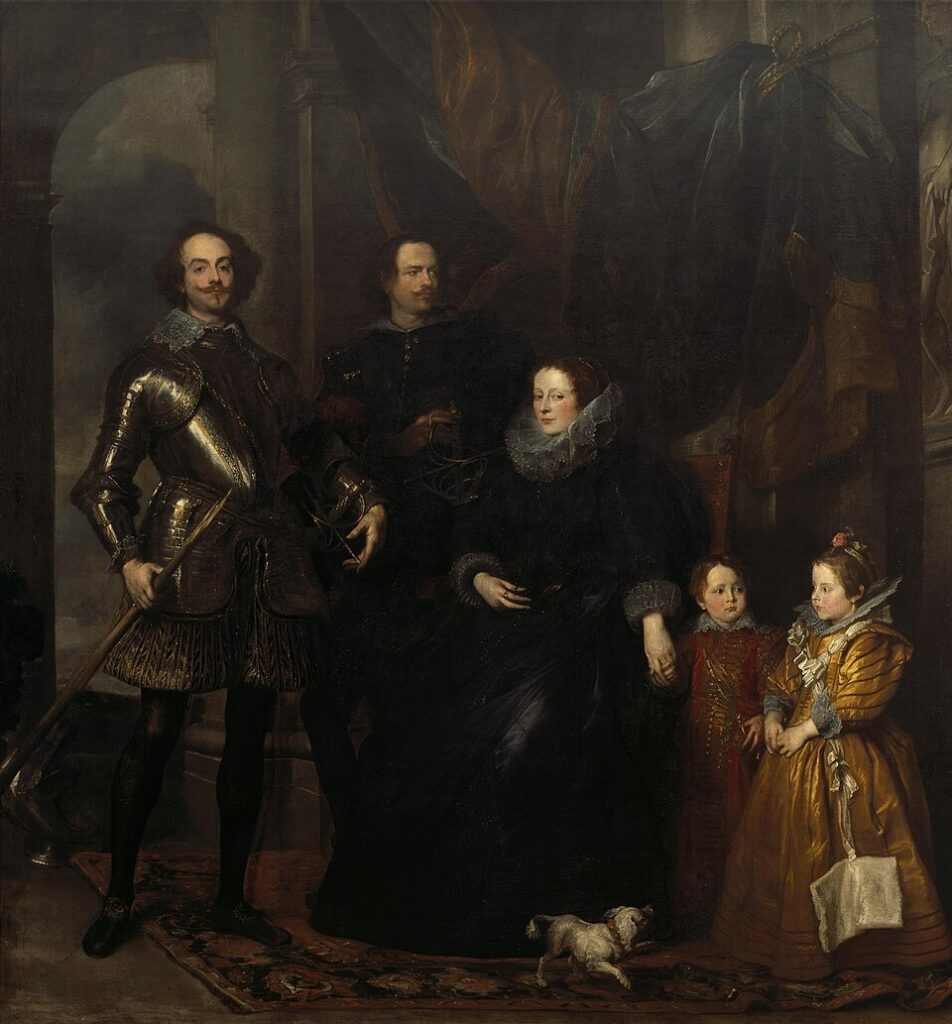
Van Dyck‘s Italian sojourn (1621–1627) proved pivotal. Working in Genoa, he portrayed wealthy patrons in an unprecedented style of languid dignity: elongated bodies, shimmering silks, architecture that acts like stage sets for the sitter. In Rome and Venice he steeped himself in Titian‘s mastery of color and Venetian style of oil paint handling where there was an atmosphere, a building-up of tone, rather than tight drawing. And Van Dyck‘s notoriously (and maddeningly) easy touch; they learned it by scrutinizing Italian Renaissance masters and the new Baroque style.
The transition was total in London where he received the title of Principal Painter in Ordinary to Their Majesties of Charles I. This title was more than a job it gave him an institutional footing to build a national visual lexicon. By painting Charles I and his companions, Van Dyck created the image of an English court: a court that was dignified, restraint, psychologically complex. An image of a court, indeed, which outlived the monarchy, which the V&A, with its vast courtly collection and tradition of portraiture, now helps explain.
What Makes Anthony Van Dyck Paintings Instantly Recognizable
The hallmark of Van Dyck’s mature work is the fusion of elegance and psychological immediacy. His sitters typically appear poised, with subtle hand gestures and carefully calibrated posture—signals of rank in a society acutely attuned to status. Yet within this code, he conveys individuality: a softened gaze, a slight turn of the mouth, the suggestion of thought behind ceremony. The Metropolitan Museum of Art, discussing portraiture of this era, emphasizes how such works were not neutral records but constructed representations designed to communicate identity and authority.
Composition is another signature. Van Dyck often places figures within a controlled spatial setting—columns, drapery, landscape openings—devices that create depth and grandeur without distracting from the sitter. Clothing and textiles are painted with a combination of specificity and painterly abbreviation: satin flashes, lace edges, and armor highlights read as tactile even when rendered with economical strokes. This is part of his persuasive magic: he selects what must be described and what can be implied.
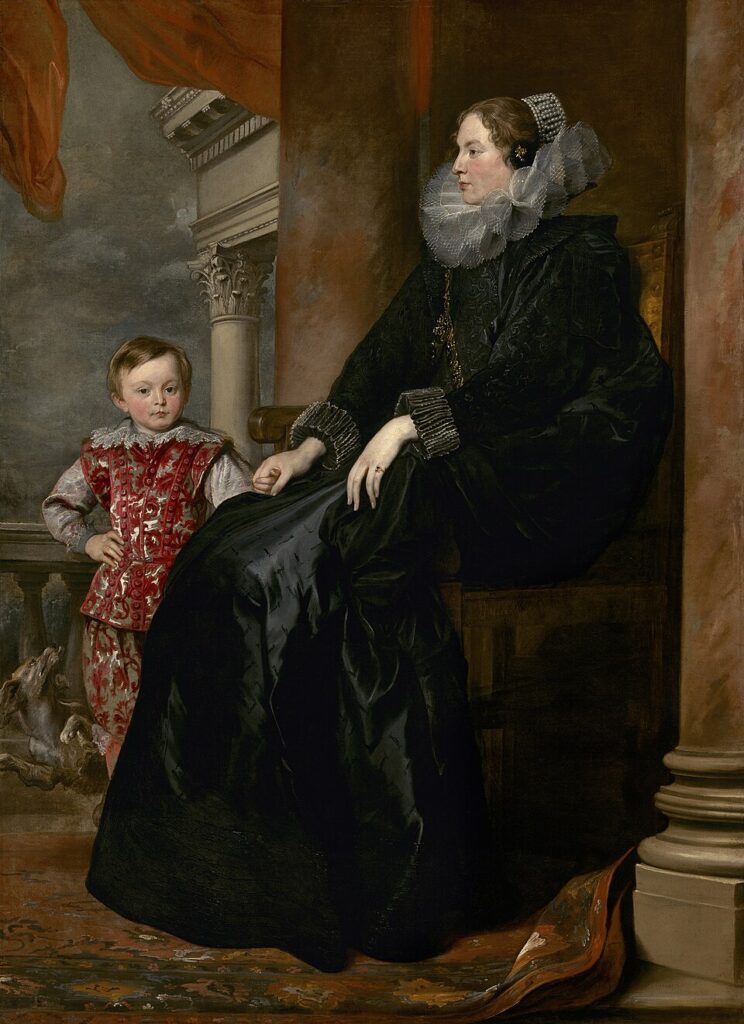
Color and paint handling complete the effect. Van Dyck adopted a warmer, more transparent palette than many northern contemporaries, influenced by Venetian painting. Flesh tones tend to glow rather than sit flat; blacks and whites—so crucial in court dress—are modulated with blues, browns, and silvery grays. The result is a visual hierarchy: faces and hands emerge as centers of life, while costume and setting support the performance of dignity. As the Louvre often stresses in its interpretive materials on Baroque portraiture, the period’s best artists used painterly means to communicate social meaning.
Key Characteristics of Anthony Van Dyck Paintings (Summary Table)
| Characteristic | How it appears in Van Dyck’s paintings | Why it matters historically |
|---|---|---|
| Courtly elegance | Elongated proportions, graceful stance, controlled gestures | Defines aristocratic portrait codes across Europe |
| Psychological presence | Direct but measured gaze; nuanced facial modeling | Moves portraiture beyond mere rank-display |
| Italianate color | Warm flesh, transparent layers, Venetian tonal richness | Connects Flemish Baroque to Italian traditions |
| Staged settings | Columns, drapery, landscapes used as framing devices | Elevates sitters into symbols of authority |
| Painterly economy | Suggestive brushwork for fabrics, hair, and highlights | Produces lifelike immediacy and modern-looking surfaces |
Landmark Works, Collections, and What Institutions Reveal
The most important works of Van Dyck are connected with the institutions which protect not only the works of art, but their historical context too. Here in London, the portraits of Charles I such as equestrian paintings and state portraits served as political symbols in the mounting conflict which ended in the English Civil War (1642–1651). The images constructed the public persona of the monarch as God-like, refined and steady. Museum inventories and scholarly catalogues consider them as icons of power rather than works of art.
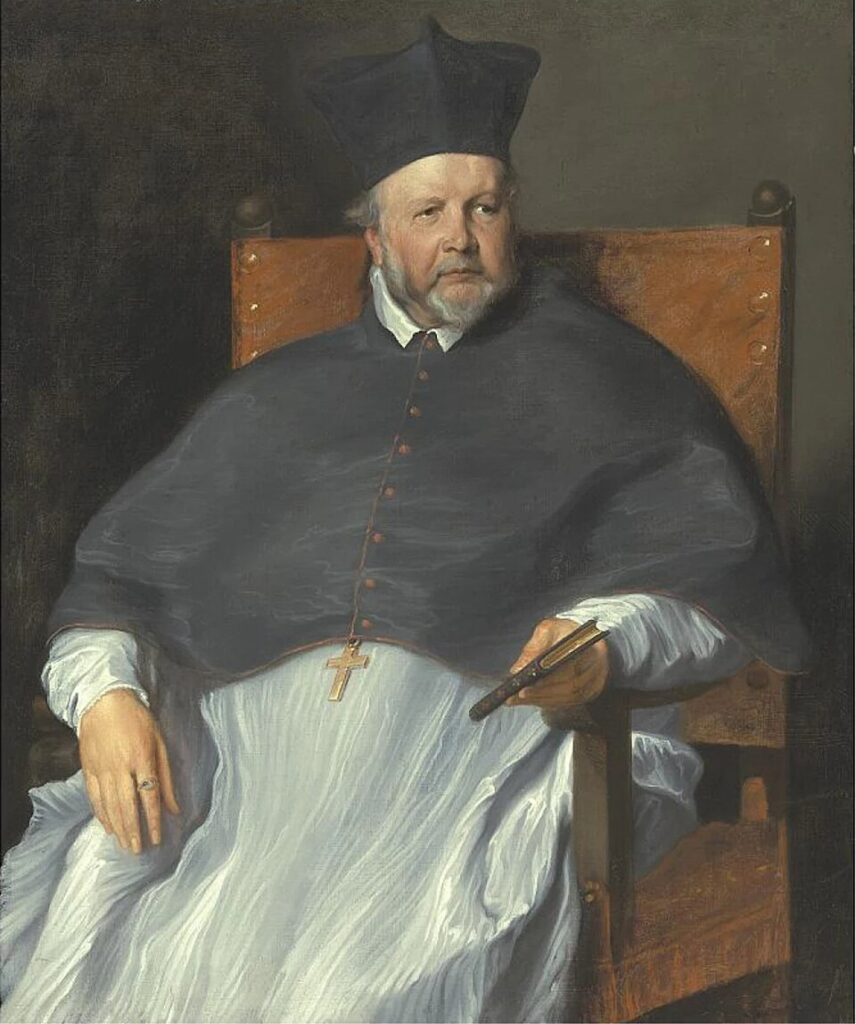
More on the Continent, his Italian commissions (including a significant output for the Genoese) illustrate a visual culture of mercantile aristocracies building wealth and status: the sitters’ sumptuous dress and environs reveal the fruits of international commerce and provincial dominion, with textiles from afar, palatial environs and self-assurance writ large. Institutions like the Louvre and other major museums on the continent contextualise these works within Baroque culture of display, of representation, and where painting became part of the presentation of social order.
Only in the US, with institutions like the Smithsonian (whose mission extends beyond mere entertainment to education and research) can we trace the long legacy of Van Dyck‘s visual signature. The “Van Dyck look” returns in the great 18th-century portraits, and even in Hollywood, when we talk about the “golden age of the celebrity portrait.” As former National Gallery director Nicholas Penny, put it, “There is an argument for calling [the best] portraiture ‘an art of persuasion as much as description’,” a description that could not apply to Van Dyck‘s court portraits any better.
Influence and Legacy: Why Van Dyck Still Matters
Van Dyck’s paintings effectively standardized elite portraiture in Britain and influenced European art far beyond his lifetime (he died in 1641). Later painters adopted his compositional solutions—three-quarter poses, aristocratic ease, controlled symbolism—because they worked. These were images built for transmission: across courts, across collectors, across centuries. In that sense, Van Dyck was not only a painter but also a designer of visual rhetoric.
His legacy is also technical. Artists studying his work see how he balances finish and freshness—how he can suggest embroidery without counting every thread, or convey a face with softness while maintaining structure. That balance became central to later portrait schools. The V&A’s focus on materials and making, as well as the Met’s conservation research, reinforces that what appears effortless is usually the product of deep knowledge and deliberate choices.
Finally, Van Dyck matters because his portraits remain compelling as human encounters. Even when the sitter’s social world feels distant—Stuart monarchy, Flemish Catholic elites, Genoese patricians—the paintings offer access to personality through pose, gaze, and touch of paint. That is the durable achievement: he created images that operate as both historical artifacts and living presences.
Frequently Asked Questions
1) What is Anthony van Dyck best known for?
He is best known for Baroque portrait paintings, especially his portraits of Charles I and the English court, which shaped British portraiture for generations.
2) Did Van Dyck study under Rubens?
Yes. Van Dyck trained in Antwerp and worked in Rubens’s orbit; Rubens’s influence is evident in Van Dyck’s early energy and later command of grand composition.
3) Why do Van Dyck’s portraits look so elegant?
He combined Italian color and refinement with Flemish painterly confidence, using posture, gesture, and framing devices (drapery, columns, landscapes) to communicate rank and grace.
4) Where can I see Anthony Van Dyck paintings today?
Major examples are held across Europe and North America. Credible institutional sources and collections include the Metropolitan Museum of Art, the Victoria and Albert Museum, the Louvre Museum, and research resources connected to institutions like the Smithsonian.
5) What historical period does Van Dyck belong to?
Van Dyck is a key figure of the early-to-mid 17th century Baroque period, active in the Spanish Netherlands, Italy (notably Genoa), and England during the reign of Charles I.
Authoritative Sources (Recommended for Further Reading)
- The Metropolitan Museum of Art (Heilbrunn Timeline of Art History; collection entries on Flemish Baroque portraiture)
- Victoria and Albert Museum (materials on portrait traditions, court culture, and relevant collection records)
- Louvre Museum (collection and interpretive resources on Baroque painting and European portraiture)
- Smithsonian Institution (research and educational resources on European art history and the social role of portraits)
“Portraiture is an art of persuasion as much as description.” — Nicholas Penny (art historian and former museum director), a principle strongly reflected in Van Dyck’s court imagery.
Van Dyck‘s paintings last because they offer one of art history‘s most elegant solutions to a hard problem: how to portray an individual, both as a private person and a public authority. In Antwerp, Rome, London, Van Dyck honed a vocabulary of portraiture that would prove archetypal: sophisticated, sensitive, institutional. To gaze at his work in the museums and libraries of today isn‘t just to see some old Baroque style. It‘s to learn how to make images.