
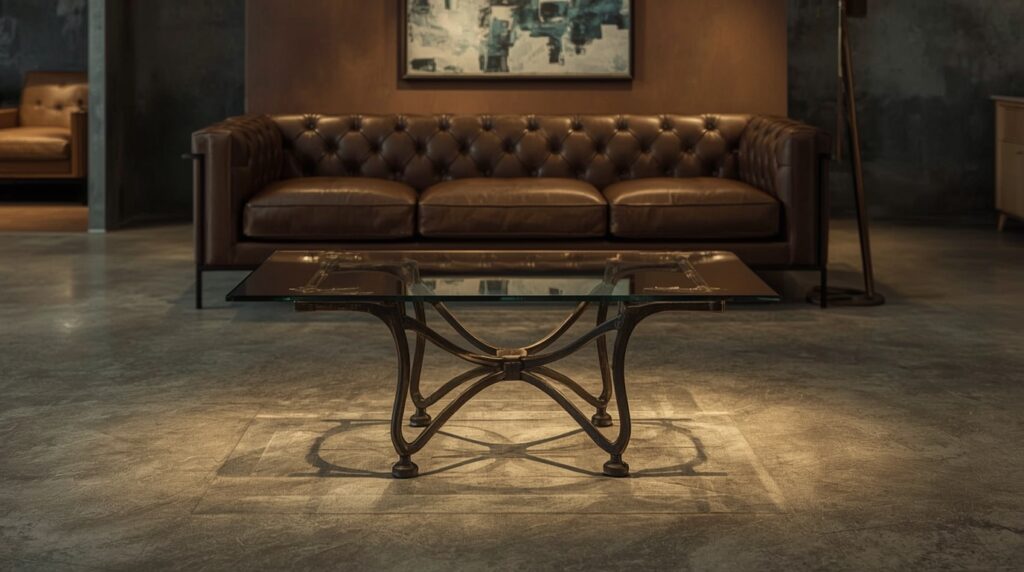
A vintage wrought iron coffee table with a glass top is more than a convenient surface—it is a compact piece of design history. Within one artifact you can see the history of industry, shifts in tastes for interior design, and the lasting desire for hand-wrought ornament. Whether you‘re interested in the geometric airy styles of Art Deco, the flowing scrollwork of French Revival pieces or the sharp architectural style of mid-century ironwork these tables reside in a somewhat unique sweet spot, appearing light but being strong, ornamental but useful, timeless but contemporary.
Origins and Historical Context: From Forge to Modern Living Room
Wrought iron has deep roots in European and American decorative arts, but its rise as an interior furnishing material is closely tied to the late 19th and early 20th centuries, when advances in metalworking and mass production met an appetite for new styles. In France and Belgium, the Art Nouveau period (c. 1890–1910) popularized sinuous, plant-like iron forms in architecture and interiors. Shortly after, Art Deco (c. 1920–1939) shifted the language to sleek symmetry, stepped motifs, and stylized florals—forms that translated beautifully into iron bases supporting glass tops.
Museums and cultural institutions provide a reliable map of these stylistic shifts. The Victoria and Albert Museum (V&A) and The Metropolitan Museum of Art (The Met) hold extensive decorative arts collections that document iron’s role in interior design alongside glass, ceramics, and wood. As the V&A notes in its discussions of design history, the early 20th century was defined by “new materials and new ways of making,” with modern interiors embracing combinations like metal and glass for their crispness and lightness. That pairing is precisely what makes the wrought iron and glass coffee table feel timeless.
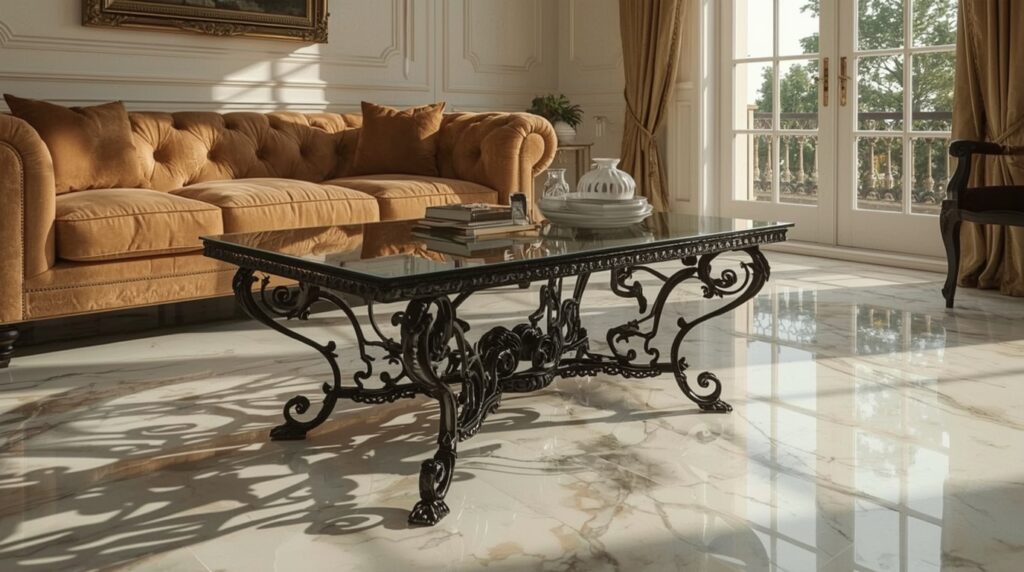
In the United States, wrought iron furnishings gained particular momentum in the interwar period and flourished again in mid-century patio and casual living trends. The Smithsonian Institution’s collections and interpretive materials on American design emphasize how domestic life and mass production shaped everyday objects; iron furniture—once associated with gates and railings—became an accessible way to bring “architectural” craft into the home. By the 1940s–1960s, iron-and-glass tables bridged indoor and outdoor living, a theme strongly associated with American postwar design.
Materials and Craftsmanship: What “Wrought” Really Means
Technically, authentic wrought iron is a low-carbon iron shaped by hand or (in older days) by rolling and forging, characterized by a fibrous structure and the ability to bend without fracturing. The majority of the “wrought iron” tables sold as vintage these days are likely made of mild steel, since true wrought iron manufacture fell off in the early 20th century. For daily use, the practical difference isn‘t enormous, but for purists, handcrafted pieces have little hammer marks, minor inconsistencies in scrolls, and joinery that says “smith” rather than “welder.”
Good vintage builds have some visual tell-tale signs. Early models will have collars and rivets, forged tenons to hold things together (but you‘ll start seeing welded joinery on more recent vintage pieces). Your base should be flat on the ground, not wobbly, legs perpendicular and bracing designed to prevent racking. The glass (which will be tempered on many later models) shouldn‘t be too thin for the distance it‘s spanning and should either be set on tabs, an outer rim or some well thought out corner brackets.
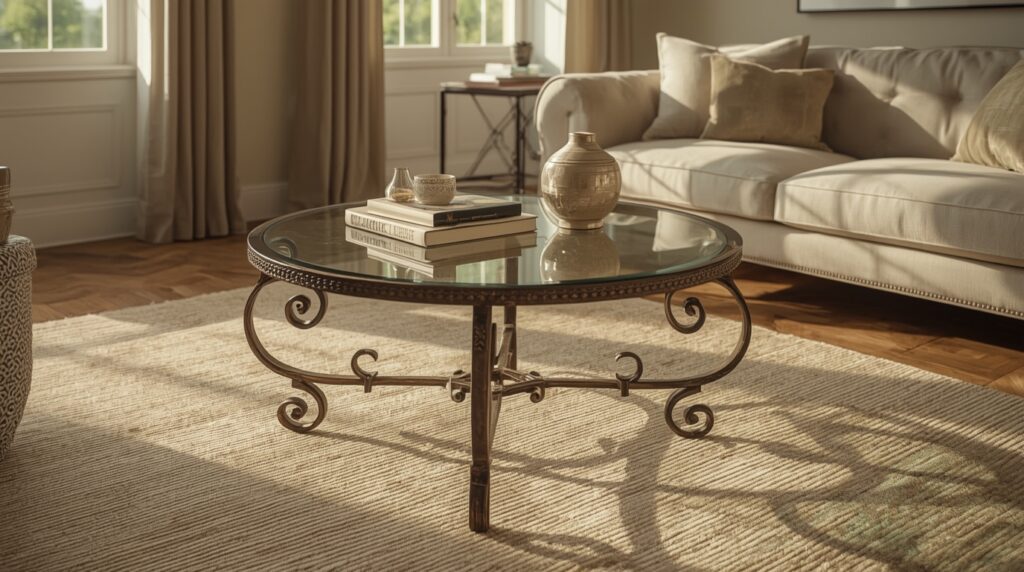
As curators and conservators regularly point out, works speak through their materials and their techniques. The Met‘s collection philosophy prioritizes how form and technique relate to each other how the material enables certain kinds of design to emerge. Wrought iron tables are a case in point; they lend themselves to open work, like twists, curves, and grilles, that serve structural purposes while lifting the piece. That‘s why glass tops work well they leave the underlying structure to be ornamental.
Key Characteristics at a Glance
| Feature | What to Look For | Why It Matters |
|---|---|---|
| Base material | True wrought iron vs. mild steel | Affects authenticity, tool marks, and collectability |
| Joinery | Forged rivets/collars vs. welds | Indicates period methods and build quality |
| Style cues | Art Nouveau curves, Art Deco geometry, Mid-century simplicity | Helps date the piece and match décor |
| Glass type | Plate vs. tempered; thickness; edge finish | Safety, durability, and period correctness |
| Finish | Patina, black enamel, bronze/gilt paint | Signals age; impacts restoration decisions |
| Proportions | Height and footprint suited to seating | Determines comfort and usability |
Style Identification and Dating: Reading the Design Language
When you start seeing vintage wrought iron coffee table you start with the shape and decoration. Art Nouveau tables have the whiplash curves, asymmetry and flora like scrolling vines, buds and leaves. Art Deco styles are symmetrical with repetitive geometric shapes that include fan shapes, sunbursts, and stepped profiles. Mid Century tables begin to slim down with the thin tapered legs and scrolls become more spare while the tables become more architectural with upholstery.
Location also comes into play. French and Italian iron furniture tends to be more curvilinear and classical; American pieces from the 40s through 60s especially tended to conform more to the indoor/outdoor living idea. Lighter, cleaner lines and simpler shapes and finishes work best on the patio and in the sunroom. You‘ll often find heavier gauge iron bases with scrollwork as a mark of revivalist periods of revival; a more linear, spare grid might suggest Deco or postwar modern.
Institutional collections add guardrails to random guesses. The Louvre, though mainly associated with French fine and decorative arts from prior eras, serves as another reminder of France‘s long history of metalwork and ornamentation referenced by designers again and again. The Met and V&A also put 20th-century furniture in context with other movements, meaning that you should be able to reference specific periods, not just loosely “old-world” or “antique-looking” things.
Buying, Authenticating, and Caring: Practical Expertise for Collectors
Authentication starts with a close, physical inspection. Turn the table over: examine the underside for weld beads, screws, replaced brackets, or modern adhesive pads. Check whether the glass is original—older glass may show minor waviness or edge wear, while new replacements can look overly perfect. Measure the glass thickness and confirm that it sits securely with proper supports rather than balancing precariously on small points.
Condition matters, but originality matters too. A stable base with honest patina is usually preferable to an over-restored piece stripped to bare metal and repainted without respect for the original finish. As the Smithsonian’s conservation perspective often emphasizes, preserving original material—when safe and feasible—maintains historical integrity. If refinishing is necessary, aim for reversible or minimally invasive approaches: gentle cleaning, rust stabilization, and finish matching rather than aggressive grinding.
For day-to-day care, keep the glass and metal working together: use felt pads under decorative objects to prevent scratching; avoid dragging items across the glass; and periodically check that rubber bumpers or spacers haven’t degraded. For iron, dust regularly and address rust early with light abrasion and appropriate protective coatings. In humid climates, a microcrystalline wax or a quality enamel touch-up can help slow corrosion—without erasing the table’s character.
Authoritative Quotes and Sources
Two principles from leading institutions capture why these tables remain desirable:
- On the value of makerly process and technique, The Metropolitan Museum of Art consistently frames decorative arts through “materials and techniques,” emphasizing how fabrication methods shape design and meaning (The Met, Heilbrunn Timeline of Art History and collection essays).
- On preservation ethics, the Smithsonian Institution’s conservation approach stresses careful stewardship of original materials—stabilizing and maintaining rather than unnecessarily replacing historic substance (Smithsonian conservation resources and collections stewardship guidance).
Credible institutional sources to consult when researching styles and periods:
- The Metropolitan Museum of Art (Heilbrunn Timeline of Art History; decorative arts collections)
- Victoria and Albert Museum (Design history resources; furniture and metalwork collections)
- Smithsonian Institution (American design, material culture, and conservation guidance)
- Louvre Museum (decorative arts context and European traditions of ornament)
Frequently Asked Questions
Are “wrought iron” vintage coffee tables always made of true wrought iron?
No. Many are mild steel marketed as wrought iron. True wrought iron is more typical in older hand-forged work, while later 20th-century pieces often use steel with similar visual styling.
How can I tell if the glass top is original?
Look for age-consistent wear, appropriate thickness, and period edge finishing. Replacement glass often appears unusually flawless or may not fit the base supports precisely.
Is rust a deal-breaker?
Not necessarily. Light surface rust can be stabilized, and some patina is normal. Structural rust—especially at joints or load points—requires careful evaluation before purchase.
What styles pair best with modern interiors?
Art Deco and mid-century iron-and-glass tables often integrate seamlessly with contemporary décor because their lines are cleaner and the glass reduces visual bulk.
What is a safe, typical height for a coffee table of this type?
Most coffee tables range roughly 15–18 inches (38–46 cm) high, but the right height depends on your seating. Aim for a surface level with—or slightly below—your sofa seat height.
Conclusion
And that vintage wrought iron coffee table with a glass top works because it marries all of its contradictions together: the brutal strength of iron and the gossamer transparency of glass; the fortress-like architecture and the breezy decoration; the history and the purpose. And by understanding that history (think the style from Art Nouveau to Art Deco and into post-war modern) and by taking a close look at materials and craftsmanship as only a conservator could, you too can buy (and look after) a table that will be just the ticket for your home today and will boast real design provenance.