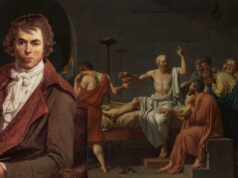
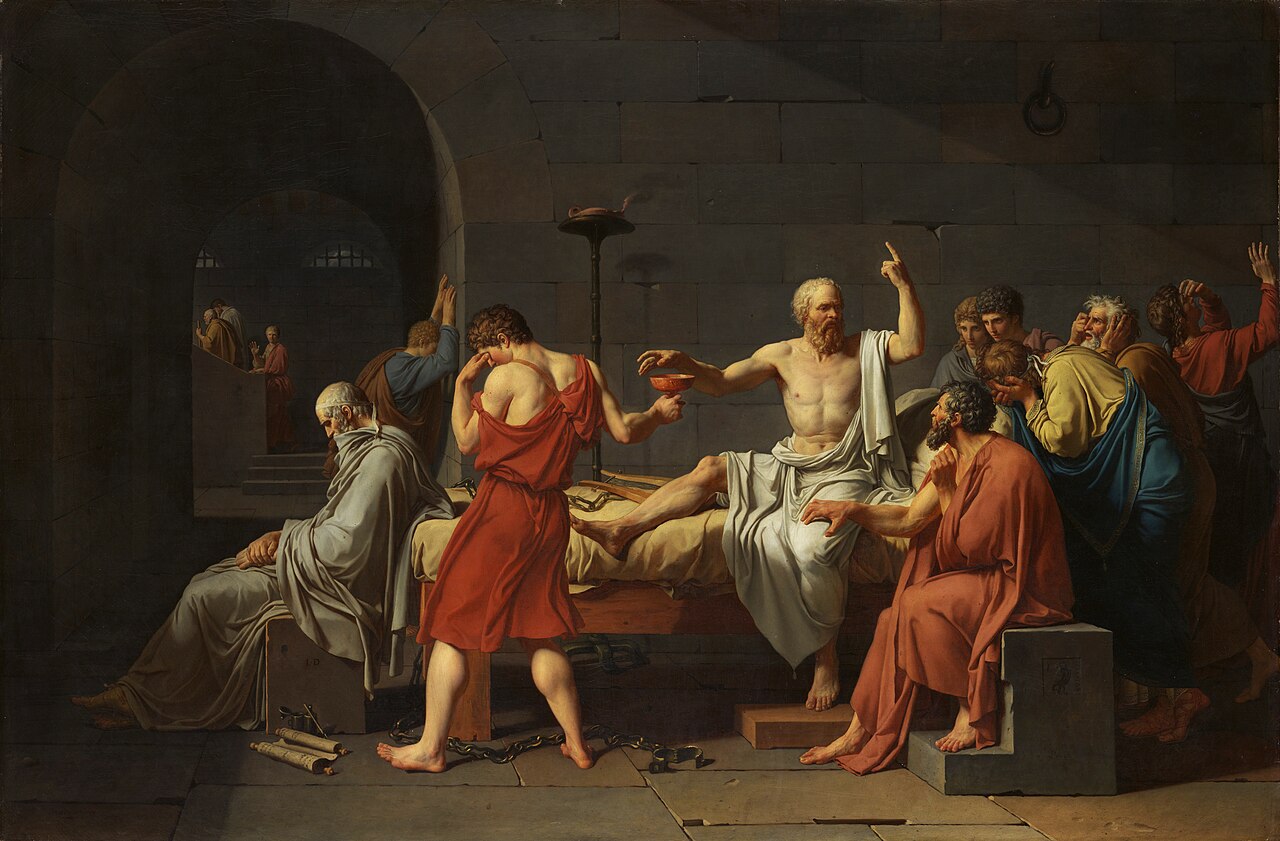
Jacques Louis David, The Death of Socrates (1787) is an iconic Neoclassical painting. The painting (from Jacques Louis David‘s collection) shows us the philosopher Socrates and shrouds him in a calmness that echoes a push toward his death, and is (as a master artwork) way more than a prop; it‘s a captivating allusion transforming the ancient, tyrannical universe of philosophy into a politicized object of venerable Enlightenment orator.
The death of Socrates is not about ancient Athens. It‘s about 18th-century France on the verge of revolution. Painted a mere two years before the storming of the Bastille, Jacques Louis David‘s death of socrates dramatizes the moment when the philosopher elects to die on principle. Architecturally composed and perfectly calm, the scene seems almost rational.
Socrates too is composed and calm as he lifts a cup to drinkha.. But what is the emotional centre of the painting is not despair. It‘s conviction. In this article, we consider why and how the death of socrates painting by jacques louis david transmuted the Enlightenment doctrine into visual doctrine and laid down a set of rules for revolutionary virtue.
Enlightenment Before Revolution
By 1787, France was a tinderbox of ideas. The defloration of trust place in monarchy had been seeded by the ideas of Voltaire and Rousseau. The canonising of the ancient world from having been uncovered in chance in 1748, 135 years after it was buried was to shape the aesthetic sensibility of the time.
Neoclassic was the language of moral gravity.
David, who had studied in Rome after his Prix de Rome remained with a visual austerity inherited from classical sculpture and with a moral severity inherited from ancient republican virtue.
Socrates–who would be judged, convicted and put to death for corrupting youth and impiety–was the Enlightenment martyr par excellence: a philosopher who died for his ideas.
Socrates‘s death by Jacques Louis David, became a secret message: strength has to stay alive, even if the silence of a power is necessary.
Geometry as Moral Architecture
The first striking feature of the death of socrates is its structural clarity. The scene is arranged in precise horizontal and vertical lines. The figures form a pyramid of emotional intensity, with Socrates at its apex.
Compositional Analysis
| Element | Visual Role | Philosophical Meaning |
|---|---|---|
| Raised index finger | Vertical axis | Truth transcends death |
| Calm torso posture | Stability | Rational dominance |
| Reclining disciples | Diagonal collapse | Human weakness |
| Architectural setting | Ordered space | Moral clarity |
| Red cloak of Plato | Color anchor | Intellectual legacy |
Unlike later Romantic paintings, the scene does not spiral into chaos. Emotion is contained within a disciplined framework.
This is reason triumphant.
Socrates’ Gesture: The Language of Enlightenment
It is the psychology of the painting: the finger raised is the center of gravity. Socrates directs it up – not to the sky, but to the world of the ideas.
He‘s not scared. He‘s lecturing.
In this moment, the death of socrates by jacques louis david becomes a declaration of intellectual independence. The dead body is not “dead” in a philosophical sense.
There is no reflection of David‘s suffering. There is a power that David exhibits.
This composure would go on to reverberate in revolutionary iconography and ultimately in images of Napoleon.
Plato and Historical Accuracy
Interestingly, the face of the figure of Plato in theforeground reflects emotions of sitting aged and forlorn at the foot of the bed. In fact, Plato was absent from Socrates’ death.
David purposefully changed history. Why? Due to symbolism was more important than fact. Plato symbolizes transmission. his red cloak makes the painting both chromatic and intellectual ground. The Enlightenment ideology of reason drawn up and transmitted through generations is visually contained. This is the same move David makes later in the death of marat—substituting ideological transparency for realism.
The painting ‘the death of socrates’ by jacues louis david was painted long before the era of Romanticism. Comparing it to other 19 th century paintings of the same subject, we can see a huge difference: Romantics—emotion in flux, motion in motion. Neoclassicism: restriction in composition, not morality. His discipline gives the image intellectual substance. The surface is plastered and polished; light glows and glitters flatly. Flesh obeys the granite or marble. Seems more carved then painted.
Political Undercurrent: Pre-Revolutionary Messaging
Even though, it was painted before 1789, the death of socrates has its subtle undertones of revolution.
Democratically, the villain Socrates is murdered for corrupting youth—a paradox of the danger of opinion without reason.
The intended recipient of the message for refined French audiences was clear: any tyranny be it the monarchy or the mob denies one access to truth.
They identified with the disciples. David‘s audience were proud of him but at the same time disappointed.
France is going to blow itself to bits within two years…
The canvas turned to prophecy.
The death of Socrates (now at The Metropolitan Museum of Art in New York) remains a prime piece of Neoclassical painting.
Its influence extends across:
The education of art, the university,
Icons of political martyrs
The visible character of the Enlightenment.
The revolution, the revolution Images of the revolution
This document have inspired many new interpretations and readings in many modern black classes, black textbook and black politics.
Bows Alive Because—‘its message surpasses, it says that intellectual guts’ die.”
Market Perspective: Rarity and Value
Like most major works by Jacques Louis David, the death of socrates is institutionally held and unavailable for sale.
However, market data shows:
- Major oil paintings by David are virtually never traded.
- Drawings attributed to David have achieved multi-million-euro results.
- High-quality works from the School of David range between €100,000 and €1 million.
- Academic copies circulate in the €15,000–€200,000 range depending on provenance.
Liquidity tier: museum-locked masterwork.
Collectors focusing on Neoclassicism must differentiate autograph works from studio pieces and later copies.
The limited palette of the painting demands more delicate conservation.
Key considerations:
Preserving the tonal balance between flesh and stoned architecture
Pre vents overcleaning that can flatten modeling
Great care to be taken to preserve original varnish layers whenever possible.
Neoclassical surfaces can be identified by the quick intervention of restoring—even the slightest—breaks the illusion of marble.
Fast Recognition Checklist
To recognize the influence of the death of socrates:
Effective geometric construction
Main person not too emotional
Internal architectural frame-work
Regulated lighting
The Anatomy in its idealized form
Philosophical narrative inherent in gesture
When emotion dictates form the piece probably drifts more into Romanticism than it does toward David.
Why The Death of Socrates Still Resonates
The death of socrates by jacques louis david remains powerful because it presents death without fear.
It asserts that ideas survive execution.
It elevates reason above survival.
It transforms a historical event into moral theater.
In a world saturated with emotional spectacle, this painting still persuades through composure.
And that composure is its revolutionary force.
How historically accurate is the death of socrates by jacques louis david compared to Plato’s original account?
Jacques-Louis David‘s 1787 cancon ‘The Death of Socrates’ is philosophically true to the source material (albeit plated with a great deal of idealization and stylization), but selected for its dramatic, moral and political implications.
It is Plato‘s account, as can be found in the Phaedo, in which Socrates discusses the immortality of the soul with contemplative clarity, finally failing to drink the cup of hemlock; David is able to depict this moment of emotional truth with astonishing acumen. Socrates is perfectly upright in his chair, self-assured for battle yet dead still in emotional intelligence, raising a trembling finger to support an argument born to be justified. But every element that makes the scene sit conceptually in the Athens of 399 takes liberty with historical verisimilitude; Plato himself is here, despite his absence at the tragedy, sitting at the foot of Socrates’ bed as wise old thinker; Socrates, physically, the fact and face of the idealist body; the prison, the best room in a Neoclassical sanitorium; the illusion is carried right through to the gathering of disciples, in which their grief is as beautiful as Socrates’ is serene in order to affirm the triumph of reason—and not decadence—over sensibility.
Yet it was perhaps less archaeological fact than the formation of a timeless ‘eternal picture’ of civic virtue that David wanted. Painted on the eve of the French Revolution, it reconfigures the martyr of principle that Socrates was — a man who preferred death to a betrayal of truth — which appealed profoundly to Enlightenment sensibilities.
The allurgico-geometrico-naif composition, subdued pallette and sculptural figures all serve to underpin the moral message. In other words, it‘s not too concerned with historical fact and visual authenticity but intellectually rigorous to Plato‘s conception of Socratic virtue and philosophical commitment.
In fact, David‘s image is not so much a documentary reconstruction as a ‘Coup de descriptif’ written in Neoclassical terms: history edited and dramatized into an ethical model to suit the needs of his politically turbulent day.