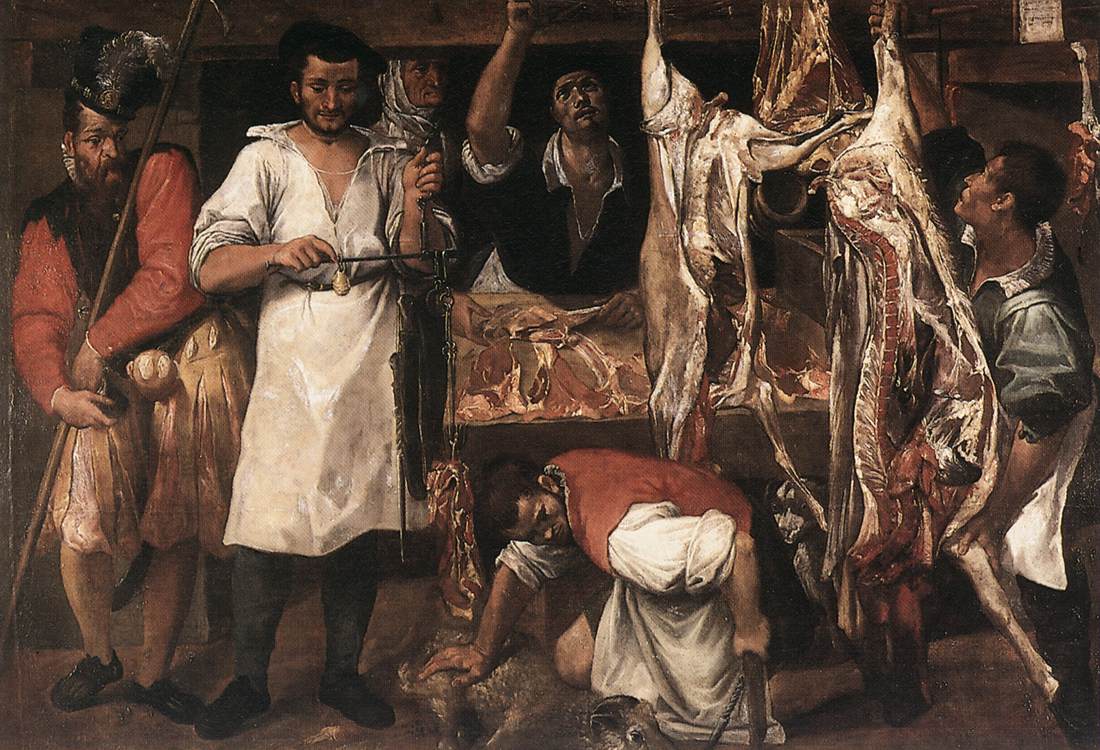
Annibale Carracci’s The Butcher’s Shop arrests the viewer with a disarming proposition: in a moment when Italian painters were still expected to elevate saints, heroes, and classical myths, here is a blood-and-bone scene of working men, carcasses, and commerce—painted with the compositional intelligence and pictorial authority usually reserved for “high” subjects. The picture is not simply a genre anecdote. It is a manifesto in paint, announcing a new seriousness about everyday life and a new honesty about how art could look after the exhausting refinements of late Mannerism. In the hands of Carracci, the butcher’s stall becomes a stage on which realism, social observation, and painterly virtuosity converge.
Historical Context: Bologna, Reform, and the Rise of the Carracci
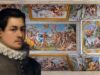
In late 16th-century Bologna—then part of the Papal States—artistic taste was shaped by courts, churches, and civic institutions that valued clarity, persuasion, and decorum. These priorities were sharpened by the Counter-Reformation and the cultural climate following the Council of Trent (1545–1563), which encouraged intelligibility in religious imagery and mistrusted overly esoteric artifice. Against this background, Annibale Carracci (1560–1609), along with his brother Agostino and cousin Ludovico, developed an approach that looked back to the naturalism of earlier Renaissance painting while absorbing lessons from Venetian color and Roman monumentality.
The Carracci’s teaching enterprise in Bologna much discussed under the rubric Accademia degli Incamminati was an incubator for this renewal. Unlike the modern academy of the later French variety, it was an organized course of drawing, con-positioning oneself to nature, and critic-ical reckoning with admired models and their works.28 And it was this culture of disciplined observation that prepares us to see the study as observed rather than invented, and to accept daily toil in the midst of so much invention.
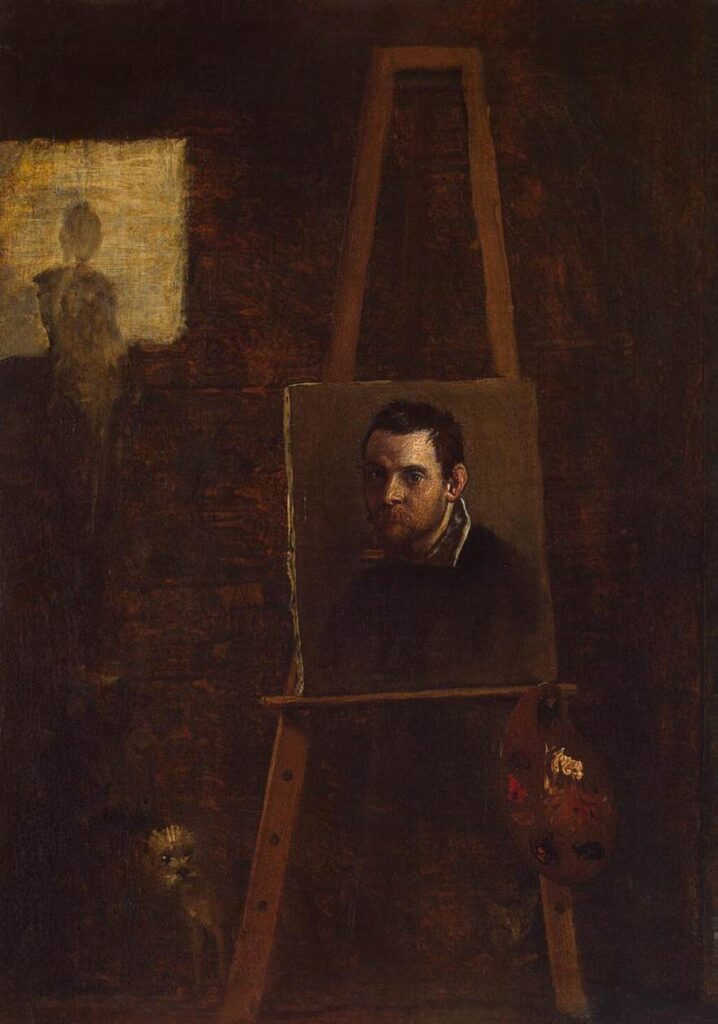
All museums, art historical institutions, wherever. Have firmly placed the Carracci at the heart of this shift to Baroque Naturalism. The Metropolitan Museum of Art, for instance, characterizes the Carracci reform as a rejection of Mannerist artificiality ‘in favor of a return to nature, combined with a study of the classical tradition’. That union observation and imitation is the force that drives The Butcher‘s Shop and makes it a defining reference in the discussion on the beginnings of Italian Baroque realism.
The Painting: Subject Matter, Composition, and Technique
The Butcher’s Shop (commonly dated to the 1580s) presents a working interior populated by butchers engaged in the practical tasks of trade: weighing meat, cutting, and preparing portions for sale. Carracci orchestrates the scene so that it reads immediately—figures are legible, actions are distinct—yet the space feels convincingly busy. The hanging carcasses and the table’s array of flesh are not there for sensationalism alone; they anchor the scene’s physical truth and place the viewer in a world of weight, texture, and smell.
In terms of compositioncaracci does not present the still life as an offhand snapshot. All the elements within are distributed for maximum formal balance: the verticals of the suspended flesh and the standing figures oppose the horizontal of the work table, and the gestures move the eye around the interchanges of labor and trade. It is one of a series of reasons the painting can be read in relation to North European market and kitchen scenes, despite its definedly Italian sense of designthe same glimpse of daily life is lifted in the air of pictorial elevation.
On a technical level the work demonstrates Carracci’s command of different handling, with strong drawing in the figures, convincing modeling of flesh, and a restrained distribution of tonal areas that holds the composition together. The emphasis placed by institutions such as the Louvre Museum and the Victoria and Albert Museum on the role of technique (draftsmanship, color and material choices) in the study of early modern painting is exemplified by Carracci. Painting in this work is descriptive rather than dissolving of form through touches of brush and is entirely realistic by prudent reduction, not through the piling up of details.
Meaning and Interpretation: Genre Painting with Moral and Social Bite
At first glance, the painting appears to be straightforward genre—workers at their trade. Yet late 16th-century viewers were alert to the moral and social resonances of images. The butcher’s shop could evoke themes of consumption, bodily mortality, and the ethics of commerce. Carracci’s refusal to moralize overtly is part of the work’s sophistication: it leaves meaning open, allowing the viewer to oscillate between appreciation of labor and recognition of the violence implicit in sustenance.
Similarly, the painting disrupts the established hierarchy of subject. Renaissance aesthetic theorists and courtly and scholarly taste formalized many of their preferences placed history painting above genre scenes. But Carracci at least begins to erase that order: the “low” genre is elevated to “high” seriousness. This has been recognized by art history as a move in that direction toward 17 th century general naturalism where divine, heroic, and everyday could inhabit a common visual vocabulary.
A useful context is provided by a widely cited remark by the biographer Giovanni Pietro Bellori, a native of seventeenth-century Rome, who in his Lives of the Modern Painters, Sculptors and Architects lauded those who aimed for the best according to nature. Bellori aimed at the true, by which the Carracci “recalled the art back from the mannered style to the imitation of the true.” Impeccably subjective though Bellori’s remarks seem, their phraseology seems appropriate for what is visible in The Butcher’s Shop.
Reception, Legacy, and Where to See Related Works Today
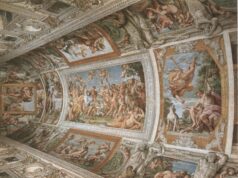
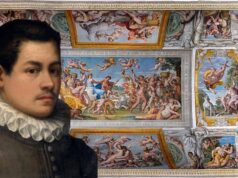
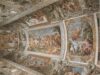
The extent of Carracci‘s achievement was magnified to epic proportions when he settled in Rome in the 1590s and undertook the ceiling of the Farnese Gallery (Palazzo Farnese) a hallmark of Baroque art. When viewed in that context, The Butcher‘s Shop appears no eccentric aside but very much in keeping with a unified artistic personality: an artist obsessed with convincing images through structure and observation. All that intelligence that informs a ceiling of mythologies is also at work in a butcher‘s stall.
Contemporary academic writing about museums supports the importance of Carracci. Essays on Italian Baroque paintings from the Metropolitan Museum of Art, for example, and educational material distributed by the Smithsonian Institution about European art, or even interpretive material from the Victoria and Albert Museum and the Louvre, all stress the move in the period towards increased naturalism, or clarity, or accessibility of images. The Butcher’s Shop certainly engages the viewer with these values by revealing them in an unexpected setting.
Although versions and related works are discussed across collections and literature, the painting is most commonly associated in public scholarship with the Kimbell Art Museum (Fort Worth), which has prominently exhibited and published on it. For readers who cannot see it in person, museum catalogues and high-resolution digital images—paired with conservation-minded technical studies—offer a reliable way to examine Carracci’s choices in composition and paint handling.
Key Characteristics (Summary Table)
| Aspect | What to Look For | Why It Matters |
|---|---|---|
| Period & Place | Late 16th century; Bologna (Papal States) | Shows reform-minded naturalism emerging from a major Italian artistic center |
| Subject | Working butchers, meat preparation, commerce | Elevates everyday labor; challenges subject hierarchies |
| Composition | Balanced arrangement, clear actions, strong structure | Demonstrates “high” design applied to a “low” theme |
| Technique | Solid drawing, controlled tones, descriptive brushwork | Achieves realism through discipline, not cluttered detail |
| Interpretation | Labor, consumption, mortality, social observation | Opens moral and cultural readings without overt allegory |
| Legacy | Bridge from late Renaissance to Baroque naturalism | Prefigures 17th-century realism and broader subject matter |
Frequently Asked Questions
1) Why is The Butcher’s Shop considered important in art history?
It exemplifies the Carracci-led shift away from late Mannerist artifice toward a naturalism grounded in observation and strong composition. By treating a scene of labor with formal seriousness, it widened what ambitious painting could address. Art historians often cite the Carracci as essential to the emergence of the Italian Baroque, and this work is a clear early statement of that reforming impulse.
2) Is the painting meant to be moralizing or satirical?
Interpretations vary, and that ambiguity is part of its strength. Early modern viewers could read butcher imagery through moral lenses—commerce, appetite, bodily vulnerability—yet Carracci avoids heavy-handed allegory. The painting feels neither mockingly satirical nor piously didactic; it instead invites sustained looking at human work within the realities of life and consumption.
3) How does this relate to Caravaggio and later realism?
Carracci and Caravaggio are often paired as pioneers of Baroque naturalism, but they arrive there differently. Carracci tends to emphasize balanced composition, clarity, and a classicizing structure; Caravaggio pushes drama through lighting and radical immediacy. The Butcher’s Shop points to a path where realism and order reinforce each other—an important strand of Baroque development alongside Caravaggio’s theatrically charged model.
Authoritative Sources and Further Reading
- The Metropolitan Museum of Art (Heilbrunn Timeline of Art History), essays on the Carracci and Italian Baroque painting: https://www.metmuseum.org/toah/
- Smithsonian Institution resources on European art and museum scholarship: https://www.si.edu/
- The Victoria and Albert Museum, collection research and interpretive texts on Renaissance/Baroque art: https://www.vam.ac.uk/
- The Louvre Museum, collections and educational materials on Italian painting and early modern art: https://www.louvre.fr/
- Giovanni Pietro Bellori, Lives of the Modern Painters, Sculptors and Architects (primary-text perspective on 17th-century artistic ideals)
Conclusion
The Butcher’s Shop endures because it is both immediate and intellectually ambitious: a scene of ordinary work painted with extraordinary command. In Bologna’s reform-minded climate, Carracci found a way to make truthfulness—visual, social, and material—feel compatible with beauty and design. The result is a painting that still resets expectations, proving that the everyday can carry the full weight of serious art.